
Verwandte Artikel zu Washington Rules: America's Path to Permanent War
Inhaltsangabe
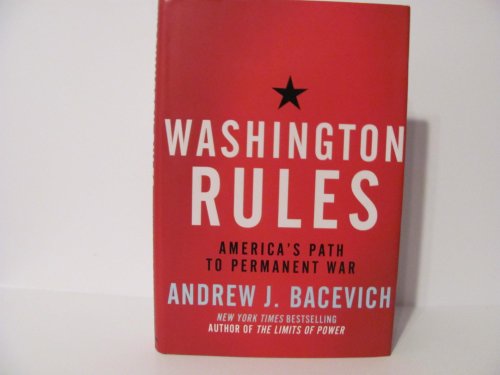
The bestselling author of The Limits of Power critically examines the Washington consensus on national security and why it must change.
For the last half century, as administrations have come and gone, the fundamental assumptions about America's military policy have remained unchanged: American security requires the United States (and us alone) to maintain a permanent armed presence around the globe, to prepare our forces for military operations in far-flung regions, and to be ready to intervene anywhere at any time. In the Obama era, just as in the Bush years, these beliefs remain unquestioned gospel.
In a vivid, incisive analysis, Andrew J. Bacevich succinctly presents the origins of this consensus, forged at a moment when American power was at its height. He exposes the preconceptions, biases, and habits that underlie our pervasive faith in military might, especially the notion that overwhelming superiority will oblige others to accommodate America's needs and desires - whether for cheap oil, cheap credit, or cheap consumer goods. And he challenges the usefulness of our militarism as it has become both unaffordable and increasingly dangerous.
Though our politicians deny it, American global might is faltering. This is the moment, Bacevich argues, to reconsider the principles which shape American policy in the world - to acknowledge that fixing Afghanistan should not take precedence over fixing Detroit. Replacing this Washington consensus is crucial to America's future, and may yet offer the key to the country's salvation.
Die Inhaltsangabe kann sich auf eine andere Ausgabe dieses Titels beziehen.
Über die Autorin bzw. den Autor
Andrew J. Bacevich, a professor of history and international relations at Boston University, retired from the U.S. Army with the rank of colonel. He is the author of Washington Rules: America's Path to Permanent War and The Limits of Power: The End of American Exceptionalism and The New American Militarism. His writing has appeared in Foreign Affairs, The Atlantic Monthly, The Nation, The New York Times, The Washington Post, and The Wall Street Journal. He holds a Ph.D. in American Diplomatic History from Princeton University, and taught at West Point and Johns Hopkins University prior to joining the faculty at Boston University in 1998. He is the recipient of a Lannan Award and a member of the Council on Foreign Relations.
Auszug. © Genehmigter Nachdruck. Alle Rechte vorbehalten.
Introduction: Slow Learner
Worldly ambition inhibits true learning. Ask me. I know. A young man in a hurry is nearly uneducable: He knows what he wants and where he's headed; when it comes to looking back or entertaining heretical thoughts, he has neither the time nor the inclination. All that counts is that he is going somewhere. Only as ambition wanes does education become a possibility.
My own education did not commence until I had reached middle age. I can fix its start date with precision: For me, education began in Berlin, on a winter's evening, at the Brandenburg Gate, not long after the Berlin Wall had fallen.
As an officer in the U.S. Army I had spent considerable time in Germany. Until that moment, however, my family and I had never had occasion to visit this most famous of German cities, still littered with artifacts of a deeply repellent history. At the end of a long day of exploration, we found ourselves in what had, until just months before, been the communist East. It was late and we were hungry, but I insisted on walking the length of the Unter den Linden, from the River Spree to the gate itself. A cold rain was falling and the pavement glistened. The buildings lining the avenue, dating from the era of Prussian kings, were dark, dirty, and pitted. Few people were about. It was hardly a night for sightseeing.
For as long as I could remember, the Brandenburg Gate had been the preeminent symbol of the age and Berlin the epicenter of contemporary history. Yet by the time I made it to the once and future German capital, history was already moving on. The Cold War had abruptly ended. A divided city and a divided nation had re united.
For Americans who had known Berlin only from a distance, the city existed primarily as a metaphor. Pick a date— 1933, 1942, 1945, 1948, 1961, 1989—and Berlin becomes an instructive symbol of power, depravity, tragedy, defiance, endurance, or vindication. For those inclined to view the past as a chronicle of parables, the modern history of Berlin offered an abundance of material. The greatest of those parables emerged from the events of 1933 to 1945, an epic tale of evil ascendant, belatedly confronted, then heroically overthrown. A second narrative, woven from events during the intense period immediately following World War II, saw hopes for peace dashed, yielding bitter antagonism but also great resolve. The ensuing stand-off—the "long twilight struggle," in John Kennedy's memorable phrase— formed the centerpiece of the third parable, its central theme stubborn courage in the face of looming peril. Finally came the exhilarating events of 1989, with freedom ultimately prevailing, not only in Berlin, but throughout Eastern Europe.
What exactly was I looking for at the Brandenburg Gate? Perhaps confirmation that those parables, which I had absorbed and accepted as true, were just that. Whatever I expected, what I actually found was a cluster of shabby- looking young men, not German, hawking badges, medallions, hats, bits of uniforms, and other artifacts of the mighty Red Army. It was all junk, cheaply made and shoddy. For a handful of deutsche marks, I bought a wristwatch emblazoned with the symbol of the Soviet armored corps. Within days, it ceased to work.
Huddling among the scarred columns, those peddlers— almost certainly off-duty Russian soldiers awaiting redeployment home—constituted a subversive presence. They were loose ends of a story that was supposed to have ended neatly when the Berlin Wall came down. As we hurried off to find warmth and a meal, this disconcerting encounter stuck with me, and I began to entertain this possibility: that the truths I had accumulated over the previous twenty years as a professional soldier—especially truths about the Cold War and U.S. foreign policy— might not be entirely true.
By temperament and upbringing, I had always taken comfort in orthodoxy. In a life spent subject to authority, deference had become a deeply ingrained habit. I found assurance in conventional wisdom. Now, I started, however hesitantly, to suspect that orthodoxy might be a sham. I began to appreciate that authentic truth is never simple and that any version of truth handed down from on high— whether by presidents, prime ministers, or archbishops— is inherently suspect. The powerful, I came to see, reveal truth only to the extent that it suits them. Even then, the truths to which they testify come wrapped in a nearly invisible filament of dissembling, deception, and duplicity. The exercise of power necessarily involves manipulation and is antithetical to candor.
I came to these obvious points embarrassingly late in life. "Nothing is so astonishing in education," the historian Henry Adams once wrote, "as the amount of ignorance it accumulates in the form of inert facts."1 Until that moment I had too often confused education with accumulating and cataloging facts. In Berlin, at the foot of the Brandenburg Gate, I began to realize that I had been a navØf. And so, at age forty-one, I set out, in a halting and haphazard fashion, to acquire a genuine education.
Twenty years later I've made only modest progress. This book provides an accounting of what I have learned thus far.
*
In October 1990, I'd gotten a preliminary hint that something might be amiss in my prior education. On October 3, communist East Germany—formally the German Democratic Republic (GDR)—ceased to exist and German reunification was officially secured. That very week I accompanied a group of American military officers to the city of Jena in what had been the GDR. Our purpose was self-consciously educational— to study the famous battle of Jena-Auerstädt in which Napoleon Bonaparte and his marshals had inflicted an epic defeat on Prussian forces commanded by the Duke of Brunswick. (The outcome of that 1806 battle inspired the philosopher Hegel, then residing in Jena, to declare that the "end of history" was at hand. The conclusion of the Cold War had only recently elicited a similarly exuberant judgment from the American scholar Francis Fukuyama.)
On this trip we did learn a lot about the conduct of that battle, although mainly inert facts possessing little real educational value. Inadvertently, we also gained insight into the reality of life on the far side of what Americans had habitually called the Iron Curtain, known in U.S. military vernacular as "the trace." In this regard, the trip proved nothing less than revelatory. The educational content of this excursion would— for me—be difficult to exaggerate.
As soon as our bus crossed the old Inner German Border, we entered a time warp. For U.S. troops garrisoned throughout Bavaria and Hesse, West Germany had for decades served as a sort of theme park—a giant Epcot filled with quaint villages, stunning scenery, and superb highways, along with ample supplies of quite decent food, excellent beer, and accommodating women. Now, we found ourselves face-to-face with an altogether different Germany. Although commonly depicted as the most advanced and successful component of the Soviet Empire, East Germany more closely resembled part of the undeveloped world.
The roads—even the main highways—were narrow and visibly crumbling. Traffic posed little problem. Apart from a few sluggish Trabants and Wartburgs—East German automobiles that tended to a retro primitivism—and an occasional exhaust-spewing truck, the way was clear. The villages through which we passed were forlorn and the small farms down at the heels. For lunch we stopped at a roadside stand. The proprietor happily accepted our D-marks, offering us inedible sausages in exchange. Although the signs assured us that we remained in a land of German speakers, it was a country that had not yet recovered from...
„Über diesen Titel“ kann sich auf eine andere Ausgabe dieses Titels beziehen.
Suchergebnisse für Washington Rules: America's Path to Permanent War

Beispielbild für diese ISBN
Washington Rules: America's Path to Permanent War
Anbieter: Orion Tech, Kingwood, TX, USA
Verkäuferbewertung 5 von 5 Sternen

Hardcover. Zustand: Good. Bestandsnummer des Verkäufers 0805091416-3-26861575
Gebraucht kaufen
EUR 3,89
Versand gratis
Versand innerhalb von USA
Versand innerhalb von USA
Anzahl: 1 verfügbar
Beispielbild für diese ISBN
Washington Rules: America's Path to Permanent War
Anbieter: Gulf Coast Books, Cypress, TX, USA
Verkäuferbewertung 5 von 5 Sternen
hardcover. Zustand: Good. Bestandsnummer des Verkäufers 0805091416-3-27703069
Gebraucht kaufen
EUR 3,89
Versand gratis
Versand innerhalb von USA
Versand innerhalb von USA
Anzahl: 1 verfügbar
Beispielbild für diese ISBN
Washington Rules: America's Path to Permanent War
Anbieter: World of Books (was SecondSale), Montgomery, IL, USA
Verkäuferbewertung 5 von 5 Sternen
Hardback. Zustand: Good. For the last half century, as administrations have come and gone, the fundamental assumptions about America's military policy have remained unchanged. In the Obama era, just as in the Bush years, these beliefs remain unquestioned gospel. The author presents the origins of this consensus, forged at a moment when American power was at its height. Bestandsnummer des Verkäufers 00093582039
Gebraucht kaufen
EUR 3,90
Versand gratis
Versand innerhalb von USA
Versand innerhalb von USA
Anzahl: 6 verfügbar
Beispielbild für diese ISBN
Washington Rules: America's Path to Permanent War
Anbieter: World of Books (was SecondSale), Montgomery, IL, USA
Verkäuferbewertung 5 von 5 Sternen
Hardback. Zustand: Very Good. For the last half century, as administrations have come and gone, the fundamental assumptions about America's military policy have remained unchanged. In the Obama era, just as in the Bush years, these beliefs remain unquestioned gospel. The author presents the origins of this consensus, forged at a moment when American power was at its height. Bestandsnummer des Verkäufers 00106922464
Gebraucht kaufen
EUR 3,90
Versand gratis
Versand innerhalb von USA
Versand innerhalb von USA
Anzahl: 4 verfügbar
Beispielbild für diese ISBN
Washington Rules: America's Path to Permanent War
Anbieter: World of Books (was SecondSale), Montgomery, IL, USA
Verkäuferbewertung 5 von 5 Sternen
Hardback. Zustand: Fair. For the last half century, as administrations have come and gone, the fundamental assumptions about America's military policy have remained unchanged. In the Obama era, just as in the Bush years, these beliefs remain unquestioned gospel. The author presents the origins of this consensus, forged at a moment when American power was at its height. Bestandsnummer des Verkäufers 00108983554
Gebraucht kaufen
EUR 3,90
Versand gratis
Versand innerhalb von USA
Versand innerhalb von USA
Anzahl: 1 verfügbar
Beispielbild für diese ISBN
Washington Rules: America's Path to Permanent War (American Empire Project)
Anbieter: Your Online Bookstore, Houston, TX, USA
Verkäuferbewertung 5 von 5 Sternen
Hardcover. Zustand: Good. Bestandsnummer des Verkäufers 0805091416-3-23976433
Gebraucht kaufen
EUR 3,91
Versand gratis
Versand innerhalb von USA
Versand innerhalb von USA
Anzahl: 1 verfügbar
Foto des Verkäufers
Washington Rules: America's Path to Permanent War
Anbieter: 3Brothers Bookstore, Egg harbor township, NJ, USA
Verkäuferbewertung 5 von 5 Sternen
Zustand: very_good. Cover may have light wear, pages in very good condition and binding is sturdy; may have other light shelf wear or creases. May have notes or highlighting. Bestandsnummer des Verkäufers EVV.0805091416.VG
Gebraucht kaufen
EUR 3,93
Versand gratis
Versand innerhalb von USA
Versand innerhalb von USA
Anzahl: 1 verfügbar
Foto des Verkäufers
Washington Rules: America's Path to Permanent War
Anbieter: Used Book Company, Egg Harbor Township, NJ, USA
Verkäuferbewertung 5 von 5 Sternen
Zustand: Very Good. Shows minimal signs of wear and previous use. Can include minimal notes/highlighting. A portion of your purchase benefits nonprofits! - Note: Edition & format may differ from what is shown in stock photo & item details. May not include supplementary material (toys, access code, dvds, etc). Bestandsnummer des Verkäufers 584ZSU000DPK_ns
Gebraucht kaufen
EUR 4,34
Versand gratis
Versand innerhalb von USA
Versand innerhalb von USA
Anzahl: 1 verfügbar
Beispielbild für diese ISBN
Washington Rules: America's Path to Permanent War
Verlag:
Metropolitan Books, 2010
ISBN 10: 0805091416
ISBN 13: 9780805091410
Gebraucht
Hardcover
Erstausgabe
Anbieter: BRT Resales, DeLand, FL, USA
Verkäuferbewertung 5 von 5 Sternen
Hardcover. Zustand: Very Good. 1st Edition. Cut on front of dust cover. Otherwise very good hardcover 9780805091410. Bestandsnummer des Verkäufers ABE-1784053302827
Gebraucht kaufen
EUR 4,51
Versand gratis
Versand innerhalb von USA
Versand innerhalb von USA
Anzahl: 1 verfügbar
Foto des Verkäufers
Washington Rules: America's Path to Permanent War
Anbieter: Reliant Bookstore, El Dorado, KS, USA
Verkäuferbewertung 5 von 5 Sternen
Zustand: acceptable. This book is a well used but readable copy. Integrity of the book is still intact with no missing pages. May have notes or highlighting. Cover image on the book may vary from photo. Ships out quickly in a secure plastic mailer. Bestandsnummer des Verkäufers RDV.0805091416.A
Gebraucht kaufen
EUR 4,53
Versand gratis
Versand innerhalb von USA
Versand innerhalb von USA
Anzahl: 1 verfügbar