
Verwandte Artikel zu The Intelligent Entrepreneur: How Three Harvard Business...
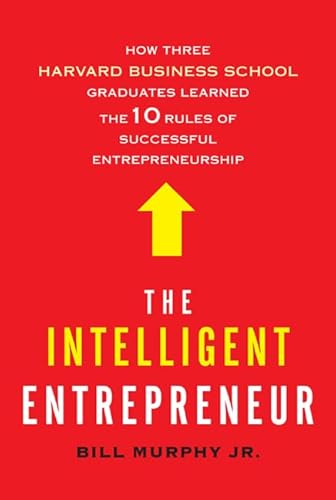
The Intelligent Entrepreneur: How Three Harvard Business School Graduates Learned the 10 Rules of Successful Entrepreneurship - Hardcover
Inhaltsangabe
Written with the cooperation of Harvard Business School, an instructive and inspiring book for anyone who dreams of starting a highly profitable business
In 1998, three Harvard Business School graduates—two men and one woman—turned down six-figure salaries at big corporations, bet on themselves, and launched their own new companies. By their ten-year reunion, their audacity had paid huge dividends. They'd made many millions of dollars, created hundreds of jobs—and left their mark on the world.
Based on dozens of interviews with highly successful entrepreneurs, Harvard Business School professors, and HBS alumni,The Intelligent Entrepreneur tells the compelling and instructive story of how these three young founders developed ideas, assembled teams, built ventures, and achieved their dreams. Along the way, they learned that starting great companies requires much more than a ferocious work ethic or good timing. Their hard-won insights—distilled into ten key rules—will help anyone become a successful entrepreneur.
What they teach you at Harvard Business School is that intelligent entrepreneurship can be learned. In that spirit, Bill Murphy Jr. uses a unique combination of vivid storytelling and lucid instruction to show would-be entrepreneurs how to improve their odds of creating dynamic, lasting businesses.
Die Inhaltsangabe kann sich auf eine andere Ausgabe dieses Titels beziehen.
Über die Autorinnen und Autoren
Bill Murphy Jr. is the author of The Intelligent Entrepreneur: How Three Harvard Business School Graduates Learned the 10 Rules of Successful Entrepreneurshipand In a Time of War: The Proud and Perilous Journey of West Point's Class of 2002. Previously, he worked as Bob Woodward's research assistant on the bestselling State of Denial. An inveterate entrepreneur who was on the founding teams of three separate start-ups, he is also a former military officer, lawyer, andWashington Post reporter.
Bill Murphy Jr. is the author of In a Time of War: The Proud and Perilous Journey of West Point's Class of 2002. Previously, he worked as Bob Woodward's research assistant on the bestselling State of Denial. An inveterate entrepreneur who was on the founding teams of three separate startups, he is also a former military officer, lawyer, and Washington Post reporter.
Auszug. © Genehmigter Nachdruck. Alle Rechte vorbehalten.
Introduction
Wonderful News:
Most New Businesses Fail
Let me guess. If you're reading this book, it's probably because you hope to become a truly successful entrepreneur. You want to build something dynamic, useful, and great, and maybe even get rich in the process. If that's the case, then allow me to give you the good news right up front:
Most new ventures fail—usually for good reasons.
They fail because their founders launch without being truly committed to their success. They fail because a would-be entrepreneur becomes convinced that a lousy business idea is brilliant, or because he doesn't understand the market he's targeting. They fail because their leaders don't hire the right people or offer the best people a good reason to join the venture. They fail because the founders don't have enough capital, don't know how to communicate effectively, or don't adapt to take advantage of new opportunities. Sometimes they fail because of bad luck. But more often—and this is key—unsuccessful entrepreneurs blame bad luck because they don't understand what actually caused their failure.
How can all this amount to good news for aspiring entrepreneurs? Simple: it opens up a world of opportunity. Since most founders don't learn from their successes and failures (let alone those of their predecessors), anyone who is willing and eager to learn the rules of successful entrepreneurship can enjoy a great advantage.
We live in a culture that claims to value entrepreneurship. We've made household names of the founders of some of our most successful companies. If you're standing in the business section at Barnes & Noble as you read this, or browsing through this book on Amazon, chances are you'll see the memoirs of several of those founders nearby.
But in recent years much of the success that many entrepreneurs supposedly achieved was revealed as illusory. Market after market collapsed. Companies that were once worth a great deal of money on paper shut their doors. More recently, a new body of research has shown that much of what we think we know about entrepreneurship is wrong. We think of startups as exciting new ventures, incorporating spectacular innovation and great new ideas. We imagine businesses operating in emerging fields, led by founders with big dreams for growth. But the truth is quite different.
• Most new businesses launch in unattractive, static fields.
• Most startups offer no innovation or competitive advantage, cannot articulate growth plans, employ only the founders, and generate revenues of less than $100,000 a year.
• Only a third of new businesses last seven years.
• The typical startup begins with less than $25,000 in capital, acquired from the founder's savings (or run up on his or her personal credit cards).
Sounds daunting, doesn't it? But for the committed founder, the one who is truly determined to dare mighty things and succeed, all that entrepreneurial carnage can be a blessing. Here's why.
First, there is rarely any reason to reinvent the wheel in entrepreneurship. Some successful founder, somewhere, has addressed the same issues that just about every founder or aspiring entrepreneur faces today. By studying their examples and outcomes, the intelligent entrepreneur can dramatically improve his or her odds of success. The answers are out there, if only you know where to look.
Second, the doomed-to-fail entrepreneur doesn't have to be you. He or she can be—should be—your competition. Remember General George Patton's wise advice about the nobility of sacrificing one's life in combat: "No bastard ever won a war by dying for his country. He won it by making the other poor dumb bastard die for his country."
Modeling SuccessEasy enough, right? Just identify the best examples and follow them. As it turns out, though, these lessons can be difficult to find. Even at a place like Harvard Business School (HBS), where they investigate successful enterprises for a living, there is a wealth of academic research on how to manage and grow big corporations—but nowhere near as much data-driven research on early-stage companies.
"Even knowing what questions to ask is difficult," explains Noam Wasserman, an HBS professor who specializes in entrepreneurship. "Moreover, these are private companies. And that means that inherently there are no data. I have to go out and collect all of my own data."
True, Wasserman continues, when companies prepare for an initial public offering, they have to reveal themselves to the Securities and Exchange Commission (SEC) and the world. But when academics study these companies, Wasserman points out, they are almost never able to study founders, because at that point few of them are still around. "Until recently, we weren't able to really draw any real conclusions about the types of issues and decisions that founders face."
I know that other authors have tried to tackle this problem. But this book is different from others, most of which choose between providing a dry analysis of founders and startups, or using made-up examples, anonymous anecdotes, and composite stories to illustrate their theories. Instead, The Intelligent Entrepreneur tells the true stories of three entrepreneurs from the Harvard Business School class of 1998 who started four successful businesses within ten years of graduating. Over the course of that decade, these HBS graduates also learned ten key rules of intelligent entrepreneurship, and this book examines the rules in detail, allowing every reader to discover what it takes to start a new business and make it a big success.
Chances are, you don't know this trio of entrepreneurs unless you happen to have been a client or competitor of one of their companies. But by following them over roughly a decade, as they imagined, started, and built their firms—and ultimately as they decided whether or not to sell what they'd created—we can absorb their stories, learn from their mistakes, and internalize their actions. Ultimately, my goal is to help you understand how they practice what I call "high-percentage entrepreneurship"—and to show you how you can, too.
Who the Heck Is Bill Murphy Jr. andWhat Does He Know About Entrepreneurship?
Fair question. They say all writing is autobiographical, and this book is no different. It grew out of a number of my personal experiences.
First, I'm a journalist, not an academic. I've been a business owner and an entrepreneur. (I was a cofounder of a publishing company, and later one of the first employees at a dot-com.) I've always been interested in entrepreneurship and leadership. Not long ago, I wrote a book about a different kind of leadership—West Point's class of 2002 and those young military officers' experiences in the wars in Iraq and Afghanistan. When I finished, I realized that I'd learned far more about the military and warfare than I'd actually used in the book. I learned how the gun sights work on an M1A1 Abrams tank. I learned what the computerized voice of the pilot warning system sounds like on an Apache Longbow attack helicopter. I learned, at least in theory, a good deal about infantry tactics and what it takes to lead men in war. I interviewed hundreds of America's best-educated soldiers. They'd thought a lot about what they had experienced, and they spent many hours with me, sharing what they'd learned.
But with no plans ever to operate a tank or a military helicopter, much of what I learned was of limited practical use. As I considered what I wanted to do next, my thoughts kept circling back to my experiences as an entrepreneur. Ultimately, the businesses I launched and joined never got past the startup stage. Frankly, they failed.
I'd always wondered whether I might have succeeded if I'd had...
„Über diesen Titel“ kann sich auf eine andere Ausgabe dieses Titels beziehen.
Suchergebnisse für The Intelligent Entrepreneur: How Three Harvard Business...

Beispielbild für diese ISBN
The Intelligent Entrepreneur: How Three Harvard Business School Graduates Learned the 10 Rules of Successful Entrepreneurship
Anbieter: Your Online Bookstore, Houston, TX, USA
Verkäuferbewertung 5 von 5 Sternen

hardcover. Zustand: Good. Bestandsnummer des Verkäufers 0805091661-3-35585302
Gebraucht kaufen
EUR 5,37
Versand gratis
Versand innerhalb von USA
Versand innerhalb von USA
Anzahl: 1 verfügbar
Beispielbild für diese ISBN
The Intelligent Entrepreneur: How Three Harvard Business School Graduates Learned the 10 Rules of Successful Entrepreneurship
Anbieter: Gulf Coast Books, Cypress, TX, USA
Verkäuferbewertung 5 von 5 Sternen
hardcover. Zustand: Good. Bestandsnummer des Verkäufers 0805091661-3-35585302
Gebraucht kaufen
EUR 5,37
Versand gratis
Versand innerhalb von USA
Versand innerhalb von USA
Anzahl: 1 verfügbar
Beispielbild für diese ISBN
The Intelligent Entrepreneur H
Anbieter: World of Books (was SecondSale), Montgomery, IL, USA
Verkäuferbewertung 5 von 5 Sternen
Zustand: Good. Item in good condition. Textbooks may not include supplemental items i.e. CDs, access codes etc. Bestandsnummer des Verkäufers 00109793544
Gebraucht kaufen
EUR 5,38
Versand gratis
Versand innerhalb von USA
Versand innerhalb von USA
Anzahl: 1 verfügbar
Beispielbild für diese ISBN
The Intelligent Entrepreneur: How Three Harvard Business School Graduates Learned the 10 Rules of Successful Entrepreneurship
Anbieter: HPB Inc., Dallas, TX, USA
Verkäuferbewertung 5 von 5 Sternen
hardcover. Zustand: Very Good. Connecting readers with great books since 1972! Used books may not include companion materials, and may have some shelf wear or limited writing. We ship orders daily and Customer Service is our top priority! Bestandsnummer des Verkäufers S_472348490
Gebraucht kaufen
EUR 2,33
EUR 3,27 Versand
Versand innerhalb von USA
Versand innerhalb von USA
Anzahl: 1 verfügbar
Beispielbild für diese ISBN
The Intelligent Entrepreneur: How Three Harvard Business School Graduates Learned the 10 Rules of Successful Entrepreneurship
Anbieter: HPB-Red, Dallas, TX, USA
Verkäuferbewertung 5 von 5 Sternen
hardcover. Zustand: Very Good. Connecting readers with great books since 1972! Used textbooks may not include companion materials such as access codes, etc. May have some wear or limited writing/highlighting. We ship orders daily and Customer Service is our top priority! Bestandsnummer des Verkäufers S_471186618
Gebraucht kaufen
EUR 2,69
EUR 3,27 Versand
Versand innerhalb von USA
Versand innerhalb von USA
Anzahl: 1 verfügbar
Beispielbild für diese ISBN
The Intelligent Entrepreneur: How Three Harvard Business School Graduates Learned the 10 Rules of Successful Entrepreneurship
Anbieter: ThriftBooks-Atlanta, AUSTELL, GA, USA
Verkäuferbewertung 5 von 5 Sternen
Hardcover. Zustand: Good. No Jacket. Former library book; Pages can have notes/highlighting. Spine may show signs of wear. ~ ThriftBooks: Read More, Spend Less. Bestandsnummer des Verkäufers G0805091661I3N10
Gebraucht kaufen
EUR 5,99
Versand gratis
Versand innerhalb von USA
Versand innerhalb von USA
Anzahl: 1 verfügbar
Beispielbild für diese ISBN
The Intelligent Entrepreneur: How Three Harvard Business School Graduates Learned the 10 Rules of Successful Entrepreneurship
Anbieter: ThriftBooks-Atlanta, AUSTELL, GA, USA
Verkäuferbewertung 5 von 5 Sternen
Hardcover. Zustand: Very Good. No Jacket. Former library book; May have limited writing in cover pages. Pages are unmarked. ~ ThriftBooks: Read More, Spend Less. Bestandsnummer des Verkäufers G0805091661I4N10
Gebraucht kaufen
EUR 5,99
Versand gratis
Versand innerhalb von USA
Versand innerhalb von USA
Anzahl: 1 verfügbar
Beispielbild für diese ISBN
The Intelligent Entrepreneur: How Three Harvard Business School Graduates Learned the 10 Rules of Successful Entrepreneurship
Anbieter: BookHolders, Towson, MD, USA
Verkäuferbewertung 5 von 5 Sternen
Zustand: Good. [ No Hassle 30 Day Returns ][ Ships Daily ] [ Underlining/Highlighting: NONE ] [ Writing: NONE ] [ Edition: First ] Publisher: Henry Holt and Co. Pub Date: 10/12/2010 Binding: Hardcover Pages: 352 First edition. Bestandsnummer des Verkäufers 6956263
Gebraucht kaufen
EUR 6,24
Versand gratis
Versand innerhalb von USA
Versand innerhalb von USA
Anzahl: 1 verfügbar
Beispielbild für diese ISBN
The Intelligent Entrepreneur : How Three Harvard Business School Graduates Learned the 10 Rules of Successful Entrepreneurship
Anbieter: Better World Books, Mishawaka, IN, USA
Verkäuferbewertung 5 von 5 Sternen
Zustand: Very Good. First Edition, 1st Printing. Former library copy. Pages intact with possible writing/highlighting. Binding strong with minor wear. Dust jackets/supplements may not be included. Includes library markings. Stock photo provided. Product includes identifying sticker. Better World Books: Buy Books. Do Good. Bestandsnummer des Verkäufers 3980615-75
Gebraucht kaufen
EUR 6,59
Versand gratis
Versand innerhalb von USA
Versand innerhalb von USA
Anzahl: 1 verfügbar
Beispielbild für diese ISBN
The Intelligent Entrepreneur : How Three Harvard Business School Graduates Learned the 10 Rules of Successful Entrepreneurship
Anbieter: Better World Books: West, Reno, NV, USA
Verkäuferbewertung 5 von 5 Sternen
Zustand: Very Good. First Edition, 1st Printing. Former library copy. Pages intact with possible writing/highlighting. Binding strong with minor wear. Dust jackets/supplements may not be included. Includes library markings. Stock photo provided. Product includes identifying sticker. Better World Books: Buy Books. Do Good. Bestandsnummer des Verkäufers 3980615-75
Gebraucht kaufen
EUR 6,59
Versand gratis
Versand innerhalb von USA
Versand innerhalb von USA
Anzahl: 1 verfügbar