
Verwandte Artikel zu Return to Bull Run: The Campaign and Battle of Second...
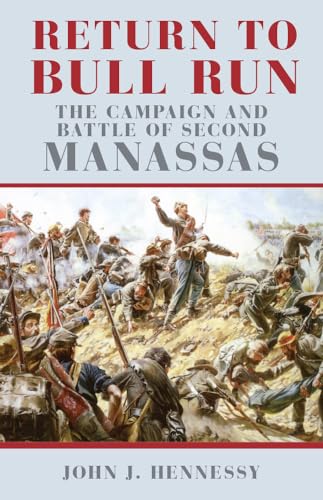
Inhaltsangabe
"This comprehensively researched, well-written book represents the definitive account of Robert E. Lee’s triumph over Union leader John Pope in the summer of 1862. . . . Lee’s strategic skills, and the capabilities of his principal subordinates James Longstreet and Stonewall Jackson, brought the Confederates onto the field of Second Manassas at the right places and times against a Union army that knew how to fight, but not yet how to win."–Publishers Weekly
Die Inhaltsangabe kann sich auf eine andere Ausgabe dieses Titels beziehen.
Über die Autorin bzw. den Autor
John J. Hennessy served as a historian at Manassas National Battlefield and is currently Assistant Superintendent at Fredericksburg and Spotsylvania National Military Park. He is the author of The First Battle of Manassas. He lives in Fredericksburg, Virginia, with his daughter Caroline.
Auszug. © Genehmigter Nachdruck. Alle Rechte vorbehalten.
Return to Bull Run
The Campaign and Battle of Second Manassas
By John J. HennessyUNIVERSITY OF OKLAHOMA PRESS
Copyright © 1993 University of Oklahoma Press
All rights reserved.
ISBN: 978-0-8061-3187-0All rights reserved.
Contents
Preface,
1 "Poor Old Virginia",
2 "We Shall Have a Busy Time",
3 To the Rappahannock,
4 The Armies Waltz,
5 Stalemate,
6 Jackson Marches, Pope Waffles,
7 Bacchanalia, Battle and Escape,
8" We Shall Bag the Whole Crowd",
9 "Bring Out Your Men, Gentlemen",
10 "A Long and Continuous Roll",
11 Pope Finds Jackson—At Last,
12 Sigel's Battle,
13 Controversy Comes from the Fringe,
14 Bloody Afternoon,
15 "I'll Expect You to Beat Them",
16 Twilight Clash,
17 Morning Delusion,
18 Pope's Pursuit,
19 Porter's Attack,
20 The Vortex of Hell,
21 Confederate Tide,
22 The Tide Crests,
23 "A Signal Victory",
24 Disaster and Shame,
Epilogue: "There Never Was Such a Campaign",
Endnotes,
Order of Battle,
Key Players in the Manassas Drama,
Bibliography,
Index,
CHAPTER 1
"Poor Old Virginia"
—Colonel David Strother
Early on the morning of August 10, 1862, Union Colonel David Hunter Strother mounted his horse and set off across the baked, bloody battlefield of Cedar Mountain. He found nothing of the glory the newspapers so fondly trumpeted in their descriptions of battles. He found only blood, misery and despair. The wounded, the dying and the dead, lying on blood-soaked stretchers, surrounded every farmhouse. They consumed every inch of shade, and many suffered under a ninety-five-degree sun. "Blood, carnage and death among the sweet shrubbery and roses," Strother called the scene, as if he were writing a poem.
Soon Strother came to Union General Nathaniel Banks's Second Corps, which had borne the previous day's fighting against Stonewall Jackson. Strother had been with Banks and his men all summer during their travails in the Shenandoah Valley, and he was anxious to see how his old friends had fared in their latest go-round with Jackson. They had not done well. Banks, despite initial success, had been driven from the field. Twenty-three hundred of his men were wounded, dead or missing—more than the entire Union army had lost at the Battle of Bull Run the year before. Strother found Generals George Gordon and Sam Crawford, two of Banks's brigadiers, huddled inside some woods trying to escape a sudden downpour. They were soaked and looked, Strother said, "worn and sad"—a faithful reflection of the army's mood that day. Gordon gestured toward a nearby group of three or four hundred men. That was all that was left of his brigade, he said.
Trotting on, Strother came to General John Pope's headquarters at the Nalle house—"a fine brick mansion" that had been, he wrote, a "home of plenty and refinement." No more. Inside, surgeons had piled the carpets in the corners and replaced them with now-bloody blankets and sheets. "Beside the piano stood the amputating table," the Colonel recorded. "The furniture not removed was dabbed with blood[;] cases of amputating instruments lay upon the tables and mantelpieces lately dedicated to elegant books and flowers." The house, Strother concluded, "looked more like a butcher's shambles than a gentleman's dwelling."
Outside the scene was no better. Sitting under one of Mr. Nalle's apple trees amid the wounded were Pope, the army's commander, and General Irvin McDowell, his closest confidant. As they sat in silence a squad of soldiers carried a dead soldier past them, followed by a work party armed with picks and shovels to bury him. The two generals watched them pass, then Pope leaned toward McDowell and said, "Well, there seems to be devilish little that is attractive about the life of a private soldier." McDowell, who had commanded the naive, overanxious Union army beaten at Manassas in the war's first battle, thought for a moment, then responded, "You might say, General, very little that is attractive in any grade of a soldier's life." As Pope pondered that, soldiers lugged five more corpses by and buried them under a nearby tree. The two generals spoke not another word.
McDowell's comment was a measure of how much the war had changed since those giddy days before First Bull Run. The war had lost its luster. It had become a brutal affair, one where battles cost thousands of young men and seemed to decide nothing; one where civilians were no longer spectators bouncing along in frilly surreys packed with picnic lunches, but rather victims of personal loss, pillage or destruction. Much of the North shared McDowell's dim view of soldiering. Indeed in that summer of 1862 the North, once united by confidence in swift victory, was cracking under the weight of defeat and stalemate in Virginia: the debacle at Bull Run; Banks, Frémont and Shields beaten by Jackson in the Shenandoah; McClellan, after a glacierlike advance with his Army of the Potomac, stalled on the Peninsula within twenty miles of Richmond. True, there had been victories in the west. But when the country, and the world, looked to see how the war was going, they looked to Virginia. And the war there was going very badly. By midsummer 1862 it was clear there would be no swift victory for the Union, and perhaps no victory at all. It was John Pope's job to change all that.
John Pope has come to us as a bumbling fool: much bluster, little substance. But in the summer of 1862 he possessed many of the qualities the administration felt it needed in Virginia. His record was not so much impressive as solid. Pope's ancestry included George Washington and an obscure line of Virginia Popes, the only hint of which that remains today is an appellation on two creeks—one of them near Washington's birthplace, the other, ironically, not far from Manassas Junction. He was born in Kentucky in 1822, migrated with his family to Illinois shortly thereafter, and graduated from West Point in the top third of the class of 1842. He saw credible service in the Mexican War, and afterward he served faithfully in the engineers out west.
With war came quick promotion for Pope, and with promotion came new opportunity for distinction, his most important accomplishment so far being the capture of New Madrid and Island Number Ten on the Mississippi River in March 1862. The Island Number Ten affair was more a triumph of engineering than military skill, and word was that much of the credit for the operation properly belonged to his subordinates. But there was no arguing the final tabulations: thirty-five hundred Confederates captured with, as Pope put it, "not so much as a stub of a toe" to the Federals. Pope then joined Western theater commander Henry Halleck and his wing led the slothful campaign against Corinth, Mississippi. Despite the slowness of the advance, the Confederates gave up the place and Pope charted yet another success. His repute waxed considerably in the Northern press.
Pope's public persona was something to which he accorded unflagging attention—a fact that his old army comrades did not fail to note. Confederate General E. P. Alexander remembered Pope as a "blatherskite," who had a fondness for exaggerating his own accomplishments—a trait he faithfully demonstrated in selling his successes at Island Number Ten and Corinth. Pope's penchant for self-promotion was even memorialized in an old army song, the first two lines of which captured its essence: "Pope told a flattering tale/Which proved to be...
„Über diesen Titel“ kann sich auf eine andere Ausgabe dieses Titels beziehen.
Suchergebnisse für Return to Bull Run: The Campaign and Battle of Second...

Beispielbild für diese ISBN
Return to Bull Run: The Campaign and Battle of Second Manassas
Verlag:
University of Oklahoma Press, 1999
ISBN 10: 080613187X
ISBN 13: 9780806131870
Gebraucht
Paperback
Anbieter: HPB-Red, Dallas, TX, USA
Verkäuferbewertung 5 von 5 Sternen

Paperback. Zustand: Good. Connecting readers with great books since 1972! Used textbooks may not include companion materials such as access codes, etc. May have some wear or writing/highlighting. We ship orders daily and Customer Service is our top priority! Bestandsnummer des Verkäufers S_469316161
Gebraucht kaufen
EUR 7,36
EUR 3,35 Versand
Versand innerhalb von USA
Versand innerhalb von USA
Anzahl: 1 verfügbar
Beispielbild für diese ISBN
Return to Bull Run: The Campaign and Battle of Second Manassas
Verlag:
University of Oklahoma Press (edition ), 1999
ISBN 10: 080613187X
ISBN 13: 9780806131870
Gebraucht
Paperback
Anbieter: BooksRun, Philadelphia, PA, USA
Verkäuferbewertung 5 von 5 Sternen
Paperback. Zustand: Fair. The item might be beaten up but readable. May contain markings or highlighting, as well as stains, bent corners, or any other major defect, but the text is not obscured in any way. Bestandsnummer des Verkäufers 080613187X-7-1
Gebraucht kaufen
EUR 11,51
Versand gratis
Versand innerhalb von USA
Versand innerhalb von USA
Anzahl: 1 verfügbar
Beispielbild für diese ISBN
Return to Bull Run: The Campaign and Battle of Second Manassas
Verlag:
University of Oklahoma Press, 1999
ISBN 10: 080613187X
ISBN 13: 9780806131870
Gebraucht
Paperback
Anbieter: World of Books (was SecondSale), Montgomery, IL, USA
Verkäuferbewertung 5 von 5 Sternen
Paperback. Zustand: Good. This comprehensively researched, well-written book represents the definitive account of Robert E. Lee's triumph over Union leader John Pope in the summer of 1862. - Publishers Weekly. Bestandsnummer des Verkäufers 00109020938
Gebraucht kaufen
EUR 12,27
Versand gratis
Versand innerhalb von USA
Versand innerhalb von USA
Anzahl: 1 verfügbar
Beispielbild für diese ISBN
Return to Bull Run: The Campaign and Battle of Second Manassas
Verlag:
University of Oklahoma Press, 1999
ISBN 10: 080613187X
ISBN 13: 9780806131870
Gebraucht
Paperback
Anbieter: World of Books Inc, Montgomery, IL, USA
Verkäuferbewertung 4 von 5 Sternen

Paperback. Zustand: Good. This comprehensively researched, well-written book represents the definitive account of Robert E. Lee's triumph over Union leader John Pope in the summer of 1862. - Publishers Weekly. Bestandsnummer des Verkäufers CIN080613187XG
Gebraucht kaufen
EUR 14,11
Versand gratis
Versand innerhalb von USA
Versand innerhalb von USA
Anzahl: 1 verfügbar
Foto des Verkäufers
Return to Bull Run: The Campaign and Battle of Second Manassas
Verlag:
University of Oklahoma Press, 1999
ISBN 10: 080613187X
ISBN 13: 9780806131870
Gebraucht
Softcover
Anbieter: Solr Books, Lincolnwood, IL, USA
Verkäuferbewertung 5 von 5 Sternen
Zustand: good. This book is in Good condition. There may be some notes and highligting but otherwise the book is in overall good condition. Bestandsnummer des Verkäufers BCV.080613187X.G
Gebraucht kaufen
EUR 11,03
EUR 7,12 Versand
Versand innerhalb von USA
Versand innerhalb von USA
Anzahl: 1 verfügbar
Beispielbild für diese ISBN
The Civil War: Strange & Fascinating Facts
Verlag:
Random House, New York, USA, 1982
ISBN 10: 080613187X
ISBN 13: 9780806131870
Gebraucht
Hardcover
Anbieter: Historical Antiques & Collectibles, Oldwick, NJ, USA
Verkäuferbewertung 5 von 5 Sternen
Hardcover/Hardback. Zustand: Good. Burke Davis collects hundreds of unusual, lesser-known stories from the American Civil War in this entertaining and informative volume. From peculiar battlefield superstitions to eccentric military customs and strange battlefield coincidences, Davis's anecdotes offer a new way to appreciate the history of the conflict. This book is well-suited for casual readers, Civil War buffs, and trivia lovers alike, providing insights that don't appear in standard military histories. Bestandsnummer des Verkäufers C65210D
Gebraucht kaufen
EUR 13,79
EUR 4,46 Versand
Versand innerhalb von USA
Versand innerhalb von USA
Anzahl: 1 verfügbar
Beispielbild für diese ISBN
Return to Bull Run: The Campaign and Battle of Second Manassas
Verlag:
University of Oklahoma Press, 1999
ISBN 10: 080613187X
ISBN 13: 9780806131870
Gebraucht
Soft cover
Erstausgabe
Anbieter: Olimpianbooks, Avon Lake, OH, USA
Verkäuferbewertung 5 von 5 Sternen
Soft cover. Zustand: Fine. 1st Edition. Like New, first printing, pages clean and crisp, covers clean, no highlighting or underlining. 100% Satisfaction guaranteed or your money back. Thank you for your interest. Free tracking number for each order. We ship the same day or the next business day. e6. Bestandsnummer des Verkäufers e6 abe
Gebraucht kaufen
EUR 18,38
Versand gratis
Versand innerhalb von USA
Versand innerhalb von USA
Anzahl: 1 verfügbar
Beispielbild für diese ISBN
Return to Bull Run: The Campaign and Battle of Second Manassas
Verlag:
University of Oklahoma Press, 1999
ISBN 10: 080613187X
ISBN 13: 9780806131870
Gebraucht
Paperback
Anbieter: Midtown Scholar Bookstore, Harrisburg, PA, USA
Verkäuferbewertung 5 von 5 Sternen
Paperback. Zustand: Acceptable. Acceptable - This is a significantly damaged book. It should be considered a reading copy only. Please order this book only if you are interested in the content and not the condition. May be ex-library. PAPERBACK Standard-sized. Bestandsnummer des Verkäufers M080613187XZ4
Gebraucht kaufen
EUR 13,24
EUR 5,36 Versand
Versand innerhalb von USA
Versand innerhalb von USA
Anzahl: 1 verfügbar
Foto des Verkäufers
Return to Bull Run: The Campaign and Battle of Second Manassas
Verlag:
University Of Oklahoma Press, Norman, Oklahoma, 1999
ISBN 10: 080613187X
ISBN 13: 9780806131870
Gebraucht
Soft cover
Anbieter: Kenneth A. Himber, Lebanon, NJ, USA
Verkäuferbewertung 5 von 5 Sternen
Soft cover. Zustand: Almost Like New. First Softcover Edition. Softcover book is a clean tight unmarked copy. (Second Manassas Battlefield Guidebook Included). Bestandsnummer des Verkäufers 026258
Gebraucht kaufen
EUR 14,25
EUR 5,35 Versand
Versand innerhalb von USA
Versand innerhalb von USA
Anzahl: 1 verfügbar
Beispielbild für diese ISBN
Return to Bull Run: The Campaign and Battle of Second Manassas
Verlag:
University of Oklahoma Press, 1999
ISBN 10: 080613187X
ISBN 13: 9780806131870
Gebraucht
Paperback
Anbieter: WorldofBooks, Goring-By-Sea, WS, Vereinigtes Königreich
Verkäuferbewertung 5 von 5 Sternen
Paperback. Zustand: Very Good. The book has been read, but is in excellent condition. Pages are intact and not marred by notes or highlighting. The spine remains undamaged. Bestandsnummer des Verkäufers GOR003556939
Gebraucht kaufen
EUR 18,72
EUR 6,69 Versand
Versand von Vereinigtes Königreich nach USA
Versand von Vereinigtes Königreich nach USA
Anzahl: 2 verfügbar