
Verwandte Artikel zu Carrying the War to the Enemy: American Operational...
Carrying the War to the Enemy: American Operational Art to 1945 (Campaigns and Commanders, Band 28) - Softcover
Buch 12 von 80: Campaigns and Commanders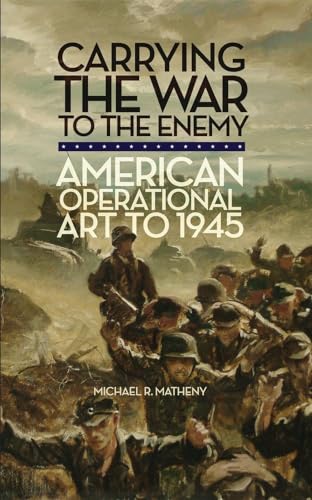
Inhaltsangabe
Military commanders turn tactics into strategic victory by means of "operational art," the knowledge and creative imagination commanders and staff employ in designing, synchronizing, and conducting battles and major operations to achieve strategic goals. Until now, historians of military theory have generally agreed that modern operational art developed between the first and second world wars, not in the United States but in Germany and the Soviet Union, whose armies were supposedly the innovators and greatest practitioners of operational art. Some have even claimed that U.S. forces struggled in World War II because their commanders had no systematic understanding of operational art.
Michael R. Matheny believes previous studies have not appreciated the evolution of U.S. military thinking at the operational level. Although they may rightly point to the U.S. Army's failure to modernize or develop a sophisticated combined arms doctrine during the interwar years, they focus too much on technology or tactical doctrine. In his revealing account, Matheny shows that it was at the operational level, particularly in mounting joint and combined operations, that senior American commanders excelled—and laid a foundation for their country's victory in World War II.
Matheny draws on archival materials from military educational institutions, planning documents, and operational records of World War II campaigns. Examining in detail the development of American operational art as land, sea, and air power matured in the twentieth century, he shows that, contrary to conventional wisdom, U.S. war colleges educated and trained commanders during the interwar years specifically for the operational art they employed in World War II.
After 1945, in the face of nuclear warfare, the American military largely abandoned operational art. But since the Vietnam War, U.S. commanders have found operational art increasingly important as they pursue modern global and expeditionary warfare requiring coordination among multiple service branches and the forces of allied countries.
Die Inhaltsangabe kann sich auf eine andere Ausgabe dieses Titels beziehen.
Über die Autorin bzw. den Autor
Michael R. Matheny retired after 30 years with the U.S. Army to earn a Ph.D. in military history and join the faculty of the Department of Military Strategy, Planning, and Operations at the U.S. Army War College, Carlisle Barracks, Pennsylvania.
„Über diesen Titel“ kann sich auf eine andere Ausgabe dieses Titels beziehen.
Suchergebnisse für Carrying the War to the Enemy: American Operational...

Beispielbild für diese ISBN
Carrying the War to the Enemy: American Operational Art to 1945 (Volume 28) (Campaigns and Commanders Series)
Verlag:
University of Oklahoma Press, 2012
ISBN 10: 080614324X
ISBN 13: 9780806143248
Gebraucht
Paperback
Anbieter: HPB-Red, Dallas, TX, USA
Verkäuferbewertung 5 von 5 Sternen

Paperback. Zustand: Good. Connecting readers with great books since 1972! Used textbooks may not include companion materials such as access codes, etc. May have some wear or writing/highlighting. We ship orders daily and Customer Service is our top priority! Bestandsnummer des Verkäufers S_477250427
Gebraucht kaufen
EUR 8,71
EUR 3,27 Versand
Versand innerhalb von USA
Versand innerhalb von USA
Anzahl: 1 verfügbar
Beispielbild für diese ISBN
Carrying the War to the Enemy: American Operational Art to 1945 Volume 28
Verlag:
University of Oklahoma Press, 2012
ISBN 10: 080614324X
ISBN 13: 9780806143248
Gebraucht
Paperback
Anbieter: ThriftBooks-Dallas, Dallas, TX, USA
Verkäuferbewertung 5 von 5 Sternen
Paperback. Zustand: Fair. No Jacket. Readable copy. Pages may have considerable notes/highlighting. ~ ThriftBooks: Read More, Spend Less. Bestandsnummer des Verkäufers G080614324XI5N00
Gebraucht kaufen
EUR 12,29
Versand gratis
Versand innerhalb von USA
Versand innerhalb von USA
Anzahl: 1 verfügbar
Beispielbild für diese ISBN
Carrying the War to the Enemy: American Operational Art to 1945 (Volume 28) (Campaigns and Commanders Series)
Verlag:
University of Oklahoma Press, 2012
ISBN 10: 080614324X
ISBN 13: 9780806143248
Gebraucht
Softcover
Anbieter: Wonder Book, Frederick, MD, USA
Verkäuferbewertung 5 von 5 Sternen
Zustand: Very Good. Very Good condition. Volume 28. A copy that may have a few cosmetic defects. May also contain light spine creasing or a few markings such as an owner's name, short gifter's inscription or light stamp. Bestandsnummer des Verkäufers L07C-01866
Gebraucht kaufen
EUR 12,71
Versand gratis
Versand innerhalb von USA
Versand innerhalb von USA
Anzahl: 2 verfügbar
Beispielbild für diese ISBN
Carrying the War to the Enemy: American Operational Art to 1945 (Campaigns and Commanders)
Verlag:
University of Oklahoma Press, 2012
ISBN 10: 080614324X
ISBN 13: 9780806143248
Gebraucht
Paperback
Anbieter: Books From California, Simi Valley, CA, USA
Verkäuferbewertung 4 von 5 Sternen

Paperback. Zustand: Very Good. Cover and edges may have some wear. Bestandsnummer des Verkäufers mon0004157430
Gebraucht kaufen
EUR 13,91
EUR 4,35 Versand
Versand innerhalb von USA
Versand innerhalb von USA
Anzahl: 1 verfügbar
Foto des Verkäufers
Carrying the War to the Enemy: American Operational Art to 1945 (Paperback or Softback)
Verlag:
University of Oklahoma Press 6/16/2012, 2012
ISBN 10: 080614324X
ISBN 13: 9780806143248
Neu
Paperback or Softback
Anbieter: BargainBookStores, Grand Rapids, MI, USA
Verkäuferbewertung 5 von 5 Sternen
Paperback or Softback. Zustand: New. Carrying the War to the Enemy: American Operational Art to 1945. Book. Bestandsnummer des Verkäufers BBS-9780806143248
Foto des Verkäufers
Carrying the War to the Enemy
Verlag:
University of Oklahoma Press, US, 2012
ISBN 10: 080614324X
ISBN 13: 9780806143248
Neu
Paperback
Anbieter: Rarewaves.com USA, London, LONDO, Vereinigtes Königreich
Verkäuferbewertung 5 von 5 Sternen
Paperback. Zustand: New. Military commanders turn tactics into strategic victory by means of ""operational art,"" the knowledge and creative imagination commanders and staff employ in designing, synchronizing, and conducting battles and major operations to achieve strategic goals. Until now, historians of military theory have generally agreed that modern operational art developed between the first and second world wars, not in the United States but in Germany and the Soviet Union, whose armies were supposedly the innovators and greatest practitioners of operational art. Some have even claimed that U.S. forces struggled in World War II because their commanders had no systematic understanding of operational art.Michael R. Matheny believes previous studies have not appreciated the evolution of U.S. military thinking at the operational level. Although they may rightly point to the U.S. Army's failure to modernize or develop a sophisticated combined arms doctrine during the interwar years, they focus too much on technology or tactical doctrine. In his revealing account, Matheny shows that it was at the operational level, particularly in mounting joint and combined operations, that senior American commanders excelled - and laid a foundation for their country's victory in World War II.Matheny draws on archival materials from military educational institutions, planning documents, and operational records of World War II campaigns. Examining in detail the development of American operational art as land, sea, and air power matured in the twentieth century, he shows that, contrary to conventional wisdom, U.S. war colleges educated and trained commanders during the interwar years specifically for the operational art they employed in World War II.After 1945, in the face of nuclear warfare, the American military largely abandoned operational art. But since the Vietnam War, U.S. commanders have found operational art increasingly important as they pursue modern global and expeditionary warfare requiring coordination among multiple service branches and the forces of allied countries. Bestandsnummer des Verkäufers LU-9780806143248
Neu kaufen
EUR 36,32
Versand gratis
Versand von Vereinigtes Königreich nach USA
Versand von Vereinigtes Königreich nach USA
Anzahl: Mehr als 20 verfügbar
Beispielbild für diese ISBN
Carrying the War to the Enemy
Print-on-DemandAnbieter: PBShop.store UK, Fairford, GLOS, Vereinigtes Königreich
Verkäuferbewertung 5 von 5 Sternen
PAP. Zustand: New. New Book. Delivered from our UK warehouse in 4 to 14 business days. THIS BOOK IS PRINTED ON DEMAND. Established seller since 2000. Bestandsnummer des Verkäufers L0-9780806143248
Neu kaufen
EUR 32,03
EUR 5,86 Versand
Versand von Vereinigtes Königreich nach USA
Versand von Vereinigtes Königreich nach USA
Anzahl: Mehr als 20 verfügbar
Beispielbild für diese ISBN
Carrying the War to the Enemy: American Operational Art to 1945 (Volume 28) (Campaigns and Commanders Series)
Anbieter: Ria Christie Collections, Uxbridge, Vereinigtes Königreich
Verkäuferbewertung 5 von 5 Sternen
Zustand: New. In English. Bestandsnummer des Verkäufers ria9780806143248_new
Neu kaufen
EUR 31,94
EUR 13,17 Versand
Versand von Vereinigtes Königreich nach USA
Versand von Vereinigtes Königreich nach USA
Anzahl: Mehr als 20 verfügbar
Beispielbild für diese ISBN
Carrying the War to the Enemy
Print-on-DemandAnbieter: Majestic Books, Hounslow, Vereinigtes Königreich
Verkäuferbewertung 4 von 5 Sternen
Zustand: New. Print on Demand pp. 360 15 Illus., 8 Maps. Bestandsnummer des Verkäufers 58076654
Neu kaufen
EUR 46,02
EUR 7,58 Versand
Versand von Vereinigtes Königreich nach USA
Versand von Vereinigtes Königreich nach USA
Anzahl: 4 verfügbar
Beispielbild für diese ISBN
Carrying the War to the Enemy: American Operational Art to 1945
Verlag:
University of Oklahoma Press, 2012
ISBN 10: 080614324X
ISBN 13: 9780806143248
Neu
Paperback / softback
Anbieter: THE SAINT BOOKSTORE, Southport, Vereinigtes Königreich
Verkäuferbewertung 5 von 5 Sternen
Paperback / softback. Zustand: New. This item is printed on demand. New copy - Usually dispatched within 5-9 working days. Bestandsnummer des Verkäufers C9780806143248
Neu kaufen
EUR 36,07
EUR 19,24 Versand
Versand von Vereinigtes Königreich nach USA
Versand von Vereinigtes Königreich nach USA
Anzahl: Mehr als 20 verfügbar