
Verwandte Artikel zu Playing House: Notes of a Reluctant Mother
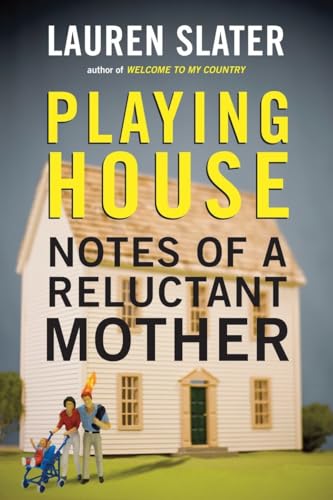
Inhaltsangabe
Acclaimed author Lauren Slater ruminates on what it means to be family.
Lauren Slater’s rocky childhood left her cold to the idea of ever creating a family of her own, but a husband, two dogs, two children, and three houses later, she came around to the challenges, trials, and unexpected rewards of playing house. In these autobiographical pieces, Slater presents snapshots of domestic life, populating them with the gritty details and jarring realities of sharing home, life, and body in the curious institution called “family.” She asks difficult questions and probes unsettling truths about sex, love, and parenting. In these pages, Slater introduces us to her struggles with her mother, her determination to make a home of her own, her compromises in deciding to marry (her conflicts manifesting as an affair on the eve of her wedding), her initial struggle to connect with her newborn child, and the dilemmas of mothering with a mental illness. She writes openly about her decision to abort her second pregnancy and her later decision to have a second child after all. She tells us about the searing decision to have elective double mastectomy and how her love for her husband was magically rekindled after she saw him catch fire in a chemical accident.
It’s not all mastectomies and chemical fires, though. Slater digs into the everyday challenges of family living, from buying a lemon of a car and fighting back menacing weeds to gaining weight and being jealous of the nanny. Beautifully written, often humorous, and always revealing, these stories scrutinize the complex questions surrounding family life, offering up sometimes uncomfortable truths.
Die Inhaltsangabe kann sich auf eine andere Ausgabe dieses Titels beziehen.
Über die Autorinnen und Autoren
Lauren Slater is the author of several books, including Blue Dreams: The Science and the Story of the Drugs That Changed Our Lives, The $60,000 Dog: My Life with Animals, Playing House: Notes of a Reluctant Mother, Welcome to My Country, and Opening Skinner’s Box: Great Psychological Experiments of the Twentieth Century. Slater lives in Harvard, Massachusetts.
Lauren Slater is a psychologist and writer. She is the author of several books, including Blue Dreams: The Science and the Story of the Drugs That Changed Our Lives, The $60,000 Dog: My Life with Animals, Playing House: Notes of a Reluctant Mother, Welcome to My Country, and Opening Skinner’s Box: Great Psychological Experiments of the Twentieth Century. Slater lives in Harvard, Massachusetts.
Auszug. © Genehmigter Nachdruck. Alle Rechte vorbehalten.
1
Tripp Lake
At the age of nine years I went to my first overnight camp, located in Poland, Maine, way up off 95, by a kidney-shaped lake where, across the shore, we could see the serrated lines of red roofs and, on sunny days, white sails walking along the water. The camp was called Tripp Lake, and it was for girls, or so my parents said, who were especially competitive, girls like me, not yet pubescent, packed with all the power of a life that has yet to really unfold, bringing with it the hard parts, the shames, the sadnesses, none of that yet. I wore my hair in what was called a “pixie cut,” which was a nice way of saying it was short as a boy’s, a crew cut really, and at that age white-blonde, so the stubble glittered silver in the summer sun. I spent my evenings playing capture the flag, an exhilarating game that requires fast feet and a bit of cunning.
Understandably, my parents thought it best to send me to a place where my energies could be shaped and expanded. I agreed. I thought I might be Olympic quality, like those skaters I’d seen or the skiers hunched over their poles, ricocheting down mountains where ice hung from all the trees.
I remember the first night at the camp, but no, let me begin before then, at the bus stop, about to leave and feeling, for the first time, a shudder of intense grief. My mother, an aloof woman whom I nonetheless adored, looked pale, her eyes foggy and distant. My father was a small man in the bakery business. Lately they’d been fighting. She wanted something grand out of life, something more than a muffin, whereas he was content to nozzle whipped cream on top of tarts. I loved my father, but I loved my mother more, more problematically is what I mean, in the crooked, hooked way only a daughter can.
I hugged my parents good-bye, and when I hugged my mother I could feel a circle of sadness in her. By leaving I felt as if I were betraying her. I had heard their voices at night, his quiet, hers shrill, you and you and you, and I’d seen my mother sometimes sitting on the porch looking out at nothing. She was a severe and brittle woman, and even at that age I knew brittle was breakable. Sometimes, driving in the car, she crushed the accelerator to the floor, just for the feeling of speed, and other times she cried with her mouth closed. I had the feeling, there at the bus stop, that she wished she were me, about to board a bus heading for the horizon, a green-striped bus with Peter Pan dancing on its flank and girls unabashedly eating apples. And because I felt her longing, inchoate, certainly unspoken, my chest seemed to split with sadness, and also guilt. This was a new emotion for me, an emotion that sat in the throat, an emotion that was maybe more imagistic than all the others. Guilt made me imagine that while I was away, my mother would come undone, her arm would fall off, her hair drift from her head. Guilt made me imagine that she would sit at night and cry, and what could I do about that? I wanted to say I was sorry, but I didn’t really know what for. I couldn’t have said it then, what I’ve since felt my whole life, that separation is a sword, painful, to be avoided at all costs.
My first night at camp: I could hear the flagpole rope banging against its post; I could hear the cry of what were maybe coyotes in the woods and the susurration of thousands of tree frogs. I couldn’t sleep, so I stepped outside, onto the damp dirt that surrounded the cabin, and in the single spotlight that shone down I found a tiny toad, no bigger than a dime, with still tinier bumps on its taupe back. I lifted the amphibian up. I could not believe god or whoever could make an animal so small, an animal that would have, if I cut it open, all the same organs as me, in miniature, the locket-sized heart, bones like white wisps. How easy it is to break an animal; I could have crushed that frog with my fist, and part of me wanted to, while another part of me wanted to protect it, while still a third part of me wanted to let it go.
Before camp I’d been a more or less happy girl, but that first night I couldn’t sleep, and by morning a wild sadness had settled in me. Where was I? Where was she? Someday I would die. Someone somewhere was sick. It was as if a curtain had been pulled back to reveal the true nature of the world, which was terror, through and through.
I became, for the first time in my life, truly afraid that summer, and the fears took forms that were not good, that did not augur well for my later life, although I didn’t know it then. That first day, sitting on the green lawn, watching a girl do a cartwheel and another girl mount the parallel bars, I developed an irrational fear that is still hard to explain; I became hyper aware of my own body, the swoosh of my blood and the paddling of my heart and the huh huh huhs of my breath, and it seemed amazing and tenuous to me, that my body did all of this without any effort on my part. As soon as I became aware of this fact—almost as though I’d discovered my lower brain stem and how it’s hitched to the spinal cord—as soon as I came to consciousness about this, I thought, “I can’t breathe.” And truly, it felt like I couldn’t breathe. I thought, “I am thinking about my breathing, and if I think too hard about my breathing, which you’re not supposed to think about, I will concentrate it right away,” and I swallowed hard, and then I became aware of all the minute mechanisms that comprise a swallow, and so I suddenly felt I couldn’t swallow anymore. It was like the lights were going out in my body, while meanwhile, in front of me, girls did cartwheels on the green lawn, completely unaware that I was dying.
After that, the fears came fast and furious. I was afraid to think about walking because then I would fall; breathing, because then I would suffocate. Swallowing was the worst one of all, to suddenly feel that you have no way of bringing the world down into your throat, of taking it in, no way. I then became afraid of the camp dining hall with its vicious swordfish mounted on one wall and its huge bear head with eyes like my mother’s, dull, distant eyes, eyes at once wild and flat. I became afraid of pancakes, of toothbrushes, of cutlery, of water, the counselors urging me into the lake, where fronds fingered through the murk and scads of fish darted by, making a current cool against my legs.
That first week at camp, I fished a dime out of my uniform pocket (we wore only blue-and-white standard-issue uniforms) and called my mother. From far, far away I heard her voice. When had her sadness started? With my father, or before that, with her mother, who insisted that she, the oldest of three girls, do endless tasks and child care, so she was never able to shoot marbles, too busy shining the silver? My mother, I knew, had been a good girl, exceedingly good, and because of that, she hated my grandmother. She called her “Frances,” and all holidays were barbed affairs, my mother sniping at her mother, making faces at the food, because she, if only given the chance, could have done better.
My mother did not go to college, despite the fact that she’s bright. In my imagination, when I construct a history for her because she’s so closed about her own, she wants to be a singer on a lit stage, or she wants to be a painter with her canvas at a quiet lakeside. She wants something larger than her own life, larger than her husband’s life, larger than the house and kids, where what she does all day is clean. Much, much later on, when I was near grown, after she and my father divorced, my mother would develop a passion for Israel,...
„Über diesen Titel“ kann sich auf eine andere Ausgabe dieses Titels beziehen.
Suchergebnisse für Playing House: Notes of a Reluctant Mother

Foto des Verkäufers
Playing House: Notes of a Reluctant Mother
Anbieter: Bay State Book Company, North Smithfield, RI, USA
Verkäuferbewertung 5 von 5 Sternen

Zustand: good. The book is in good condition with all pages and cover intact, including the dust jacket if originally issued. The spine may show light wear. Pages may contain some notes or highlighting, and there might be a "From the library of" label. Boxed set packaging, shrink wrap, or included media like CDs may be missing. Bestandsnummer des Verkäufers BSM.19V57
Gebraucht kaufen
EUR 5,19
Versand gratis
Versand innerhalb von USA
Versand innerhalb von USA
Anzahl: 1 verfügbar
Beispielbild für diese ISBN
Playing House: Notes of a Reluctant Mother
Anbieter: Bellwetherbooks, McKeesport, PA, USA
Verkäuferbewertung 4 von 5 Sternen

hardcover. Zustand: Good. Bruise/tear to cover. Bestandsnummer des Verkäufers mon0000054755
Gebraucht kaufen
EUR 2,98
EUR 3,52 Versand
Versand innerhalb von USA
Versand innerhalb von USA
Anzahl: 1 verfügbar
Beispielbild für diese ISBN
Playing House : Notes of a Reluctant Mother
Anbieter: Better World Books, Mishawaka, IN, USA
Verkäuferbewertung 5 von 5 Sternen
Zustand: Fine. Used book that is in almost brand-new condition. May contain a remainder mark. Better World Books: Buy Books. Do Good. Bestandsnummer des Verkäufers 54504523-6
Gebraucht kaufen
EUR 6,55
Versand gratis
Versand innerhalb von USA
Versand innerhalb von USA
Anzahl: 1 verfügbar
Beispielbild für diese ISBN
Playing House : Notes of a Reluctant Mother
Anbieter: Better World Books, Mishawaka, IN, USA
Verkäuferbewertung 5 von 5 Sternen
Zustand: Very Good. Former library copy. Pages intact with possible writing/highlighting. Binding strong with minor wear. Dust jackets/supplements may not be included. Includes library markings. Stock photo provided. Product includes identifying sticker. Better World Books: Buy Books. Do Good. Bestandsnummer des Verkäufers 949742-6
Gebraucht kaufen
EUR 6,55
Versand gratis
Versand innerhalb von USA
Versand innerhalb von USA
Anzahl: 1 verfügbar
Beispielbild für diese ISBN
Playing House: Notes of a Reluctant Mother
Anbieter: ThriftBooks-Dallas, Dallas, TX, USA
Verkäuferbewertung 5 von 5 Sternen
Hardcover. Zustand: Very Good. No Jacket. Former library book; May have limited writing in cover pages. Pages are unmarked. ~ ThriftBooks: Read More, Spend Less. Bestandsnummer des Verkäufers G0807001732I4N10
Gebraucht kaufen
EUR 6,63
Versand gratis
Versand innerhalb von USA
Versand innerhalb von USA
Anzahl: 1 verfügbar
Beispielbild für diese ISBN
Playing House: Notes of a Reluctant Mother
Anbieter: ThriftBooks-Atlanta, AUSTELL, GA, USA
Verkäuferbewertung 5 von 5 Sternen
Hardcover. Zustand: Good. No Jacket. Former library book; Pages can have notes/highlighting. Spine may show signs of wear. ~ ThriftBooks: Read More, Spend Less. Bestandsnummer des Verkäufers G0807001732I3N10
Gebraucht kaufen
EUR 6,63
Versand gratis
Versand innerhalb von USA
Versand innerhalb von USA
Anzahl: 1 verfügbar
Beispielbild für diese ISBN
Playing House: Notes of a Reluctant Mother
Anbieter: ThriftBooks-Dallas, Dallas, TX, USA
Verkäuferbewertung 5 von 5 Sternen
Hardcover. Zustand: Good. No Jacket. Former library book; Pages can have notes/highlighting. Spine may show signs of wear. ~ ThriftBooks: Read More, Spend Less. Bestandsnummer des Verkäufers G0807001732I3N10
Gebraucht kaufen
EUR 6,63
Versand gratis
Versand innerhalb von USA
Versand innerhalb von USA
Anzahl: 1 verfügbar
Beispielbild für diese ISBN
Playing House
Anbieter: Russell Books, Victoria, BC, Kanada
Verkäuferbewertung 5 von 5 Sternen
Hardcover. Zustand: Very Good. Bestandsnummer des Verkäufers FORT353211
Gebraucht kaufen
EUR 9,16
EUR 17,79 Versand
Versand von Kanada nach USA
Versand von Kanada nach USA
Anzahl: 1 verfügbar
Beispielbild für diese ISBN
Playing House: Notes of a Reluctant Mother
Anbieter: BennettBooksLtd, Los Angeles, CA, USA
Verkäuferbewertung 5 von 5 Sternen
hardcover. Zustand: New. In shrink wrap. Looks like an interesting title! Bestandsnummer des Verkäufers Q-0807001732
Neu kaufen
EUR 70,11
EUR 6,19 Versand
Versand innerhalb von USA
Versand innerhalb von USA
Anzahl: 1 verfügbar
Beispielbild für diese ISBN
Playing House: Notes of a Reluctant Mother
Anbieter: Buchpark, Trebbin, Deutschland
Verkäuferbewertung 5 von 5 Sternen
Zustand: Hervorragend. Zustand: Hervorragend | Sprache: Englisch | Produktart: Bücher | Keine Beschreibung verfügbar. Bestandsnummer des Verkäufers 23406114/1
Gebraucht kaufen
EUR 27,81
EUR 105,00 Versand
Versand von Deutschland nach USA
Versand von Deutschland nach USA
Anzahl: 1 verfügbar