
Verwandte Artikel zu When the Drama Club is Not Enough: Lessons from the...
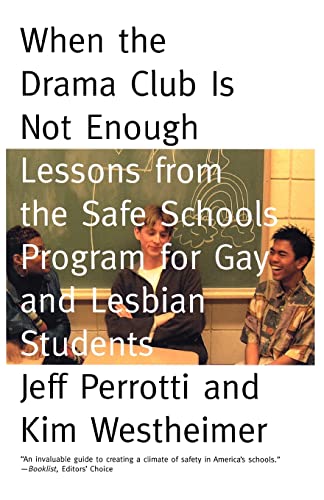
When the Drama Club is Not Enough: Lessons from the Safe Schools Program for Gay and Lesbian Students - Softcover
Inhaltsangabe
When the Drama Club Is Not Enough presents the work of two young activists who have been at the forefront of the successful Safe Schools Program for Gay and Lesbian Students in Massachusetts, a model for states and school districts nationwide. They give concrete, hard-won, and often inspiring lessons on integrating gay and lesbian issues to create powerful change for school communities.
The book discusses the previously undiscussable--gay and lesbian identity and self-esteem at the middle and elementary school level, and gay and lesbian issues in school sports. It tells the story of a high school junior who, at the end of one of Jeff Perrotti's workshops on school sports, raised his hand and said he was a football captain and wanted to come out and needed help, and uses this dramatic narrative of personal courage to show step-by-step how gay and lesbian issues can be a catalyst for transformation of schools.
The authors speak directly to those who want to change school climate--parents, teachers, administrators, and students concerned about harassment and safety. They offer seasoned and often humorous advice on dealing with controversy--even if it occurs in the context of a school presentation on sexual orientation attended by angry and disruptive parents. When the Drama Club Is Not Enough includes chapters on 'Getting Started' and 'Race and Gender' and sections on school policies and students' legal rights in order to ensure safe schools.
Die Inhaltsangabe kann sich auf eine andere Ausgabe dieses Titels beziehen.
Über die Autorin bzw. den Autor
Jeff Perrotti
Auszug. © Genehmigter Nachdruck. Alle Rechte vorbehalten.
When the Drama Club is Not Enough
Lessons from the Safe Schools Program for Gay and Lesbian StudentsBy Jeff PerrottiBeacon Press
Copyright © 2002 Jeff PerrottiAll right reserved.
ISBN: 9780807031315
Chapter One
Three Schools
The experiences of three Massachusetts schools highlight three lessonswe have learned about creating support for gay, lesbian, and bisexualstudents: the power of student activism, the ability of one personto make a difference, and the importance of community building.In one rural school, a gay/straight alliance (GSA) fought to havea rainbow flag displayed. In one urban school an openly gay guidancecounselor inspired others with his courage and leadership. And in asuburban school, community members, teachers, and students ralliedto counter opposition to classroom presentations.
Mahar Regional Junior Senior High School
If you were to venture into the small town of Orange, Massachusetts,you would see the requisite New England village green surroundedby a small business community. The economic difficulties of thisformerly industrial town are evident in a handful of closed storefronts.Most of the people who live in Orange and the surroundingtowns are White.
Ralph C. Mahar Regional High School, known by most simply as"Mahar," is just outside the center of Orange. The school is proud ofits deep links to the community. The superintendent graduated fromthe local high school and has worked for the school district for overforty years. It is not unusual for young people to stay in the area afterthey graduate from high school or to come back after they attendcollege.
Before 1993, most people in Orange would have thought that discussionsabout sexual orientation were not relevant to their lives.Some might have recognized that there were gay or lesbian adults intheir midst, but the subject wasn't generally discussed. One womanrecalls that the teachers at her Catholic school would not allow studentsto go to a nearby gift shop because it was owned by two gaymen.
Today it would be difficult to live in Orange and not be aware thatgay, lesbian, and bisexual people are part of the community. Outsidethe school's main entrance, a rainbow flag symbolizing diversity andgay pride flies alongside the U.S. and Massachusetts flags. Inside theschool a bulletin board for Save Our Schools, the gay/straight alliance,prominently displays the club's logo along with educational informationand notices of upcoming events.
In the early 1990s, Rebecca Silver, a Mahar student and memberof the statewide student advisory council to the Massachusetts Boardof Education, heard about gay/straight alliances. Through Rebecca,Mahar's principal, Frank Zak, learned of the new state-supportedsafe schools initiatives. He acknowledges that his reaction to her requestto form a GSA was mixed. While he calmly told Rebecca thatshe would need to find an advisor for the club, internally he wasthinking "damn state." Despite his initial reticence, which he nowlaughs at, he says it was hard to be against the group because hisphilosophy is that all students should feel wanted. Any concerns hehad about the group faded when he read the report from the educationcommittee of the Governor's Commission on Gay and LesbianYouth. The information about the high suicide and violence risksfaced by gay and lesbian students hit home.
Rebecca and the other students who formed the GSA were fortunateto find an exceptional advisor. Polly Bixby, an openly lesbianphysical education teacher, has been key to the club's success. Shegrew up in Orange, graduated from Mahar in 1958, and returnedright after college to teach there. Her family is well respected in thecommunity, her daughter is an elementary school teacher, and herpartner, Karen, also teaches at Mahar. Over the years, Polly has beenincreasingly open regarding her sexual orientation. Having been thetarget of homophobic actions from community members and students,she consistently champions the rights of students and teachersto be open about their lives.
With Polly's support, the students received permission to makepresentations on antigay name-calling to all of the physical educationclasses. They asked students to stop using epithets such as "faggot,""lezzie," and "dyke." Many students reported that hearing the painthese taunts caused was an eye-opening experience. In a video aboutMahar's GSA, a student athlete who joined the GSA soon after itsformation talked about how he had been changed: "I was kind ofhomophobic before—now I'm different. I don't have just cause tofeel anger or resentment toward anyone who has a different sexualpreference. They're no different from anybody else.... I catch myselfsometimes saying, `Like hey man, stop that, you're queer,' or`How are you doing, fag?" because [those were] terms my friendsused.... [But] it's not acceptable."
In the spring of 1995, the Mahar GSA won a rainbow flag at thefirst statewide youth pride march in Boston. The group proposed tothe student council that the flag be flown in front of the school, andthe administration gave them permission to do so. Immediately, religiousgroups and members of the Veterans of Foreign Wars from outsideof Orange spoke out against the flag, and approximately 350 peoplesigned a petition in protest.
Some students also reacted negatively to the flag. The day it wasraised, a GSA member recalls hearing a crowd of students yelling,"We don't want the fag flag here!" Lucy Snow, a transgender youngperson, was in ninth grade and the only openly gay member of theGSA when the flag was raised. For weeks, she was harassed by studentswho associated her with both the GSA and the rainbow flag.Despite this, she is glad the flag went up. "It raised a lot of issues. Itmade people look at their own views and question them. A lot of thepeople in town who were opposed to the flag at first couldn't tell youwhy. I think a lot of them changed their views."
Students had a strong presence throughout this dispute. Theygathered support from teachers and parents, and they spoke publiclyabout why the flag belonged in front of their school. The tenor of thedebate is captured in the following statements taken from an AssociatedPress article:
"We feel that the flag should be flying because ... it encompasses everyone, including people who are bigoted," said Micah Silver, who will be a junior and vice-president of the student council next fall. "This flag says that people who have different opinions can voice them freely. It represents anyone of any beliefs, any religion, any sexuality, any color."
"It represents things that most of us don't believe in. It represents homosexuals," said Bill Fellows, a Korean War veteran. "Either they're going to have to climb back in the closet or be a little bit more low-key."
Mahar Superintendent Eileen Perkins said the flag was meant to demonstrate that the school wanted every student to feel safe, regardless of race, color, religion, ethnicity, or sexual orientation.
The school committee held a public meeting to discuss whether theflag should be displayed; nearly two hundred community membersrepresenting all sides of the issue showed up. The students...
„Über diesen Titel“ kann sich auf eine andere Ausgabe dieses Titels beziehen.
Suchergebnisse für When the Drama Club is Not Enough: Lessons from the...

Beispielbild für diese ISBN
When the Drama Club is Not Enough: Lessons from the Safe Schools Program for Gay and Lesbian Students
Anbieter: World of Books (was SecondSale), Montgomery, IL, USA
Verkäuferbewertung 5 von 5 Sternen

Zustand: Good. Item in good condition. Textbooks may not include supplemental items i.e. CDs, access codes etc. Bestandsnummer des Verkäufers 00088757837
Gebraucht kaufen
EUR 4,04
Versand gratis
Versand innerhalb von USA
Versand innerhalb von USA
Anzahl: 1 verfügbar
Beispielbild für diese ISBN
When the Drama Club is Not Enough: Lessons from the Safe Schools Program for Gay and Lesbian Students
Anbieter: World of Books (was SecondSale), Montgomery, IL, USA
Verkäuferbewertung 5 von 5 Sternen
Zustand: Very Good. Item in very good condition! Textbooks may not include supplemental items i.e. CDs, access codes etc. Bestandsnummer des Verkäufers 00099944032
Gebraucht kaufen
EUR 4,04
Versand gratis
Versand innerhalb von USA
Versand innerhalb von USA
Anzahl: 1 verfügbar
Foto des Verkäufers
When the Drama Club is Not Enough: Lessons from the Safe Schools Program for Gay and Lesbian Students
Anbieter: Zoom Books East, Glendale Heights, IL, USA
Verkäuferbewertung 5 von 5 Sternen
Zustand: like_new. Book is in like new condition with minimal signs of wear. Pages are clean and free from notes or highlighting. Dust cover is intact. May not contain miscellaneous items toys, dvds, etc. . We offer 100% money back guarantee and 24 7 customer service. Bestandsnummer des Verkäufers ZEV.0807031313.LN
Gebraucht kaufen
EUR 4,05
Versand gratis
Versand innerhalb von USA
Versand innerhalb von USA
Anzahl: 1 verfügbar
Foto des Verkäufers
When the Drama Club is Not Enough: Lessons from the Safe Schools Program for Gay and Lesbian Students
Anbieter: Reliant Bookstore, El Dorado, KS, USA
Verkäuferbewertung 5 von 5 Sternen
Zustand: good. Pages can have notes highlighting. Spine may show signs of wear. May have varying covers. Fast Shipping - Mailed in plastic mailer! Bestandsnummer des Verkäufers 56JPTJ0015W1_ns
Gebraucht kaufen
EUR 4,49
Versand gratis
Versand innerhalb von USA
Versand innerhalb von USA
Anzahl: 1 verfügbar
Beispielbild für diese ISBN
When the Drama Club is Not Enough: Lessons from the Safe Schools Program for Gay and Lesbian Students
Verlag:
Beacon Press (edition ), 2002
ISBN 10: 0807031313
ISBN 13: 9780807031315
Gebraucht
Paperback
Anbieter: BooksRun, Philadelphia, PA, USA
Verkäuferbewertung 5 von 5 Sternen
Paperback. Zustand: Very Good. It's a well-cared-for item that has seen limited use. The item may show minor signs of wear. All the text is legible, with all pages included. It may have slight markings and/or highlighting. Bestandsnummer des Verkäufers 0807031313-11-18
Gebraucht kaufen
EUR 4,60
Versand gratis
Versand innerhalb von USA
Versand innerhalb von USA
Anzahl: 1 verfügbar
Beispielbild für diese ISBN
When the Drama Club is Not Enough: Lessons from the Safe Schools Program for Gay and Lesbian Students
Anbieter: ThriftBooks-Dallas, Dallas, TX, USA
Verkäuferbewertung 5 von 5 Sternen
Paperback. Zustand: Good. No Jacket. Pages can have notes/highlighting. Spine may show signs of wear. ~ ThriftBooks: Read More, Spend Less. Bestandsnummer des Verkäufers G0807031313I3N00
Gebraucht kaufen
EUR 6,40
Versand gratis
Versand innerhalb von USA
Versand innerhalb von USA
Anzahl: 1 verfügbar
Beispielbild für diese ISBN
When the Drama Club is Not Enough: Lessons from the Safe Schools Program for Gay and Lesbian Students
Anbieter: Midtown Scholar Bookstore, Harrisburg, PA, USA
Verkäuferbewertung 5 von 5 Sternen
Paperback. Zustand: Good. some shelfwear but still NICE! - may have remainder mark or previous owner's name Standard-sized. Bestandsnummer des Verkäufers 0807031313-01
Gebraucht kaufen
EUR 2,75
EUR 5,34 Versand
Versand innerhalb von USA
Versand innerhalb von USA
Anzahl: 1 verfügbar
Beispielbild für diese ISBN
When the Drama Club is Not Enough: Lessons from the Safe Schools Program for Gay and Lesbian Students
Anbieter: Books From California, Simi Valley, CA, USA
Verkäuferbewertung 4 von 5 Sternen

paperback. Zustand: Good. Cover shows minor shelf & handling wear, some light creasing. Spine has a small rip on it's bottom edge. Pages are very lightly marked with highlighting. Bestandsnummer des Verkäufers mon0003715018
Gebraucht kaufen
EUR 3,66
EUR 4,44 Versand
Versand innerhalb von USA
Versand innerhalb von USA
Anzahl: 1 verfügbar
Beispielbild für diese ISBN
WHEN THE DRAMA CLUB IN NOT ENOUGH : LESSONS FROM THE SAFE SCHOOLS PROGRAM FOR GAY AND LESBIAN STUDENTS
Anbieter: Magers and Quinn Booksellers, Minneapolis, MN, USA
Verkäuferbewertung 5 von 5 Sternen
Paperback. Zustand: Very Good. May have light to moderate shelf wear and/or a remainder mark. Complete. Clean pages. Bestandsnummer des Verkäufers 1314621
Gebraucht kaufen
EUR 5,94
EUR 3,55 Versand
Versand innerhalb von USA
Versand innerhalb von USA
Anzahl: 1 verfügbar
Beispielbild für diese ISBN
When the Drama Club Is Not Enough : Lessons from the Safe Schools Program for Gay and Lesbian Students
Anbieter: Better World Books, Mishawaka, IN, USA
Verkäuferbewertung 5 von 5 Sternen
Zustand: Very Good. 1 Edition. Former library copy. Pages intact with possible writing/highlighting. Binding strong with minor wear. Dust jackets/supplements may not be included. Includes library markings. Stock photo provided. Product includes identifying sticker. Better World Books: Buy Books. Do Good. Bestandsnummer des Verkäufers GRP70746113
Gebraucht kaufen
EUR 10,08
Versand gratis
Versand innerhalb von USA
Versand innerhalb von USA
Anzahl: 1 verfügbar