In Schools We Trust: Creating Communities of Learning in an Era of Testing and Standardization - Softcover
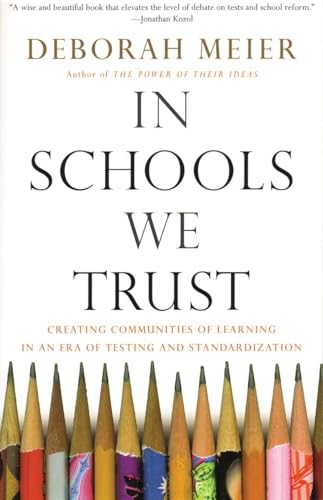
Meier, Deborah

 
9780807031513: In Schools We Trust: Creating Communities of Learning in an Era of Testing and Standardization

Inhaltsangabe

We are in an era of radical distrust of public education. Increasingly, we turn to standardized tests and standardized curricula-now adopted by all fifty states-as our national surrogates for trust.

Legendary school founder and reformer Deborah Meier believes fiercely that schools have to win our faith by showing they can do their job. But she argues just as fiercely that standardized testing is precisely the wrong way to that end. The tests themselves, she argues, cannot give the results they claim. And in the meantime, they undermine the kind of education we actually want.

In this multilayered exploration of trust and schools, Meier critiques the ideology of testing and puts forward a different vision, forged in the success stories of small public schools she and her colleagues have created in Boston and New York. These nationally acclaimed schools are built, famously, around trusting teachers-and students and parents-to use their own judgment.

Meier traces the enormous educational value of trust; the crucial and complicated trust between parents and teachers; how teachers need to become better judges of each others' work; how race and class complicate trust at all levels; and how we can begin to 'scale up' from the kinds of successes she has created.

Die Inhaltsangabe kann sich auf eine andere Ausgabe dieses Titels beziehen.

Über die Autorin bzw. den Autor

MacArthur Award-winning educator Deborah Meier is author of The Power of Their Ideas and Will Standards Save Public Education?. She lives in Hillsdale, New York, and Boston, Massachusetts

Auszug. © Genehmigter Nachdruck. Alle Rechte vorbehalten.

chapter one

Learning in the Company of Adults

One afternoon I find myself approaching a group of young teenagers hanging
out in our hallways. They aren't hanging out surreptitiously. They are not
always within earshot, but they frequently make it known that they are
nearby, where we adults are also hanging out—fixing our rooms, meeting
together informally, arguing about some important matter or other. They give
me the distinct impression that they want both to have their own world and to
be sure it is connected to ours.

Still I am obliged to remind them (and myself), "School was over an hour ago.
You can't hang out in the school like this; it's not safe." I mean safe for me,
of course. I am worried about liability issues. Some years earlier an amused
but genuinely curious adolescent boy had even put the irony into words for
me: "Do you mean it would be safer for us to be out on the street?" So as
usual I let it go with a warning that neither they nor I take seriously.

Two things move me about the memory of these events, and countless
others like them: the genuine, heartfelt desire of young people to be in the
company of adults who are doing adult work, and the way our institutions and
adult lives are structured more and more to keep us at a distance. As I think
back on more than thirty years in schools, I believe that the contradiction
between these two facts is the central educational dilemma of our times. In
those boys' desire to hang out with and around adults lies the secret, the key
to transforming our schools—and the key to the best avenues to learning.


A television interviewer talking to a group of high school dropouts some years
ago asked them whether they knew any grown-ups who were college
graduates. They all said no. Not true, I thought—since, after all, they had
known a dozen or more teachers over the years, all of whom had attended
college. But I was wrong. As I began to pay closer attention I realized that of
course they had not known any of their teachers. We adults were invisible to
them. In commenting to a friend about how disrespected I felt when some
teenagers poured in the subway car playing loud music, using what appeared
to me inappropriate public language, and dressed to shock, I was reminded
that, alas, my assumption that they were doing this "to annoy" might be
wishful thinking—maybe they didn't really register our presence at all.

It's a striking fact that kids don't keep a lot of company these days with the
kind of adults—in or out of school—whom they might grow up to be (or whom
we might wish them to grow up to be); in fact, they don't keep genuine
company with many adults at all beyond their immediate family. Our children
don't work alongside adults in ways that, for good or bad, were once the
norm for most young people in training to become adults. Even when they
take jobs, it's usually in the company of teenagers—at a Gap or McDonald's.

Is this phenomenon truly new? Yes. And does it have an impact on the trust
necessary for good schooling? Yes again.

A century ago, even less, children made the transition to adulthood early,
steeped in the company of adults. Surely by fifteen or sixteen, when a
majority of youngsters today are still a half dozen years or more away from
entering the adult world, most were already in the thick of adult lives: having
children, earning a living. They spent their time in the midst of multiage
settings from birth on—small communities, farms, workplaces where they
knew grown-ups intimately and knew a lot about how they went about their
work, negotiating their way through life. Being young in the olden days wasn't
idyllic, not by a long shot. It's useful to say this to oneself over and over. The
early immersion in adulthood that characterized life a century ago was for
many a source of enormous pain and hardship. Good people worked hard to
help create a longer and more protected childhood. But for good or ill, until
quite recently, most of the learning of how to be an adult took place formally
or informally in the company of grown-ups—by working alongside them,
picking up the language and customs of grown-upness through both
instruction and immersion, much as they had learned to talk and walk.

Children once learned the arts and crafts of being a grown-up by belonging to
a community whose habits and rituals they naturally absorbed. When I was
born, the majority of young people even in the United States never attended
high school, and what they learned from formal schooling was a very small
part of what counted for getting on in the world. Usually the trades they went
into were ones they were very familiar with and had observed for many years,
and thus taking on adult burdens came about gradually, step by step. The
passage from being a novice to becoming an expert was often very gradual
and had little to do with formal schooling. Children gradually absorbed—
sometimes uncomfortably—the skills, aptitudes, and attitudes that went
along with membership in the "club" of adulthood, in psycholinguist Frank
Smith's apt metaphor. They found the present and future predictable and, at
least in that sense, trustworthy. However conservative a vision such a style of
learning suggested—generation following generation in orderly progression—
it was the way most humans learned for centuries.

In seeking a substitute for the natural learning communities of yesterday, we
invented schools and then systematically began to downgrade anything
learned in nonschool ways. Schools bore the burden of replacing many if not
most of the functions of those former multiage communities—and at
increasingly earlier ages. In a daunting but perhaps not surprising twist of
fate, the schools that replaced those natural learning communities
simultaneously underwent a transformation too—toward greater
depersonalization.

Formal learning in particular deliberately ignored what might have been the
strengths of the traditional routes from childhood to adulthood. Most children
today are disconnected from any community of adults—including, absurdly,
the adults they encounter in schools. Many young people literally finish four
years of high school without knowing or being known by a single adult in the
school building. Dry textbooks and standardized curricula unconnected with
any passions or interests of children, delivered by adults in seven, eight, or
sometimes nine 45-minute time slots, dominate schooling.

We've invented schools that present at best a caricature of what the kids
need in order to grow up to be effective citizens, skillful team members,
tenacious and ingenious thinkers, or truth seekers. They sit, largely
passively, through one after another different subject matter in no special
order of relevance, directed by people they can't imagine becoming, much
less would like to become. The older they get, the less like "real life" their
schooling experience is—and the more disconnected and fractionated. As
my granddaughter Sarah tells me with delight at her new eight-period
schedule (which she knows I disapprove of): "But Grandma, it's more fun;
there's no time to get bored—you're in and out so fast, and you get a chance
to chat with friends between classes." Children are expected to learn to do
hard things in the absence of ever seeing experts at work doing such things—
to become shoemakers when they've never seen shoes or a shoemaker
making them.

We've cut kids adrift, without the support or nurturance of grown-ups, without
the surrounding of a community in which they might feel it safe to try out
various roles, listen into the world of adults whom they might someday want
to join as full members. At earlier and earlier ages they must negotiate with a
variety of barely familiar adults, increasingly barren classrooms, and
increasingly complex institutional settings; for many it starts as early as
three or four years of age. My grandson, in a big New York City elementary
school, spent his seven-year-old energies finding ways to avoid the halls,
bathrooms, lunchroom, and recess, where everyone he encountered was
likely to be a stranger—and a risk to his sense of safety. In some
communities kids go from one huge school to another every three years—by
design. Large schools designed exclusively for kindergarten through second
grade, grades three through five, grades six through eight, and grades ten
through twelve are not weird aberrations but are increasingly common. There
are nowadays fewer children in schools where there are likely to be teachers
they or their families have known over the years. We are—in short—perhaps
the only civilization in history that organizes its youth so that the nearer they
get to being adults the less and less likely they are to know any adults.

I believe this needn't be; schools can turn around the distrustful distance that
the young experience toward the adult world. They can return children to the
company of adults in ways that meet the needs of a rapidly changing and
more globalized world. It's not true that the best way to learn to deal with
adult change and trauma is to know nothing but change and trauma. In fact,
quite the opposite. Greater, not less, intimacy between generations is at the
heart of all the best school reform efforts around today and is the surest path
to restoring public trust in public education—while also enhancing the
capacity for creativity and novelty, which earlier forms of apprenticeship
learning often downgraded.


The kind of company I want children to keep with adults is essential to
learning. And the key building block of this relationship between student and
teacher is trust. The more complex the learning, the more children need
genuine adult company, and the more trusted the adults must be.

Polly Wagner, our school's math consultant, noted that seventh grader Jerry
was busily doing his geometry assignment but seemed to have no idea what
an angle was. But what's so puzzling about an angle? So we explored it with
Jerry. For one thing, it's the first time he's ever run into a measurement that
stays the same even when what's being measured appears to get bigger. It
took a while for his teacher, Emily Chang, to figure out how to explain this to
herself, then to us, and along the way to a puzzled Jerry. As Emily pointed
out, in some self-astonishment, it isn't a measurement "in that sense." Aha, I
said. We tried to define different meanings of "measurement." There we were,
three adults and one kid, puzzling over and complicating what had seemed to
us so obvious until we looked at it through Jerry's eyes.

What is the setting that allowed Jerry to explore the obvious more fully with
us, and to have his confusion taken so seriously? Furthermore, what was
required for the adults as well to find each other's company so trustworthy
that we stopped for a moment to consider our own confusion? What allowed
us to reconnect to the sense of surprise and wonder that is at the heart of
human learning?

The key was that we risked showing ourselves to be learners alongside the
student. We teachers made it acceptable for Jerry to ask questions, because
we so clearly were asking questions we didn't already know the answers to
ourselves. There is no way to get around it: the willingness to take risks, ask
questions, and make mistakes is a requirement for the development of
expertise. We can learn secretly, but at a price. If we act as if we take it for
granted that there's never (well rarely) a "dumb" question, just occasions
when it is hard for us to understand where we're each coming from, then we
can more readily go public with our confusions. And confusion is essential—if
uncomfortable. It's the frequent outcome of allowing ourselves to pursue our
curiosity more deeply, to pay attention to the unexpected. Whatever do I
mean by "up" and "down"? Why is it that I can forever go east but not forever
north? Am I wrong that the sun used to rise over that building and now it
doesn't? However can it be that a big heavy metal boat doesn't sink?

Living without answers is unsettling, of course, but when we're not required to
immediately pretend to master uncertainty, and probably only then, we can
make the slow intellectual leaps required of all children today. It's not a
luxury that only a favored few need, as it may once have been. The trustful
relationship with the world that this acceptance of uncertainty allows—with
respect to people, ideas, and things—is at the heart of learning.

Lots of successful students probably never really trusted teachers or school
systems when they were kids; still they got by and even did well. How
come? In part because kids were once school successes even if they never
took more than a year or so of math beyond arithmetic, at most a year of
science, and one or two courses in history. Most of what life required us to
learn happened over time in authentic, natural settings. Furthermore, what
the most successful students had going for them was that even in
kindergarten, with their hands eagerly raised, they were ready to show off
their school smarts. Starting on day one, certain forms of knowledge and
skill—the stuff they've eagerly brought with them from home—was confirmed
and honored, thus increasing their self-confidence to take still more risks.
What they were good at grew out of trust—it's just that the trust came from
something or someone outside of the schoolhouse.

But many other students never found a replacement for a school and teacher
who didn't recognize their genius, who responded with a shrug or a look of
incomprehension as they offered their equally eager home truths. They too
soon learned that in school all they could show off was their ignorance.
Better to be bad, or uninterested, or to just silently withdraw.

Today schools are expected to impart, even to five-year-olds, more complex,
bookish, abstract knowledge than ever before, including much that is
counterintuitive. Children in today's science-rich world even need literally to
unlearn what some learning theorists call "cognitive illusions" common to
our "native" minds—prescientific assumptions about how the universe works
that are at odds with the realities of probability theory, modern physics, and
biology, and a good deal more. As these demands on content increase, the
gap between the well educated and the pseudoeducated threatens to widen
even earlier. I want us to imagine what it would be like if we were to create
environments that fostered learning because of—not in spite of—school, that
took advantage of what we know about how all children best learn and what
all children can contribute from day one, so that all children will maintain their
trust in their own learning abilities and in the families who are their first
teachers.


I enjoy telling all who will listen the startling fact that kids, rich and poor,
learn new words at the amazing rate of about ten per day from the time they
first start understanding speech until their early adolescence, when the pace
slows down. It's so counterintuitive that it takes repeating often for the
importance of this fact to sink in. I didn't accept it right away myself. So-
called dumb kids do this, as well as smart ones, kids from disadvantaged
homes and kids from wealthy homes (although which words they learn may
differ). Now that's a feat no school or schoolteacher I've ever encountered has
matched. And not only do they learn ten a day, but they don't forget them.
(Linguists measure accumulated word recognition—tallied annually—and
then divide by the number of days in the year.) At school we'd be thankful if
they learned ten a week and still retained them a week later.

I'm told we can learn this astounding amount of vocabulary because our
brains are wired that way. When people acknowledge this fact, they often
suggest that it's somehow peculiar to learning our spoken native language.
But I think quite the opposite. If kids are wired in such a way for the
development of spoken language—and all the ideas, concepts, faces,
names, and places implied in the process—we'd do well to pay attention to
these natural ways when we organize learning in the formal setting of school,
including for reading, math, and science!

The way children best learn the complex skills and dispositions of adulthood
is through keeping real company with the kinds of experts they hope to
become (and, incidentally, through keeping company with the real things of
the world—the malleable and predictable—although occasionally surprising—
stuff of which the world is made). The amazing thing is that we no longer trust
these ways of learning.

Think how efficiently virtually all young people learn to drive a car if they have
lived for years in a family of drivers, have ridden in the front seat, have
imitated (both in their heads and in their bodies) the motions of a driver, have
gotten a feel for where the sides of the car are and how close the outside
world is. When my mother finally suggested I should move into the driver's
seat, I, like so many of my friends, already knew how to drive—except I was
surprised when I tried to restart the car on a hill (this was in the days before
automatic transmissions), plus there were the mysteries of parallel parking. If
we were to stop to think about all the discrete skills we internalized when we
were pretending to drive, it's actually both staggering and scary. Some of us
need not much more than a few hours of formal instruction! In contrast,
people who come to driving without having had such exposure have a hard
time learning and are often handicapped for years by not having this natural
sense. Sufficient naive trust in the other drivers on the road is probably also
essential to skillful driving and can come only from years of reinforcing traffic
experience. It helps also if the driving teacher—formal or informal—is
someone you respect, has little reason to believe you will probably fail, and
will not benefit from your failure. And keep in mind that despite the cost we
almost never try to teach anyone how to drive except one-on-one.

Lots of tasks that we think of as fairly simple seem so only because we
learned them in settings like this. Cleaning house, folding fitted sheets
properly, and even doing the dishes—not to mention cooking—are more
complicated than we usually realize. Depending on the culture we grow up in,
we naturally learn different but equally complex skills—many of which are
unacknowledged by the larger world, if not literally devalued as trivial. Some
kids use the same techniques they use at home for learning new things, even
in quite traditional schools—learning on the sly through listening in when
other kids are on the hot seat, copying from peers, waiting until after class to
ask a trusted friend to explain—except we think of it as inappropriate to learn
this way in school. In every class I've taught, a few kids (usually boys) creep
up behind me to listen in while I am teaching another kid, muttering the right
answer under their breath. When approached one-on-one, they clam up. If we
begin to see all the kids who come to us in school as possessing quite
remarkably complex skills that are springboards to doing equally well in a
host of new learning topics, we'd be on our way to imagining new ways to
approach teaching.

Why we join some clubs and not others is an intriguing question. Probably it
depends a lot on how long we stick around, which in turn depends on how
unconditionally we are welcomed and how much we are trusted to have what
it takes. Do the more expert members see us as one of them? Are they
flattered by our efforts to copy them, or do they shoo us away or scorn us for
our stumbling tries? Above all, do they take it for granted that we'll get the
knack of it over time? The more these qualities are part of the setting, the
more efficiently we learn.

Learning happens fastest when the novices trust the setting so much that
they aren't afraid to take risks, make mistakes, or do something dumb.
Learning works best, in fact, when the very idea that it's risky hasn't even
occurred to kids. After all, babies learning language or learning to walk don't
consciously muster up courage to take risks —they are simply safe enough
to do what comes naturally. They count on us to keep danger at bay. Our
parents are delighted with our silly mistakes—our malapropisms. They
assume that most of what we can't do is not out of orneriness, lack of natural
talent, or bad intentions, but that we are not yet skilled enough. We will get
there. No one is sorting or ranking us, and we are not confronted with much
that is out of our family's control, stuff that is arbitrary and could hurt us.
We're in the company of the people who are most firmly on our side, no
matter what.

There is no way to avoid doing something dumb when you are inexperienced
or lacking in knowledge, except by not trying at all, insisting you don't care
or aren't interested, thinking the task itself is dumb (not you), or trying
secretly so no one can catch your mistakes—or offer you useful feedback. Of
course, these are the excuses we drive most kids into when they don't trust
us enough to make mistakes in our presence. Clearly this is also a list of
ways to reduce the opportunity of becoming more skillful to nearly zero—
except for some extraordinary autodidacts who can make their mistakes in
the privacy of their own minds. Isaac Newton at seventeen learned most of
his early mathematics and physics through reading page by page from
Descartes's geometry—out of the sight of Cambridge's esteemed math
teachers, who deemed him mathematically weak. Only then did he venture
forth among his peers.

Even learning the role that making mistakes plays in learning is best learned
by observing experts making mistakes. But we usually make such critical
knowledge invisible. To prove that light is essential to life, teachers the world
over place some plants on the windowsill and a control group in the dark. But
alas, when I tried this, the ones in the window dried up and the ones in the
closet flourished. I secretly tossed them away overnight so I could redo it to
turn out "right." My favorite college physics teacher did the same thing when
his demonstration lesson on falling objects didn't work. He tried a few
adjustments and then ruefully promised to "show it to you again next week."
What he and I had in common was an unwillingness to do that "figuring out"
with our students, which would have been the really important experience.
We both believed, perhaps, that our students wouldn't trust us if we exposed
our fallibility, or perhaps we overestimated the danger of students seeing the
wrong answer. We acknowledged the importance of trust, but we thought it
required that our students see us as infallible. It's not just that kids have a
hard time believing that their teachers use the bathroom, but that their
teachers learn the same way they do, and that it's what we do with our
mistakes that makes us worthy of our authority.

All of these details requires a community of presumed equals—equals not in
knowledge or expertise but in that deeper sense that anyone of us could find
ourselves in the shoes of another, that we are members of a common
community. Kids need to hear adults say—and mean—"what an interesting
way to think about this" rather than "you couldn't have been listening if you
think that." Taking interest in wrong answers increases the odds that we will
have students' energy on our side, which in turn allows us to feel confident
that most children will fill in for some of our mistakes and lapses as
teachers—which under the best of circumstances are many. We have to
trust students' drive to learn, because it is the greater part of what we have
going for us.


If what I've been saying is true, then dramatic changes are required in
schooling—both in curriculum and in pedagogy, what and how—above all in
the relationships of learners to teachers, teachers to families, and teachers
to each other. There are schools that have made such dramatic changes in
their own often quite different ways—all radically different from what we now
see as "real" school. (Kids sometimes tell me that our school is not a "real"
one. It amazes me to see even four- and five-year-olds play "school" with a
scolding teacher barking orders to their untrusting charges.) Despite vast
differences, there are some commonalities in terms of the relationships
between teachers and learners in the schools that work to build the
intellectual skills of all kids.

First: schools that work are safe. We know that infants require safety to
thrive, but so do school-age kids. The more time that must be devoted to
protecting oneself from bodily or mental harm—from peers or authorities—the
less energy there is left to devote to other tasks. Creating safety for kids with
a diversity of histories and goals means more than just making them
physically safe—it includes helping them to feel safe from ridicule and
embarrassment.

Second: schools that work do their best to reproduce the ratios that make for
successful learning—that is, the number of experts per novice. That means
not only the ratio of teachers to students but also the range of expertise
available to kids—other adults, older students, and students with different
skills and abilities, not to mention varied learning tools (computers, books,
real-life learning experiences). The ways are varied: small classes, multiple-
age classes, older students working with younger ones, adult volunteers,
activities that cut across age and skill levels. Successful schools are always
looking for those magical relationships—the ones that break down the
barriers.

Third: schools that work make it possible for those precious experts—even if
they are only slightly more expert—to show their stuff, to display and
demonstrate both their passion and their skill in highly personal ways (not
just to talk about what they're good at but actually to do their stuff alongside
of novices). Sharing expertise—copying—is viewed not as cheating but as a
useful way of learning. We learn best alongside people we rather like, who
can't resist showing us this or that amazing pattern even, if it isn't part of
their official duty. Coming across hundreds of snails in our schoolyard for the
first time launched an unexpected but irresistible study of snail life. How
wonderful it was for our children to learn that there are famous scientists who
study snails (and make a living at it) all their lives.

Fourth: schools that work offer a range of ways for learners to find their way
around any new domain of knowledge, and more than one way to become
good at science or history. Successful schools take it for granted that
mistakes have a logic to them that needs to be uncovered, not just corrected.
Placing objects such as a nail or a heavy box or a sliver of wood in a body of
water and exploring what happens, probing tactfully—"what would happen if
you added this?"—can lead to fascinating discoveries, but this approach
takes expertise, plus an open scientific mind-set, if it is to lead to "aha's" for
most of us. Even then not all of us will come to the aha's through one
particular experiment alone. There need to be other openings for discussing
the differences between density, mass, and weight—which initially may
seem identical. When a thirteen-year-old said to me over lunch the other
day, "Do you know, if I tried to count to a billion it would take me a lifetime?"
how delighted she was that after all these years of being an adult I was for a
moment skeptically astonished. But she's right—as we figured out together.
Whether we take in new ideas as babies by exploring the nature of the
objects in our environment with hands and mouth, or later on by measuring
objects on a scale, over and over again, or by calculating how many seconds
it would take to get to a billion, we are doing the same thing: making ideas
ours. Once they are ours, they don't seem counterintuitive anymore—or,
equally important, they don't seem like nonsense. We now have a basis for
making sense of not just this one thing but many more.

Fifth: such schools offer plenty of time for ideas to grow, and they don't set
rigid timetables. For some kids the aha's are almost immediate; others
require seemingly endless repetitions—just in case next time it will come out
differently. Besides, such qualities of patience are to be cherished and are,
after all, part of the scientific tradition. Although making a flat map out of a
round globe does what no book-based explanation of map distortion can
achieve—try it!—it's a waste of precious time if we think about it as an
exercise in coverage rather than in understanding.

Sixth: schools built around this model of learning do their best to make
schooling engaging and fun. Engagement and pleasure help focus the mind,
keep one persevering, and encourage repeated practice. Pain may
occasionally teach us a lesson, but not as a regular routine, and the lesson it
most often teaches is avoidance. This means filling up the classroom with
stuff of interest that couldn't help but fascinate and leads to questions, ideas,
experiments. It means including both ordinary materials—sand, dirt, and
water—in new contexts, more exotic ones—centipedes and monarch
butterflies—that amaze, or unusual ideas that can't actually be seen or
touched but fascinate—like the distance to the moon. And adding to these
collections of things and ideas are all those books—including beautiful ones—
that might illuminate students' questions. It helps (for many reasons) for kids
to see themselves, their communities, and their stories reflected in what is
studied—but often in new and unexpected contexts. Ulysses' boasts are
familiar, after all, as he endangers himself and his men just to get in the last
word to the Cyclops. Good schools have ways to latch on to kids'
idiosyncratic passions as well—their love of cars or wrestlers even—in the
formal instructional day as well as after school, on Saturdays, and during the
summer.

Seventh: such schools know that what one is learning needs to have lots of
possible hooks to other things and thus lends itself to being practiced in the
normal course of living. Suddenly, as soon as you're studying a new subject,
it seems that the whole world is talking about what you've just learned!
Studying about American politics when it's election year or the Supreme
Court when there's a major debate over who is to be selected to sit on the
high court make getting the most out of such subjects far easier. My high
school teaching colleagues and I missed a great opportunity in the early
nineties when we ignored the breakup of the Soviet empire and just kept on
with our self-prescribed course of study. We did better when the world
became so much more frightening for us all on September 11, 2001. We took
the time to explore the unsettling immediacies of the moment in depth and
thoughtfulness with our older students. (For many teachers of tenth graders
these days, changing the course outline in light of the changed course of
history is literally to risk children's educational futures—and their own—in
light of state exams.) But studying about ancient Greece last year for all the
kids from kindergarten through eighth grade didn't seem irrelevant either. The
students ran across so much stuff with Greek motifs in the daily press,
magazines, buildings, stories, and everyday language. I have seen
elementary school students and high school kids take to ancient Egypt with
an even greater zeal. It turns out to be a favorite regardless of age, second
only to dinosaurs—so there must be hooks we don't always recognize.


Those seven, plus that love which doesn't allow us to give up, is all there is to
it, except that it's very hard to see how we can organize schools around
these ideas. In fact we have organized our schools around precisely the
opposite ideas: passive learning of curricula designed to cover an unrealistic
amount of material, therefore discouraging exploration and understanding.
That's the startling and disturbing fact. And the poorer the kid, the more likely
she is to be a person of color, the more disadvantages she otherwise has in
life and the more likely the school is to ignore all seven of the above ideas.
Not to mention the pernicious influence of standardized testing and its
associated regimes, which systematically work against environments built on
trust—supposedly, but as we shall see, falsely, in the very name of trust—
once again, above all for those students most in need of and dependent on
good schooling.

But since the schools we have today are a relatively new invention, and in
fact the ways I'm proposing come from an older tradition, I believe we can
reinvent schools to better conform to what we know about teaching and
learning. Such reinvention will require patience—because it cannot be
imposed on unwilling subjects, be carried out by teachers who are opposed
to it, or by communities who see it as a threat to their children. And this
reinvention will be hard even for the converted to do when in part they still are
beholden—as we all are, consciously or unconsciously—to quite different
theories of teaching and learning ourselves. Whenever I say "One teaches
best by listening and learns best by telling," I startle myself and others. I
know I'm right, but it's very hard for me to practice what I preach. At the
moment it goes against so many of the conscious tactics used for formal
learning that I experienced in school.

Hardest of all, the task of reinvention requires the creation of an adult culture
that matches the one we are trying to organize for the children. It requires, to
be truly efficient, that a child's in-school and out-of-school worlds overlap and
sometimes even merge. It takes putting kids and adults into a shared
community in which they are all members, albeit with different levels of
responsibility and skill, different kinds of authority, with each accountable for
different parts of the whole. And it takes trusting in our children's vast
intellectual potential along with our innately human drive to understand and
master.

I've seen it happen. It can be done.

„Über diesen Titel“ kann sich auf eine andere Ausgabe dieses Titels beziehen.

Weitere beliebte Ausgaben desselben Titels

9780807031421: In Schools We Trust: Creating Communities of Learning in an Era of Testing and Standardization

Vorgestellte Ausgabe

ISBN 10:  0807031429 ISBN 13:  9780807031421
Verlag: Beacon Pr, 2002
Hardcover