
"You Can Tell Just By Looking": And 20 Other Myths about LGBT Life and People (Myths Made in America, Band 3) - Softcover
Buch 2 von 9: Myths Made in America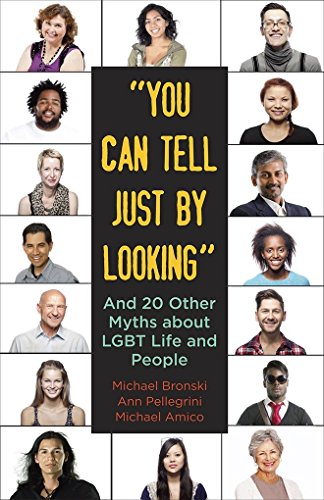
Inhaltsangabe
2014 Lambda Literary Award Finalist: LGBT Nonfiction
Breaks down the most commonly held misconceptions about lesbian, gay, bisexual, and transgender people and their lives
In “You Can Tell Just by Looking” three scholars and activists come together to unpack enduring, popular, and deeply held myths about lesbian, gay, bisexual, and transgender people, culture, and life in America. Myths, such as “All Religions Condemn Homosexuality” and “Transgender People Are Mentally Ill,” have been used to justify discrimination and oppression of LGBT people. Others, such as “Homosexuals Are Born That Way,” have been embraced by LGBT communities and their allies. In discussing and dispelling these myths—including gay-positive ones—the authors challenge readers to question their own beliefs and to grapple with the complexities of what it means to be queer in the broadest social, political, and cultural sense.
Die Inhaltsangabe kann sich auf eine andere Ausgabe dieses Titels beziehen.
Über die Autorin bzw. den Autor
Michael Bronski (Cambridge, Massachusetts) has written extensively on LGBT issues for four decades. He is the author of several award-winning books, including most recently A Queer History of the United States. He is Professor of the Practice in Activism and Media in the Studies of Women, Gender, and Sexuality at Harvard University.
Ann Pellegrini (New York, New York) is professor of performance studies and religious studies at New York University, where she also directs NYU’s Center for the Study of Gender and Sexuality. She has written extensively about religion, sexuality, and US public life. Her publications include Performance Anxieties and the coauthored book Love the Sin.
Michael Amico (New Haven, Connecticut) is a PhD candidate in American studies at Yale University, and is writing a history of the love between two men in the Civil War. He has written for LGBT youth publications, such as Young Gay America, and provided political analysis for the Boston Phoenix and other venues.
Auszug. © Genehmigter Nachdruck. Alle Rechte vorbehalten.
Myth 7
HOMOSEXUALS ARE BORN THAT WAY
Award-winning and openly lesbian actress Cynthia Nixon landed herself in hot water—twice. Her missteps? Nixon, best known for playing brainy and neurotic Miranda on Sex in the City, stated, in her acceptance of GLAAD’s Vito Russo Award in March 2010, “I’ve been straight and I’ve been gay, and gay is better.” LGBT advocates objected to the implication that homosexuality was a choice. In a January 2012 interview with the New York Times, Nixon unapologetically stood her ground: “For me, it is a choice. I understand that for many people it’s not, but for me it’s a choice, and you don’t get to define my gayness for me.” Nixon’s words went viral.
Since the Stonewall riots in 1969, LGB activists have encouraged gay people to come out and speak the truth about their lives. Why were activists so angry with Nixon for boldly telling her own truth? What political, and personal, nerve had she inadvertently struck?
In the past decade, the argument that homosexuals are born that way has become a major talking point used by LGB advocates to argue for equal rights. Nixon’s declaration, “For me, it’s a choice,” strayed from this carefully crafted political and legal script. Worse, it could be heard as reinforcing the antigay message of some conservative political groups. These groups, in their own public relations strategy, describe homosexuality as a “lifestyle choice” or “behavior-based identity.” If being gay is a “choice,” it supposedly does not merit the civil rights protections extended to racial minorities and women.
But “born that way” is more than a sound bite in a public relations war. Many LGB people describe their sexual identities as in- born, an immutable part of who they are. Some others, like Nixon, claim they choose to be gay. This may be particularly true for lesbians. In the late 1970s, some feminists believed lesbianism was a chosen political and sexual identity. These “political lesbians” did not necessarily have sex with, or even sexually desire, women. Most self-declared lesbians decidedly do desire and have sex with other women (see myth 13, “Lesbians Do Not Have Real Sex”).
Still other LGB people would say their sexuality is both chosen and unchosen. They may not have chosen their same-sex desires, but they do choose to act on them and come out as L, G, or B. Other LGB people would say they do not care how or why they came to be gay—they are gay and it is fine. LGB people, like straight people, have all sorts of ways of answering the question, “Why are you the way you are?”
Sexuality, or the life of desire, asks profound questions about relating to others in the world we share. The intricacies of sexual desire, especially whom we desire, have been understood as an important key to who we are since “homosexuality” and “heterosexuality” were invented as distinct identities in the mid-nineteenth century. Yet in the contemporary United States—because heterosexuality is presumed to be the natural, default position—all the pressure is on LGB people to explain their desires and justify their existence. This has meant that LGB people’s explanations for who and why they are acquire disproportionately large moral, legal, and personal significance.
What is the connection between whether or not LGB people are born gay and whether they should be protected from discrimination? If LGB people are born that way, and cannot change who they are, it would be unjust to discriminate against them. Alternately, if homosexuality is a choice, then society is not required to extend equal protections to LGB people as a group. This latter argument implies that homosexuality is not just a choice, but a bad choice. Ironically, the gay-affirming, born-that-way argument may imply this as well. Defending homosexuality on the grounds that LGB people are born that way and just can’t help it could bolster the idea that there is something wrong with being L, G, or B.
This discussion raises several issues that need to be addressed. When it comes to the moral question of how to treat other people in everyday interactions, it does not matter what causes homosexuality. There is nothing wrong with same-sex desire or LGB lives.
Second, LGB people deserve equal protection under the law. As a simple matter of fairness and legal precedent, it does not matter whether homosexuality is “immutable.” This is not a legal requirement for granting equal rights.
Finally, it is simply not true that heterosexuality is the way everyone naturally is. We know from studies that a large number of heterosexually identified people have had same-sex sexual relations at some point in their lives (see myth 2, “About 10 Percent of People Are Gay or Lesbian”). Heterosexuality does not occupy a moral high ground of naturalness. It is also as much in need of explanation as homosexuality.
„Über diesen Titel“ kann sich auf eine andere Ausgabe dieses Titels beziehen.
Suchergebnisse für "You Can Tell Just By Looking": And 20 Other...

Beispielbild für diese ISBN
"You Can Tell Just By Looking": And 20 Other Myths about LGBT Life and People (Myths Made in America)
Anbieter: Your Online Bookstore, Houston, TX, USA
Verkäuferbewertung 5 von 5 Sternen

Paperback. Zustand: Good. Bestandsnummer des Verkäufers 0807042455-3-24186894
Gebraucht kaufen
EUR 4,33
Versand gratis
Versand innerhalb von USA
Versand innerhalb von USA
Anzahl: 1 verfügbar
Foto des Verkäufers
"You Can Tell Just By Looking": And 20 Other Myths about LGBT Life and People (Myths Made in America)
Anbieter: Reliant Bookstore, El Dorado, KS, USA
Verkäuferbewertung 5 von 5 Sternen
Zustand: good. This book is in good condition with very minimal damage. Pages may have minimal notes or highlighting. Cover image on the book may vary from photo. Ships out quickly in a secure plastic mailer. Bestandsnummer des Verkäufers RDV.0807042455.G
Gebraucht kaufen
EUR 4,34
Versand gratis
Versand innerhalb von USA
Versand innerhalb von USA
Anzahl: 1 verfügbar
Beispielbild für diese ISBN
"You Can Tell Just By Looking": And 20 Other Myths about LGBT Life and People (Queer Ideas/Queer Action)
Anbieter: More Than Words, Waltham, MA, USA
Verkäuferbewertung 5 von 5 Sternen
Zustand: Good. 9780979264429. . All orders guaranteed and ship within 24 hours. Before placing your order for please contact us for confirmation on the book's binding. Check out our other listings to add to your order for discounted shipping. Bestandsnummer des Verkäufers WAL-T-2b-01948
Gebraucht kaufen
EUR 1,21
EUR 3,43 Versand
Versand innerhalb von USA
Versand innerhalb von USA
Anzahl: 1 verfügbar
Beispielbild für diese ISBN
"You Can Tell Just By Looking": And 20 Other Myths about LGBT Life and People (Queer Ideas/Queer Action)
Anbieter: More Than Words, Waltham, MA, USA
Verkäuferbewertung 5 von 5 Sternen
Zustand: Very Good. . . All orders guaranteed and ship within 24 hours. Before placing your order for please contact us for confirmation on the book's binding. Check out our other listings to add to your order for discounted shipping. Bestandsnummer des Verkäufers WAL-O-1c-02296
Gebraucht kaufen
EUR 1,21
EUR 3,43 Versand
Versand innerhalb von USA
Versand innerhalb von USA
Anzahl: 1 verfügbar
Beispielbild für diese ISBN
"You Can Tell Just By Looking": And 20 Other Myths about LGBT Life and People (Myths Made in America)
Verlag:
Beacon Press (edition First Edition), 2013
ISBN 10: 0807042455
ISBN 13: 9780807042458
Gebraucht
Paperback
Erstausgabe
Anbieter: BooksRun, Philadelphia, PA, USA
Verkäuferbewertung 5 von 5 Sternen
Paperback. Zustand: Fair. First Edition. The item might be beaten up but readable. May contain markings or highlighting, as well as stains, bent corners, or any other major defect, but the text is not obscured in any way. Bestandsnummer des Verkäufers 0807042455-7-1
Gebraucht kaufen
EUR 5,05
Versand gratis
Versand innerhalb von USA
Versand innerhalb von USA
Anzahl: 1 verfügbar
Beispielbild für diese ISBN
"You Can Tell Just By Looking": And 20 Other Myths about LGBT Life and People (Myths Made in America)
Anbieter: World of Books (was SecondSale), Montgomery, IL, USA
Verkäuferbewertung 5 von 5 Sternen
Zustand: Good. Item in good condition. Textbooks may not include supplemental items i.e. CDs, access codes etc. Bestandsnummer des Verkäufers 00068047335
Gebraucht kaufen
EUR 5,26
Versand gratis
Versand innerhalb von USA
Versand innerhalb von USA
Anzahl: 4 verfügbar
Beispielbild für diese ISBN
"You Can Tell Just By Looking": And 20 Other Myths about LGBT Life and People (Myths Made in America)
Anbieter: World of Books (was SecondSale), Montgomery, IL, USA
Verkäuferbewertung 5 von 5 Sternen
Zustand: Acceptable. Item in acceptable condition! Textbooks may not include supplemental items i.e. CDs, access codes etc. Bestandsnummer des Verkäufers 00098090626
Gebraucht kaufen
EUR 5,26
Versand gratis
Versand innerhalb von USA
Versand innerhalb von USA
Anzahl: 1 verfügbar
Beispielbild für diese ISBN
You Can Tell Just by Looking: And 20 Other Myths about LGBT Life and People
Anbieter: ThriftBooks-Atlanta, AUSTELL, GA, USA
Verkäuferbewertung 5 von 5 Sternen
Paperback. Zustand: Good. No Jacket. Pages can have notes/highlighting. Spine may show signs of wear. ~ ThriftBooks: Read More, Spend Less. Bestandsnummer des Verkäufers G0807042455I3N00
Gebraucht kaufen
EUR 5,73
Versand gratis
Versand innerhalb von USA
Versand innerhalb von USA
Anzahl: 1 verfügbar
Beispielbild für diese ISBN
You Can Tell Just by Looking: And 20 Other Myths about LGBT Life and People
Anbieter: ThriftBooks-Dallas, Dallas, TX, USA
Verkäuferbewertung 5 von 5 Sternen
Paperback. Zustand: Very Good. No Jacket. Former library book; May have limited writing in cover pages. Pages are unmarked. ~ ThriftBooks: Read More, Spend Less. Bestandsnummer des Verkäufers G0807042455I4N10
Gebraucht kaufen
EUR 5,73
Versand gratis
Versand innerhalb von USA
Versand innerhalb von USA
Anzahl: 1 verfügbar
Beispielbild für diese ISBN
You Can Tell Just by Looking: And 20 Other Myths about LGBT Life and People
Anbieter: ThriftBooks-Atlanta, AUSTELL, GA, USA
Verkäuferbewertung 5 von 5 Sternen
Paperback. Zustand: Very Good. No Jacket. Former library book; May have limited writing in cover pages. Pages are unmarked. ~ ThriftBooks: Read More, Spend Less. Bestandsnummer des Verkäufers G0807042455I4N10
Gebraucht kaufen
EUR 5,73
Versand gratis
Versand innerhalb von USA
Versand innerhalb von USA
Anzahl: 1 verfügbar