
Verwandte Artikel zu The Adams-Jefferson Letters: The Complete Correspondence...
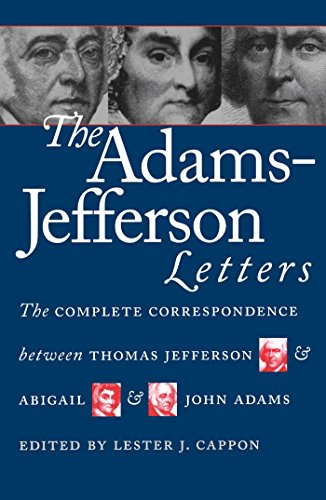
The Adams-Jefferson Letters: The Complete Correspondence Between Thomas Jefferson and Abigail and John Adams (Published by the Omohundro Institute of Early American Histo) - Softcover
Inhaltsangabe
An intellectual dialogue of the highest plane achieved in America, the correspondence between John Adams and Thomas Jefferson spanned half a century and embraced government, philosophy, religion, quotidiana, and family griefs and joys. First meeting as delegates to the Continental Congress in 1775, they initiated correspondence in 1777, negotiated jointly as ministers in Europe in the 1780s, and served the early Republic — each, ultimately, in its highest office. At Jefferson’s defeat of Adams for the presidency in 1800, they became estranged, and the correspondence lapses from 1801 to 1812, then is renewed until the death of both in 1826, fifty years to the day after the Declaration of Independence.
Lester J. Cappon’s edition, first published in 1959 in two volumes, provides the complete correspondence between these two men and includes the correspondence between Abigail Adams and Jefferson. Many of these letters have been published in no other modern edition, nor does any other edition devote itself exclusively to the exchange between Jefferson and the Adamses. Introduction, headnotes, and footnotes inform the reader without interrupting the speakers. This reissue of The Adams–Jefferson Letters in a one-volume unabridged edition brings to a broader audience one of the monuments of American scholarship and, to quote C. Vann Woodward, 'a major treasure of national literature.'
Die Inhaltsangabe kann sich auf eine andere Ausgabe dieses Titels beziehen.
Über die Autorin bzw. den Autor
The late Lester J. Cappon was director of the Institute of Early American History and Culture and editor-in-chief of the Atlas of Early American History: The Revolutionary Era, 1760-1790.
Von der hinteren Coverseite
The correspondence between John Adams and Thomas Jefferson embraces government, philosophy, religion, quotidiana, and family griefs and joys. It begins in 1777, ceases in 1801 after Jefferson's defeat of Adams for the presidency, resumes in 1812, and continues until the death of both in 1826.
Auszug. © Genehmigter Nachdruck. Alle Rechte vorbehalten.
Adams-Jefferson Letters
The Complete Correspondence Between Thomas Jefferson and Abigail and John AdamsBy Lester J. CapponUniversity of North Carolina Press
Copyright © 1988 Lester J. CapponAll right reserved.
ISBN: 9780807842300
Chapter One
"The great Work of Confederation,
draggs heavily on"
* MAY 1777-OCTOBER 1781 *
John Adams and Thomas Jefferson first met in Philadelphia duringthe summer of 1775 as delegates to the Continental Congress. Adamswas thirty-nine, Jefferson thirty-two. Both were lawyers and each hadto his credit several years' experience in the lower house of his provinciallegislature. The elder, who had represented Massachusetts inthe Congress of 1774, quickly became identified as a radical in theconflicting loyalties and emotions of the times. His authorship of theanonymous Novanglus letters, printed in January 1775, was not longin doubt, so vigorously did they uphold the rights of the Bay Colonyagainst the oppression of the British government. The younger delegatehad exposed himself even earlier to the charge of radicalism inhis Summary View of the Rights of British America, resolutions whichhe sent to friends in advance of his attending the Virginia House ofBurgesses in 1774. Without asking his permission, they supplied thetitle, "By a Native, and Member of the House of Burgesses," and hadit printed at Williamsburg in August of that year. Within a fewmonths it was reprinted in Philadelphia, again anonymously, thusbranding the author, who was easily identified, as one of the revolutionaryvanguard even before he took his seat in Congress.
During 1775-76 Jefferson and Adams found themselves on the sameside of the debates, impatient with the moderates whose hope for conciliationwas stronger than their love of liberty, and they readily tookeach other's measure. The fledgling from Virginia was impressed byAdams's clarity of argument and forcefulness of phrase, and by his"sound head on substantial points"; the latter probed the depth ofthe reticent Jefferson, whose "reputation of a masterly pen" had wonconsiderable recognition.
During May 1776 the movement in Congress on behalf of independencewas accelerated in response to the more advanced developmentsin some of the colonies; and after Richard Henry Lee's resolutionof June 7 that "the Congress should declare that these United Coloniesare and of right ought to be free and independent states," Adams andJefferson were appointed to the committee of five, with BenjaminFranklin, Roger Sherman, and Robert R. Livingston, to draft a declarationof independence. To Adams it seemed a foregone conclusionthat Jefferson the Virginian, rather than an "obnoxious" New Englander,should write the declaration. There is no uncertainty as toauthorship, however much some critics may question its originality.Although Adams hailed Congress's adoption of Lee's resolution forindependence on July 2 as "the most memorable epocha in the historyof America," Jefferson's Declaration, designed to convince a "candidworld" that separation from Great Britain was both just and justifiable,has forever fixed the Fourth of July as the anniversary of Americanindependence.
The association of Adams and Jefferson in the Continental Congresscontinued until September 2, 1776, when Jefferson left Philadelphiato return to Monticello. During the next five years, however, hespent only intermittent periods of a few weeks or months at home, forhe was a conscientious member of the Virginia House of Delegatesand served on innumerable committees. His attendance in Congresshad deprived him of the opportunity to participate in the revolutionaryConvention which established the Commonwealth of Virginia, buthe now played an important part in assuring the reality of the Revolutionto his own people through the orderly operation of government.Two of those years, 1779-81, were spent as governor, when militarynecessity often threatened civil rights. Adams's services continuedon the national stage which, for him, merged with the internationalearly in 1778. He had been a member of the American delegation thatmet Lord Howe on Staten Island in June 1776 to consider impossibleterms of reconciliation with Great Britain. Among his many committeeassignments, Adams drafted the credentials of the commissioners toFrance (originally Franklin, Arthur Lee, and Silas Deane), and inFebruary 1778 he was aboard the frigate Boston en route to France toreplace Deane. Ten years of diplomatic service were to be interruptedonly by his brief stay in Massachusetts in 1779 as a member of itsConstitutional Convention.
Though Jefferson and Adams thus viewed the issues of the waryears from different vantage points, one as a local legislator andexecutive, the other as a national legislator and diplomat, they stillfound themselves in fundamental agreement harking back to theircollaboration in Congress. From this background and set of circumstancesbegan their correspondence, on a limited scale: six letters inseven years of war and revolution.
In the opening letters of May 1777 they discussed a crucial needof their time—strength and unity of purpose at home in order to winsympathy and support abroad. It was questionable how long the resolute"join or die" spirit that initiated the conflict could survive theattrition of localism and provincial prejudice. In the protracted winningof the war the Americans left an abundant record of defeatism,promoted by successive armies of occupation and the disintegration ofcivilian life and loyalties. Despite the untiring efforts of Adams andJefferson on behalf of independence, it was a distant goal when theybegan their correspondence in 1777. An undercurrent of discouragementruns through it, in their discussion of requisitioning troops forthe Continental Army, financing the war—"Financiers," declaredAdams, "we want more than Soldiers"—and regulating trade.
Both men were convinced that confederation was "a great and necessarywork," but Jefferson doubted that any implied power shouldbe left open to Congress. He was also concerned about the votingpower of the states under the Articles and his proposal for reconcilingthe differences between the large and the small states anticipated oneof the fundamental issues in the Federal Convention of 1787. AlthoughAdams conceded that the "Work of Confederation, draggsheavily on," he was the more optimistic: "I don't despair of it."But it was four years before the Articles of Confederation were ratifiedby nine states and went into effect in 1781; and it was threemore years before the careers of Jefferson and Adams converged onthe diplomatic scene in Europe.
Jefferson to Adams
Williamsburgh May 16. 1777.
Dear Sir
Matters in our part of the continent are too much in quiet to send younews from hence. Our battalions for the Continental service were sometime ago so far filled as rendered the recommendation of a draught fromthe militia hardly requisite, and the more so as in this country it ever wasthe most unpopular and impracticable thing that could be attempted. Ourpeople even under the monarchical government had learnt to consider itas the last of all oppressions. I learn from our delegates that the Confederationis again on the carpet. A...
„Über diesen Titel“ kann sich auf eine andere Ausgabe dieses Titels beziehen.
Suchergebnisse für The Adams-Jefferson Letters: The Complete Correspondence...

Foto des Verkäufers
The Adams-Jefferson Letters: The Complete Correspondence Between Thomas Jefferson and Abigail and John Adams
Verlag:
Omohundro Institute and Unc Press, 1988
ISBN 10: 0807842303
ISBN 13: 9780807842300
Gebraucht
Softcover
Anbieter: Dream Books Co., Denver, CO, USA
Verkäuferbewertung 5 von 5 Sternen

Zustand: acceptable. This copy has clearly been enjoyedâ"expect noticeable shelf wear and some minor creases to the cover. Binding is strong, and all pages are legible. May contain previous library markings or stamps. Bestandsnummer des Verkäufers DBV.0807842303.A
Gebraucht kaufen
EUR 9,97
Versand gratis
Versand innerhalb von USA
Versand innerhalb von USA
Anzahl: 1 verfügbar
Beispielbild für diese ISBN
The Adams-Jefferson Letters: The Complete Correspondence Between Thomas Jefferson and Abigail and John Adams
Verlag:
Omohundro Institute and Unc Press, 1988
ISBN 10: 0807842303
ISBN 13: 9780807842300
Gebraucht
Softcover
Anbieter: World of Books (was SecondSale), Montgomery, IL, USA
Verkäuferbewertung 5 von 5 Sternen
Zustand: Good. Item in good condition. Textbooks may not include supplemental items i.e. CDs, access codes etc. Bestandsnummer des Verkäufers 00108932840
Gebraucht kaufen
EUR 10,44
Versand gratis
Versand innerhalb von USA
Versand innerhalb von USA
Anzahl: 6 verfügbar
Beispielbild für diese ISBN
The Adams-Jefferson Letters: The Complete Correspondence Between Thomas Jefferson and Abigail and John Adams
Verlag:
Omohundro Institute and Unc Press, 1988
ISBN 10: 0807842303
ISBN 13: 9780807842300
Gebraucht
Softcover
Anbieter: World of Books (was SecondSale), Montgomery, IL, USA
Verkäuferbewertung 5 von 5 Sternen
Zustand: Very Good. Item in very good condition! Textbooks may not include supplemental items i.e. CDs, access codes etc. Bestandsnummer des Verkäufers 00107770057
Gebraucht kaufen
EUR 10,44
Versand gratis
Versand innerhalb von USA
Versand innerhalb von USA
Anzahl: 1 verfügbar
Beispielbild für diese ISBN
The Adams-Jefferson Letters: The Complete Correspondence Between Thomas Jefferson and Abigail and John Adams
Verlag:
The University of North Carolina Press, 1988
ISBN 10: 0807842303
ISBN 13: 9780807842300
Gebraucht
Paperback
Anbieter: World of Books Inc, Montgomery, IL, USA
Verkäuferbewertung 4 von 5 Sternen

Paperback. Zustand: Good. An intellectual dialogue of the highest plane achieved in America, the correspondence between John Adams and Thomas Jefferson spanned half a century and embraced government, philosophy, religion, quotidiana, and family griefs and joys. This reissue of The Adams-Jefferson Letters brings to a broader audience one of the monuments of American scholarship. Bestandsnummer des Verkäufers CIN0807842303G
Gebraucht kaufen
EUR 12,23
Versand gratis
Versand innerhalb von USA
Versand innerhalb von USA
Anzahl: 6 verfügbar
Beispielbild für diese ISBN
The Adams-Jefferson Letters: The Complete Correspondence Between Thomas Jefferson and Abigail and John Adams
Verlag:
The University of North Carolina Press, 1988
ISBN 10: 0807842303
ISBN 13: 9780807842300
Gebraucht
Paperback
Anbieter: World of Books Inc, Montgomery, IL, USA
Verkäuferbewertung 4 von 5 Sternen
Paperback. Zustand: Very Good. An intellectual dialogue of the highest plane achieved in America, the correspondence between John Adams and Thomas Jefferson spanned half a century and embraced government, philosophy, religion, quotidiana, and family griefs and joys. This reissue of The Adams-Jefferson Letters brings to a broader audience one of the monuments of American scholarship. Bestandsnummer des Verkäufers CIN0807842303VG
Gebraucht kaufen
EUR 12,23
Versand gratis
Versand innerhalb von USA
Versand innerhalb von USA
Anzahl: 1 verfügbar
Beispielbild für diese ISBN
The Adams-Jefferson Letters: The Complete Correspondence Between Thomas Jefferson and Abigail and John Adams
ISBN 10: 0807842303
ISBN 13: 9780807842300
Gebraucht
Paperback
Erstausgabe
Anbieter: BooksRun, Philadelphia, PA, USA
Verkäuferbewertung 5 von 5 Sternen
Paperback. Zustand: Fair. First Edition. The item might be beaten up but readable. May contain markings or highlighting, as well as stains, bent corners, or any other major defect, but the text is not obscured in any way. Bestandsnummer des Verkäufers 0807842303-7-1
Gebraucht kaufen
EUR 12,49
Versand gratis
Versand innerhalb von USA
Versand innerhalb von USA
Anzahl: 1 verfügbar
Beispielbild für diese ISBN
The Adams-Jefferson Letters: The Complete Correspondence Between Thomas Jefferson and Abigail and John Adams
Verlag:
University of North Carolina Pre, 1988
ISBN 10: 0807842303
ISBN 13: 9780807842300
Gebraucht
Paperback
Anbieter: Midtown Scholar Bookstore, Harrisburg, PA, USA
Verkäuferbewertung 5 von 5 Sternen
Paperback. Zustand: Acceptable. Water damaged. Acceptable - This is a significantly damaged book. It should be considered a reading copy only. Please order this book only if you are interested in the content and not the condition. May be ex-library. PAPERBACK Standard-sized. Bestandsnummer des Verkäufers M0807842303Z4
Gebraucht kaufen
EUR 7,82
EUR 5,22 Versand
Versand innerhalb von USA
Versand innerhalb von USA
Anzahl: 1 verfügbar
Beispielbild für diese ISBN
The Adams-Jefferson Letters: The Complete Correspondence Between Thomas Jefferson and Abigail and John Adams
Verlag:
The University of North Carolina, 1988
ISBN 10: 0807842303
ISBN 13: 9780807842300
Gebraucht
Paperback
Anbieter: Half Price Books Inc., Dallas, TX, USA
Verkäuferbewertung 5 von 5 Sternen
Paperback. Zustand: Very Good. Connecting readers with great books since 1972! Used books may not include companion materials, and may have some shelf wear or limited writing. We ship orders daily and Customer Service is our top priority! Bestandsnummer des Verkäufers S_480918253
Gebraucht kaufen
EUR 10,04
EUR 3,26 Versand
Versand innerhalb von USA
Versand innerhalb von USA
Anzahl: 1 verfügbar
Beispielbild für diese ISBN
The Adams-Jefferson Letters: The Complete Correspondence Between Thomas Jefferson and Abigail and John Adams
Verlag:
Omohundro Institute and Unc Press, 1988
ISBN 10: 0807842303
ISBN 13: 9780807842300
Gebraucht
Softcover
Anbieter: Wonder Book, Frederick, MD, USA
Verkäuferbewertung 5 von 5 Sternen
Zustand: Very Good. Very Good condition. A copy that may have a few cosmetic defects. May also contain light spine creasing or a few markings such as an owner's name, short gifter's inscription or light stamp. Bestandsnummer des Verkäufers M10E-03409
Gebraucht kaufen
EUR 13,49
Versand gratis
Versand innerhalb von USA
Versand innerhalb von USA
Anzahl: 1 verfügbar
Beispielbild für diese ISBN
The Adams-Jefferson Letters: The Complete Correspondence Between Thomas Jefferson and Abigail and John Adams
Verlag:
The University of North Carolina, 1988
ISBN 10: 0807842303
ISBN 13: 9780807842300
Gebraucht
Paperback
Anbieter: HPB-Ruby, Dallas, TX, USA
Verkäuferbewertung 5 von 5 Sternen
Paperback. Zustand: Very Good. Connecting readers with great books since 1972! Used books may not include companion materials, and may have some shelf wear or limited writing. We ship orders daily and Customer Service is our top priority! Bestandsnummer des Verkäufers S_483335213
Gebraucht kaufen
EUR 11,65
EUR 3,26 Versand
Versand innerhalb von USA
Versand innerhalb von USA
Anzahl: 1 verfügbar