
Verwandte Artikel zu Prague in Black and Gold: Scenes from the Life of a...
Inhaltsangabe
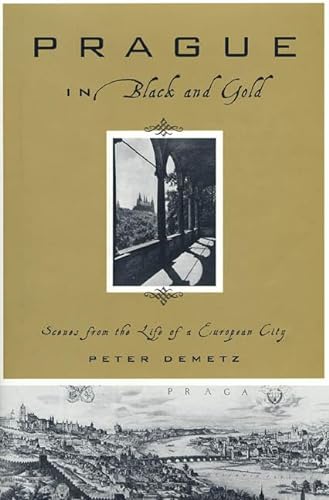
A history of the Bohemian capital assesses Prague's true place in world civilization, separating the truths from the myths of the city's origins and surveying the key moments in its history in the heart of the Old World.
Die Inhaltsangabe kann sich auf eine andere Ausgabe dieses Titels beziehen.
Über die Autorin bzw. den Autor
Peter Demetz, Professor Emeritus of German and Comparative Literature at Yale University, was born in Prague.
Auszug. © Genehmigter Nachdruck. Alle Rechte vorbehalten.
Prague in Black and Gold
1
LIBUSSA, OR VERSIONS OF ORIGIN
What the Schoolchildren Learn
In February 1893, the Czech writer Alois Jirásek, patriot, industrious historian, and late ally of Walter Scott, was preparing a little book for young readers and, in a letter to a friend, expressed his hope that it would make its way without "big band and loud advertising." Jirásek's Old Czech Legends first appeared in 1894, and his hopes, and those of his publisher, Josef Richard Vilfmek, were fulfilled far beyond their expectations. Old Czech Legends has been published and republished for a hundred years now, to be read in and outside school, and every educated Czech remembers at least some scenes and sayings from the book--though perhaps, among the more recent, skeptical generation, not so vividly as those from Jaroslav Hašek's Good Soldier Švejk. Making eclectic use of old chronicles, Jirásek described the wandering of the Czechs, their arrival in Bohemia, where they settled after a perilous migration, and the wise Libussa, who, after she married the peasant lad Pemysl (father of future Czech kings), in one of her trances guided the people to a place in the forest where the castle and the city of Prague, of never-ending fame and glory, were founded.
Jirásek's Old Czech Legends appeared thirteen years after the premiere of Smetana's patriotic opera Libuše (1881), and Jirásek's admiration for Smetana (as a Prague student he liked to go to the old Café Slavia because he could see the composer sitting there) clearly shows. The tales are grand opera, too, highly serious, intentionally archaic in vocabulary and syntax, and written without the slightest trace of irony. The movement of unnamed masses (the chorus) in proper old Czech costumes alternates withceremonious speeches (or, rather, arias) of the rulers, heroines, and heroes; and the space in which events occur is decorously arranged with a fine sense of symmetry and hierarchical proportions, lighting effects included. In Jirásek's tale of origin a tribe from the east, later named after its leader and patriarch, Czech, moves westward and crosses three rivers, the Oder, the Elbe, and the Vltava, and the people think of the far country which they have left behind and begin to grumble about the perils and the fatigue; "there is no lasting rest for us anywhere." Ur-father Czech, their Moses, ascends a mountain rising from the land, and when he arrives at the top: "Lo and behold! The broad landscape unfolded into the endless distance up to the bluish mountain ranges, easily and freely, forests and thickets, glens and meadows, and through the wild green the rivers shone like silver spilled." The land is empty of other people, "and the rivers well stocked with fish, and the soil fertile," and after three days of meditation, Ur-father Czech tells his people that the "land long promised" was right there and that their wanderings were over for good.
A golden age of love, peace, work, and mutual trust followed, at least as long as Ur-father Czech lived; after his death, his son Krok ruled the tribe, always deeply respecting the assembly of elders (Jirásek wanted to stress Czech democratic traditions), but there was trouble when Krok died without a male heir. Each of his three daughters had particular gifts and virtues: Kazi, the oldest, knew healing herbs and often, by uttering the magic names of the gods, was able to save a life in agony; Teta watched over religious rites and guided the people in observing the rhythm of sacrifices and prayers; and Libussa, the youngest, particularly beautiful, unworldly and serious, was able to see what was hidden from other people's ken and to prophesy. The assembly of elders invested Libussa with the power to rule and to judge, and at first everybody was willing to accept a woman's resolutions. Yet when two neighbors fought over the boundaries of their fields and Libussa resolved the case in favor of the younger man, the older exploded in unseemly anger, condemning her and all women, "long hair, short minds," screaming, the spittle running down his chin, that it would be better to die than to bear with the rule of women, a custom unknown to any other tribe.
Pensive Libussa, far from losing dignity, answered that she was a woman indeed and behaved like one, judging not with an iron rod but with compassion, which was unfortunately taken for weakness. After a night of prayers in her sacred grove, she called a meeting of the elders and warned the assembly that a male ruler would demand service and tribute. The meeting would not nominate a candidate, and she made herown decision with the help of the gods, sent out messengers to be led by her magic white horse to find, near a little river, the plowman Pemysl (the "thoughtful," or even the "cunning"), who was working with his oxen. (For some time he has been reappearing on Czech TV before the evening news.) Libussa duly married Pemysl, invited him to see the treasures and her sacred grove, and he began to rule and to judge in his own male way. Once, on a mild summer night when Libussa, her husband, and the elders stood on a cliff above the Vltava River, while looking across the water to the wooded hills she was seized by the spirit, raised her hands toward the other shore, and uttered her prophecy: "I see a great city whose fame will touch the stars!" She guided her people to find a man there who was busy hewing the threshold (in Czech, prah) of a house and asked them to build a castle, to be called Praha, right on the spot. "Just as princes and army commanders bow their heads when they enter a house," she proclaimed, "so will they bow their heads to my city. It will be honored, noble, and respected by all the world."
Not everybody, however, was happy after Libussa's marriage and the prophecy of future glory. Her maidens, who enjoyed high esteem in the time of gynocracy, felt abandoned and "angry when the men held them up to ridicule" and called them "lost sheep." It was Vlasta, Libussa's favorite, who gathered the disconcerted and harassed women; they seized arms, and the "Maidens' War" against the menfolk began. Vlasta deftly organized her army and trained the many women who were leaving their husbands, brothers, and fathers to join the fight; the strong were chosen to lead the attack, and the most beautiful to entice the men away from their battle groups to be killed. Pemysl's male retinue made fun of the armed women, but Pemysl himself warned the men not to underrate the women's strength. In the forest and valleys, much blood was shed mercilessly, hundreds of men died in the field, many were killed in bed, and young Ctirad, strong and handsome--and particularly hated, or perhaps loved, by Vlasta--was lured into an ambush by attractive Šárka, then tortured and put to death. The warriors wanted revenge, and Vlasta, fighting stubbornly, was killed; a counterattack of the maidens failed, all were slaughtered, and the fortified Dvn, or "Castle of the Maidens," was razed. The storyteller would like to side with the young women but finally turns against them because, he says, they had no heart.
What Archaeologists and Historians Believe: Hypotheses and Reconstructions
In the beginning (after firm land had risen for the third time from the primal seas) were the clouds, the sun, the river, and the hills that gently descended to the east and southeast and softly flattened out to the north (at least after the recurrent glaciations of the alpine and northern lands of Europe had come to an end). The region in which, much later, many hamlets, villages, and townships were to constitute the city of Prague was attractive to human beings in search of food...
„Über diesen Titel“ kann sich auf eine andere Ausgabe dieses Titels beziehen.
Suchergebnisse für Prague in Black and Gold: Scenes from the Life of a...

Beispielbild für diese ISBN
Prague in Black and Gold
Anbieter: World of Books (was SecondSale), Montgomery, IL, USA
Verkäuferbewertung 5 von 5 Sternen

Hardback. Zustand: Good. Prague is at the core of everything both wonderful and terrible in Western history, but few people truly understand this city's unique culture. In Prague in Black and Gold, Peter Demetz strips away sentimentalities and distortions and shows how Czechs, Germans, Italians, and Jews have lived and worked together for over a thousand years. . Bestandsnummer des Verkäufers 00105972121
Gebraucht kaufen
EUR 4,03
Versand gratis
Versand innerhalb von USA
Versand innerhalb von USA
Anzahl: 2 verfügbar
Foto des Verkäufers
Prague in Black and Gold: Scenes from the Life of a European City
Anbieter: Zoom Books Company, Lynden, WA, USA
Verkäuferbewertung 5 von 5 Sternen
Zustand: very_good. Book is in very good condition and may include minimal underlining highlighting. The book can also include "From the library of" labels. May not contain miscellaneous items toys, dvds, etc. . We offer 100% money back guarantee and 24 7 customer service. Bestandsnummer des Verkäufers ZBV.0809078430.VG
Gebraucht kaufen
EUR 4,04
Versand gratis
Versand innerhalb von USA
Versand innerhalb von USA
Anzahl: 1 verfügbar
Foto des Verkäufers
Prague in Black and Gold: Scenes from the Life of a European City
Anbieter: ZBK Books, Carlstadt, NJ, USA
Verkäuferbewertung 5 von 5 Sternen
Zustand: good. Fast & Free Shipping â" Good condition. It may show normal signs of use, such as light writing, highlighting, or library markings, but all pages are intact and the book is fully readable. A solid, complete copy that's ready to enjoy. Bestandsnummer des Verkäufers ZWV.0809078430.G
Gebraucht kaufen
EUR 5,04
Versand gratis
Versand innerhalb von USA
Versand innerhalb von USA
Anzahl: 1 verfügbar
Beispielbild für diese ISBN
Prague in Black and Gold: Scenes from the Life of a European City
Anbieter: More Than Words, Waltham, MA, USA
Verkäuferbewertung 5 von 5 Sternen
Zustand: Good. . good. All orders guaranteed and ship within 24 hours. Before placing your order for please contact us for confirmation on the book's binding. Check out our other listings to add to your order for discounted shipping. Bestandsnummer des Verkäufers WAL-N-5c-002050
Gebraucht kaufen
EUR 2,12
EUR 3,55 Versand
Versand innerhalb von USA
Versand innerhalb von USA
Anzahl: 1 verfügbar
Beispielbild für diese ISBN
Prague in Black and Gold
Anbieter: World of Books Inc, Montgomery, IL, USA
Verkäuferbewertung 4 von 5 Sternen

Hardback. Zustand: Good. Prague is at the core of everything both wonderful and terrible in Western history, but few people truly understand this city's unique culture. In Prague in Black and Gold, Peter Demetz strips away sentimentalities and distortions and shows how Czechs, Germans, Italians, and Jews have lived and worked together for over a thousand years. . Bestandsnummer des Verkäufers CIN0809078430G
Gebraucht kaufen
EUR 5,87
Versand gratis
Versand innerhalb von USA
Versand innerhalb von USA
Anzahl: 2 verfügbar
Beispielbild für diese ISBN
Prague in Black and Gold: Scenes from the Life of a European City
Verlag:
Hill and Wang (edition First Edition), 1997
ISBN 10: 0809078430
ISBN 13: 9780809078431
Gebraucht
Hardcover
Erstausgabe
Anbieter: BooksRun, Philadelphia, PA, USA
Verkäuferbewertung 5 von 5 Sternen
Hardcover. Zustand: Fair. First Edition. The item might be beaten up but readable. May contain markings or highlighting, as well as stains, bent corners, or any other major defect, but the text is not obscured in any way. Bestandsnummer des Verkäufers 0809078430-7-1
Gebraucht kaufen
EUR 6,38
Versand gratis
Versand innerhalb von USA
Versand innerhalb von USA
Anzahl: 1 verfügbar
Beispielbild für diese ISBN
Prague in Black and Gold: Scenes from the Life of a European City
Anbieter: HPB Inc., Dallas, TX, USA
Verkäuferbewertung 5 von 5 Sternen
hardcover. Zustand: Very Good. Connecting readers with great books since 1972! Used books may not include companion materials, and may have some shelf wear or limited writing. We ship orders daily and Customer Service is our top priority! Bestandsnummer des Verkäufers S_462478990
Gebraucht kaufen
EUR 3,21
EUR 3,33 Versand
Versand innerhalb von USA
Versand innerhalb von USA
Anzahl: 1 verfügbar
Beispielbild für diese ISBN
Prague in Black and Gold: Scenes from the Life of a European City
Anbieter: HPB-Emerald, Dallas, TX, USA
Verkäuferbewertung 5 von 5 Sternen
hardcover. Zustand: Very Good. Connecting readers with great books since 1972! Used books may not include companion materials, and may have some shelf wear or limited writing. We ship orders daily and Customer Service is our top priority! Bestandsnummer des Verkäufers S_461482160
Gebraucht kaufen
EUR 3,21
EUR 3,33 Versand
Versand innerhalb von USA
Versand innerhalb von USA
Anzahl: 1 verfügbar
Beispielbild für diese ISBN
Prague in Black and Gold: Scenes from the Life of a European City
Anbieter: HPB-Diamond, Dallas, TX, USA
Verkäuferbewertung 5 von 5 Sternen
hardcover. Zustand: Very Good. Connecting readers with great books since 1972! Used books may not include companion materials, and may have some shelf wear or limited writing. We ship orders daily and Customer Service is our top priority! Bestandsnummer des Verkäufers S_473952386
Gebraucht kaufen
EUR 3,21
EUR 3,33 Versand
Versand innerhalb von USA
Versand innerhalb von USA
Anzahl: 1 verfügbar
Beispielbild für diese ISBN
Prague in Black and Gold: Scenes from the Life of a European City
Anbieter: Half Price Books Inc., Dallas, TX, USA
Verkäuferbewertung 5 von 5 Sternen
hardcover. Zustand: Very Good. Connecting readers with great books since 1972! Used books may not include companion materials, and may have some shelf wear or limited writing. We ship orders daily and Customer Service is our top priority! Bestandsnummer des Verkäufers S_469812645
Gebraucht kaufen
EUR 3,21
EUR 3,33 Versand
Versand innerhalb von USA
Versand innerhalb von USA
Anzahl: 1 verfügbar