
Verwandte Artikel zu Three and Out: Rich Rodriguez and the Michigan Wolverines...
Three and Out: Rich Rodriguez and the Michigan Wolverines in the Crucible of College Football - Hardcover
Inhaltsangabe
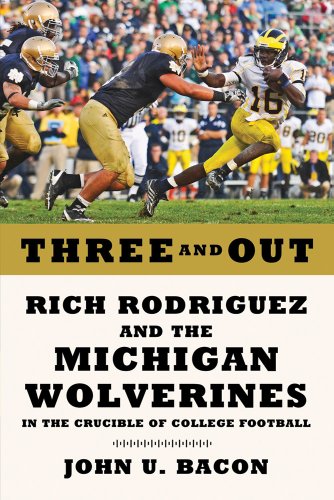
Three and Out tells the story of how college football’s most influential coach took over the nation’s most successful program, only to produce three of the worst seasons in the histories of both Rich Rodriguez and the University of Michigan. Shortly after his controversial move from West Virginia, where he had just taken his alma mater to the #1 ranking for the first time in school history, Coach Rich Rodriguez granted author and journalist John U. Bacon unrestricted access to Michigan’s program. Bacon saw it all, from the meals and the meetings, to the practices and the games, to the sidelines and the locker rooms. Nothing and no one was off limits. John U. Bacon’s Three and Out is the definitive account of a football marriage seemingly made in heaven that broke up after just three years, and lifts the lid on the best and the worst of college football.
Die Inhaltsangabe kann sich auf eine andere Ausgabe dieses Titels beziehen.
Über die Autorin bzw. den Autor
John U. Bacon has written for Time, The New York Times, and ESPN Magazine, among other publications, earning national honors. He is the author of five books on sports and business, including Bo’s Lasting Lessons (with Bo Schembechler), a New York Times and Wall Street Journal business bestseller. Bacon teaches at Northwestern University and the University of Michigan and is a popular public speaker.
Von der hinteren Coverseite
Sports fans invest great hopes and dreams into their teams. College football fans invest even more, I think, because of the stronger connection they feel with the school and the players. But I’ve never seen any fans ask more of their teams than Michigan football fans ask of theirs.
There are only two groups who are more devoted to the Wolverines, and demand more in return: the coaches and the players. They have the most to gain and the most to lose. They know the stakes. And they accept them—even embrace them. It’s why all of them, from Rich Rodriguez to Tate Forcier to Denard Robinson, came to Ann Arbor. Not to be average, or even good, but “the leaders and best.”
Anything less would not do.
This book explains how the coach and his team fell short—and what happened when they did.
Auszug. © Genehmigter Nachdruck. Alle Rechte vorbehalten.
1 LEADERS AND BEST
This is a story that could happen only in America.
When you travel abroad you quickly realize it is impossible to explain why a university would own the largest stadium in the country. It is, literally, a foreign concept, one as original as the U.S. Constitution.
Indeed, it was Thomas Jefferson who drafted the Northwest Ordinance, providing for the funding of public schools and universities in the states that now constitute most of the Big Ten. “Religion, morality, and knowledge being necessary to good government and the happiness of mankind, schools and the means of education shall forever be encouraged.” The idea is so central to Michigan’s mission—even its very existence—it is engraved on the façade of its central building, Angell Hall.
If Ken Burns is right that the national parks are “America’s best idea,” our state universities—another uniquely American concept—might be a close second. The United States has spawned more colleges and graduates per capita than any other country in the world and created college towns rising out of cornfields, another American phenomenon.
Ann Arbor’s founders, in an effort to attract settlers and make money on their real estate venture, first bid for the state capital—and lost to Lansing. Then they bid for the state penitentiary—and lost to Jackson. Finally, they bid for the state university—and won, the best bronze medal ever awarded a brand-new town.
But as the university grew, Ann Arbor experienced problems common to all college towns. Put thousands of healthy young men in one place with little adult supervision, and all that testosterone has to go somewhere—which explains why the game of football was born and raised not in the city or the country but on college campuses.
Football was already so popular at Harvard by 1860 that the school’s president felt compelled to ban it for being too violent. That, of course, only piqued the young men’s desire to play it. When Rutgers played the College of New Jersey—now called Princeton—on November 6, 1869, the game was a little different from the one Michigan and Connecticut would play in 2010. In the 1869 version, each team had twenty-five men who played the entire game and, because they hadn’t yet conceived the forward pass, engaged in a glorified melee.
Rutgers actually won 6–4, marking the first time Rutgers was the nation’s top-ranked team—and the last. When Princeton beat Rutgers in the rematch a week later, Rutgers’s brief moment at the summit was over.
The college boys that day could not have imagined that their wide-ranging scrum would become one of their nation’s most popular spectator sports—a billion-dollar American obsession worthy of stadiums holding over one hundred thousand people, with luxury boxes that would start at $55,000 per season. But that’s exactly what they set in motion that day. They also started something the students, the alumni, and the reporters would love—and the university presidents would hate just as much.
Just two years after that first game, Andrew Dickson White—who had left his post as a history and English professor at the University of Michigan to become Cornell’s first president—received a request from a group of students to take the train to Cleveland to play football against Western Reserve (now Case Western). He famously replied that he would not permit thirty men to travel two hundred miles just to “agitate … a pig’s bladder full of wind!”
But he was fighting a losing battle. Ten years later, in 1879, a group of Michigan students traveled to Chicago to play a team from Racine College in Wisconsin, in the first football game on the far side of the Alleghenies—or “the West,” as they called it then. The Wolverines won 1–0, starting a tradition that, 131 years later, would be described by athletic director and former regent Dave Brandon as the most prominent feature of Michigan’s “brand.”
The college presidents responded to this relationship like fathers of debutantes who find their pristine daughters falling for hooligans. It was not simply a Hatfield marrying a McCoy. It was a Vanderbilt marrying a McCoy.
If they could have annulled the marriage, they would have. But, conceding the impossibility of preventing this ungodly union of academics and athletics, Purdue president James H. Smart wrote to the presidents of Minnesota, Wisconsin, Illinois, Northwestern, Chicago, and Michigan, inviting them to meet on January 11, 1895, in a wood-paneled room at the Palmer House in Chicago. If they were going to have to put up with this shotgun marriage, they at least wanted to put down some ground rules.
They started with the premise that they, the presidents, should have complete authority over all sports played in their universities’ names, and then created rules ensuring that everyone on the field was a bona fide student and an amateur athlete—issues schools still struggle with today.
This was a “radical departure from the prevailing norm,” former Big Ten commissioner Tug Wilson wrote, and he was right. The Big Ten was the first major organization of its kind, predating high school associations, other college conferences, and even the NCAA itself. Soon the rest of the country’s colleges and high schools followed suit, forming their own leagues based on the Big Ten model.
The American marriage of academics and athletics—something no other country in the world would even consider—had been officially consummated.
It’s been a rocky relationship, to say the least, and presidents to this day chafe at having to work with the unruly beast down the street. But it’s lasted over a century, and even a trial separation seems out of the question.
Of the seven schools that day that created what would become the Big Ten, one would emerge as the conference’s crown jewel. But if the Big Ten penned its Magna Carta at the Palmer House in 1895, the Wolverines would wait three more years to craft their constitution. They needed inspiration, and they found it in the Big Ten’s first rivalry.
When John D. Rockefeller decided to bankroll a university to open in 1892, he called it the University of Chicago and hired Yale’s William Rainey Harper to become the school’s first president. Neither Rockefeller nor Harper was stupid. They knew the fastest way to put their new school on the map was to make a splash in the sensation sweeping the nation: college football, thereby becoming one of the first schools to leverage the game to enhance its academic reputation.
One of President Harper’s first hires was his former Yale Hebrew student Amos Alonzo Stagg, a man trained by Walter Camp, the father of football and the author of its first rule book. The investment in Stagg quickly paid off when he turned the Chicago Maroons into a regional power, strong enough after just four seasons to join the nascent Big Ten.
Three years later, on November 24, 1898, in front of twelve thousand fans at Chicago’s Marshall Field, the undefeated Wolverines took on the 9–1–1 Maroons to see who could claim their first Big Ten title. Late in the game, Michigan’s little-used Charles “Chuck” Widman broke loose for a 65-yard touchdown, followed by Neil Snow’s crucial two-point conversion—just enough for a 12–11 victory and the first of Michigan’s forty-two conference crowns.
“My spirits were so uplifted that I was clear off the earth,” said Michigan music student Louis Elbel. The surprising finish started a song in his head. Some accounts have him finishing the melody by the time he got to his brother’s house, others on the train back to Ann Arbor. Either way, Elbel worked with amazing efficiency—perhaps because he seems to have lifted the renowned melody of “The Victors’” from “The Spirit of Liberty,” which his friend George Rosenberg had copyrighted seven months earlier.
But no one questions that the powerful lyrics are all Elbel’s. A year later John Philip Sousa performed the song in Ann Arbor and reportedly declared it “the greatest college fight song ever written.”
One overlooked aspect of “The Victors” separates it from all others. Most school songs urge their teams to make a great effort in the hopes of winning. “On, Wisconsin!” ask the Badgers to “fight on for her fame … We’ll win this game.” “The Buckeye Battle Cry” exhorts the “men of the Scarlet and Gray … We’ve got to win this game today.”
“The Victors,” in contrast, celebrates a contest already won.
Hail! to the victors valiant
Hail! to the conqu’ring heroes
Hail! Hail! to Michigan
The leaders and best!
Hail! to the victors valiant
Hail! to the conqu’ring heroes
Hail! Hail! to Michigan,
The champions of the West!
There is no wiggle room in those words. No hoping, no wishing—just a clear-as-day declaration that the Michigan Wolverines are “the leaders and best,” and everyone else will simply have to deal with it.
Of all the trappings of Michigan’s vaunted tradition, the first is something you cannot see or touch. It’s just a song. But more than the marching band, big house, or banner, “The Victors” established the most important element of Michigan’s identity—confidence—which served as the North Star for all that followed.
* * *
He wasn’t raised in Michigan, he didn’t play there or even take a single class in Ann Arbor, but no one did more to shape Michigan’s reputation for excellence—and arroganc...
This is a story that could happen only in America.
When you travel abroad you quickly realize it is impossible to explain why a university would own the largest stadium in the country. It is, literally, a foreign concept, one as original as the U.S. Constitution.
Indeed, it was Thomas Jefferson who drafted the Northwest Ordinance, providing for the funding of public schools and universities in the states that now constitute most of the Big Ten. “Religion, morality, and knowledge being necessary to good government and the happiness of mankind, schools and the means of education shall forever be encouraged.” The idea is so central to Michigan’s mission—even its very existence—it is engraved on the façade of its central building, Angell Hall.
If Ken Burns is right that the national parks are “America’s best idea,” our state universities—another uniquely American concept—might be a close second. The United States has spawned more colleges and graduates per capita than any other country in the world and created college towns rising out of cornfields, another American phenomenon.
Ann Arbor’s founders, in an effort to attract settlers and make money on their real estate venture, first bid for the state capital—and lost to Lansing. Then they bid for the state penitentiary—and lost to Jackson. Finally, they bid for the state university—and won, the best bronze medal ever awarded a brand-new town.
But as the university grew, Ann Arbor experienced problems common to all college towns. Put thousands of healthy young men in one place with little adult supervision, and all that testosterone has to go somewhere—which explains why the game of football was born and raised not in the city or the country but on college campuses.
Football was already so popular at Harvard by 1860 that the school’s president felt compelled to ban it for being too violent. That, of course, only piqued the young men’s desire to play it. When Rutgers played the College of New Jersey—now called Princeton—on November 6, 1869, the game was a little different from the one Michigan and Connecticut would play in 2010. In the 1869 version, each team had twenty-five men who played the entire game and, because they hadn’t yet conceived the forward pass, engaged in a glorified melee.
Rutgers actually won 6–4, marking the first time Rutgers was the nation’s top-ranked team—and the last. When Princeton beat Rutgers in the rematch a week later, Rutgers’s brief moment at the summit was over.
The college boys that day could not have imagined that their wide-ranging scrum would become one of their nation’s most popular spectator sports—a billion-dollar American obsession worthy of stadiums holding over one hundred thousand people, with luxury boxes that would start at $55,000 per season. But that’s exactly what they set in motion that day. They also started something the students, the alumni, and the reporters would love—and the university presidents would hate just as much.
Just two years after that first game, Andrew Dickson White—who had left his post as a history and English professor at the University of Michigan to become Cornell’s first president—received a request from a group of students to take the train to Cleveland to play football against Western Reserve (now Case Western). He famously replied that he would not permit thirty men to travel two hundred miles just to “agitate … a pig’s bladder full of wind!”
But he was fighting a losing battle. Ten years later, in 1879, a group of Michigan students traveled to Chicago to play a team from Racine College in Wisconsin, in the first football game on the far side of the Alleghenies—or “the West,” as they called it then. The Wolverines won 1–0, starting a tradition that, 131 years later, would be described by athletic director and former regent Dave Brandon as the most prominent feature of Michigan’s “brand.”
The college presidents responded to this relationship like fathers of debutantes who find their pristine daughters falling for hooligans. It was not simply a Hatfield marrying a McCoy. It was a Vanderbilt marrying a McCoy.
If they could have annulled the marriage, they would have. But, conceding the impossibility of preventing this ungodly union of academics and athletics, Purdue president James H. Smart wrote to the presidents of Minnesota, Wisconsin, Illinois, Northwestern, Chicago, and Michigan, inviting them to meet on January 11, 1895, in a wood-paneled room at the Palmer House in Chicago. If they were going to have to put up with this shotgun marriage, they at least wanted to put down some ground rules.
They started with the premise that they, the presidents, should have complete authority over all sports played in their universities’ names, and then created rules ensuring that everyone on the field was a bona fide student and an amateur athlete—issues schools still struggle with today.
This was a “radical departure from the prevailing norm,” former Big Ten commissioner Tug Wilson wrote, and he was right. The Big Ten was the first major organization of its kind, predating high school associations, other college conferences, and even the NCAA itself. Soon the rest of the country’s colleges and high schools followed suit, forming their own leagues based on the Big Ten model.
The American marriage of academics and athletics—something no other country in the world would even consider—had been officially consummated.
It’s been a rocky relationship, to say the least, and presidents to this day chafe at having to work with the unruly beast down the street. But it’s lasted over a century, and even a trial separation seems out of the question.
Of the seven schools that day that created what would become the Big Ten, one would emerge as the conference’s crown jewel. But if the Big Ten penned its Magna Carta at the Palmer House in 1895, the Wolverines would wait three more years to craft their constitution. They needed inspiration, and they found it in the Big Ten’s first rivalry.
When John D. Rockefeller decided to bankroll a university to open in 1892, he called it the University of Chicago and hired Yale’s William Rainey Harper to become the school’s first president. Neither Rockefeller nor Harper was stupid. They knew the fastest way to put their new school on the map was to make a splash in the sensation sweeping the nation: college football, thereby becoming one of the first schools to leverage the game to enhance its academic reputation.
One of President Harper’s first hires was his former Yale Hebrew student Amos Alonzo Stagg, a man trained by Walter Camp, the father of football and the author of its first rule book. The investment in Stagg quickly paid off when he turned the Chicago Maroons into a regional power, strong enough after just four seasons to join the nascent Big Ten.
Three years later, on November 24, 1898, in front of twelve thousand fans at Chicago’s Marshall Field, the undefeated Wolverines took on the 9–1–1 Maroons to see who could claim their first Big Ten title. Late in the game, Michigan’s little-used Charles “Chuck” Widman broke loose for a 65-yard touchdown, followed by Neil Snow’s crucial two-point conversion—just enough for a 12–11 victory and the first of Michigan’s forty-two conference crowns.
“My spirits were so uplifted that I was clear off the earth,” said Michigan music student Louis Elbel. The surprising finish started a song in his head. Some accounts have him finishing the melody by the time he got to his brother’s house, others on the train back to Ann Arbor. Either way, Elbel worked with amazing efficiency—perhaps because he seems to have lifted the renowned melody of “The Victors’” from “The Spirit of Liberty,” which his friend George Rosenberg had copyrighted seven months earlier.
But no one questions that the powerful lyrics are all Elbel’s. A year later John Philip Sousa performed the song in Ann Arbor and reportedly declared it “the greatest college fight song ever written.”
One overlooked aspect of “The Victors” separates it from all others. Most school songs urge their teams to make a great effort in the hopes of winning. “On, Wisconsin!” ask the Badgers to “fight on for her fame … We’ll win this game.” “The Buckeye Battle Cry” exhorts the “men of the Scarlet and Gray … We’ve got to win this game today.”
“The Victors,” in contrast, celebrates a contest already won.
Hail! to the victors valiant
Hail! to the conqu’ring heroes
Hail! Hail! to Michigan
The leaders and best!
Hail! to the victors valiant
Hail! to the conqu’ring heroes
Hail! Hail! to Michigan,
The champions of the West!
There is no wiggle room in those words. No hoping, no wishing—just a clear-as-day declaration that the Michigan Wolverines are “the leaders and best,” and everyone else will simply have to deal with it.
Of all the trappings of Michigan’s vaunted tradition, the first is something you cannot see or touch. It’s just a song. But more than the marching band, big house, or banner, “The Victors” established the most important element of Michigan’s identity—confidence—which served as the North Star for all that followed.
* * *
He wasn’t raised in Michigan, he didn’t play there or even take a single class in Ann Arbor, but no one did more to shape Michigan’s reputation for excellence—and arroganc...
„Über diesen Titel“ kann sich auf eine andere Ausgabe dieses Titels beziehen.
Suchergebnisse für Three and Out: Rich Rodriguez and the Michigan Wolverines...

Beispielbild für diese ISBN
Three and Out: Rich Rodriguez and the Michigan Wolverines in the Crucible of College Football
Verlag:
Farrar, Straus and Giroux, 2011
ISBN 10: 0809094665
ISBN 13: 9780809094660
Gebraucht
Hardcover
Anbieter: World of Books (was SecondSale), Montgomery, IL, USA
Verkäuferbewertung 5 von 5 Sternen

Hardback. Zustand: Good. Sports fans invest great hopes and dreams into their teams. College football fans invest even more, I think, because of the stronger connection they feel with the school and the players. But I've never seen any fans ask more of their teams than Michigan football fans ask of theirs. There are only two groups who are more devoted to the Wolverines, and demand more in return: the coaches and the players. They have the most to gain and the most to lose. They know the stakes. And they accept them--even embrace them. It's why all of them, from Rich Rodriguez to Tate Forcier to Denard Robinson, came to Ann Arbor. Not to be average, or even good, but the leaders and best. Anything less would not do. This book explains how the coach and his team fell short--and what happened when they did. Bestandsnummer des Verkäufers 00093710243
Gebraucht kaufen
EUR 4,56
Versand gratis
Versand innerhalb von USA
Versand innerhalb von USA
Anzahl: 4 verfügbar
Beispielbild für diese ISBN
Three and Out: Rich Rodriguez and the Michigan Wolverines in the Crucible of College Football
Verlag:
Farrar, Straus and Giroux, 2011
ISBN 10: 0809094665
ISBN 13: 9780809094660
Gebraucht
Hardcover
Anbieter: World of Books (was SecondSale), Montgomery, IL, USA
Verkäuferbewertung 5 von 5 Sternen
Hardback. Zustand: Fair. Sports fans invest great hopes and dreams into their teams. College football fans invest even more, I think, because of the stronger connection they feel with the school and the players. But I've never seen any fans ask more of their teams than Michigan football fans ask of theirs. There are only two groups who are more devoted to the Wolverines, and demand more in return: the coaches and the players. They have the most to gain and the most to lose. They know the stakes. And they accept them--even embrace them. It's why all of them, from Rich Rodriguez to Tate Forcier to Denard Robinson, came to Ann Arbor. Not to be average, or even good, but the leaders and best. Anything less would not do. This book explains how the coach and his team fell short--and what happened when they did. Bestandsnummer des Verkäufers 00108490767
Gebraucht kaufen
EUR 4,56
Versand gratis
Versand innerhalb von USA
Versand innerhalb von USA
Anzahl: 2 verfügbar
Beispielbild für diese ISBN
Three and Out: Rich Rodriguez and the Michigan Wolverines in the Crucible of College Football
Verlag:
Farrar, Straus and Giroux (edition First Edition), 2011
ISBN 10: 0809094665
ISBN 13: 9780809094660
Gebraucht
Hardcover
Erstausgabe
Anbieter: BooksRun, Philadelphia, PA, USA
Verkäuferbewertung 5 von 5 Sternen
Hardcover. Zustand: Very Good. First Edition. With dust jacket. It's a well-cared-for item that has seen limited use. The item may show minor signs of wear. All the text is legible, with all pages included. It may have slight markings and/or highlighting. Bestandsnummer des Verkäufers 0809094665-11-1-29
Gebraucht kaufen
EUR 5,61
Versand gratis
Versand innerhalb von USA
Versand innerhalb von USA
Anzahl: 1 verfügbar
Beispielbild für diese ISBN
Three and Out: Rich Rodriguez and the Michigan Wolverines in the Crucible of College Football
Verlag:
Farrar, Straus and Giroux, 2011
ISBN 10: 0809094665
ISBN 13: 9780809094660
Gebraucht
Hardcover
Anbieter: ThriftBooks-Atlanta, AUSTELL, GA, USA
Verkäuferbewertung 5 von 5 Sternen
Hardcover. Zustand: Very Good. No Jacket. Missing dust jacket; May have limited writing in cover pages. Pages are unmarked. ~ ThriftBooks: Read More, Spend Less. Bestandsnummer des Verkäufers G0809094665I4N01
Gebraucht kaufen
EUR 6,10
Versand gratis
Versand innerhalb von USA
Versand innerhalb von USA
Anzahl: 1 verfügbar
Beispielbild für diese ISBN
Three and Out: Rich Rodriguez and the Michigan Wolverines in the Crucible of College Football
Verlag:
Farrar, Straus and Giroux, 2011
ISBN 10: 0809094665
ISBN 13: 9780809094660
Gebraucht
Hardcover
Anbieter: World of Books Inc, Montgomery, IL, USA
Verkäuferbewertung 4 von 5 Sternen

Hardback. Zustand: Good. Sports fans invest great hopes and dreams into their teams. College football fans invest even more, I think, because of the stronger connection they feel with the school and the players. But I've never seen any fans ask more of their teams than Michigan football fans ask of theirs. There are only two groups who are more devoted to the Wolverines, and demand more in return: the coaches and the players. They have the most to gain and the most to lose. They know the stakes. And they accept them--even embrace them. It's why all of them, from Rich Rodriguez to Tate Forcier to Denard Robinson, came to Ann Arbor. Not to be average, or even good, but the leaders and best. Anything less would not do. This book explains how the coach and his team fell short--and what happened when they did. Bestandsnummer des Verkäufers CIN0809094665G
Gebraucht kaufen
EUR 6,39
Versand gratis
Versand innerhalb von USA
Versand innerhalb von USA
Anzahl: 4 verfügbar
Beispielbild für diese ISBN
Three and Out: Rich Rodriguez and the Michigan Wolverines in the Crucible of College Football
Verlag:
Farrar, Straus and Giroux, 2011
ISBN 10: 0809094665
ISBN 13: 9780809094660
Gebraucht
Hardcover
Anbieter: World of Books Inc, Montgomery, IL, USA
Verkäuferbewertung 4 von 5 Sternen
Hardback. Zustand: Fair. Sports fans invest great hopes and dreams into their teams. College football fans invest even more, I think, because of the stronger connection they feel with the school and the players. But I've never seen any fans ask more of their teams than Michigan football fans ask of theirs. There are only two groups who are more devoted to the Wolverines, and demand more in return: the coaches and the players. They have the most to gain and the most to lose. They know the stakes. And they accept them--even embrace them. It's why all of them, from Rich Rodriguez to Tate Forcier to Denard Robinson, came to Ann Arbor. Not to be average, or even good, but the leaders and best. Anything less would not do. This book explains how the coach and his team fell short--and what happened when they did. Bestandsnummer des Verkäufers CIN0809094665A
Gebraucht kaufen
EUR 6,39
Versand gratis
Versand innerhalb von USA
Versand innerhalb von USA
Anzahl: 2 verfügbar
Beispielbild für diese ISBN
Three and Out: Rich Rodriguez and the Michigan Wolverines in the Crucible of College Football
Verlag:
Farrar, Straus and Giroux, 2011
ISBN 10: 0809094665
ISBN 13: 9780809094660
Gebraucht
Hardcover
Signiert
Anbieter: Wonder Book, Frederick, MD, USA
Verkäuferbewertung 5 von 5 Sternen
Zustand: Good. Signed Copy . Very Good dust jacket. Inscribed by author on half title page. Bestandsnummer des Verkäufers P16OS-00382
Gebraucht kaufen
EUR 6,76
Versand gratis
Versand innerhalb von USA
Versand innerhalb von USA
Anzahl: 1 verfügbar
Beispielbild für diese ISBN
Three and Out: Rich Rodriguez and the Michigan Wolverines in the Crucible of College Football
Verlag:
Farrar, Straus and Giroux, 2011
ISBN 10: 0809094665
ISBN 13: 9780809094660
Gebraucht
Hardcover
Anbieter: Wonder Book, Frederick, MD, USA
Verkäuferbewertung 5 von 5 Sternen
Zustand: Very Good. Very Good condition. Acceptable dust jacket. A copy that may have a few cosmetic defects. May also contain light spine creasing or a few markings such as an owner's name, short gifter's inscription or light stamp. Bestandsnummer des Verkäufers E01B-01005
Gebraucht kaufen
EUR 6,76
Versand gratis
Versand innerhalb von USA
Versand innerhalb von USA
Anzahl: 1 verfügbar
Beispielbild für diese ISBN
Three and Out: Rich Rodriguez and the Michigan Wolverines in the Crucible of College Football
Verlag:
Farrar, Straus and Giroux, 2011
ISBN 10: 0809094665
ISBN 13: 9780809094660
Gebraucht
Hardcover
Anbieter: Wonder Book, Frederick, MD, USA
Verkäuferbewertung 5 von 5 Sternen
Zustand: Good. Good condition. Very Good dust jacket. A copy that has been read but remains intact. May contain markings such as bookplates, stamps, limited notes and highlighting, or a few light stains. Bestandsnummer des Verkäufers L04D-03199
Gebraucht kaufen
EUR 6,76
Versand gratis
Versand innerhalb von USA
Versand innerhalb von USA
Anzahl: 1 verfügbar
Beispielbild für diese ISBN
Three and Out: Rich Rodriguez and the Michigan Wolverines in the Crucible of College Football
Verlag:
Farrar, Straus and Giroux, 2011
ISBN 10: 0809094665
ISBN 13: 9780809094660
Gebraucht
Hardcover
Anbieter: Half Price Books Inc., Dallas, TX, USA
Verkäuferbewertung 5 von 5 Sternen
hardcover. Zustand: Very Good. Connecting readers with great books since 1972! Used books may not include companion materials, and may have some shelf wear or limited writing. We ship orders daily and Customer Service is our top priority! Bestandsnummer des Verkäufers S_478440387
Gebraucht kaufen
EUR 3,67
EUR 3,34 Versand
Versand innerhalb von USA
Versand innerhalb von USA
Anzahl: 1 verfügbar