
Verwandte Artikel zu A Future Perfect: The Challenge and Promise of Globalization
Inhaltsangabe
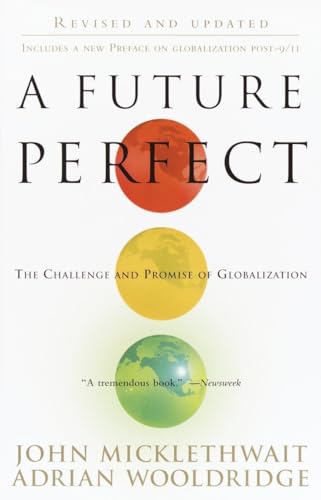
A Future Perfect is the first comprehensive examination of the most important revolution of our time—globalization—and how it will continue to change our lives. Do businesses benefit from going global? Are we creating winner-take-all societies? Will globalization seal the triumph of junk culture? What will happen to individual careers? Gathering evidence worldwide, from the shantytowns of São Paolo to the boardrooms of General Electric, from the troubled Russia-Estonia border to the booming San Fernando Valley sex industry, John Micklethwait and Adrian Wooldridge deliver an illuminating tour of the global economy and a fascinating assessment of its potential impact.
Die Inhaltsangabe kann sich auf eine andere Ausgabe dieses Titels beziehen.
Über die Autorin bzw. den Autor
John Micklethwait and Adrian Wooldridge
Von der hinteren Coverseite
re Perfect is the first comprehensive examination of the most important revolution of our time—globalization—and how it will continue to change our lives. Do businesses benefit from going global? Are we creating winner-take-all societies? Will globalization seal the triumph of junk culture? What will happen to individual careers? Gathering evidence worldwide, from the shantytowns of São Paolo to the boardrooms of General Electric, from the troubled Russia-Estonia border to the booming San Fernando Valley sex industry, John Micklethwait and Adrian Wooldridge deliver an illuminating tour of the global economy and a fascinating assessment of its potential impact.
Aus dem Klappentext
re Perfect is the first comprehensive examination of the most important revolution of our time globalization and how it will continue to change our lives. Do businesses benefit from going global? Are we creating winner-take-all societies? Will globalization seal the triumph of junk culture? What will happen to individual careers? Gathering evidence worldwide, from the shantytowns of São Paolo to the boardrooms of General Electric, from the troubled Russia-Estonia border to the booming San Fernando Valley sex industry, John Micklethwait and Adrian Wooldridge deliver an illuminating tour of the global economy and a fascinating assessment of its potential impact.
Auszug. © Genehmigter Nachdruck. Alle Rechte vorbehalten.
1
The Fall and Rise of Globalization
In March 1906, a twenty-two-year-old Englishman who was to become one of the titans of the twentieth century took his first foreign holiday unencumbered by his parents. The trip was spent largely in Italy, a country whose food he praised but whose youth he regarded, perhaps hypocritically, as “physically repulsive.” For the young traveler, the journey was a revelation of the joys of globalization. He needed no passport to visit foreign countries, and his gold sovereigns were universally convertible into local currencies at fixed rates of exchange. He found that the world was knit together by railways and steamships and that he could find comfortable hotels wherever he wanted to stay and post offices whenever he wanted to get a message back home.
At the time, Great Britain occupied much the same position in the world that the United States occupies today: that of commercial leviathan, military giant, and cultural arbiter. British goods dominated the world’s markets. British money irrigated the world’s businesses. British military might protected the world’s trading routes. British culture was so powerful that foreigners even took to playing that most idiosyncratic of games, cricket. And most of the world accepted the British gospel of free trade and globalization.
There was no sterner defender of this creed than the young traveler, John Maynard Keynes, one of the most gilded members of one of the most gilded generations in English history. The son of a noted university administrator, he had won scholarships first to Eton and then to King’s College, Cambridge. He had tried, rather precociously, to win a fellowship at King’s soon after graduating, but he had been told to wait.
Yet while Keynes was a child of the establishment, he was certainly not a creature of it. A homosexual in an age when such a trait was not always appreciated, he also belonged to a generation–or rather to a clique within a generation, the Bloomsbury group–that was in more or less open revolt against the certainties of Victorian civilization. As Keynes’s biographer, Robert Skidelsky, records, he spent time with the painter Duncan Grant in Paris on his way to Italy, and then with Lytton Strachey in Genoa, where the two men passed the hours, in Keynes’s words, “eating omelettes and discussing ethics and sodomy.”1 Strachey later wrote the definitive Victorian-bashing book, Eminent Victorians.
You might imagine that Keynes rebelled against Victorian economics as well as Victorian morality. Yet at the time his enthusiasm for free trade was absolute. In his undergraduate days, he spoke out against protectionism in student debates. “I hate all priests and protectionists,” he wrote to a friend, praising “Free Trade and Free Thought.” In fact, free trade was arguably the only political cause that stirred the young Keynes. “We must hold to Free Trade, in its widest interpretation, as an inflexible dogma, to which no exception is admitted,” he thundered. “We should hold to Free Trade as a principle of international morals, and not merely as a doctrine of economic advantage.”2
Three great works helped persuade young men such as Keynes of the virtues of free trade: Adam Smith’s The Wealth of Nations (1776), David Ricardo’s On the Principles of Political Economy and Taxation (1817), and James Mill’s Elements of Political Economy (1821). Smith’s argument that the economy works best when it is left to the “invisible hand” of the market was above all a brief on the virtues of trade: Protectionism is one of the most misguided forms of state intervention. Mill reinforced Smith’s argument by polemicizing against the mercantilist idea (still held widely
today) that only one sort of trade–exports–is good. Mill argued, rather, that the only reason to export something is to get the money to import other things. “The benefit, which is derived from exchanging one commodity for another,” he claimed, “arises in all cases from the commodity received, not the commodity given.”
For his part, Ricardo elaborated the idea of “comparative advantage,” according to which free trade offers all countries, both rich and poor, chances to gain by specializing in what they do best. Sometimes these comparative advantages arise from things as basic as geography or climate (nobody took the British wine industry seriously, even then), but more often they have to do with local skills and productivity. As Ricardo argued, the most productive countries gravitate toward the industries in which they have the greatest advantage, leaving opportunities for others. As long as both the most productive countries and their less-developed peers can trade freely, both gain from this specialization. Globalization arguably comes down to nothing more than allowing this specialization to happen.
To the young Keynes, these were not merely logical arguments; they were the victors in the bloodiest intellectual battle of the previous century. Smith, Mill, and Ricardo had provided the most important battering ram against the protectionist corn laws (which protected farmers by keeping the price of wheat artificially high). That struggle–which had been won only in 1846 after Sir Robert Peel betrayed his own Conservative party and repealed the laws–had inspired people to storm out of dinner parties and even to found magazines. Long after the fuss about the corn laws had died away, internationalism was more than just a way of piling up wealth for the Victorians; it was a moral duty they felt they had to the rest of humanity, a way of spreading the virtues not just of free trade but of free institutions and Christian morality.
From Keynes’s perspective, Britain was the engine of a free-trading system that spanned an ever greater portion of the globe. Several economists have shown recently that the idea that the world economy was “more global” a century ago than it is today is something of a canard. There is far more trade in services today than there was a century ago, far more trade among multinational companies, and far more widely ranging capital markets. But there was nonetheless an impressive degree of integration: The movement of capital and the transfer of profits were largely unhampered; governments exercised little influence over the distribution of wealth; the gold standard provided the entire industrial world and much of the developing world with a friction-free means of exchange. By 1913, the total stock of long-term foreign investment had reached $44 billion, and nearly 60 percent of the securities traded in London were foreign ones.
In one vital way, the world was probably more integrated then than it is today: the movement of people. Citizenship was granted freely to immigrants, and people moved between countries without the bother of a passport, let alone a work permit. America allowed access to anybody who was not a prostitute, a convict, a lunatic, or, after 1882, Chinese. It attracted about two thirds of the thirty-six million people who emigrated from Europe in the fifty years before the First World War, usually searching for cheap land. (Even more people moved from one part of Asia to another, though many of them were indentured workers or coolies.)
There were weeds in this garden, as Keynes well knew. Continental Europe, in general, was much less enthusiastic about free trade than the Anglo-Saxon world was. Between 1875 and 1913, tariffs crept up in most European countries, in part because of the “great grain invasion” from Russia and the United States. Italy, the country that Keynes was visiting, still paid lip service to the...
„Über diesen Titel“ kann sich auf eine andere Ausgabe dieses Titels beziehen.
Suchergebnisse für A Future Perfect: The Challenge and Promise of Globalization

Beispielbild für diese ISBN
A Future Perfect: The Challenge and Promise of Globalization
Verlag:
Random House Publishing Group (edition Reprint), 2003
ISBN 10: 0812966805
ISBN 13: 9780812966800
Gebraucht
Paperback
Anbieter: BooksRun, Philadelphia, PA, USA
Verkäuferbewertung 5 von 5 Sternen

Paperback. Zustand: Fair. Reprint. The item might be beaten up but readable. May contain markings or highlighting, as well as stains, bent corners, or any other major defect, but the text is not obscured in any way. Bestandsnummer des Verkäufers 0812966805-7-1
Gebraucht kaufen
EUR 4,71
Versand gratis
Versand innerhalb von USA
Versand innerhalb von USA
Anzahl: 1 verfügbar
Beispielbild für diese ISBN
A Future Perfect: The Challenge and Promise of Globalization
Anbieter: World of Books (was SecondSale), Montgomery, IL, USA
Verkäuferbewertung 5 von 5 Sternen
Paperback. Zustand: Very Good. A Future Perfect is the first comprehensive examination of the most important revolution of our time--globalization--and how it will continue to change our lives. Do businesses benefit from going global? Are we creating winner-take-all societies? Will globalization seal the triumph of junk culture? What will happen to individual careers? Gathering evidence worldwide, from the shantytowns of São Paolo to the boardrooms of General Electric, from the troubled Russia-Estonia border to the booming San Fernando Valley sex industry, John Micklethwait and Adrian Wooldridge deliver an illuminating tour of the global economy and a fascinating assessment of its potential impact. Bestandsnummer des Verkäufers 00102660560
Gebraucht kaufen
EUR 4,71
Versand gratis
Versand innerhalb von USA
Versand innerhalb von USA
Anzahl: 1 verfügbar
Beispielbild für diese ISBN
A Future Perfect: The Challenge and Promise of Globalization
Anbieter: World of Books (was SecondSale), Montgomery, IL, USA
Verkäuferbewertung 5 von 5 Sternen
Paperback. Zustand: Good. A Future Perfect is the first comprehensive examination of the most important revolution of our time--globalization--and how it will continue to change our lives. Do businesses benefit from going global? Are we creating winner-take-all societies? Will globalization seal the triumph of junk culture? What will happen to individual careers? Gathering evidence worldwide, from the shantytowns of São Paolo to the boardrooms of General Electric, from the troubled Russia-Estonia border to the booming San Fernando Valley sex industry, John Micklethwait and Adrian Wooldridge deliver an illuminating tour of the global economy and a fascinating assessment of its potential impact. Bestandsnummer des Verkäufers 00099137768
Gebraucht kaufen
EUR 4,71
Versand gratis
Versand innerhalb von USA
Versand innerhalb von USA
Anzahl: 2 verfügbar
Beispielbild für diese ISBN
A Future Perfect : The Challenge and Promise of Globalization
Verlag:
Random House Publishing Group, 2003
ISBN 10: 0812966805
ISBN 13: 9780812966800
Gebraucht
Softcover
Anbieter: Better World Books, Mishawaka, IN, USA
Verkäuferbewertung 5 von 5 Sternen
Zustand: Very Good. (rev)03 Edition. Former library copy. Pages intact with possible writing/highlighting. Binding strong with minor wear. Dust jackets/supplements may not be included. Includes library markings. Stock photo provided. Product includes identifying sticker. Better World Books: Buy Books. Do Good. Bestandsnummer des Verkäufers 15842155-20
Gebraucht kaufen
EUR 6,16
Versand gratis
Versand innerhalb von USA
Versand innerhalb von USA
Anzahl: 1 verfügbar
Beispielbild für diese ISBN
A Future Perfect : The Challenge and Promise of Globalization
Verlag:
Random House Publishing Group, 2003
ISBN 10: 0812966805
ISBN 13: 9780812966800
Gebraucht
Softcover
Anbieter: Better World Books: West, Reno, NV, USA
Verkäuferbewertung 5 von 5 Sternen
Zustand: Very Good. (rev)03 Edition. Former library copy. Pages intact with possible writing/highlighting. Binding strong with minor wear. Dust jackets/supplements may not be included. Includes library markings. Stock photo provided. Product includes identifying sticker. Better World Books: Buy Books. Do Good. Bestandsnummer des Verkäufers 15842155-20
Gebraucht kaufen
EUR 6,16
Versand gratis
Versand innerhalb von USA
Versand innerhalb von USA
Anzahl: 1 verfügbar
Beispielbild für diese ISBN
A Future Perfect: The Challenge and Promise of Globalization
Verlag:
Random House Trade, New York, NY, 2003
ISBN 10: 0812966805
ISBN 13: 9780812966800
Gebraucht
Trade paperback
Anbieter: 2Vbooks, Derwood, MD, USA
Verkäuferbewertung 5 von 5 Sternen
Trade paperback. Zustand: Very good. Trade paperback (US). Glued binding. 416 p. Audience: General/trade. No previous owner's name SC 113. Bestandsnummer des Verkäufers Alibris.0022550
Gebraucht kaufen
EUR 2,06
EUR 4,43 Versand
Versand innerhalb von USA
Versand innerhalb von USA
Anzahl: 1 verfügbar
Beispielbild für diese ISBN
A Future Perfect: The Challenge and Promise of Globalization
Anbieter: World of Books Inc, Montgomery, IL, USA
Verkäuferbewertung 4 von 5 Sternen

Paperback. Zustand: Good. A Future Perfect is the first comprehensive examination of the most important revolution of our time--globalization--and how it will continue to change our lives. Do businesses benefit from going global? Are we creating winner-take-all societies? Will globalization seal the triumph of junk culture? What will happen to individual careers? Gathering evidence worldwide, from the shantytowns of São Paolo to the boardrooms of General Electric, from the troubled Russia-Estonia border to the booming San Fernando Valley sex industry, John Micklethwait and Adrian Wooldridge deliver an illuminating tour of the global economy and a fascinating assessment of its potential impact. Bestandsnummer des Verkäufers CIN0812966805G
Gebraucht kaufen
EUR 6,54
Versand gratis
Versand innerhalb von USA
Versand innerhalb von USA
Anzahl: 2 verfügbar
Beispielbild für diese ISBN
A Future Perfect: The Challenge and Promise of Globalization
Anbieter: World of Books Inc, Montgomery, IL, USA
Verkäuferbewertung 4 von 5 Sternen
Paperback. Zustand: Very Good. A Future Perfect is the first comprehensive examination of the most important revolution of our time--globalization--and how it will continue to change our lives. Do businesses benefit from going global? Are we creating winner-take-all societies? Will globalization seal the triumph of junk culture? What will happen to individual careers? Gathering evidence worldwide, from the shantytowns of São Paolo to the boardrooms of General Electric, from the troubled Russia-Estonia border to the booming San Fernando Valley sex industry, John Micklethwait and Adrian Wooldridge deliver an illuminating tour of the global economy and a fascinating assessment of its potential impact. Bestandsnummer des Verkäufers CIN0812966805VG
Gebraucht kaufen
EUR 6,54
Versand gratis
Versand innerhalb von USA
Versand innerhalb von USA
Anzahl: 1 verfügbar
Beispielbild für diese ISBN
A Future Perfect: The Challenge and Promise of Globalization
Verlag:
Random House Trade Paperbacks, 2003
ISBN 10: 0812966805
ISBN 13: 9780812966800
Gebraucht
paperback
Anbieter: Polly's Books, Grand Rapids, MI, USA
Verkäuferbewertung 5 von 5 Sternen
paperback. Zustand: Very Good. A nice softcover copy with a tight and square binding. Text is clean and bright. Softcovers are very good (clean, no creasing, no edge wear). Careful packaging and fast shipping. We recommend EXPEDITED MAIL for even faster delivery. Shipped in 100% recyclable material. Bestandsnummer des Verkäufers 43617
Gebraucht kaufen
EUR 1,55
EUR 7,10 Versand
Versand innerhalb von USA
Versand innerhalb von USA
Anzahl: 1 verfügbar
Beispielbild für diese ISBN
A Future Perfect: The Challenge and Promise of Globalization
Verlag:
Random House Publishing Group, 2003
ISBN 10: 0812966805
ISBN 13: 9780812966800
Gebraucht
paperback
Anbieter: One Planet Books, Columbia, MO, USA
Verkäuferbewertung 4 von 5 Sternen
paperback. Zustand: Good. Reprint. Ships in a BOX from Central Missouri! May not include working access code. Will not include dust jacket. Has used sticker(s) and some writing and/or highlighting. UPS shipping for most packages, (Priority Mail for AK/HI/APO/PO Boxes). Bestandsnummer des Verkäufers 000611090U
Gebraucht kaufen
EUR 6,85
EUR 3,55 Versand
Versand innerhalb von USA
Versand innerhalb von USA
Anzahl: 2 verfügbar