
Verwandte Artikel zu They Came Before Columbus: The African Presence in...
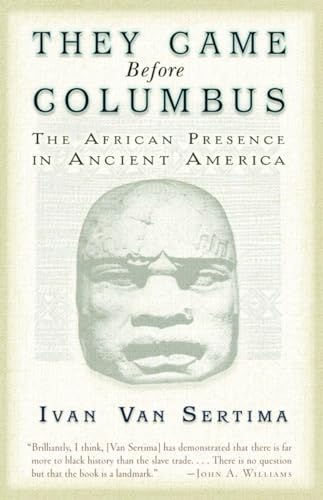
They Came Before Columbus: The African Presence in Ancient America (Journal of African Civilizations) - Softcover
Inhaltsangabe
“A landmark . . . brilliantly [demonstrates] has that there is far more to black history than the slave trade.”—John A. Williams
They Came Before Columbus reveals a compelling, dramatic, and superbly detailed documentation of the presence and legacy of Africans in ancient America. Examining navigation and shipbuilding; cultural analogies between Native Americans and Africans; the transportation of plants, animals, and textiles between the continents; and the diaries, journals, and oral accounts of the explorers themselves, Ivan Van Sertima builds a pyramid of evidence to support his claim of an African presence in the New World centuries before Columbus.
Combining impressive scholarship with a novelist’s gift for storytelling, Van Sertima re-creates some of the most powerful scenes of human history: the launching of the great ships of Mali in 1310 (two hundred master boats and two hundred supply boats), the sea expedition of the Mandingo king in 1311, and many others. In They Came Before Columbus, we see clearly the unmistakable face and handprint of black Africans in pre-Columbian America, and their overwhelming impact on the civilizations they encountered.
Die Inhaltsangabe kann sich auf eine andere Ausgabe dieses Titels beziehen.
Über die Autorin bzw. den Autor
Ivan Van Sertima’s pioneering work in linguistics and anthropology has appeared in numerous scholarly journals. Professor Van Sertima teaches Afro-American studies at Rutgers University.
Von der hinteren Coverseite
"They Came Before Columbus reveals a compelling, dramatic, and superbly detailed documentation of the presence and legacy of Africans in ancient America. Examining navigation and shipbuilding; cultural analogies between Native Americans and Africans; the transportation of plants, animals, and textiles between the continents; and the diaries, journals, and oral accounts of the explorers themselves, Ivan Van Sertima builds a pyramid of evidence to support his claim of an African presence in the New World centuries before Columbus. Combining impressive scholarship with a novelist's gift for storytelling, Van Sertima re-creates some of the most powerful scenes of human history: the launching of the great ships of Mali in 1310 (two hundred master boats and two hundred supply boats), the sea expedition of the Mandingo king in 1311, and many others. In "They Came Before Columbus, we see clearly the unmistakable face and handprint of black Africans in pre-Columbian America, and their overwhelming impact on the civilizations they encountered.
Aus dem Klappentext
They Came Before Columbus reveals a compelling, dramatic, and superbly detailed documentation of the presence and legacy of Africans in ancient America. Examining navigation and shipbuilding; cultural analogies between Native Americans and Africans; the transportation of plants, animals, and textiles between the continents; and the diaries, journals, and oral accounts of the explorers themselves, Ivan Van Sertima builds a pyramid of evidence to support his claim of an African presence in the New World centuries before Columbus. Combining impressive scholarship with a novelists gift for storytelling, Van Sertima re-creates some of the most powerful scenes of human history: the launching of the great ships of Mali in 1310 (two hundred master boats and two hundred supply boats), the sea expedition of the Mandingo king in 1311, and many others. In They Came Before Columbus, we see clearly the unmistakable face and handprint of black Africans in pre-Columbian America, and their overwhelming impact on the civilizations they encountered.
Auszug. © Genehmigter Nachdruck. Alle Rechte vorbehalten.
Chapter 1
THE SECRET ROUTE FROM GUINEA
. . . and he [Columbus] wanted to find out what the Indians of Hispaniola had told him, that there had come to it from the south and southeast Negro people, who brought those spear points made of a metal which they call guanin, of which he had sent to the king and queen for assaying, and which was found to have thirty-two parts, eighteen of gold, six of silver, and eight of copper.
-Raccolta, parte i, vol. i
African guanines were alloys of gold containing copper for the sake of its odor, for it seems that the Negroes like to smell their wealth. The guanines brought home by Columbus were assayed in Spain and were found to contain the same ratio of alloy as those in African Guinea.
-frederick pohl, Amerigo Vespucci, Pilot Major
On Saturday evening, March 9, 1493, a week after Columbus had been driven by a storm into Lisbon, following his first voyage to the Indies, he sat down to dinner with the Portuguese king at his court in the valley of Paraiso. Don Juan seemed to be in an extremely good mood. He talked to Columbus as to a close friend, with great candor and sweetness, insisting that his guest not stand, bow or accord him any special deference, but sit beside him at table as an equal. The admiral was surprised, deeply warmed by this hospitality, but marveling, nonetheless, at the apparent absence of resentment or envy in the king. All through dinner he looked at Don Juan closely, wondering whether the mask would suddenly slip to reveal the malice Columbus believed was beneath. Had not Don Juan sent three armed caravels to track him down last September as he was setting out on his Atlantic journey? Had not the king given orders that on the islands of Madeira, Puerto Sancto and the Azores, and in the regions and harbors where there were Portuguese, Columbus should be taken? Only last Tuesday Bartholomew Diaz, patron to the king's ship, armed to the teeth, had confronted him, as he lay helpless in the port of Lisbon, his sails split in half by the storm. Diaz had ordered him to leave his ship and render an account to the factors of the king and had pulled back only because Columbus had responded with fighting words, saying he was the Most High Admiral to the Sovereigns of Castile and had to give an account to no one.
Perhaps, thought Columbus, he had overreacted to the event because of the fatigue and terror he had suffered in the storm. After he had formally presented his letters to Diaz, had not Alvaro Dama, the Portuguese captain, come to his caravel in great state, with kettledrums and trumpets and pipes? The king too had received him with the highest honors, as befitted a foreign prince. There was nothing, therefore, to be alarmed about. Diaz had issued a routine challenge to a foreign fleet lying at anchor in his country's port. And the talk of the three caravels last September (for he had never seen them) may have been just alarmist talk. Yet as he sat there, balancing these interpretations in his mind, Columbus felt uneasy and afraid.
He had brought with him some of the Indian hostages he had seized on the island of Guanahani (Watling Island). These strange guests fascinated the Portuguese court. Not since 62 b.c., when the king of the Suevians presented Quintus Metellus Celer, the Roman proconsul in Gaul, with a gift of "Indians" cast up on the shores of Germany by a storm, had men with skin the tint of red sand been seen in Europe.
If the faintest shadow of his true feelings passed across Don Juan's face during his talk at dinner, it was when he looked at these men. Captives though they were, they became inverted in the king's agitated mind into a triumphant troop, their vigorous young bodies branded already with the rival insignia of the Spanish crown. He saw them as King Ferdinand's little puppets, signaling with their hands and limbs for the lack and loss of words. Some of them had paint on their faces, as puppets do, and their hair was unreal, as is the hair of puppets, as coarse and black as a horse's tail drooping over the eyebrows. Some appeared to the king like dolls, oriental dolls with eyes of hard, black glass, void of all expression. Within the glass of those eyes he saw the lands he too had dreamed about, and about which mariners and traders in his African service had spoken. Had he taken the rumors from Guinea more seriously he would have been sitting there that evening, emperor of two continents. The thought of it tormented him. The deep resentments he felt against Columbus, which for diplomatic reasons he had suppressed, crystallized into a beam of mischievous energy directed at the men of the Indies.
After dinner that evening, while he was talking with Columbus, "he ordered a dish of beans brought and placed on a table near them, and by signs ordered an Indian from among those who were there, to designate the many islands of his country that Columbus said he had discovered. The Indian at once showed Española and Cuba and the Lucayos and others. The king noted it with morose consideration and in a moment, as though inadvertently, he undid with his hand what the Indian had constructed. In a few moments he ordered another Indian to do the same with the beans, and this Indian quickly and diligently showed with the beans what the other Indian had shown, adding more islands and lands, giving the reason in his language for all he had shown, though no one understood it. And then the king, recognizing clearly the greatness of the lands discovered and their riches, was unable to conceal his grief at the loss of such things and cried out loudly and impetuously, giving himself a blow with his fist in the breast: 'O you wretched fool! Why did you let an undertaking of such importance slip through your fingers?' "
The mask had fallen with spectacular suddenness. Columbus's fears were realized. Several members of the court surrounded the king. Some of them attributed his grief to the boldness of the admiral and begged leave to kill Columbus on the spot, destroy all the ships awaiting him in Lisbon, nine leagues from the court, so that news of the discovery would not go back to Castile. But Don Juan said that God would damn his soul to hell for it, and that they should not touch the man.
After this frenzied, whispered session with his advisers, Don Juan resumed his conversations with Columbus as if nothing had happened. His face was flushed, but his manner showed none of the agitation which had driven him to that extraordinary outburst. He made it clear, and with a certain grave candor and graciousness, that regardless of his grief and disappointment at not having been Columbus's patron, "he felt great pleasure, nevertheless, that the voyage had been made and had terminated favorably." The whole Christian world should rejoice at this, Don Juan said. His queen was staying in the monastery of San Antonio near the village of Villafranca on the right bank of the Tagus, less than a day's journey from the court. She too would like to see Columbus and accord him every honor before he left for Spain.
The truth was, having failed to intercept Columbus both on his outward journey and his return, and having no heart now to order his assassination, as some of his advisers had urged, Don Juan quickly reconciled himself to the implications of this breakthrough to the islands and lands west of the ocean-sea. These implications, he knew, could be serious for Portugal. They would call for a repartitioning of the Christian world, a redefinition of the spheres of power and influence assumed by the two great maritime powers.
Before there could be any more Spanish claims to islands and lands within the ocean-sea, he must negotiate the most advantageous terms for the partitioning. He must strive somehow to make Columbus his ally in this, for he would soon be as much a power to be...
„Über diesen Titel“ kann sich auf eine andere Ausgabe dieses Titels beziehen.
Suchergebnisse für They Came Before Columbus: The African Presence in...

Foto des Verkäufers
They Came Before Columbus: The African Presence in Ancient America (Journal of African Civilizations)
Verlag:
Random House Trade Paperbacks, 2003
ISBN 10: 0812968174
ISBN 13: 9780812968170
Gebraucht
Softcover
Anbieter: Goodwill Southern California, Los Angeles, CA, USA
Verkäuferbewertung 5 von 5 Sternen

Zustand: good. Paperback Book. Bestandsnummer des Verkäufers 4CJWRU000LY5
Gebraucht kaufen
EUR 6,43
EUR 2,68 Versand
Versand innerhalb von USA
Versand innerhalb von USA
Anzahl: 1 verfügbar
Beispielbild für diese ISBN
They Came Before Columbus: The African Presence in Ancient America (Journal of African Civilizations)
Verlag:
Random House Trade Paperbacks, 2003
ISBN 10: 0812968174
ISBN 13: 9780812968170
Gebraucht
Paperback
Anbieter: HPB-Diamond, Dallas, TX, USA
Verkäuferbewertung 5 von 5 Sternen
Paperback. Zustand: Very Good. Connecting readers with great books since 1972! Used books may not include companion materials, and may have some shelf wear or limited writing. We ship orders daily and Customer Service is our top priority! Bestandsnummer des Verkäufers S_486960618
Gebraucht kaufen
EUR 9,18
EUR 3,34 Versand
Versand innerhalb von USA
Versand innerhalb von USA
Anzahl: 1 verfügbar
Beispielbild für diese ISBN
They Came Before Columbus : The African Presence in Ancient America
Verlag:
Random House Publishing Group, 2003
ISBN 10: 0812968174
ISBN 13: 9780812968170
Gebraucht
Softcover
Anbieter: Better World Books, Mishawaka, IN, USA
Verkäuferbewertung 5 von 5 Sternen
Zustand: Good. Pages intact with minimal writing/highlighting. The binding may be loose and creased. Dust jackets/supplements are not included. Stock photo provided. Product includes identifying sticker. Better World Books: Buy Books. Do Good. Bestandsnummer des Verkäufers 4298238-6
Gebraucht kaufen
EUR 13,32
Versand gratis
Versand innerhalb von USA
Versand innerhalb von USA
Anzahl: 1 verfügbar
Beispielbild für diese ISBN
They Came Before Columbus : The African Presence in Ancient America
Verlag:
Random House Publishing Group, 2003
ISBN 10: 0812968174
ISBN 13: 9780812968170
Gebraucht
Softcover
Anbieter: Better World Books, Mishawaka, IN, USA
Verkäuferbewertung 5 von 5 Sternen
Zustand: Good. Former library copy. Pages intact with minimal writing/highlighting. The binding may be loose and creased. Dust jackets/supplements are not included. Includes library markings. Stock photo provided. Product includes identifying sticker. Better World Books: Buy Books. Do Good. Bestandsnummer des Verkäufers 4954722-6
Gebraucht kaufen
EUR 13,32
Versand gratis
Versand innerhalb von USA
Versand innerhalb von USA
Anzahl: 1 verfügbar
Foto des Verkäufers
They Came Before Columbus : The African Presence in Ancient America
Verlag:
Random House Trade Paperbacks, 2003
ISBN 10: 0812968174
ISBN 13: 9780812968170
Neu
Softcover
Anbieter: GreatBookPrices, Columbia, MD, USA
Verkäuferbewertung 5 von 5 Sternen
Zustand: New. Bestandsnummer des Verkäufers 1157603-n
Neu kaufen
EUR 15,39
EUR 2,35 Versand
Versand innerhalb von USA
Versand innerhalb von USA
Anzahl: Mehr als 20 verfügbar
Foto des Verkäufers
They Came Before Columbus
Anbieter: Rarewaves USA, HEBRON, KY, USA
Verkäuferbewertung 5 von 5 Sternen
Paperback. Zustand: New. Bestandsnummer des Verkäufers LU-9780812968170
Neu kaufen
EUR 17,83
Versand gratis
Versand innerhalb von USA
Versand innerhalb von USA
Anzahl: Mehr als 20 verfügbar
Beispielbild für diese ISBN
They Came Before Columbus: The African Presence in Ancient America (Journal of African Civilizations)
Verlag:
Random House Trade Paperbacks, 2003
ISBN 10: 0812968174
ISBN 13: 9780812968170
Neu
Softcover
Anbieter: Lakeside Books, Benton Harbor, MI, USA
Verkäuferbewertung 5 von 5 Sternen
Zustand: New. Brand New! Not Overstocks or Low Quality Book Club Editions! Direct From the Publisher! We're not a giant, faceless warehouse organization! We're a small town bookstore that loves books and loves it's customers! Buy from Lakeside Books! Bestandsnummer des Verkäufers OTF-S-9780812968170
Neu kaufen
EUR 14,28
EUR 3,56 Versand
Versand innerhalb von USA
Versand innerhalb von USA
Anzahl: Mehr als 20 verfügbar
Foto des Verkäufers
They Came Before Columbus : The African Presence in Ancient America
Verlag:
Random House Trade Paperbacks, 2003
ISBN 10: 0812968174
ISBN 13: 9780812968170
Gebraucht
Softcover
Anbieter: GreatBookPrices, Columbia, MD, USA
Verkäuferbewertung 5 von 5 Sternen
Zustand: As New. Unread book in perfect condition. Bestandsnummer des Verkäufers 1157603
Gebraucht kaufen
EUR 16,02
EUR 2,35 Versand
Versand innerhalb von USA
Versand innerhalb von USA
Anzahl: Mehr als 20 verfügbar
Beispielbild für diese ISBN
They Came Before Columbus Format: Paperback
Anbieter: INDOO, Avenel, NJ, USA
Verkäuferbewertung 5 von 5 Sternen
Zustand: As New. Unread copy in mint condition. Bestandsnummer des Verkäufers RH9780812968170
Gebraucht kaufen
EUR 18,45
Versand gratis
Versand innerhalb von USA
Versand innerhalb von USA
Anzahl: Mehr als 20 verfügbar
Beispielbild für diese ISBN
They Came Before Columbus Format: Paperback
Anbieter: INDOO, Avenel, NJ, USA
Verkäuferbewertung 5 von 5 Sternen
Zustand: New. Brand New. Bestandsnummer des Verkäufers 9780812968170
Neu kaufen
EUR 18,55
Versand gratis
Versand innerhalb von USA
Versand innerhalb von USA
Anzahl: Mehr als 20 verfügbar