
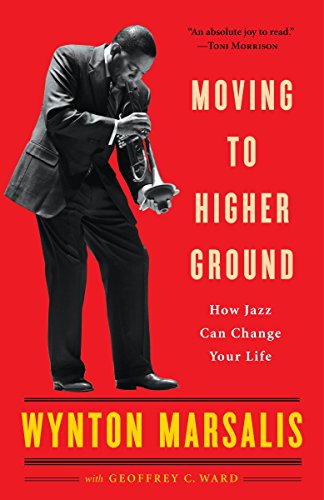
Inhaltsangabe
In this beautiful book, Pulitzer Prize—winning musician and composer Wynton Marsalis draws upon lessons he’s learned from a lifetime in jazz–lessons that can help us all move to higher ground. With wit and candor he demystifies the music that is the birthright of every American and demonstrates how a real understanding of the central idea of jazz–the unique balance between self-expression and sacrifice for the common good exemplified on the bandstand–can enrich every aspect of our lives, from the bedroom to the boardroom, from the schoolroom to City Hall. Along the way, Marsalis helps us understand the life-changing message of the blues, reveals secrets about playing–and listening–and passes on wisdom he has gleaned from working with three generations of great musicians. Illuminating and inspiring, Moving to Higher Ground is a master class on jazz and life, conducted by a brilliant American artist.
Die Inhaltsangabe kann sich auf eine andere Ausgabe dieses Titels beziehen.
Über die Autorin bzw. den Autor
Wynton Marsalis, the artistic director of Jazz at Lincoln Center, musician, educator, and composer, was born in New Orleans, Louisiana, and received his first trumpet from renowned musician Al Hirt at the age of six. Marsalis has won nine Grammy Awards, in both jazz and classical categories, and is the only artist to have won Grammy Awards in five consecutive years, from 1983 to 1987. In 1997, Marsalis’s oratorio on slavery and freedom, Blood on the Fields, became the first and, to date, only jazz composition to win the Pulitzer Prize in music.
Geoffrey C. Ward, a historian, screenwriter, and former editor of American Heritage, is the bestselling author of many books, including The War: An Intimate History, 1941-1945, Jazz: A History of America’s Music, and A First-Class Temperament: The Emergence of Franklin Roosevelt, which won a National Critics Circle Award.
Auszug. © Genehmigter Nachdruck. Alle Rechte vorbehalten.
CHAPTER ONE
Discovering the Joy of Swinging
Kids were supposed to stay in the back room. But some kind of way I stumbled into the front room of this tiny wood-frame house in Little Farms, Louisiana. I must have been four or five years old at the time, but I remember it was dark in there, lit only by a soft blue light or a red one, and a lot of grown-ups, men and women, were snapping their fingers on two and four and grooving to a rhythm and blues song. Some sang the words, but they were all dancing up a healthy sweat. I didn’t know what was going on back then, but I could tell it was something good—so good I wasn’t supposed to be around it.
Well, I could be around the music, couldn’t miss it, actually. R&B was always on the radio: “Baby this” and “Baby that”; “I need you, girl”; “Why’d you leave me? Come back. Ohhh!” That music was a way of life. Everybody knew those songs and everybody loved them: “I Heard It Through the Grapevine”; “Stop! In the Name of Love”; “Lean on Me”; “Papa’s Got a Brand New Bag.”
Now, jazz was different. That’s what my father played: modern jazz. No one danced to it, ever. That had something to do with rhythm. The backbeat of R&B was steady and unchanging. The rhythms my daddy and his friends played were ever changing and many, a torrent of ideas that came together and felt good. I later came to know it as swing.
The first jazz gigs I remember going to with my older brother Branford were like recitals. Only a handful of older people turned up. Some gave us candy, and there was always a good opportunity for us to run around. I noticed that very few black people seemed to like this kind of music. As a matter of fact, so few people understood it, I wondered why my father and his friends bothered to play it at all.
Then, when I was about eight or nine, I began to notice something very strange. Even though most of the people in our community would never attend a jazz concert (or anything artistic for that matter), even though they didn’t even consider playing music to be a profession, they had a type of respect for my father. I figured it had to have something to do with jazz, because he certainly was not in possession of any material goods indicative of even the slightest financial success.
I began to pay closer attention to all the jazzmen who came to our house or played with my father in clubs around New Orleans. They were an interesting group, if you could get past how different they seemed to be. First, they had their own language, calling each other “cats,” calling jobs “gigs” and instruments “axes,” peppering their conversations with all types of colorful, pungent words and unapologetic truisms.
Even if you were a child, they spoke directly to you and might actually listen to what you had to say.
Of course, they talked about men and women, politics and race and sports. But above all, they loved to talk about jazz music, its present and its past at once, like it was all now: “ ’Trane and them was playin’ so much music I couldn’t move. And people had been telling me all week they weren’t playing nothin’. Man, the music stood me up at the door.”
They could go on and on about what different musicians played or did or said, great men who all seemed to have colorful names: “Frog,” “Rabbit,” “Sweets.” It seemed to me that all of these people knew one another or at least had some type of connection. For all of that hard, profane talk, there was an unusual type of gentleness in the way they treated one another. Always a hug upon greeting and—from even the most venerated musicians—sometimes a kiss on the cheek. A natural ease with those teetering on the edge of sanity. A way of admonishing but not alienating those who might have drug problems. Always the feeling that things in our country, in our culture, in our souls, in the world, would get better. And beyond that, the feeling that this mysterious music would someday help people see how things fit together: segregation and integration, men and women, the political process, even the stock market.
That’s why these were still confident, optimistic men. Even though they were broke and misunderstood, sometimes difficult of personality, sometimes impaired by a too intense encounter with mind-altering substances and trapped in a culture that was rapidly moving away from professional levels of musicianship, romantic expression, and the arts in general, they still believed in the value of this jazz they played and still understood that their job was inventing music—and making sense of it with one another.
They improvised.
Now, the ability to improvise—to make up things that could get you out of a tight spot—well, everyone needed to know how to do that, even if it was just coming up with the right words at the right time. I thought there must be something to this improvised music. I needed to learn more about it. And hanging around jazz musicians was a great education for a nine- or ten-year-old because they told great stories and they knew how to listen. That was their way, talking and listening, listening and talking.
My father could talk for hours, still can. But he would also listen intently and never respond in that patronizing way that drives kids crazy. I have all kinds of memories of telling him partially-fabricated stories of what I had done in a football or basketball game and him just standing there listening intently to every detail and cosigning, “Uh-huh. Yep.” When he and other jazzmen listened to records or the radio, they could hear all kinds of things I didn’t come close to noticing. I couldn’t understand how three notes from a tenor saxophone was all they needed to conclude, “That’s Gene Ammons.” “Yeah, that’s ‘Jug,’ ” or “Monk, I hear you, Thelonious!” That seemingly magical ability to hear made me figure that perhaps my father knew when I was embellishing stuff.
He and his friends seemed to be able to follow every moment of what the person played. Now, you have to remember, the rest of us were listening to three-minute records of tunes with words, words that were as easy to memorize as the thirty seconds of repeated musical accompaniment. But these guys were listening to things like Sonny Rollins’s “Alfie’s Theme,” seven or eight minutes of somebody playing all kind of saxophone up and down the horn, following it as if it were spoken by the oracle at Delphi, saying, “Tell your story,” and so on. There would be certain points in the music where the “um-hmms” became “ohhh” or “oowee!”—the type of ecstatic eruptions that overcame some people in church. They would respond to Sonny as if he were right there in the room, and during all that seven or eight minutes not one word on the recording, spoken or sung! And I’d be sitting there listening to them speaking in what was almost a foreign language, trying to understand, wanting to learn it.
At twelve, I began listening to John Coltrane, Clifford Brown, Miles Davis, and Freddie Hubbard. Just by paying serious attention to these musicians every day, I came to realize that each musician opens a chamber into the very center of their being and expresses that center in the uniqueness of their sound. The sound of a master musician is as personalized and distinct as the sound of a person’s voice. has. After that basic realization, I focused on what they were communicating through...
„Über diesen Titel“ kann sich auf eine andere Ausgabe dieses Titels beziehen.
Weitere beliebte Ausgaben desselben Titels

Suchergebnisse für Moving to Higher Ground: How Jazz Can Change Your Life

Foto des Verkäufers
Moving to Higher Ground: How Jazz Can Change Your Life
Verlag:
Random House Publishing Group, 2009
ISBN 10: 0812969081
ISBN 13: 9780812969085
Gebraucht
Softcover
Anbieter: Dream Books Co., Denver, CO, USA
Verkäuferbewertung 5 von 5 Sternen

Zustand: very_good. Pages are clean with no markings. May show minor signs of wear or cosmetic defects marks, cuts, bends, or scuffs on the cover, spine, pages, or dust jacket. May have remainder marks on edges. Bestandsnummer des Verkäufers DBV.0812969081.VG
Gebraucht kaufen
EUR 3,76
Versand gratis
Versand innerhalb von USA
Versand innerhalb von USA
Anzahl: 1 verfügbar
Beispielbild für diese ISBN
Moving to Higher Ground: How J
Verlag:
Random House Publishing Group, 2009
ISBN 10: 0812969081
ISBN 13: 9780812969085
Gebraucht
Softcover
Anbieter: World of Books (was SecondSale), Montgomery, IL, USA
Verkäuferbewertung 5 von 5 Sternen
Zustand: Good. Item in good condition. Textbooks may not include supplemental items i.e. CDs, access codes etc. Bestandsnummer des Verkäufers 00098065407
Gebraucht kaufen
EUR 3,82
Versand gratis
Versand innerhalb von USA
Versand innerhalb von USA
Anzahl: 3 verfügbar
Beispielbild für diese ISBN
Moving to Higher Ground: How J
Verlag:
Random House Publishing Group, 2009
ISBN 10: 0812969081
ISBN 13: 9780812969085
Gebraucht
Softcover
Anbieter: World of Books (was SecondSale), Montgomery, IL, USA
Verkäuferbewertung 5 von 5 Sternen
Zustand: Very Good. Item in very good condition! Textbooks may not include supplemental items i.e. CDs, access codes etc. Bestandsnummer des Verkäufers 00102888604
Gebraucht kaufen
EUR 3,82
Versand gratis
Versand innerhalb von USA
Versand innerhalb von USA
Anzahl: 1 verfügbar
Beispielbild für diese ISBN
Moving to Higher Ground: How J
Verlag:
Random House Publishing Group, 2009
ISBN 10: 0812969081
ISBN 13: 9780812969085
Gebraucht
Softcover
Anbieter: World of Books (was SecondSale), Montgomery, IL, USA
Verkäuferbewertung 5 von 5 Sternen
Zustand: Acceptable. Item in good condition. Textbooks may not include supplemental items i.e. CDs, access codes etc. Bestandsnummer des Verkäufers 00061451332
Gebraucht kaufen
EUR 3,82
Versand gratis
Versand innerhalb von USA
Versand innerhalb von USA
Anzahl: 1 verfügbar
Foto des Verkäufers
Moving to Higher Ground: How Jazz Can Change Your Life
Verlag:
Random House Publishing Group, 2009
ISBN 10: 0812969081
ISBN 13: 9780812969085
Gebraucht
Softcover
Anbieter: Zoom Books East, Glendale Heights, IL, USA
Verkäuferbewertung 5 von 5 Sternen
Zustand: good. Book is in good condition and may include underlining highlighting and minimal wear. The book can also include "From the library of" labels. May not contain miscellaneous items toys, dvds, etc. . We offer 100% money back guarantee and 24 7 customer service. Bestandsnummer des Verkäufers ZEV.0812969081.G
Gebraucht kaufen
EUR 4,39
Versand gratis
Versand innerhalb von USA
Versand innerhalb von USA
Anzahl: 1 verfügbar
Foto des Verkäufers
Moving to Higher Ground: How Jazz Can Change Your Life
Verlag:
Random House Publishing Group, 2009
ISBN 10: 0812969081
ISBN 13: 9780812969085
Gebraucht
Softcover
Anbieter: Greenworld Books, Arlington, TX, USA
Verkäuferbewertung 5 von 5 Sternen
Zustand: good. Fast Free Shipping â" Good condition. It may show normal signs of use, such as light writing, highlighting, or library markings, but all pages are intact and the book is fully readable. A solid, complete copy that's ready to enjoy. Bestandsnummer des Verkäufers GWV.0812969081.G
Gebraucht kaufen
EUR 5,08
Versand gratis
Versand innerhalb von USA
Versand innerhalb von USA
Anzahl: 1 verfügbar
Beispielbild für diese ISBN
Moving to Higher Ground: How Jazz Can Change Your Life
Anbieter: ThriftBooks-Atlanta, AUSTELL, GA, USA
Verkäuferbewertung 5 von 5 Sternen
Paperback. Zustand: Good. No Jacket. Pages can have notes/highlighting. Spine may show signs of wear. ~ ThriftBooks: Read More, Spend Less. Bestandsnummer des Verkäufers G0812969081I3N00
Gebraucht kaufen
EUR 5,75
Versand gratis
Versand innerhalb von USA
Versand innerhalb von USA
Anzahl: 1 verfügbar
Beispielbild für diese ISBN
Moving to Higher Ground: How Jazz Can Change Your Life
Anbieter: ThriftBooks-Dallas, Dallas, TX, USA
Verkäuferbewertung 5 von 5 Sternen
Paperback. Zustand: Very Good. No Jacket. May have limited writing in cover pages. Pages are unmarked. ~ ThriftBooks: Read More, Spend Less. Bestandsnummer des Verkäufers G0812969081I4N00
Gebraucht kaufen
EUR 5,75
Versand gratis
Versand innerhalb von USA
Versand innerhalb von USA
Anzahl: 2 verfügbar
Beispielbild für diese ISBN
Moving to Higher Ground: How Jazz Can Change Your Life
Anbieter: ThriftBooks-Phoenix, Phoenix, AZ, USA
Verkäuferbewertung 5 von 5 Sternen
Paperback. Zustand: Very Good. No Jacket. May have limited writing in cover pages. Pages are unmarked. ~ ThriftBooks: Read More, Spend Less. Bestandsnummer des Verkäufers G0812969081I4N00
Gebraucht kaufen
EUR 5,75
Versand gratis
Versand innerhalb von USA
Versand innerhalb von USA
Anzahl: 1 verfügbar
Beispielbild für diese ISBN
Moving to Higher Ground: How Jazz Can Change Your Life
Anbieter: ThriftBooks-Dallas, Dallas, TX, USA
Verkäuferbewertung 5 von 5 Sternen
Paperback. Zustand: Good. No Jacket. Pages can have notes/highlighting. Spine may show signs of wear. ~ ThriftBooks: Read More, Spend Less. Bestandsnummer des Verkäufers G0812969081I3N00
Gebraucht kaufen
EUR 5,75
Versand gratis
Versand innerhalb von USA
Versand innerhalb von USA
Anzahl: 1 verfügbar