
Verwandte Artikel zu The American Revolution: A History (Modern Library...
The American Revolution: A History (Modern Library Chronicles, Band 9) - Softcover
Buch 9 von 33: Modern Library Chronicles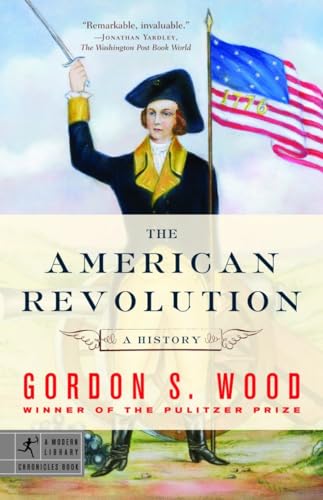
Inhaltsangabe
NEW YORK TIMES BESTSELLER
“An elegant synthesis done by the leading scholar in the field, which nicely integrates the work on the American Revolution over the last three decades but never loses contact with the older, classic questions that we have been arguing about for over two hundred years.”—Joseph J. Ellis, author of Founding Brothers
A magnificent account of the revolution in arms and consciousness that gave birth to the American republic.
When Abraham Lincoln sought to define the significance of the United States, he naturally looked back to the American Revolution. He knew that the Revolution not only had legally created the United States, but also had produced all of the great hopes and values of the American people. Our noblest ideals and aspirations-our commitments to freedom, constitutionalism, the well-being of ordinary people, and equality-came out of the Revolutionary era. Lincoln saw as well that the Revolution had convinced Americans that they were a special people with a special destiny to lead the world toward liberty. The Revolution, in short, gave birth to whatever sense of nationhood and national purpose Americans have had.
No doubt the story is a dramatic one: Thirteen insignificant colonies three thousand miles from the centers of Western civilization fought off British rule to become, in fewer than three decades, a huge, sprawling, rambunctious republic of nearly four million citizens. But the history of the American Revolution, like the history of the nation as a whole, ought not to be viewed simply as a story of right and wrong from which moral lessons are to be drawn. It is a complicated and at times ironic story that needs to be explained and understood, not blindly celebrated or condemned. How did this great revolution come about? What was its character? What were its consequences? These are the questions this short history seeks to answer. That it succeeds in such a profound and enthralling way is a tribute to Gordon Wood’s mastery of his subject, and of the historian’s craft.
Die Inhaltsangabe kann sich auf eine andere Ausgabe dieses Titels beziehen.
Über die Autorin bzw. den Autor
Gordon S. Wood received his B.A. from Tufts University and his Ph.D. from Harvard University. Since 1969 he has been at Brown University, where he is a professor of history. In 1970 his book The Creation of the American Republic 1776—1787 was nominated for the National Book Award and received the Bancroft and John H. Dunning prizes. In 1993 he won the Pulitzer Prize for The Radicalism of the American Revolution. He lives in Providence, Rhode Island.
Von der hinteren Coverseite
"An elegant synthesis done by the leading scholar in the field, which nicely integrates the work on the American Revolution over the last three decades but never loses contact with the older, classic questions that we have been arguing about for over two hundred years."
-Joseph J. Ellis, author of Founding Brothers
A magnificent account of the revolution in arms and consciousness that gave birth to the American republic.
When Abraham Lincoln sought to define the significance of the United States, he naturally looked back to the American Revolution. He knew that the Revolution not only had legally created the United States, but also had produced all of the great hopes and values of the American people. Our noblest ideals and aspirations-our commitments to freedom, constitutionalism, the well-being of ordinary people, and equality-came out of the Revolutionary era. Lincoln saw as well that the Revolution had convinced Americans that they were a special people with a special destiny to lead the world toward liberty. The Revolution, in short, gave birth to whatever sense of nationhood and national purpose Americans have had.
No doubt the story is a dramatic one: Thirteen insignificant colonies three thousand miles from the centers of Western civilization fought off British rule to become, in fewer than three decades, a huge, sprawling, rambunctious republic of nearly four million citizens. But the history of the American Revolution, like the history of the nation as a whole, ought not to be viewed simply as a story of right and wrong from which moral lessons are to be drawn. It is a complicated and at times ironic story that needs to be explained and understood, not blindlycelebrated or condemned. How did this great revolution come about? What was its character? What were its consequences? These are the questions this short history seeks to answer. That it succeeds in such a profound and enthralling way is a tribute to Gordon Wood's mastery of his subject, and of the historian's craft.
"From the Hardcover edition.
Auszug. © Genehmigter Nachdruck. Alle Rechte vorbehalten.
Chapter I
Origins
The origins of the Revolution necessarily lie deep in America’s past. A century and a half of dynamic developments in the British continental colonies of the New World had fundamentally transformed inherited European institutions and customary patterns of life and had left many colonists believing that they were seriously deviating from the cultivated norms of European life. In comparison with prosperous and powerful metropolitan England, America in the middle of the eighteenth century seemed a primitive, backward place, disordered and turbulent, without a real aristocracy, without magnificent courts or large urban centers, indeed, without any of the attributes of the civilized world. Consequently, the colonists repeatedly felt pressed to apologize for the crudity of their society, the insignificance of their art and literature, and the triviality of their affairs.
Suddenly in the 1760s Great Britain thrust its imperial power into this changing world with a thoroughness that had not been felt in a century and precipitated a crisis within the loosely organized empire. American resistance turned into rebellion; but as the colonists groped to make sense of the peculiarities of their society, this rebellion became a justification and idealization of American life as it had gradually and unintentionally developed over the previous century and a half. Instead of being in the backwaters of history, Americans suddenly saw themselves as a new society ideally equipped for a republican future. In this sense, as John Adams later said, “the Revolution was effected before the war commenced.” It was a change “in the minds and hearts of the people.”
But this change was not the whole American Revolution. The Revolution was not simply an intellectual endorsement of a previously existing social reality. It was also an integral part of the great transforming process that carried America into the liberal democratic society of the modern world. Although colonial America was already a different place from Europe in 1760, it still retained, along with powdered wigs and knee breeches, many traditional habits of monarchical behavior and dependent social relationships. The Revolution shattered what remained of these traditional patterns of life and prepared the way for the more fluid, bustling, individualistic world that followed.
The changes were remarkable, and they gave the American people as grand a vision of their future as any people have ever had. Americans saw their new nation not only leading a world revolution on behalf of republicanism and liberty but also becoming the place where the best of all the arts and sciences would flourish. What began as a colonial rebellion on the very edges of the civilized world was transformed into an earth-shaking event—an event that promised, as one clergyman declared, to create out of the “perishing World . . . a new World, a young world, a World of countless Millions, all in the fair Bloom of Piety.”
THE GROWTH AND MOVEMENT OF POPULATION
In 1763, Great Britain straddled the world with the greatest and richest empire since the fall of Rome. From India to the Mississippi River its armies and navies had been victorious. The Peace of Paris that concluded the Seven Years’ War— or the French and Indian War, as the Americans called it—gave Britain undisputed dominance over the eastern half of North America. From the defeated powers, France and Spain, Britain acquired huge chunks of territory in the New World—all of Canada, East and West Florida, and millions of fertile acres between the Appalachian Mountains and the Mississippi River. France turned over to Spain the territory of Louisiana in compensation for Spain’s loss of Florida; and thus this most fearsome of Britain’s enemies removed itself altogether from the North American continent.
Yet at the moment of Britain’s supremacy there were powerful forces at work that would soon, almost overnight, change everything. In the aftermath of the Seven Years’ War, British officials found themselves having to make long-postponed decisions concerning the colonies that would set in motion a chain of events that ultimately shattered the empire.
Ever since the formation of the British Empire in the late seventeenth century, royal officials and bureaucrats had been interested in reforming the ramshackle imperial structure and in expanding royal authority over the American colonists. But most of their schemes had been blocked by English ministries more concerned with the patronage of English politics than with colonial reform. Under such circumstances the empire had been allowed to grow haphazardly, without much control from London. People from different places in Europe had been allowed to settle in the colonies, and land had been given out freely.
Although few imperial officials had ever doubted that the colonies were supposed to be inferior to the mother country and dependent on it, in fact the empire had not worked that way. The relationship that had developed reflected the irrational and inefficient nature of the imperial system—the variety of offices, the diffusion of power, and the looseness of organization. Even in trade regulation, which was the empire’s main business, inefficiency, loopholes, and numerous opportunities for corruption prevented the imperial authorities from interfering substantively with the colonists’ pursuit of their own economic and social interests.
By the middle of the eighteenth century, however, new circumstances began forcing changes in this irrational but working relationship. The British colonies—there were twenty-two of them in the Western Hemisphere in 1760—were becoming too important to be treated as casually as the mother country had treated them in the first half of the eighteenth century. Dynamic developments throughout the greater British world demanded that England pay more attention to its North Ameri- can colonies.
The most basic of these developments were the growth and movement of population. In the middle decades of the eighteenth century, the number of people throughout the whole English-speaking world—in Britain and the colonies alike—was increasing at unprecedented rates. During the 1740s the population of England, which had hardly grown at all for half a century, suddenly began to increase. The populations of Ireland and Scotland had been rising steadily since the beginning of the eighteenth century. The population of the North American colonies was growing even faster— virtually exploding—and had been doing so almost since the beginning of the settlements. Indeed, the North American colonists continued to multiply more rapidly than any other people in the Western world. Between 1750 and 1770 they doubled in number, from 1 million to more than 2 million, and thereby became an even more important part of the British world. In 1700 the American population had been only one twentieth of the British and Irish populations combined; by 1770 it was nearly one fifth, and such farsighted colonists as Benjamin Franklin were predicting that sooner or later the center of the British Empire would shift to America.
Everywhere the expanding British population was in motion, moving from village to village and from continent to continent. In Britain growing numbers of migrants in a few decades created the new industrial cities of Birmingham, Manchester, and Leeds and made London the largest urban center in the Western world. A steady stream moved from the British Isles across the Atlantic to the New World. The migration of Protestant Irish and Scots that had begun early in the century increased after the Seven Years’ War of the 1750s. Between 1764 and 1776 some 125,000 people left the...
„Über diesen Titel“ kann sich auf eine andere Ausgabe dieses Titels beziehen.
Suchergebnisse für The American Revolution: A History (Modern Library...

Beispielbild für diese ISBN
The American Revolution A Hist
Anbieter: World of Books (was SecondSale), Montgomery, IL, USA
Verkäuferbewertung 5 von 5 Sternen

Zustand: Acceptable. Item in acceptable condition! Textbooks may not include supplemental items i.e. CDs, access codes etc. Bestandsnummer des Verkäufers 00106493134
Gebraucht kaufen
EUR 5,27
Versand gratis
Versand innerhalb von USA
Versand innerhalb von USA
Anzahl: 3 verfügbar
Beispielbild für diese ISBN
The American Revolution A Hist
Anbieter: World of Books (was SecondSale), Montgomery, IL, USA
Verkäuferbewertung 5 von 5 Sternen
Zustand: Good. Item in good condition. Textbooks may not include supplemental items i.e. CDs, access codes etc. Bestandsnummer des Verkäufers 00104989430
Gebraucht kaufen
EUR 5,27
Versand gratis
Versand innerhalb von USA
Versand innerhalb von USA
Anzahl: 16 verfügbar
Beispielbild für diese ISBN
The American Revolution: A History (Modern Library Chronicles)
Anbieter: More Than Words, Waltham, MA, USA
Verkäuferbewertung 5 von 5 Sternen
Zustand: Good. A sound copy with only light wear. Overall a solid copy at a great price! Bestandsnummer des Verkäufers BOS-I-14d-01430
Gebraucht kaufen
EUR 2,01
EUR 3,44 Versand
Versand innerhalb von USA
Versand innerhalb von USA
Anzahl: 13 verfügbar
Beispielbild für diese ISBN
The American Revolution: A History (Modern Library Chronicles)
Anbieter: Evergreen Goodwill, Seattle, WA, USA
Verkäuferbewertung 5 von 5 Sternen
paperback. Zustand: Acceptable. Pages include notes, underlining, or highlighting. Bestandsnummer des Verkäufers mon0000231747
Gebraucht kaufen
EUR 2,22
EUR 3,44 Versand
Versand innerhalb von USA
Versand innerhalb von USA
Anzahl: 1 verfügbar
Beispielbild für diese ISBN
The American Revolution: A History
Anbieter: ThriftBooks-Reno, Reno, NV, USA
Verkäuferbewertung 5 von 5 Sternen
Paperback. Zustand: Fair. No Jacket. Readable copy. Pages may have considerable notes/highlighting. ~ ThriftBooks: Read More, Spend Less. Bestandsnummer des Verkäufers G0812970411I5N00
Gebraucht kaufen
EUR 5,76
Versand gratis
Versand innerhalb von USA
Versand innerhalb von USA
Anzahl: 1 verfügbar
Beispielbild für diese ISBN
The American Revolution: A History
Anbieter: ThriftBooks-Atlanta, AUSTELL, GA, USA
Verkäuferbewertung 5 von 5 Sternen
Paperback. Zustand: Fair. No Jacket. Readable copy. Pages may have considerable notes/highlighting. ~ ThriftBooks: Read More, Spend Less. Bestandsnummer des Verkäufers G0812970411I5N00
Gebraucht kaufen
EUR 5,95
Versand gratis
Versand innerhalb von USA
Versand innerhalb von USA
Anzahl: 1 verfügbar
Beispielbild für diese ISBN
The American Revolution: A History
Anbieter: ThriftBooks-Dallas, Dallas, TX, USA
Verkäuferbewertung 5 von 5 Sternen
Paperback. Zustand: Fair. No Jacket. Readable copy. Pages may have considerable notes/highlighting. ~ ThriftBooks: Read More, Spend Less. Bestandsnummer des Verkäufers G0812970411I5N00
Gebraucht kaufen
EUR 5,95
Versand gratis
Versand innerhalb von USA
Versand innerhalb von USA
Anzahl: 1 verfügbar
Foto des Verkäufers
The American Revolution: A History (Modern Library Chronicles)
Anbieter: Dream Books Co., Denver, CO, USA
Verkäuferbewertung 5 von 5 Sternen
Zustand: acceptable. This copy has clearly been enjoyedâ"expect noticeable shelf wear and some minor creases to the cover. Binding is strong, and all pages are legible. May contain previous library markings or stamps. Bestandsnummer des Verkäufers DBV.0812970411.A
Gebraucht kaufen
EUR 6,49
Versand gratis
Versand innerhalb von USA
Versand innerhalb von USA
Anzahl: 1 verfügbar
Beispielbild für diese ISBN
The American Revolution: A History (Modern Library Chronicles)
Anbieter: HPB-Diamond, Dallas, TX, USA
Verkäuferbewertung 5 von 5 Sternen
Paperback. Zustand: Very Good. Connecting readers with great books since 1972! Used books may not include companion materials, and may have some shelf wear or limited writing. We ship orders daily and Customer Service is our top priority! Bestandsnummer des Verkäufers S_473148310
Gebraucht kaufen
EUR 3,55
EUR 3,23 Versand
Versand innerhalb von USA
Versand innerhalb von USA
Anzahl: 1 verfügbar
Beispielbild für diese ISBN
The American Revolution: A History (Modern Library Chronicles)
Anbieter: HPB Inc., Dallas, TX, USA
Verkäuferbewertung 5 von 5 Sternen
Paperback. Zustand: Very Good. Connecting readers with great books since 1972! Used books may not include companion materials, and may have some shelf wear or limited writing. We ship orders daily and Customer Service is our top priority! Bestandsnummer des Verkäufers S_389937277
Gebraucht kaufen
EUR 3,77
EUR 3,23 Versand
Versand innerhalb von USA
Versand innerhalb von USA
Anzahl: 1 verfügbar