
Verwandte Artikel zu Chasing the Sun: The Epic Story of the Star That Gives...
Inhaltsangabe
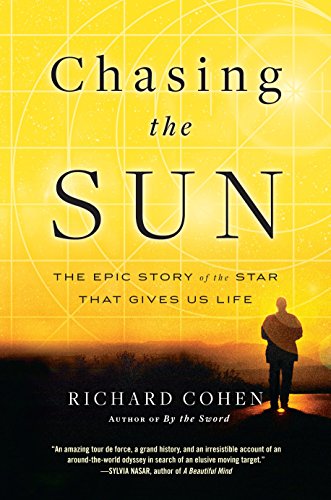
In the grand tradition of the scholar-adventurer, acclaimed author Richard Cohen takes us around the world to illuminate our relationship with the star that gives us life. Drawing on more than seven years of research, he reports from locations in eighteen different countries. As he soon discovers, the Sun is present everywhere—in mythology, language, religion, politics, sciences, art, literature, and medicine, even in the ocean’s depths. For some ancient worshippers, our star was a man abandoned by his spouse because his brightness made her weary. The early Christians appropriated the Sun’s imagery, with the cross becoming an emblem of the star and its rays, and the halo a variation of that. Einstein helped replicate the Sun’s power to create the atomic bomb, while Richard Wagner had Tristan inveigh against daylight as the enemy of romantic love. In this splendidly illustrated volume packed with captivating facts, extraordinary myths, and surprising anecdotes, Cohen not only explains the star that so inspires us, but shows how multifacted our relationship with it has been—and continues to be.
Die Inhaltsangabe kann sich auf eine andere Ausgabe dieses Titels beziehen.
Über die Autorin bzw. den Autor
Richard Cohen is the former publishing director of Hutchinson and Hodder & Stoughton and the founder of Richard Cohen Books. The acclaimed author of By the Sword: A History of Gladiators, Musketeers, Samurai, Swashbucklers, and Olympic Champions, he has written for The New York Times and most leading London newspapers, and has appeared on BBC radio and television. He lives in New York City.
Auszug. © Genehmigter Nachdruck. Alle Rechte vorbehalten.
chapter 1
Telling Stories
I look upon the sunrise and sunset, on the daily return of day and night, on the battle between light and darkness, on the whole solar drama in all its
details that is acted every day, every month, every year, in heaven and in earth, as the principal subject of early mythology.
-Max Müller,
the nineteenth-century
Oxford professor who
transformed the study
of solar mythology1
Man has weav'd out a net,
And this net throwne
Upon the heavens,
And now they are his owne.
-John Donne2
Donne's awed yet mocking lines were written in the early years of the Copernican revolution, but they could apply just as easily to man's attempt to make sense of the heavens-to make them "his owne"-by telling stories. Because all societies have myths about the Sun, their sheer variety is glorious-here it is a magician or trickster, there a ball of fire some figure must carry, another time a canoe, a mirror, or an amazing menagerie of beasts. In Peru and northern Chile, many tribes knew the Sun as the god Inti, who descended into the ocean every evening, swam back to the east, then reappeared, refreshed by his bath.3 As soon as the horse became domesticated (early in the second millennium b.c.) the Sun was portrayed as guiding a chariot drawn by four flaming steeds. In ancient India, these were termed arushá, Sanskrit for "Sun-bright" (the Greek word "eros" shares that meaning, having evolved from the same root as "sun horse"). Birds are often invoked-a falcon, or an eagle, and of course the phoenix, which dies and is reborn from its own ashes. In Africa and India, the tiger and lion are solar animals, sunrise being represented by a young lion, noon by one in its prime, sunset by one in old age. Where lions are absent, local communities adapt: in the pre-Conquest Americas, the eagle and jaguar are the chosen beasts.
Several cultures described the Sun in more than one way: to the Egyptians, the solar gods numbered not only Ra but Khepri, "the Self- Transforming One," and Harakhty, "the Far One." The Aztecs employed Huitzilopochtli (from huitzilin, a hummingbird) to mean both the rising Sun and the star at its zenith, and Tezcatlipoca, "Smoking (or Shining) Mirror," for twilight or evening. The Sun is continually reborn; so that in all they had a jaguar sun, a wind sun, a rain sun, a rain-of-fire sun, and the god Nanahuatzin ("Full of Sores") who became a fifth solar force, that of the earthquake. Yet whatever form the Sun takes-an eye, a wing, a boat, a dragon, a fish, a bird-there is a common core, a similarity to these tales that spring up in cultures often hemispheres, and millennia, apart.
Sometimes the Sun is seen as so overwhelming a threat that it must in some way be tamed. In ancient Chinese mythology, for instance, the goddess Xihi gives birth to ten suns, which rise simultaneously into the heavens, burning the harvests and all plant life-bar one huge mulberry bush, the fusang, on which the suns perch. Every morning the goddess bathes one of them, letting it fly up to her on the back of a crow. One day all the suns escape, and life on Earth becomes unbearable. A variety of monsters scour the land: the ogre Zuochi, with long teeth; Quiying, who kills with water and fire; a giant bird that unleashes the wind, Dafeng; the giant boar Fengxi; and the great serpent Xisushe. The wretched people below endlessly beg the suns to come down, but they refuse. Total destruction impends, until Houyi, a young archer, slays the ogre, the monster, and the giant bird, cuts the serpent in two, captures the boar and-his crowning act-shoots down nine of the suns. Ever since, the story concludes, there has been only the one last sun.
Aesop's fable "The Sun Gets Married" has a different plot but the same threat. One hot summer, word comes that the Sun is to marry. All the birds and beasts rejoice, especially the frogs, until a wise old toad calls for order. "My friends," he tells them, "you should temper your enthusiasm. For if the Sun alone dries up the marshes so that we can hardly bear it, what will become of us if he should have half a dozen little suns in addition?" Two stories, both teaching that one can have too much of a good thing.
Almost all ancient civilizations believed the universe to have existed for unknown ages without benefit of any human intervention. The same did not hold true for the Sun, which in a host of mythologies exists only by virtue of man's nurture. The Hopi of northeast Arizona, for instance, claimed they made the Sun by throwing up a buckskin shield along with a fox's coat and a parrot's tail (to make the colors of sunrise and sunset). But whatever form or character it took, the Sun was rarely cast as fully invulnerable (an old German custom forbade pointing at the star lest one do it harm), and it has been variously depicted as having been freed from a cave, or stolen, or having sprung into life through the self-sacrifice of a god or hero. Among the Inuit of the Bering Strait, all creation is attributed to a Raven Father, who is so annoyed at man's rapacity that he hides the Sun in a bag. The terrified people offer him gifts until he relents, but only to a degree, holding the Sun up in the sky for a time before removing it again.
Every early society personified the cycles of nature, but where the Sun is concerned, cultures have differed on its gender. In the Romance languages the star is male, but in the Germanic and Celtic it is feminine and the Moon masculine: in upper Bavaria the Sun is still spoken of as "Frau Sonne" and the Moon as "Herr Mond." For the Rwala Bedouin of Arabia, the Sun is a mean and destructive old hag who forces the handsome Moon to sleep with her once a month and so exhausts him that he needs another month to recover.4 Other groups, such as the Eskimo, Cherokee, and Yuchi, also regard the Sun as female, while in Polish the Sun is neuter, the Moon male. These variations may have arisen from climatic differences: in some areas the day is mild and welcoming, hence the Sun tends to be termed feminine, whereas the Moon, ruling the chill, stern nighttime, is male. In equatorial regions, where daytime is searingly forbidding and the night mild and pleasant, the genders reverse. There are exceptions: on the Malay Peninsula, Sun and Moon are both regarded as female and the stars as the Moon's children.5
Most creation accounts cast the Sun as paramount, both over the Moon and over the heavens. The Book of Genesis declares: "God made the two great lights, the greater light to rule the day, and the lesser light to rule the night."6 The Egyptians referred to Sun and Moon as "the two lights," the right and left eye, respectively, of Ra-the left being described as weaker, because damaged. In Central and South America and among the Mundas of Bengal, Sun and Moon are man and wife. The Bengalis charmingly call the Sun "Sing-Bonga," believing him a gentle god who does not interfere in human affairs. Another myth of the same region fashions the star as a man with three eyes and four arms who is abandoned by his wife because his dazzle wearies her. She installs Chhaya (Darkness) in his place, but the Sun wins her back by reducing his effulgence to seven-eighths of its original brilliance (an interesting example of the spirit of compromise making companionship possible). Many stories are told about such marital troubles, it being a given that Sun and Moon can never live happily together.
It occurred to some of the more sophisticated ancient cultures to wonder why, if the Sun were indeed so powerful, he had to abide by strict laws rather than roam at will. Surely only a slave would perform so repetitively? Numerous legends were devised to explain this thralldom. The Sun was portrayed as erratic, sometimes hurrying too fast, at other times dawdling, coming too close to Earth...
„Über diesen Titel“ kann sich auf eine andere Ausgabe dieses Titels beziehen.
Suchergebnisse für Chasing the Sun: The Epic Story of the Star That Gives...

Beispielbild für diese ISBN
Chasing the Sun: The Epic Story of the Star That Gives Us Life
Verlag:
Random House Trade Paperbacks, 2011
ISBN 10: 0812980921
ISBN 13: 9780812980929
Gebraucht
Softcover
Anbieter: World of Books (was SecondSale), Montgomery, IL, USA
Verkäuferbewertung 5 von 5 Sternen

Zustand: Good. Item in good condition. Textbooks may not include supplemental items i.e. CDs, access codes etc. Bestandsnummer des Verkäufers 00094529951
Gebraucht kaufen
EUR 5,25
Versand gratis
Versand innerhalb von USA
Versand innerhalb von USA
Anzahl: 1 verfügbar
Beispielbild für diese ISBN
Chasing the Sun: The Epic Story of the Star That Gives Us Life
Verlag:
Random House Trade Paperbacks (edition ), 2011
ISBN 10: 0812980921
ISBN 13: 9780812980929
Gebraucht
Paperback
Anbieter: BooksRun, Philadelphia, PA, USA
Verkäuferbewertung 5 von 5 Sternen
Paperback. Zustand: Very Good. It's a well-cared-for item that has seen limited use. The item may show minor signs of wear. All the text is legible, with all pages included. It may have slight markings and/or highlighting. Bestandsnummer des Verkäufers 0812980921-11-1
Gebraucht kaufen
EUR 5,26
Versand gratis
Versand innerhalb von USA
Versand innerhalb von USA
Anzahl: 1 verfügbar
Beispielbild für diese ISBN
Chasing the Sun: The Epic Story of the Star That Gives Us Life
Verlag:
Random House Trade Paperbacks, 2011
ISBN 10: 0812980921
ISBN 13: 9780812980929
Gebraucht
paperback
Anbieter: HPB Inc., Dallas, TX, USA
Verkäuferbewertung 5 von 5 Sternen
paperback. Zustand: Very Good. Connecting readers with great books since 1972! Used books may not include companion materials, and may have some shelf wear or limited writing. We ship orders daily and Customer Service is our top priority! Bestandsnummer des Verkäufers S_459850209
Gebraucht kaufen
EUR 3,44
EUR 3,23 Versand
Versand innerhalb von USA
Versand innerhalb von USA
Anzahl: 1 verfügbar
Beispielbild für diese ISBN
Chasing the Sun: The Epic Story of the Star That Gives Us Life
Anbieter: ThriftBooks-Atlanta, AUSTELL, GA, USA
Verkäuferbewertung 5 von 5 Sternen
Paperback. Zustand: Good. No Jacket. Pages can have notes/highlighting. Spine may show signs of wear. ~ ThriftBooks: Read More, Spend Less. Bestandsnummer des Verkäufers G0812980921I3N00
Gebraucht kaufen
EUR 6,99
Versand gratis
Versand innerhalb von USA
Versand innerhalb von USA
Anzahl: 1 verfügbar
Beispielbild für diese ISBN
Chasing the Sun: The Epic Story of the Star That Gives Us Life
Anbieter: ThriftBooks-Dallas, Dallas, TX, USA
Verkäuferbewertung 5 von 5 Sternen
Paperback. Zustand: Good. No Jacket. Pages can have notes/highlighting. Spine may show signs of wear. ~ ThriftBooks: Read More, Spend Less. Bestandsnummer des Verkäufers G0812980921I3N00
Gebraucht kaufen
EUR 6,99
Versand gratis
Versand innerhalb von USA
Versand innerhalb von USA
Anzahl: 1 verfügbar
Beispielbild für diese ISBN
Chasing the Sun: The Epic Story of the Star That Gives Us Life
Anbieter: ThriftBooks-Atlanta, AUSTELL, GA, USA
Verkäuferbewertung 5 von 5 Sternen
Paperback. Zustand: Very Good. No Jacket. Former library book; May have limited writing in cover pages. Pages are unmarked. ~ ThriftBooks: Read More, Spend Less. Bestandsnummer des Verkäufers G0812980921I4N10
Gebraucht kaufen
EUR 6,99
Versand gratis
Versand innerhalb von USA
Versand innerhalb von USA
Anzahl: 1 verfügbar
Beispielbild für diese ISBN
Chasing the Sun: The Epic Story of the Star That Gives Us Life
Anbieter: World of Books Inc, Montgomery, IL, USA
Verkäuferbewertung 2 von 5 Sternen

Paperback. Zustand: Good. In the grand tradition of the scholar-adventurer, acclaimed author Richard Cohen takes us around the world to illuminate our relationship with the star that gives us life. Drawing on more than seven years of research, he reports from locations in eighteen different countries. As he soon discovers, the Sun is present everywhere--in mythology, language, religion, politics, sciences, art, literature, and medicine, even in the ocean's depths. For some ancient worshippers, our star was a man abandoned by his spouse because his brightness made her weary. The early Christians appropriated the Sun's imagery, with the cross becoming an emblem of the star and its rays, and the halo a variation of that. Einstein helped replicate the Sun's power to create the atomic bomb, while Richard Wagner had Tristan inveigh against daylight as the enemy of romantic love. In this splendidly illustrated volume packed with captivating facts, extraordinary myths, and surprising anecdotes, Cohen not only explains the star that so inspires us, but shows how multifacted our relationship with it has been--and continues to be. Bestandsnummer des Verkäufers CIN0812980921G
Gebraucht kaufen
EUR 7,03
Versand gratis
Versand innerhalb von USA
Versand innerhalb von USA
Anzahl: 1 verfügbar
Beispielbild für diese ISBN
Chasing the Sun: The Epic Story of the Star That Gives Us Life
Verlag:
Random House Trade Paperbacks, 2011
ISBN 10: 0812980921
ISBN 13: 9780812980929
Gebraucht
Softcover
Anbieter: St Vincent de Paul of Lane County, Eugene, OR, USA
Verkäuferbewertung 5 von 5 Sternen
Zustand: Acceptable. COVER SHOWS SOME GENERAL WEAR, SUCH AS SCRATCHES, RUBBING, CREASES AND DINGED EDGES EXTERIOR PAGE EDGES HAVE A FEW SMALL LIQUID STAINS. A FEW PAGE CORNERS ARE BENT/CREASED. paperback 100% of proceeds go to charity! Acceptable reading copy with obvious signs of use, wear, and/or cosmetic issues. Item is complete and remains readable despite notable condition issues. Bestandsnummer des Verkäufers N-03-5009
Gebraucht kaufen
EUR 3,99
EUR 3,44 Versand
Versand innerhalb von USA
Versand innerhalb von USA
Anzahl: 1 verfügbar
Beispielbild für diese ISBN
Chasing the Sun : The Epic Story of the Star That Gives Us Life
Verlag:
Random House Publishing Group, 2011
ISBN 10: 0812980921
ISBN 13: 9780812980929
Gebraucht
Softcover
Anbieter: Better World Books: West, Reno, NV, USA
Verkäuferbewertung 5 von 5 Sternen
Zustand: Good. Reprint. Former library copy. Pages intact with minimal writing/highlighting. The binding may be loose and creased. Dust jackets/supplements are not included. Includes library markings. Stock photo provided. Product includes identifying sticker. Better World Books: Buy Books. Do Good. Bestandsnummer des Verkäufers 8888113-75
Gebraucht kaufen
EUR 8,50
Versand gratis
Versand innerhalb von USA
Versand innerhalb von USA
Anzahl: 1 verfügbar
Beispielbild für diese ISBN
Chasing the Sun : The Epic Story of the Star That Gives Us Life
Verlag:
Random House Publishing Group, 2011
ISBN 10: 0812980921
ISBN 13: 9780812980929
Gebraucht
Softcover
Anbieter: Better World Books: West, Reno, NV, USA
Verkäuferbewertung 5 von 5 Sternen
Zustand: Very Good. Reprint. Former library copy. Pages intact with possible writing/highlighting. Binding strong with minor wear. Dust jackets/supplements may not be included. Includes library markings. Stock photo provided. Product includes identifying sticker. Better World Books: Buy Books. Do Good. Bestandsnummer des Verkäufers 16091251-6
Gebraucht kaufen
EUR 8,50
Versand gratis
Versand innerhalb von USA
Versand innerhalb von USA
Anzahl: 1 verfügbar