
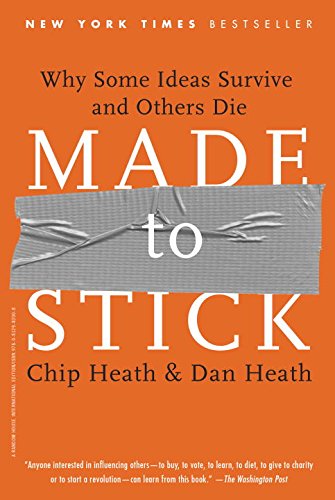
Inhaltsangabe
NEW YORK TIMES BESTSELLER • The instant classic about why some ideas thrive, why others die, and how to make your ideas stick.
“Anyone interested in influencing others—to buy, to vote, to learn, to diet, to give to charity or to start a revolution—can learn from this book.”—The Washington Post
Mark Twain once observed, “A lie can get halfway around the world before the truth can even get its boots on.” His observation rings true: Urban legends, conspiracy theories, and bogus news stories circulate effortlessly. Meanwhile, people with important ideas—entrepreneurs, teachers, politicians, and journalists—struggle to make them “stick.”
In Made to Stick, Chip and Dan Heath reveal the anatomy of ideas that stick and explain ways to make ideas stickier, such as applying the human scale principle, using the Velcro Theory of Memory, and creating curiosity gaps. Along the way, we discover that sticky messages of all kinds—from the infamous “kidney theft ring” hoax to a coach’s lessons on sportsmanship to a vision for a new product at Sony—draw their power from the same six traits.
Made to Stick will transform the way you communicate. It’s a fast-paced tour of success stories (and failures): the Nobel Prize-winning scientist who drank a glass of bacteria to prove a point about stomach ulcers; the charities who make use of the Mother Teresa Effect; the elementary-school teacher whose simulation actually prevented racial prejudice.
Provocative, eye-opening, and often surprisingly funny, Made to Stick shows us the vital principles of winning ideas—and tells us how we can apply these rules to making our own messages stick.
Die Inhaltsangabe kann sich auf eine andere Ausgabe dieses Titels beziehen.
Über die Autorin bzw. den Autor
Chip Heath is a professor at Stanford Graduate School of Business, teaching courses on strategy and organizations. He has helped over 450 startups hone their business strategy and messages. He lives in Los Gatos, California.
Dan Heath is a senior fellow at Duke University’s CASE center, which supports entrepreneurs fighting for social good. He lives in Durham, North Carolina.
Together, Chip and Dan have written three New York Times bestselling books: Made to Stick, Switch, and Decisive. Their books have sold over two million copies worldwide and have been translated into thirty-three languages, including Thai, Arabic, and Lithuanian. Their most recent book is The Power of Moments.
Auszug. © Genehmigter Nachdruck. Alle Rechte vorbehalten.
I I N T R O D U C T I O N
WHAT STICKS?
A friend of a friend of ours is a frequent business traveler. Let’s call him Dave. Dave was recently in Atlantic City for an important meeting with clients. Afterward, he had some time to kill before his flight, so he went to a local bar for a drink.
He’d just finished one drink when an attractive woman approached and asked if she could buy him another. He was surprised but flattered. Sure, he said. The woman walked to the bar and brought back two more drinks—one for her and one for him. He thanked her and took a sip. And that was the last thing he remembered.
Rather, that was the last thing he remembered until he woke up, disoriented, lying in a hotel bathtub, his body submerged in ice.
He looked around frantically, trying to figure out where he was and how he got there. Then he spotted the note: don’t move. call 911.
A cell phone rested on a small table beside the bathtub. He picked it up and called 911, his fingers numb and clumsy from the ice. The operator seemed oddly familiar with his situation. She said, “Sir, I want you to reach behind you, slowly and carefully. Is there a tube protruding from your lower back?”
Anxious, he felt around behind him. Sure enough, there was a tube.
The operator said, “Sir, don’t panic, but one of your kidneys has been harvested. There’s a ring of organ thieves operating in this city, and they got to you. Paramedics are on their way. Don’t move until they arrive.”
You’ve just read one of the most successful urban legends of the past fifteen years. The first clue is the classic urban-legend opening: “A friend of a friend . . .” Have you ever noticed that our friends’ friends have much more interesting lives than our friends themselves?
You’ve probably heard the Kidney Heist tale before. There are hundreds of versions in circulation, and all of them share a core of three elements: (1) the drugged drink, (2) the ice-filled bathtub, and (3) the kidney-theft punch line. One version features a married man who receives the drugged drink from a prostitute he has invited to his room in Las Vegas. It’s a morality play with kidneys.
Imagine that you closed the book right now, took an hourlong break, then called a friend and told the story, without rereading it. Chances are you could tell it almost perfectly. You might forget that the traveler was in Atlantic City for “an important meeting with clients”—who cares about that? But you’d remember all the important stuff.
The Kidney Heist is a story that sticks. We understand it, we remember it, and we can retell it later. And if we believe it’s true, it might change our behavior permanently—at least in terms of accepting drinks from attractive strangers.
Contrast the Kidney Heist story with this passage, drawn from a paper distributed by a nonprofit organization. “Comprehensive community building naturally lends itself to a return-on-investment rationale that can be modeled, drawing on existing practice,” it begins, going on to argue that “[a] factor constraining the flow of resources to CCIs is that funders must often resort to targeting or categorical requirements in grant making to ensure accountability.”
Imagine that you closed the book right now and took an hourlong break. In fact, don’t even take a break; just call up a friend and retell that passage without rereading it. Good luck.
Is this a fair comparison—an urban legend to a cherry-picked bad passage? Of course not. But here’s where things get interesting: Think of our two examples as two poles on a spectrum of memorability. Which sounds closer to the communications you encounter at work? If you’re like most people, your workplace gravitates toward the nonprofit pole as though it were the North Star.
Maybe this is perfectly natural; some ideas are inherently interesting and some are inherently uninteresting. A gang of organ thieves—inherently interesting! Nonprofit financial strategy—inherently uninteresting! It’s the nature versus nurture debate applied to ideas: Are ideas born interesting or made interesting?
Well, this is a nurture book.
So how do we nurture our ideas so they’ll succeed in the world? Many of us struggle with how to communicate ideas effectively, how to get our ideas to make a difference. A biology teacher spends an hour explaining mitosis, and a week later only three kids remember what it is. A manager makes a speech unveiling a new strategy as the staffers nod their heads enthusiastically, and the next day the frontline employees are observed cheerfully implementing the old one.
Good ideas often have a hard time succeeding in the world. Yet the ridiculous Kidney Heist tale keeps circulating, with no resources whatsoever to support it.
Why? Is it simply because hijacked kidneys sell better than other topics? Or is it possible to make a true, worthwhile idea circulate as effectively as this false idea?
The Truth About Movie Popcorn
Art Silverman stared at a bag of movie popcorn. It looked out of place sitting on his desk. His office had long since filled up with fake-butter fumes. Silverman knew, because of his organization’s research, that the popcorn on his desk was unhealthy. Shockingly unhealthy, in fact. His job was to figure out a way to communicate this message to the unsuspecting moviegoers of America.
Silverman worked for the Center for Science in the Public Interest (CSPI), a nonprofit group that educates the public about nutrition. The CSPI sent bags of movie popcorn from a dozen theaters in three major cities to a lab for nutritional analysis. The results surprised everyone.
The United States Department of Agriculture (USDA) recommends that a normal diet contain no more than 20 grams of saturated fat each day. According to the lab results, the typical bag of popcorn had 37 grams.
The culprit was coconut oil, which theaters used to pop their popcorn. Coconut oil had some big advantages over other oils. It gave the popcorn a nice, silky texture, and released a more pleasant and natural aroma than the alternative oils. Unfortunately, as the lab results showed, coconut oil was also brimming with saturated fat.
The single serving of popcorn on Silverman’s desk—a snack someone might scarf down between meals—had nearly two days’ worth of saturated fat. And those 37 grams of saturated fat were packed into a medium-sized serving of popcorn. No doubt a decentsized bucket could have cleared triple digits.
The challenge, Silverman realized, was that few people know what “37 grams of saturated fat” means. Most of us don’t memorize the USDA’s daily nutrition recommendations. Is 37 grams good or bad? And even if we have an intuition that it’s bad, we’d wonder if it was “bad bad” (like cigarettes) or “normal bad” (like a cookie or a milk shake).
Even the phrase “37 grams of saturated fat” by itself was enough to cause most people’s eyes to glaze over. “Saturated fat has zero appeal,” Silverman says. “It’s dry, it’s academic, who cares?”
Silverman could have created some kind of visual comparison— perhaps an advertisement comparing the amount of saturated fat in the popcorn with the USDA’s recommended daily allowance. Think of a bar graph, with one of the bars stretching twice as high as the other.
But that was too scientific somehow. Too rational. The amount of fat in this popcorn was, in some sense, not rational. It was ludicrous. The CSPI needed a way to shape the message in a way that fully communicated this ludicrousness.
Silverman...
„Über diesen Titel“ kann sich auf eine andere Ausgabe dieses Titels beziehen.
Weitere beliebte Ausgaben desselben Titels

Suchergebnisse für Made to Stick: Why Some Ideas Survive and Others Die

Beispielbild für diese ISBN
Made to Stick: Why Some Ideas Survive and Others Die
Verlag:
Random House Trade Paperbacks, 2010
ISBN 10: 0812982002
ISBN 13: 9780812982008
Gebraucht
Softcover
Anbieter: Better World Books: West, Reno, NV, USA
Verkäuferbewertung 5 von 5 Sternen

Zustand: Very Good. Pages intact with possible writing/highlighting. Binding strong with minor wear. Dust jackets/supplements may not be included. Stock photo provided. Product includes identifying sticker. Better World Books: Buy Books. Do Good. Bestandsnummer des Verkäufers 19201496-6
Gebraucht kaufen
EUR 12,42
Versand gratis
Versand innerhalb von USA
Versand innerhalb von USA
Anzahl: 1 verfügbar
Foto des Verkäufers
Made to Stick : Why Some Ideas Survive and Others Die
Verlag:
Random House Trade Paperbacks, 2010
ISBN 10: 0812982002
ISBN 13: 9780812982008
Gebraucht
Softcover
Anbieter: GreatBookPrices, Columbia, MD, USA
Verkäuferbewertung 5 von 5 Sternen
Zustand: As New. Unread book in perfect condition. Bestandsnummer des Verkäufers 10035739
Gebraucht kaufen
EUR 12,03
EUR 2,31 Versand
Versand innerhalb von USA
Versand innerhalb von USA
Anzahl: 6 verfügbar
Beispielbild für diese ISBN
Made to Stick: Why Some Ideas Survive and Others Die
Verlag:
Random House Trade Paperbacks, 2010
ISBN 10: 0812982002
ISBN 13: 9780812982008
Gebraucht
Softcover
Anbieter: medimops, Berlin, Deutschland
Verkäuferbewertung 5 von 5 Sternen
Zustand: good. Befriedigend/Good: Durchschnittlich erhaltenes Buch bzw. Schutzumschlag mit Gebrauchsspuren, aber vollständigen Seiten. / Describes the average WORN book or dust jacket that has all the pages present. Bestandsnummer des Verkäufers M00812982002-G
Gebraucht kaufen
EUR 9,17
EUR 10,00 Versand
Versand von Deutschland nach USA
Versand von Deutschland nach USA
Anzahl: 3 verfügbar
Beispielbild für diese ISBN
Made to Stick: Why Some Ideas Survive and Others Die
Verlag:
Random House Trade Paperbacks, 2010
ISBN 10: 0812982002
ISBN 13: 9780812982008
Gebraucht
Softcover
Anbieter: medimops, Berlin, Deutschland
Verkäuferbewertung 5 von 5 Sternen
Zustand: very good. Gut/Very good: Buch bzw. Schutzumschlag mit wenigen Gebrauchsspuren an Einband, Schutzumschlag oder Seiten. / Describes a book or dust jacket that does show some signs of wear on either the binding, dust jacket or pages. Bestandsnummer des Verkäufers M00812982002-V
Gebraucht kaufen
EUR 9,17
EUR 10,00 Versand
Versand von Deutschland nach USA
Versand von Deutschland nach USA
Anzahl: 1 verfügbar
Foto des Verkäufers
Made to Stick: Why Some Ideas Survive and Others Die
Verlag:
Random House Trade Paperbacks, 2010
ISBN 10: 0812982002
ISBN 13: 9780812982008
Gebraucht
Softcover
Anbieter: ZBK Books, Carlstadt, NJ, USA
Verkäuferbewertung 5 von 5 Sternen
Zustand: very_good. Fast & Free Shipping â" Very Good condition book with a firm cover and clean pages. Shows normal use and some light wear or limited notes markings. A solid, nice copy to enjoy. Bestandsnummer des Verkäufers ZWV.0812982002.VG
Gebraucht kaufen
EUR 19,24
Versand gratis
Versand innerhalb von USA
Versand innerhalb von USA
Anzahl: 1 verfügbar
Beispielbild für diese ISBN
Made to Stick: Why Some Ideas Take Hold and Others Come Unstuck
Anbieter: Revaluation Books, Exeter, Vereinigtes Königreich
Verkäuferbewertung 5 von 5 Sternen
Paperback. Zustand: Brand New. 7.91x5.32x0.91 inches. In Stock. Bestandsnummer des Verkäufers __0812982002
Neu kaufen
EUR 14,63
EUR 11,73 Versand
Versand von Vereinigtes Königreich nach USA
Versand von Vereinigtes Königreich nach USA
Anzahl: 2 verfügbar
Foto des Verkäufers
Made to Stick : Why Some Ideas Survive and Others Die
Verlag:
Random House Trade Paperbacks, 2010
ISBN 10: 0812982002
ISBN 13: 9780812982008
Neu
Softcover
Anbieter: GreatBookPrices, Columbia, MD, USA
Verkäuferbewertung 5 von 5 Sternen
Zustand: New. Bestandsnummer des Verkäufers 10035739-n
Neu kaufen
EUR 24,76
EUR 2,31 Versand
Versand innerhalb von USA
Versand innerhalb von USA
Anzahl: 3 verfügbar
Beispielbild für diese ISBN
Made to Stick: Why Some Ideas Survive and Others Die
Verlag:
Random House Trade Paperbacks, 2010
ISBN 10: 0812982002
ISBN 13: 9780812982008
Neu
Softcover
Anbieter: Majestic Books, Hounslow, Vereinigtes Königreich
Verkäuferbewertung 4 von 5 Sternen

Zustand: New. Bestandsnummer des Verkäufers 142415679
Neu kaufen
EUR 19,59
EUR 7,62 Versand
Versand von Vereinigtes Königreich nach USA
Versand von Vereinigtes Königreich nach USA
Anzahl: 1 verfügbar
Foto des Verkäufers
Made to Stick : Why Some Ideas Survive and Others Die
Verlag:
Random House Trade Paperbacks, 2010
ISBN 10: 0812982002
ISBN 13: 9780812982008
Gebraucht
Softcover
Anbieter: GreatBookPricesUK, Woodford Green, Vereinigtes Königreich
Verkäuferbewertung 5 von 5 Sternen
Zustand: As New. Unread book in perfect condition. Bestandsnummer des Verkäufers 10035739
Gebraucht kaufen
EUR 15,49
EUR 17,59 Versand
Versand von Vereinigtes Königreich nach USA
Versand von Vereinigtes Königreich nach USA
Anzahl: 11 verfügbar
Foto des Verkäufers
Made to Stick
Verlag:
Random House LLC US Sep 2010, 2010
ISBN 10: 0812982002
ISBN 13: 9780812982008
Neu
Taschenbuch
Anbieter: Rheinberg-Buch Andreas Meier eK, Bergisch Gladbach, Deutschland
Verkäuferbewertung 5 von 5 Sternen
Taschenbuch. Zustand: Neu. Neuware -NEW YORK TIMES BESTSELLER The instant classic aboutwhy some ideas thrive, why others die, and how to make your ideas stick. Anyone interested in influencing others to buy, to vote, to learn, to diet, to give to charity or to start a revolution can learn from this book. The Washington Post Mark Twain once observed, A lie can get halfway around the world before the truth can even get its boots on. His observation rings true: Urban legends, conspiracy theories, and bogus news stories circulate effortlessly. Meanwhile, people with important ideas entrepreneurs, teachers, politicians, and journalists struggle to make them stick. In Made to Stick, Chip and Dan Heath reveal the anatomy of ideas that stick and explain ways to make ideas stickier, such as applying the human scale principle, using the Velcro Theory of Memory, and creating curiosity gaps.Along the way, we discover that sticky messages of all kinds from the infamous kidney theft ring hoax to a coach s lessons on sportsmanship to a vision for a new product at Sony draw their power from the same six traits. Made to Stick will transform the way you communicate. It s a fast-paced tour of success stories (and failures): the Nobel Prize-winning scientist who drank a glass of bacteria to prove a point about stomach ulcers; the charities who make use of the Mother Teresa Effect; the elementary-school teacher whose simulation actually prevented racial prejudice. Provocative, eye-opening, and often surprisingly funny, Made to Stick shows us the vital principles of winning ideas and tells us how we can apply these rules to making our own messages stick. 336 pp. Englisch. Bestandsnummer des Verkäufers 9780812982008
Neu kaufen
EUR 13,50
EUR 23,00 Versand
Versand von Deutschland nach USA
Versand von Deutschland nach USA
Anzahl: 2 verfügbar