
Verwandte Artikel zu The Language of Success: Business Writing that Informs,...
Inhaltsangabe
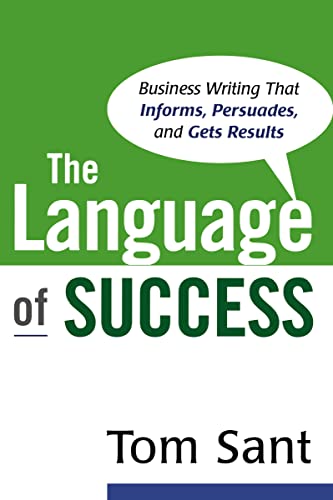
Language is the medium of business. To be successful, we need to communicate effectively not only when speaking but in writing as well.
Whether we are providing instructions to our colleagues, communicating with our customers, or advising our direct reports, language gauges success. We must be able to deliver clear, accurate messages that inform, persuade and motivate. Unfortunately, people lapse into habits that interfere with their ability to communicate.
In The Language of Success, author Tom Sant helps you master the lost art of clear writing and:
- eliminate ambiguities, jargon and grandiose claims
- master proper paragraph structure so the message doesn’t get muddled
- avoid misconstrued or misleading terms
- write clear concise sentences that follow the “first time right rule”
- use e-mail professionally and efficiently
- create career-enhancing reports
This book shows you how to avoid common mistakes, and to write lucid, concise, and accurate e-mails, letters, performance appraisals, and presentations.
Honest and authoritative, The Language of Success will gives you practical techniques to help you cut through the fluff, guff, geek, and hyperbole, write exceptional business documents, and get your message heard.
Die Inhaltsangabe kann sich auf eine andere Ausgabe dieses Titels beziehen.
Über die Autorin bzw. den Autor
TOM SANT is a renowned proposal consultant, whose clients range from small entrepreneurial operations to Global 500 companies, including General Electric, Microsoft, Lucent, and Accenture. He is the creator of the world's most widely used proposal automation systems, ProposalMaster and RFPMaster.
Auszug. © Genehmigter Nachdruck. Alle Rechte vorbehalten.
The Language of Success
Business Writing That Informs, Persuades, and Gets ResultsBy Tom SantAMACOM
Copyright © 2008 Tom SantAll right reserved.
ISBN: 978-0-8144-7473-0
Contents
Acknowledgments................................................................................xiChapter 1 Introduction.........................................................................1Chapter 2 The Problem: How Fluff, Guff, Geek, and Weasel Ruin Your Writing.....................27Chapter 3 The Principles: Modern Methods in Business Writing...................................55Chapter 4 The Practice: Real-World Applications of the Language of Success.....................127Chapter 5 Your Potential.......................................................................197Index..........................................................................................199About the Author...............................................................................207
Chapter One
Introduction
Where We're Going and Why the Trip Is Worth Taking
This book is about words, about the damage that can be done when they are used ineffectively, and about the power to be gained when they are used well. The purpose of this book is to show you how to write more effectively. It's designed to help you produce the kinds of documents that are likely to be part of your professional life—documents that ask and answer questions, that provide information other people need to do their jobs, that communicate your opinions, or that persuade, instruct, or update. We'll emphasize e-mail as the primary medium for delivering most of these messages for several reasons. First, e-mail has obviously become the dominant mode of communication all over the world. Second, it's different enough from traditional ink-on-paper writing that it poses its own unique set of challenges. Along the way, I'll provide examples of both good and bad writing for you to consider, explaining what works and what doesn't so that you can adapt the ideas quickly to your own use.
So that's where we're going. Admittedly, writing is a skill that most people embrace reluctantly at best. But it's a skill that can make a huge difference in your career. From a practical standpoint, few professional accomplishments will pay off more in terms of your personal success or the success of your company or organization than learning to communicate effectively.
In my experience, most people don't like to write. There are exceptions, of course. I'm one of them. I usually enjoy writing, especially if there's room for creativity or if there's a challenge to the task. Lots of people make their living as writers, in fields like technical writing, marketing communications, journalism, public relations, sales support, proposal writing, speech writing, and so on. You have to figure most of them don't mind writing. Other professions are virtually inseparable from the need to write—higher education, for example, where you must "publish or perish," or the practice of law, where letters, contracts, and other documents are often the deliverable for which the client is paying. All the same, the people who love to write are clearly in the minority. For the vast majority of people in the workforce, writing is a necessary evil. It's something they have to do, but they don't see it as a core part of their professional responsibility. Writing isn't part of their "real" job, they'll tell you.
But, of course, they are wrong.
Over the past fifteen or twenty years, the nature of work has changed dramatically. More valuable than any other raw material or resource, knowledge has become the engine of economic growth and the primary driver of increased productivity. The fact is we have now completed the shift to a knowledge-based workforce, a shift just as significant in its own right as was the shift to an industrial workforce in the late nineteenth century. During the past ten years, for the first time in world history, over half of the gross domestic product of the major Western economies has been directly linked to knowledge-based activities. As a result, businesses, institutions of higher learning, government agencies, and others in this knowledge-based economy now place greater importance than ever before on finding, sharing, and using information as efficiently as possible. Useful, valuable knowledge has become the fundamental source of differentiation for both organizations and individuals.
The concept of useful and valuable knowledge is worth examining. It means doing more than simply sharing information. Facts, details, instructions, and other forms of data may be necessary, but they tend to have less value than informed insight. Think about the money and effort that organizations put into identifying and implementing "best practices." Owners and senior managers don't want some checklist of steps to follow when performing a certain task or a template for organizing certain processes. What they want is deeper insight into business process, insight that will enable them to improve bottom line results. In a knowledge-based economy, progress is measured by such factors as increased innovation, improved productivity, or better financial performance. As a result, implementing best practices is not merely a matter of collecting facts and data, but rather of identifying and disseminating knowledge. And that requires clear, effective, flexible communication.
In a knowledge-based economy, our success and our organization's progress depend on our ability to communicate with our bosses, our subordinates, our colleagues and our customers.
Sometimes people need us to provide factual details and other forms of explicit information that are relatively uncomplicated. Here is the company's current mileage allowance on expense accounts. How to change your password. The new starting time for the budget review meeting. Some unexpected results from our recent lab tests of titanium alloys. Third quarter sales results showed a 2 percent decline in our core markets. In these situations, we are providing others with the information they need to do their jobs. This is an important task and early in our career it's likely to be the kind of writing we do most often.
As we advance, as we acquire more experience and responsibility, people are likely to turn to us to provide deeper insights into the why behind those facts. Why should I change my password? What do you think caused those unexpected results you got from the new titanium alloys? Why did our sales go down in the third quarter? What they want from us now is our opinion, presumably based on our training and experience. By providing facts in combination with our expert opinion about what those facts mean, we have taken on a more complex communication challenge. As we move up in our organization, particularly if we achieve recognition as a technical expert or if we have a management role, we will do a lot more of this kind of writing.
Sometimes we need to write messages that the audience isn't looking for at all. In these instances, we write because we need to motivate employees; we need to persuade customers, convince management, or possibly assure investors. Let's prevent any further data losses by adhering to our information security standards! Three reasons we should change the design specs of our engine housing. The long-term outlook for the housing downturn and our plan to stabilize earnings. In these situations, we may provide facts and offer some...
„Über diesen Titel“ kann sich auf eine andere Ausgabe dieses Titels beziehen.
Suchergebnisse für The Language of Success: Business Writing that Informs,...

Beispielbild für diese ISBN
The Language of Success: Business Writing That Informs, Persuades, and Gets Results
Anbieter: World of Books (was SecondSale), Montgomery, IL, USA
Verkäuferbewertung 5 von 5 Sternen

Paperback. Zustand: Very Good. Language is the medium of business. To be successful, we need to communicate effectively in writing. The Language of Success shows readers how to avoid these mistakes, and to write lucid, concise, and accurate e-mails, letters, performance appraisals, and presentations. Bestandsnummer des Verkäufers 00084566033
Gebraucht kaufen
EUR 5,43
Versand gratis
Versand innerhalb von USA
Versand innerhalb von USA
Anzahl: 2 verfügbar
Beispielbild für diese ISBN
The Language of Success
Anbieter: BooksRun, Philadelphia, PA, USA
Verkäuferbewertung 5 von 5 Sternen
Paperback. Zustand: Very Good. 1. It's a well-cared-for item that has seen limited use. The item may show minor signs of wear. All the text is legible, with all pages included. It may have slight markings and/or highlighting. Bestandsnummer des Verkäufers 081447473X-11-1
Gebraucht kaufen
EUR 5,44
Versand gratis
Versand innerhalb von USA
Versand innerhalb von USA
Anzahl: 1 verfügbar
Beispielbild für diese ISBN
The Language of Success: Business Writing That Informs, Persuades, and Gets Results
Anbieter: ThriftBooks-Atlanta, AUSTELL, GA, USA
Verkäuferbewertung 5 von 5 Sternen
Paperback. Zustand: Very Good. No Jacket. Former library book; May have limited writing in cover pages. Pages are unmarked. ~ ThriftBooks: Read More, Spend Less. Bestandsnummer des Verkäufers G081447473XI4N10
Gebraucht kaufen
EUR 6,12
Versand gratis
Versand innerhalb von USA
Versand innerhalb von USA
Anzahl: 1 verfügbar
Beispielbild für diese ISBN
The Language of Success: Business Writing That Informs, Persuades, and Gets Results
Anbieter: ThriftBooks-Dallas, Dallas, TX, USA
Verkäuferbewertung 5 von 5 Sternen
Paperback. Zustand: As New. No Jacket. Pages are clean and are not marred by notes or folds of any kind. ~ ThriftBooks: Read More, Spend Less. Bestandsnummer des Verkäufers G081447473XI2N00
Gebraucht kaufen
EUR 6,12
Versand gratis
Versand innerhalb von USA
Versand innerhalb von USA
Anzahl: 1 verfügbar
Beispielbild für diese ISBN
The Language of Success
Anbieter: Better World Books, Mishawaka, IN, USA
Verkäuferbewertung 5 von 5 Sternen
Zustand: Very Good. Pages intact with possible writing/highlighting. Binding strong with minor wear. Dust jackets/supplements may not be included. Stock photo provided. Product includes identifying sticker. Better World Books: Buy Books. Do Good. Bestandsnummer des Verkäufers 9916617-6
Gebraucht kaufen
EUR 6,56
Versand gratis
Versand innerhalb von USA
Versand innerhalb von USA
Anzahl: 2 verfügbar
Beispielbild für diese ISBN
The Language of Success: Business Writing That Informs, Persuades, and Gets Results
Anbieter: World of Books Inc, Montgomery, IL, USA
Verkäuferbewertung 4 von 5 Sternen

Paperback. Zustand: Very Good. Language is the medium of business. To be successful, we need to communicate effectively in writing. The Language of Success shows readers how to avoid these mistakes, and to write lucid, concise, and accurate e-mails, letters, performance appraisals, and presentations. Bestandsnummer des Verkäufers CIN081447473XVG
Gebraucht kaufen
EUR 7,27
Versand gratis
Versand innerhalb von USA
Versand innerhalb von USA
Anzahl: 2 verfügbar
Foto des Verkäufers
The Language of Success: Business Writing that Informs, Persuades, and Gets Results
Anbieter: WeBuyBooks, Rossendale, LANCS, Vereinigtes Königreich
Verkäuferbewertung 5 von 5 Sternen
paperback. Zustand: Very Good. Most items will be dispatched the same or the next working day. A copy that has been read, but is in excellent condition. Pages are intact and not marred by notes or highlighting. The spine remains undamaged. Bestandsnummer des Verkäufers rev3768807011
Gebraucht kaufen
EUR 1,46
EUR 6,90 Versand
Versand von Vereinigtes Königreich nach USA
Versand von Vereinigtes Königreich nach USA
Anzahl: 1 verfügbar
Beispielbild für diese ISBN
The Language of Success: Business Writing that Informs, Persuades, and Gets Results
Anbieter: AwesomeBooks, Wallingford, Vereinigtes Königreich
Verkäuferbewertung 5 von 5 Sternen
Paperback. Zustand: Very Good. The Language of Success: Business Writing that Informs, Persuades, and Gets Results This book is in very good condition and will be shipped within 24 hours of ordering. The cover may have some limited signs of wear but the pages are clean, intact and the spine remains undamaged. This book has clearly been well maintained and looked after thus far. Money back guarantee if you are not satisfied. See all our books here, order more than 1 book and get discounted shipping. Bestandsnummer des Verkäufers 7719-9780814474730
Gebraucht kaufen
EUR 3,59
EUR 4,86 Versand
Versand von Vereinigtes Königreich nach USA
Versand von Vereinigtes Königreich nach USA
Anzahl: 2 verfügbar
Beispielbild für diese ISBN
The Language of Success: Business Writing that Informs, Persuades, and Gets Results
Anbieter: Bahamut Media, Reading, Vereinigtes Königreich
Verkäuferbewertung 4 von 5 Sternen
Paperback. Zustand: Very Good. This book is in very good condition and will be shipped within 24 hours of ordering. The cover may have some limited signs of wear but the pages are clean, intact and the spine remains undamaged. This book has clearly been well maintained and looked after thus far. Money back guarantee if you are not satisfied. See all our books here, order more than 1 book and get discounted shipping. Bestandsnummer des Verkäufers 6545-9780814474730
Gebraucht kaufen
EUR 3,96
EUR 8,23 Versand
Versand von Vereinigtes Königreich nach USA
Versand von Vereinigtes Königreich nach USA
Anzahl: 2 verfügbar
Foto des Verkäufers
Language of Success
Anbieter: Blue Mountain Collectibles, LLC, Front Royal, VA, USA
Verkäuferbewertung 4 von 5 Sternen
Softcover. Bestandsnummer des Verkäufers BK9171
Gebraucht kaufen
EUR 8,27
EUR 5,80 Versand
Versand innerhalb von USA
Versand innerhalb von USA
Anzahl: 1 verfügbar