
Verwandte Artikel zu Brookings Papers on Economic Activity: Spring 2012
Inhaltsangabe
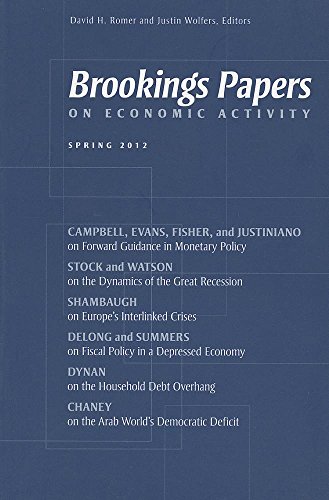
Contents • Democratic Change in the Arab World, Past and Present Eric Chaney (Harvard University) • Disentangling the Channels of the 2007–2009 Recession James Stock (Harvard University) and Mark Watson (Princeton University) • Macroeconomic Effects of FOMC Forward Guidance Jeffrey Campbell, Charles Evans, Jonas Fisher, and Alejandro Justiniano (Federal Reserve Bank of Chicago) • Is the Debt Overhang Holding Back Consumption? Karen Dynan (Brookings Institution) • The Euro's Three Crises Jay Shambaugh (Georgetown University) • Fiscal Policy in a Depressed Economy J. Bradford DeLong (University of California–Berkeley) and Lawrence Summers (Harvard University )
Die Inhaltsangabe kann sich auf eine andere Ausgabe dieses Titels beziehen.
Auszug. © Genehmigter Nachdruck. Alle Rechte vorbehalten.
Brookings Papers ON ECONOMIC ACTIVITY
BROOKINGS INSTITUTION PRESS
Copyright © 2012 THE BROOKINGS INSTITUTIONAll right reserved.
ISBN: 978-0-8157-2432-2
Contents
Editors' Introduction..............................................................................................................................................viiJEFFREY R. CAMPBELL, CHARLES L. EVANS, JONAS D. M. FISHER, and ALEJANDRO JUSTINIANO Macroeconomic Effects of Federal Reserve Forward Guidance.....................1JAMES H. STOCK and MARK W. WATSON Disentangling the Channels of the 2007–09 Recession........................................................................81JAY C. SHAMBAUGH The Euro's Three Crises..........................................................................................................................157J. BRADFORD DELONG and LAWRENCE H. SUMMERS Fiscal Policy in a Depressed Economy...................................................................................233KAREN DYNAN Is a Household Debt Overhang Holding Back Consumption?................................................................................................299ERIC CHANEY Democratic Change in the Arab World, Past and Present.................................................................................................363
Chapter One
JEFFREY R. CAMPBELL Federal Reserve Bank of ChicagoCHARLES L. EVANS Federal Reserve Bank of Chicago
JONAS D. M. FISHER Federal Reserve Bank of Chicago
ALEJANDRO JUSTINIANO Federal Reserve Bank of Chicago
Macroeconomic Effects of Federal Reserve Forward Guidance
ABSTRACT A large output gap accompanied by stable inflation close to its target calls for further monetary accommodation, but the zero lower bound on interest rates has robbed the Federal Open Market Committee (FOMC) of the usual tool for its provision. We examine how public statements of FOMC intentions—forward guidance—can substitute for lower rates at the zero bound. We distinguish between Odyssean forward guidance, which publicly commits the FOMC to a future action, and Delphic forward guidance, which merely forecasts macroeconomic performance and likely monetary policy actions. Others have shown how forward guidance that commits the central bank to keeping rates at zero for longer than conditions would otherwise warrant can provide monetary easing, if the public trusts it. We empirically characterize the responses of asset prices and private macroeconomic forecasts to FOMC forward guidance, both before and since the recent financial crisis. Our results show that the FOMC has extensive experience successfully telegraphing its intended adjustments to evolving conditions, so communication difficulties do not present an insurmountable barrier to Odyssean forward guidance. Using an estimated dynamic stochastic general equilibrium model, we investigate how pairing such guidance with bright-line rules for launching rate increases can mitigate risks to the Federal Reserve's price stability mandate.
From the onset of the financial crisis and through the Great Recession and ensuing modest recovery, the Federal Open Market Committee (FOMC) of the Federal Reserve has commented upon the likely duration of monetary policy accommodation in the formal statement that follows each of its meetings. In December 2008 it said, "The Committee anticipates that weak economic conditions are likely to warrant exceptionally low levels of the federal funds rate for some time." In March 2009, when the first round of large-scale purchases of Treasury securities was announced, "an extended period" replaced "some time" in the formal statement. The August 2011 FOMC statement gave specificity to "an extended period" by announcing that the committee expected the funds rate to remain exceptionally low until "at least ... mid-2013." The January 2012 statement lengthened the anticipated period of exceptionally low rates even further, to "late 2014," language that remained in the March 2012 statement. Such communications of monetary authorities' intentions are referred to as forward guidance.
The nature of this most recent forward guidance by the FOMC is the subject of substantial debate. Studies by Paul Krugman (1999) and by Gauti Eggertsson and Michael Woodford (2003) before the recent episode and by Iván Werning (2012) more recently suggest that a monetary policymaker encountering the zero lower bound (ZLB) on the policy interest rate can stimulate current aggregate demand by credibly promising to keep the rate at zero longer than required by economic conditions and thereby creating an economic boom in the future. One might interpret "late 2014" as such a credible promise, but one also might interpret it as merely describing what the FOMC's policy reaction function would prescribe if current forecasts of sluggish economic activity and low inflation through that date come to pass. "Late 2014" predicts unusually accommodative policy whenever the underlying policy reaction function would dictate an earlier "liftoff" of the funds rate from zero given the identical conditioning data.
Motivated by these competing interpretations of "late 2014," we distinguish between two kinds of forward guidance. Delphic forward guidance publicly states a forecast of macroeconomic performance and likely or intended monetary policy actions based on the policymaker's potentially superior information about future macroeconomic fundamentals and its own policy goals. Such forward guidance presumably improves macro economic outcomes by reducing private decisionmakers' uncertainty. Importantly, however, it does not publicly commit the policymaker to a particular course of action. Odyssean forward guidance, in contrast, does publicly commit the policymaker, just as Odysseus committed himself to staying on his ship by having himself bound to the mast. Tying one's hands in the face of an uncertain future might seem like a foolish sacrifice for no apparent gain, but economic fluctuations routinely present opportunities for monetary policy to benefit from issuing Odyssean forward guidance. The reason is that by so doing, policymakers can change public expectations of their actions tomorrow in a way that improves macroeconomic performance today.
Nevertheless, the implementation of Odyssean policy faces a fundamental challenge. When the appointed time for action arrives, any beneficial effects of the policy's anticipation will be bygones that nothing can change. Therefore, both the monetary policymaker and the public will at that later time prefer a policy that addresses only the present circumstances and ignores the beneficial effects of its anticipation on past macroeconomic performance. For example, when it comes time to keep an earlier promise to raise aggregate demand, the FOMC will be concerned about its price stability mandate and, acting as it has always done in normal times, will not want to follow through. Just as Odysseus anticipated that on hearing the Sirens' song he would regret his commitment to stay aboard his ship, so might monetary policymakers anticipate regretting their commitment to ease policy. If the public understands this and therefore believes that such promises will not be kept, they will not have the intended effect. Odysseus could use the rope that bound him to the mast to enforce his commitment. Lacking such an enforcement mechanism, monetary policymakers must rely on their reputations for accuracy and honesty to make their commitments credible.
The Odyssean monetary policies elucidated by Krugman, Eggertsson and Woodford, and Werning have inspired several recent...
„Über diesen Titel“ kann sich auf eine andere Ausgabe dieses Titels beziehen.
Weitere beliebte Ausgaben desselben Titels

Suchergebnisse für Brookings Papers on Economic Activity: Spring 2012

Foto des Verkäufers
Brookings Papers on Economic Activity
Anbieter: Bill & Ben Books, Faringdon, Vereinigtes Königreich
Verkäuferbewertung 5 von 5 Sternen

Paperback. Zustand: New. ContentsDemocratic Change in the Arab World, Past and Present Eric Chaney (Harvard University)Disentangling the Channels of the 2007-2009 Recession James Stock (Harvard University) and Mark Watson (Princeton University)Macroeconomic Effects of FOMC Forward Guidance Jeffrey Campbell, Charles Evans, Jonas Fisher, and Alejandro Justiniano (Federal Reserve Bank of Chicago)Is the Debt Overhang Holding Back Consumption? Karen Dynan (Brookings Institution)The Euro's Three Crises Jay Shambaugh (Georgetown University)Fiscal Policy in a Depressed Economy J. Bradford DeLong (University of California-Berkeley) and Lawrence Summers (Harvard University ). Bestandsnummer des Verkäufers 0077198
Neu kaufen
EUR 15,60
EUR 11,77 Versand
Versand von Vereinigtes Königreich nach USA
Versand von Vereinigtes Königreich nach USA
Anzahl: 1 verfügbar