
Verwandte Artikel zu Notes on Introductory Combinatorics (Progress in Computer...
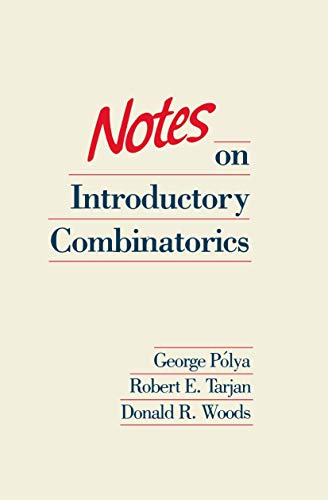
Notes on Introductory Combinatorics (Progress in Computer Science and Applied Logic, 4, Band 4) - Softcover
Inhaltsangabe
In the winter of 1978, Professor George P61ya and I jointly taught Stanford University's introductory combinatorics course. This was a great opportunity for me, as I had known of Professor P61ya since having read his classic book, How to Solve It, as a teenager. Working with P6lya, who ·was over ninety years old at the time, was every bit as rewarding as I had hoped it would be. His creativity, intelligence, warmth and generosity of spirit, and wonderful gift for teaching continue to be an inspiration to me. Combinatorics is one of the branches of mathematics that play a crucial role in computer sCience, since digital computers manipulate discrete, finite objects. Combinatorics impinges on computing in two ways. First, the properties of graphs and other combinatorial objects lead directly to algorithms for solving graph-theoretic problems, which have widespread application in non-numerical as well as in numerical computing. Second, combinatorial methods provide many analytical tools that can be used for determining the worst-case and expected performance of computer algorithms. A knowledge of combinatorics will serve the computer scientist well. Combinatorics can be classified into three types: enumerative, eXistential, and constructive. Enumerative combinatorics deals with the counting of combinatorial objects. Existential combinatorics studies the existence or nonexistence of combinatorial configurations.
Die Inhaltsangabe kann sich auf eine andere Ausgabe dieses Titels beziehen.
Über die Autorin bzw. den Autor
Biography of George Pólya Born in Budapest, December 13, 1887, George Pólya initially studied law, then languages and literature in Budapest. He came to mathematics in order to understand philosophy, but the subject of his doctorate in 1912 was in probability theory and he promptly abandoned philosophy. After a year in Göttingen and a short stay in Paris, he received an appointment at the ETH in Zürich. His research was multi-faceted, ranging from series, probability, number theory and combinatorics to astronomy and voting systems. Some of his deepest work was on entire functions. He also worked in conformal mappings, potential theory, boundary value problems, and isoperimetric problems in mathematical physics, as well as heuristics late in his career. When Pólya left Europe in 1940, he first went to Brown University, then two years later to Stanford, where he remained until his death on September 7, 1985. Biography of Gabor Szegö Born in Kunhegyes, Hungary, January 20, 1895, Szegö studied in Budapest and Vienna, where he received his Ph. D. in 1918, after serving in the Austro-Hungarian army in the First World War. He became a privatdozent at the University of Berlin and in 1926 succeeded Knopp at the University of K?nigsberg. It was during his time in Berlin that he and Pólya collaborated on their great joint work, the Problems and Theorems in Analysis. Szegö's own research concentrated on orthogonal polynomials and Toeplitz matrices. With the deteriorating situation in Germany at that time, he moved in 1934 to Washington University, St. Louis, where he remained until 1938, when he moved to Stanford. As department head at Stanford, he arranged for Pólya to join the Stanford faculty in 1942. Szegö remained at Stanford until his death on August 7, 1985.
„Über diesen Titel“ kann sich auf eine andere Ausgabe dieses Titels beziehen.
Suchergebnisse für Notes on Introductory Combinatorics (Progress in Computer...

Beispielbild für diese ISBN
Notes on Introductory Combinatorics
Anbieter: Chequamegon Books, Washburn, WI, USA
Verkäuferbewertung 5 von 5 Sternen

paperback. Zustand: very good. 190 pages; 5 3/4 x 9" Light wear to cover edges; the front cover lower corner and the first few lower corners are slightly creased. Bestandsnummer des Verkäufers 131672
Gebraucht kaufen
EUR 27,59
EUR 5,80 Versand
Versand innerhalb von USA
Versand innerhalb von USA
Anzahl: 1 verfügbar
Foto des Verkäufers
Notes on Introductory Combinatorics
Print-on-DemandAnbieter: BuchWeltWeit Ludwig Meier e.K., Bergisch Gladbach, Deutschland
Verkäuferbewertung 5 von 5 Sternen
Taschenbuch. Zustand: Neu. This item is printed on demand - it takes 3-4 days longer - Neuware -In the winter of 1978, Professor George P61ya and I jointly taught Stanford University's introductory combinatorics course. This was a great opportunity for me, as I had known of Professor P61ya since having read his classic book, How to Solve It, as a teenager. Working with P6lya, who was over ninety years old at the time, was every bit as rewarding as I had hoped it would be. His creativity, intelligence, warmth and generosity of spirit, and wonderful gift for teaching continue to be an inspiration to me. Combinatorics is one of the branches of mathematics that play a crucial role in computer sCience, since digital computers manipulate discrete, finite objects. Combinatorics impinges on computing in two ways. First, the properties of graphs and other combinatorial objects lead directly to algorithms for solving graph-theoretic problems, which have widespread application in non-numerical as well as in numerical computing. Second, combinatorial methods provide many analytical tools that can be used for determining the worst-case and expected performance of computer algorithms. A knowledge of combinatorics will serve the computer scientist well. Combinatorics can be classified into three types: enumerative, eXistential, and constructive. Enumerative combinatorics deals with the counting of combinatorial objects. Existential combinatorics studies the existence or nonexistence of combinatorial configurations. 204 pp. Englisch. Bestandsnummer des Verkäufers 9780817631703
Neu kaufen
EUR 85,59
EUR 23,00 Versand
Versand von Deutschland nach USA
Versand von Deutschland nach USA
Anzahl: 2 verfügbar
Foto des Verkäufers
Notes on Introductory Combinatorics
Verlag:
Birkhäuser Boston, 1990
ISBN 10: 0817631704
ISBN 13: 9780817631703
Neu
Kartoniert / Broschiert
Anbieter: moluna, Greven, Deutschland
Verkäuferbewertung 5 von 5 Sternen
Kartoniert / Broschiert. Zustand: New. Dieser Artikel ist ein Print on Demand Artikel und wird nach Ihrer Bestellung fuer Sie gedruckt. In the winter of 1978, Professor George P61ya and I jointly taught Stanford University s introductory combinatorics course. This was a great opportunity for me, as I had known of Professor P61ya since having read his classic book, How to Solve It, as a teen. Bestandsnummer des Verkäufers 5975335
Neu kaufen
EUR 74,71
EUR 48,99 Versand
Versand von Deutschland nach USA
Versand von Deutschland nach USA
Anzahl: Mehr als 20 verfügbar
Foto des Verkäufers
Notes on Introductory Combinatorics
Anbieter: AHA-BUCH GmbH, Einbeck, Deutschland
Verkäuferbewertung 5 von 5 Sternen
Taschenbuch. Zustand: Neu. Druck auf Anfrage Neuware - Printed after ordering - In the winter of 1978, Professor George P61ya and I jointly taught Stanford University's introductory combinatorics course. This was a great opportunity for me, as I had known of Professor P61ya since having read his classic book, How to Solve It, as a teenager. Working with P6lya, who was over ninety years old at the time, was every bit as rewarding as I had hoped it would be. His creativity, intelligence, warmth and generosity of spirit, and wonderful gift for teaching continue to be an inspiration to me. Combinatorics is one of the branches of mathematics that play a crucial role in computer sCience, since digital computers manipulate discrete, finite objects. Combinatorics impinges on computing in two ways. First, the properties of graphs and other combinatorial objects lead directly to algorithms for solving graph-theoretic problems, which have widespread application in non-numerical as well as in numerical computing. Second, combinatorial methods provide many analytical tools that can be used for determining the worst-case and expected performance of computer algorithms. A knowledge of combinatorics will serve the computer scientist well. Combinatorics can be classified into three types: enumerative, eXistential, and constructive. Enumerative combinatorics deals with the counting of combinatorial objects. Existential combinatorics studies the existence or nonexistence of combinatorial configurations. Bestandsnummer des Verkäufers 9780817631703
Neu kaufen
EUR 91,53
EUR 35,00 Versand
Versand von Deutschland nach USA
Versand von Deutschland nach USA
Anzahl: 1 verfügbar
Beispielbild für diese ISBN
Notes on Introductory Combinatorics
Anbieter: Books Puddle, Woodside, NY, USA
Verkäuferbewertung 4 von 5 Sternen

Zustand: New. pp. 212 1st Edition. Bestandsnummer des Verkäufers 26318040
Neu kaufen
EUR 126,60
EUR 3,56 Versand
Versand innerhalb von USA
Versand innerhalb von USA
Anzahl: 4 verfügbar
Beispielbild für diese ISBN
Notes on Introductory Combinatorics
Print-on-DemandAnbieter: Majestic Books, Hounslow, Vereinigtes Königreich
Verkäuferbewertung 4 von 5 Sternen
Zustand: New. Print on Demand pp. 212. Bestandsnummer des Verkäufers 7562631
Neu kaufen
EUR 131,14
EUR 7,67 Versand
Versand von Vereinigtes Königreich nach USA
Versand von Vereinigtes Königreich nach USA
Anzahl: 4 verfügbar
Beispielbild für diese ISBN
Notes on Introductory Combinatorics
Print-on-DemandAnbieter: Biblios, Frankfurt am main, HESSE, Deutschland
Verkäuferbewertung 4 von 5 Sternen
Zustand: New. PRINT ON DEMAND pp. 212. Bestandsnummer des Verkäufers 18318034
Neu kaufen
EUR 129,64
EUR 9,95 Versand
Versand von Deutschland nach USA
Versand von Deutschland nach USA
Anzahl: 4 verfügbar
Foto des Verkäufers
Notes on Introductory Combinatorics
Verlag:
Birkhäuser, Birkhäuser Jan 1990, 1990
ISBN 10: 0817631704
ISBN 13: 9780817631703
Neu
Taschenbuch
Anbieter: buchversandmimpf2000, Emtmannsberg, BAYE, Deutschland
Verkäuferbewertung 5 von 5 Sternen
Taschenbuch. Zustand: Neu. This item is printed on demand - Print on Demand Titel. Neuware -In the winter of 1978, Professor George P61ya and I jointly taught Stanford University's introductory combinatorics course. This was a great opportunity for me, as I had known of Professor P61ya since having read his classic book, How to Solve It, as a teenager. Working with P6lya, who was over ninety years old at the time, was every bit as rewarding as I had hoped it would be. His creativity, intelligence, warmth and generosity of spirit, and wonderful gift for teaching continue to be an inspiration to me. Combinatorics is one of the branches of mathematics that play a crucial role in computer sCience, since digital computers manipulate discrete, finite objects. Combinatorics impinges on computing in two ways. First, the properties of graphs and other combinatorial objects lead directly to algorithms for solving graph-theoretic problems, which have widespread application in non-numerical as well as in numerical computing. Second, combinatorial methods provide many analytical tools that can be used for determining the worst-case and expected performance of computer algorithms. A knowledge of combinatorics will serve the computer scientist well. Combinatorics can be classified into three types: enumerative, eXistential, and constructive. Enumerative combinatorics deals with the counting of combinatorial objects. Existential combinatorics studies the existence or nonexistence of combinatorial configurations.Springer Nature c/o IBS, Benzstrasse 21, 48619 Heek 204 pp. Englisch. Bestandsnummer des Verkäufers 9780817631703
Neu kaufen
EUR 85,59
EUR 60,00 Versand
Versand von Deutschland nach USA
Versand von Deutschland nach USA
Anzahl: 1 verfügbar
Beispielbild für diese ISBN
Notes on Introductory Combinatorics
Anbieter: Revaluation Books, Exeter, Vereinigtes Königreich
Verkäuferbewertung 5 von 5 Sternen
Paperback. Zustand: Brand New. 212 pages. 9.00x6.00x0.50 inches. In Stock. Bestandsnummer des Verkäufers zk0817631704
Neu kaufen
EUR 142,90
EUR 11,80 Versand
Versand von Vereinigtes Königreich nach USA
Versand von Vereinigtes Königreich nach USA
Anzahl: 1 verfügbar