
Inhaltsangabe
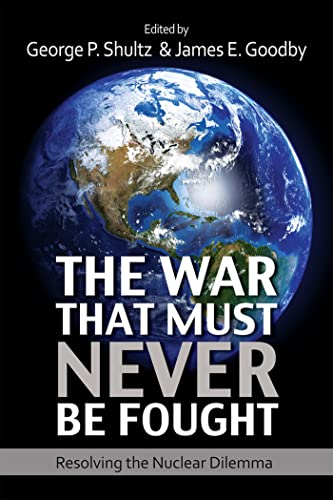
This book discusses the nuclear dilemma from various countries’ points of view: from Japan, Korea, the Middle East, and others. The final chapter proposes a new solution for the nonproliferation treaty review.
Die Inhaltsangabe kann sich auf eine andere Ausgabe dieses Titels beziehen.
Über die Autorin bzw. den Autor
George P. Shultz has had a distinguished career in government, in academia, and in the world of business. He is one of two individuals who have held four different federal cabinet posts, has taught at three of the country’s great universities, and for eight years he was president of a major engineering and construction company. He is a coauthor of Implications of the Reykjavik Summit on Its Twentieth Anniversary and Nuclear Security and coeditor of Deterrence, Ending Government Bailouts as We Know Them, Game Changers, The Nuclear Enterprise, and Reykjavik Revisited. He lives in San Francisco. James E. Goodby has served in the U.S. Foreign Service, achieving the rank of Career Minister, and was appointed to five ambassadorial-rank positions and taught at Georgetown, Syracuse, and Carnegie Mellon Universities and is Distinguished Service Professor Emeritus at Carnegie Mellon. He is a research fellow at the Hoover Institution and a senior fellow with the Center for Northeast Asia Policy Studies at the Brookings Institution. He lives in Washington, DC.
Auszug. © Genehmigter Nachdruck. Alle Rechte vorbehalten.
The War That Must Never Be Fought
Dilemmas of Nuclear Deterrence
By George P. Shultz, James E. GoodbyHoover Institution Press
Copyright © 2015 Board of Trustees of the Leland Stanford Junior University
All rights reserved.
ISBN: 978-0-8179-1845-3All rights reserved.
Contents
Preface by George P. Shultz,
Acknowledgments,
Introduction to Part One,
1 A Bet Portrayed as a Certainty: Reassessing the Added Deterrent Value of Nuclear Weapons by Benoît Pelopidas,
2 The Nuclear Dilemma: Constants and Variables in American Strategic Policies by James E. Goodby,
3 A Realist's Rationale for a World without Nuclear Weapons by Steven Pifer,
Introduction to Part Two,
4 The Debate Over Disarmament within NATO by Isabelle Williams and Steven P. Andreasen,
5 Russia, Strategic Stability, and Nuclear Weapons by Pavel Podvig,
6 Comparing German and Polish Post — Cold War Nuclear Policies: A Convergence of European Attitudes on Nuclear Disarmament and Deterrence? by Katarzyna Kubiak and Oliver Meier,
7 Utility of Nuclear Deterrence in the Middle East by Shlomo Brom,
8 Proliferation and Deterrence beyond the Nuclear Tipping Point in the Middle East by Karim Haggag,
9 A Middle East Free of Weapons of Mass Destruction: Moving beyond the Stalemate by Peter Jones,
10 Decoupling Nuclear Weapons and Deterrence in South Asia by S. Paul Kapur,
11 Getting to the Table: Prospects and Challenges for Arms Control with China by Michael S. Gerson,
12 China and Global Nuclear Arms Control and Disarmament by Li Bin,
13 Korea: Will South Korea's Non-Nuclear Strategy Defeat North Korea's Nuclear Breakout? by Peter Hayes and Chung-in Moon,
14 Japan's Disarmament Dilemma: Between the Moral Commitment and the Security Reality by Nobumasa Akiyama,
Introduction to Part Three,
15 Creating the Conditions for a World without Nuclear Weapons by James E. Goodby and Steven Pifer,
About the Authors,
Index,
CHAPTER 1
A Bet Portrayed as a Certainty: Reassessing the Added Deterrent Value of Nuclear Weapons
Benoît Pelopidas
"Concepts, first employed to make things intelligible, are clung to often when they make them unintelligible."
William James
The Argument
A world free of nuclear weapons has been seen as an exercise in utopian dreaming. It took the credentials of realists like Secretaries Shultz, Perry, and Kissinger and Senator Nunn to bring this goal back to the front of the US political scene. But framing the discussion in terms of utopia versus reality is deceptive because in actuality both supporters and critics of this goal hold to a vision of the world as they think it ought to be. On the one hand, setting a goal of a world without nuclear weapons while there are still approximately seventeen thousands of them in the world today is clearly ambitious. On the other hand, those who reject this goal and want to continue to rely on the threat of nuclear retaliation have to assume that this strategy will work perfectly until the end of days. There is no third future. Either nuclear weapons remain in numbers higher than necessary to create a global-scale disaster and we have to rely on deterrence and hope for the best or we reach very low numbers or zero and the issue then will be to make sure that they are not rebuilt. Even if a credible missile defense system could be built, it would not constitute a third future; it would just be another parameter in the choice between these two futures.
Proponents of a world without nuclear weapons use the rhetoric of only two possible futures: either getting to zero or nuclear proliferation. But getting to very low numbers versus trusting nuclear deterrence forever reflects a more fundamental truth. This depiction of future choices does not make any assumption about the pace of proliferation or the connection between nuclear disarmament and nuclear proliferation.
If the only two available futures are getting to zero (or very low numbers) and relying on luck forever, which future ought to be realized? This is not a question of realism or utopia. It is a question of political choice: we either wager on perpetual luck or we wager on the ability of people to adjust to new international environments. Which future do you choose as a goal before putting your forces into the battle to "bring the 'is' closer to the 'ought'"? Maybe the proponents of nuclear deterrence assume that a civilization-destroying disaster will happen before nuclear weapons are used, so that their priorities lie elsewhere, but this bet is not made explicit or maybe they imply that future nuclear weapons use is inevitable and can be limited. Those are debatable assumptions which should be made explicit and become part of the conversation. Once this is done and the proponents of nuclear deterrence acknowledge the fundamental problem of global nuclear vulnerability, the burden of proof will be shared more equally and the ethical and political questions about which future we want to strive for will be fruitfully reopened.
The Case for Nuclear Deterrence
In this paper, I address three of the most frequently used arguments for maintaining a significant measure of dependence for international security on nuclear deterrence both globally and regionally:
1. Nuclear weapons have deterred great powers from waging war against each other, so a world without nuclear weapons will lead to, or at least might encourage, great-power war.
2. The US nuclear umbrella has deterred nuclear proliferation, so the reduction of the US nuclear arsenal will undermine the credibility of US extended deterrence and create additional incentives for nuclear proliferation.
3. Nuclear weapons have deterred other powers from invading the territory of those states that possess nuclear weapons and thus leaders of countries with relatively weak conventional capabilities will keep their weapons as an equalizer. A version of this argument focuses on dictatorial regimes or "rogue states" whose very existence depends on their having nuclear weapons.
I argue that none of these arguments holds.
These three arguments for acquiring and keeping nuclear arsenals rest on the power of these weapons to deter an action, whether a great-powers war, nuclear proliferation, or invasion of and regime change in weaker nations. But deterrence of such an action is most often based on the credibility of a set of national capabilities that include all the non-nuclear assets of a nation, including its credibility as an ally. Therefore, deterrence should not be identified with nuclear weapons and defined by them as has become the habit, almost unconsciously. The added deterrent value of nuclear weapons, rather than their deterrent value per se, has to be reexamined, keeping in mind that conventional weapons and other factors (economic, as an example) can have a deterrent effect with a much higher credibility of actual use.
After showing that these arguments are not as convincing as their frequency suggests, I will delineate opportunities which advocates for a nuclear-free world should exploit on their way to advancing their goal, based on the decoupling of nuclear weapons and deterrence.
One cannot state for certain that great-power war will be more likely in a world without nuclear weapons
The most intimidating critique of the goal of a world free of nuclear weapons is that it would make the world safe for further war among great powers. Its most eloquent proponent was...
„Über diesen Titel“ kann sich auf eine andere Ausgabe dieses Titels beziehen.
Suchergebnisse für The War That Must Never Be Fought: Resolving the Nuclear...

Beispielbild für diese ISBN
The War That Must Never Be Fought: Dilemmas of Nuclear Deterrence
Anbieter: Basement Seller 101, Cincinnati, OH, USA
Verkäuferbewertung 5 von 5 Sternen

paperback. Zustand: New. Bestandsnummer des Verkäufers 240624006
Neu kaufen
EUR 10,53
EUR 4,40 Versand
Versand innerhalb von USA
Versand innerhalb von USA
Anzahl: 1 verfügbar
Beispielbild für diese ISBN
The War That Must Never Be Fought: Dilemmas of Nuclear Deterrence
Verlag:
Hoover Institution Press, 2015
ISBN 10: 0817918450
ISBN 13: 9780817918453
Gebraucht
Paperback
Anbieter: ThriftBooks-Dallas, Dallas, TX, USA
Verkäuferbewertung 5 von 5 Sternen
Paperback. Zustand: Good. No Jacket. Pages can have notes/highlighting. Spine may show signs of wear. ~ ThriftBooks: Read More, Spend Less. Bestandsnummer des Verkäufers G0817918450I3N00
Gebraucht kaufen
EUR 15,14
Versand gratis
Versand innerhalb von USA
Versand innerhalb von USA
Anzahl: 1 verfügbar
Foto des Verkäufers
War That Must Never Be Fought : Resolving the Nuclear Dilemma
Verlag:
Hoover Institution Press, 2015
ISBN 10: 0817918450
ISBN 13: 9780817918453
Gebraucht
Softcover
Anbieter: GreatBookPrices, Columbia, MD, USA
Verkäuferbewertung 5 von 5 Sternen
Zustand: As New. Unread book in perfect condition. Bestandsnummer des Verkäufers 23473905
Gebraucht kaufen
EUR 20,58
EUR 2,32 Versand
Versand innerhalb von USA
Versand innerhalb von USA
Anzahl: Mehr als 20 verfügbar
Foto des Verkäufers
War That Must Never Be Fought : Resolving the Nuclear Dilemma
Anbieter: GreatBookPrices, Columbia, MD, USA
Verkäuferbewertung 5 von 5 Sternen
Zustand: New. Bestandsnummer des Verkäufers 23473905-n
Neu kaufen
EUR 21,62
EUR 2,32 Versand
Versand innerhalb von USA
Versand innerhalb von USA
Anzahl: Mehr als 20 verfügbar
Beispielbild für diese ISBN
The War That Must Never Be Fought (Paperback)
Verlag:
Hoover Institution Press,U.S., Stanford, 2015
ISBN 10: 0817918450
ISBN 13: 9780817918453
Neu
Paperback
Anbieter: Grand Eagle Retail, Bensenville, IL, USA
Verkäuferbewertung 5 von 5 Sternen
Paperback. Zustand: new. Paperback. The Nuclear Dilemma in a Changing World.The War That Must Never Be Fought explores how nuclear deterrence should be understood seventy years after the first nuclear tests. These essays, edited by George P. Shultz and James E. Goodby, challenge outdated deterrence theories and show a clear need to re-examine notions from the Cold War that no longer fit present circumstances. They argue that a world without nuclear weapons is a desirable objective that is in the national security interests of the United States.The contributors examine nuclear deterrence from the vantage points of nations in Europe, the Middle East, and Asia, all of which have some form of security relationship with the United States, either cooperative or competitive. They explain, for instance, why agreement by Poland and Germany on nuclear deterrence and nuclear arms control is necessary if Europeans are to be proactive in reducing nuclear weapons in Europe and. They explore the strategic views, and resulting nuclear policies, of India and Pakistan to determine the possibilities for decoupling nuclear weapons from deterrence. They also tell why successfully reducing and ultimately eliminating the nuclear threat must be based on a combination of regional and global joint enterprises. The authors conclude with suggestions that might lead to a successful joint enterprise on security among the world's nuclear powers. Explores how nuclear deterrence should be understood seventy years after the first nuclear tests. These essays, edited by George P. Shultz and James E. Goodby, challenge outdated deterrence theories and show a clear need to re-examine notions from the Cold War that no longer fit present circumstances. They argue that a world without nuclear weapons is a desirable objective. Shipping may be from multiple locations in the US or from the UK, depending on stock availability. Bestandsnummer des Verkäufers 9780817918453
Foto des Verkäufers
The War That Must Never Be Fought
Verlag:
Hoover Institution Press,U.S., US, 2015
ISBN 10: 0817918450
ISBN 13: 9780817918453
Neu
Paperback
Anbieter: Rarewaves USA, OSWEGO, IL, USA
Verkäuferbewertung 5 von 5 Sternen
Paperback. Zustand: New. The Nuclear Dilemma in a Changing World.The War That Must Never Be Fought explores how nuclear deterrence should be understood seventy years after the first nuclear tests. These essays, edited by George P. Shultz and James E. Goodby, challenge outdated deterrence theories and show a clear need to re-examine notions from the Cold War that no longer fit present circumstances. They argue that a world without nuclear weapons is a desirable objective that is in the national security interests of the United States.The contributors examine nuclear deterrence from the vantage points of nations in Europe, the Middle East, and Asia, all of which have some form of security relationship with the United States, either cooperative or competitive. They explain, for instance, why agreement by Poland and Germany on nuclear deterrence and nuclear arms control is necessary if Europeans are to be proactive in reducing nuclear weapons in Europe and. They explore the strategic views, and resulting nuclear policies, of India and Pakistan to determine the possibilities for decoupling nuclear weapons from deterrence. They also tell why successfully reducing and ultimately eliminating the nuclear threat must be based on a combination of regional and global joint enterprises. The authors conclude with suggestions that might lead to a successful joint enterprise on security among the world's nuclear powers. Bestandsnummer des Verkäufers LU-9780817918453
Neu kaufen
EUR 26,96
Versand gratis
Versand innerhalb von USA
Versand innerhalb von USA
Anzahl: Mehr als 20 verfügbar
Beispielbild für diese ISBN
The War That Must Never Be Fought Format: Paperback
Anbieter: INDOO, Avenel, NJ, USA
Verkäuferbewertung 5 von 5 Sternen
Zustand: New. Brand New. Bestandsnummer des Verkäufers 9780817918453
Neu kaufen
EUR 28,74
Versand gratis
Versand innerhalb von USA
Versand innerhalb von USA
Anzahl: Mehr als 20 verfügbar
Foto des Verkäufers
The War That Must Never Be Fought
Verlag:
Hoover Institution Press,U.S., US, 2015
ISBN 10: 0817918450
ISBN 13: 9780817918453
Neu
Paperback
Anbieter: Rarewaves.com USA, London, LONDO, Vereinigtes Königreich
Verkäuferbewertung 5 von 5 Sternen
Paperback. Zustand: New. The Nuclear Dilemma in a Changing World.The War That Must Never Be Fought explores how nuclear deterrence should be understood seventy years after the first nuclear tests. These essays, edited by George P. Shultz and James E. Goodby, challenge outdated deterrence theories and show a clear need to re-examine notions from the Cold War that no longer fit present circumstances. They argue that a world without nuclear weapons is a desirable objective that is in the national security interests of the United States.The contributors examine nuclear deterrence from the vantage points of nations in Europe, the Middle East, and Asia, all of which have some form of security relationship with the United States, either cooperative or competitive. They explain, for instance, why agreement by Poland and Germany on nuclear deterrence and nuclear arms control is necessary if Europeans are to be proactive in reducing nuclear weapons in Europe and. They explore the strategic views, and resulting nuclear policies, of India and Pakistan to determine the possibilities for decoupling nuclear weapons from deterrence. They also tell why successfully reducing and ultimately eliminating the nuclear threat must be based on a combination of regional and global joint enterprises. The authors conclude with suggestions that might lead to a successful joint enterprise on security among the world's nuclear powers. Bestandsnummer des Verkäufers LU-9780817918453
Neu kaufen
EUR 35,00
Versand gratis
Versand von Vereinigtes Königreich nach USA
Versand von Vereinigtes Königreich nach USA
Anzahl: Mehr als 20 verfügbar
Beispielbild für diese ISBN
The War That Must Never Be Fought: Dilemmas of Nuclear Deterrence
Anbieter: Kennys Bookshop and Art Galleries Ltd., Galway, GY, Irland
Verkäuferbewertung 5 von 5 Sternen
Zustand: New. This book discusses the nuclear dilemma from various countries points of view: from Japan, Korea, the Middle East, and others. The final chapter proposes a new solution for the nonproliferation treaty review." Editor(s): Shultz, George P.; Goodby, James E. Num Pages: 450 pages. BIC Classification: JWMN. Category: (G) General (US: Trade). Dimension: 155 x 229 x 40. Weight in Grams: 876. . 2015. Paperback. . . . . Bestandsnummer des Verkäufers V9780817918453
Neu kaufen
EUR 29,74
EUR 10,50 Versand
Versand von Irland nach USA
Versand von Irland nach USA
Anzahl: Mehr als 20 verfügbar
Beispielbild für diese ISBN
The War That Must Never Be Fought: Dilemmas of Nuclear Deterrence
Verlag:
Hoover Institution Press, 2015
ISBN 10: 0817918450
ISBN 13: 9780817918453
Gebraucht
Paperback
Signiert
Anbieter: Colewood Books, San Francisco, CA, USA
Verkäuferbewertung 5 von 5 Sternen
Paperback. Zustand: VG+. Signed 1st printing of Hoover Institution Press soft cover, 2015. VG+, w/ clean text, tight binding, straight and uncreased spine; light edge/corner wear. Appears to be unread. Signed by co-author George Shultz and signed by co-author Goodby (and inscribed to previous owner) on half-title page. Free delivery confirmation. Signed by Author(s). Bestandsnummer des Verkäufers SKU1020876
Gebraucht kaufen
EUR 36,22
EUR 4,84 Versand
Versand innerhalb von USA
Versand innerhalb von USA
Anzahl: 1 verfügbar