
Verwandte Artikel zu Faithful Living, Faithful Dying: Anglican Reflections...
Inhaltsangabe
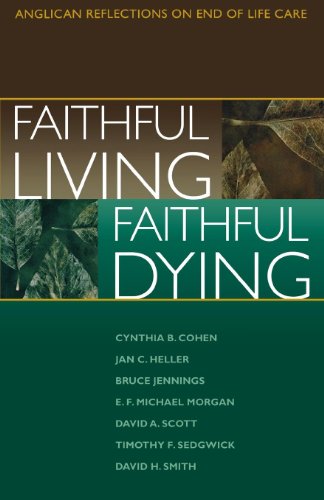
An important examination of the theological, spiritual, and ethical issues surrounding death.
At the end of a life of faithfulness comes our dying. To approach it as faithfully as we have our living calls for some serious forethought. Because one of the simplest facts of life―that we all die―seems like the most complicated thing we do.
Not only have advances in
medical technology saved lives, but they also have prolonged death, and raise a
number ethical, moral, social, and theological issues. How far should we go to
sustain life? Is it right to withdraw artificial feeding from the dying? Is it
wrong to end the lives of those in pain? No matter who we are, dealing with
these sorts of choices near the end of life is difficult to do on our own.Faithful Living, Faithful
Dying: Anglican Reflections on End of Life Care brings together the wisdom of a
task force created by the 72nd General Convention of the Episcopal Church to
study what faithful living and faithful dying mean today. The task force’s
reflections, published for the first time in this book, assist individuals,
congregations, and the Church as a whole to disentangle the thicket of ethical,
theological, pastoral, and policy concerns.
Die Inhaltsangabe kann sich auf eine andere Ausgabe dieses Titels beziehen.
Über die Autorin bzw. den Autor
The Episcopal Church welcomes all who worship Jesus Christ and comprises 106 dioceses and one mission area across 22 countries or territories. The Episcopal Church is a member province of the worldwide Anglican Communion.
Auszug. © Genehmigter Nachdruck. Alle Rechte vorbehalten.
FAITHFUL LIVING FAITHFUL DYING
ANGLICAN REFLECTIONS
By Cynthia B. Cohen, Jan C. Heller, Bruce Jennings, E. F. Michael Morgan, David A. Scott, Timothy F. Sedgwick, David H. SmithChurch Publishing Incorporated
Copyright © 2000 General Convention of the Episcopal Church
All rights reserved.
ISBN: 978-0-8192-1830-8All rights reserved.
Contents
| Acknowledgments | |
| Introduction | |
| Part I Theological and Ethical Understandings | |
| Chapter 1. The Reality of Death | |
| Chapter 2. God, Death, and Anglican Theology | |
| Chapter 3. Moral Journey, Ethical Compass | |
| Part II Faithful Responses | |
| Chapter 4. Using Our Medical Powers Appropriately | |
| Chapter 5. Making Responsible Treatment Choices | |
| Chapter 6. Accepting, Caring, and Mourning | |
| Chapter 7. Enriching the Church's Response | |
| Chapter 8. Broadening the Conversation | |
| Final Reflections | |
| Appendix | |
| 1. Last Things: A Parish Resource for the Time of Death, St. Matthias Episcopal Church, Waukesha, Wisconsin | |
| 2. Memorial Garden, St. Andrew's Episcopal Church, Saratoga, California | |
| 3. Regulations and Conditions, St. Peter's Columbarium, St. Peter's Church, Conway, Arkansas | |
| 4. A Form f Prayer at a Time When Life-Sustaining Treatment Is Withdrawn, Committee on Medical Ethics, Diocese of Washington, Washington, D.C. | |
| Members of End of Life Task Force |
CHAPTER 1
THE REALITY OF DEATH
Death, for Christians, is understood not merely as an event that we must undergoat the end of life but also as an ever-present accompaniment to the story of ourlives. It is an integral part of life, a mystery to be contemplated as we live.Here we consider the awesome force of death, exploring the import of therealization that we will die for all of us, but especially for those within theAnglican tradition. We then turn to consider the significance of death as aspecific event in our lives. For Christians, the actual experience of death isreal, but not ultimate; it does not speak the last word about our humancondition. This exploration of the significance of death is not merely aphilosophical bypath or theological nicety but is forced upon us by the oftendifficult decisions—medical, ethical, personal, and spiritual—that we must makewhen death appears on the horizon. Therefore, the task force reflects here uponhow the Anglican perspective on the meaning of death can illuminate the concernsand realities that we face today near the end of life.
DEATH AS A PART OF LIFE
Throughout our lives, especially as we grow older, we are aware that someday wewill die. This awareness is not often conscious but lies just beneath thesurface, ready to emerge again and again. Many things can call it to mind. Thedeath of someone whom we know well and love reminds us that we, too, must die.The death of a person our own age makes us pause, abruptly bringing our ownmortality into focus. News headlines of a massacre, a plane crash, an epidemic,or an accident bring our awareness of the inevitability of our own death rushingto the fore. Even the change of the seasons reminds us that our lives, like alllife around us, are caught up in a cycle of birth, growth, decline, and death.Aging makes the reality of upcoming death even more vivid to us as time becomesetched in the lines on our skin. We feel our mortality in our bones and in ourdiscernibly diminishing capacities.
Thus, the awareness that someday we will die accompanies us throughout ourlives, waiting to step out of the shadows of our absorption in the activities ofdaily life. And, in the Christian understanding of death, this is not a badthing. We are taught by these recurring reminders of death to "number our days,"that is, to contemplate that our lives have a limit. We have but one life tolive and one life to offer. We can resist this awareness or we can consent toit. For Christians, the awareness of death can be a spiritual discipline, a partof the schooling that teaches us to mature in our faith. Indeed, within theAnglican tradition, a consciousness of the fact that we will die someday is anecessary accompaniment to faithful living.
Yet we receive little support from contemporary society for our Christianendeavor to face death in life. Our culture conspires against acknowledging itsinevitability. Death in our secular society typically provokes fear and denial,rather than contemplation and reflection. And so our society deals with death byevasions and lies. Advertisements abound for products promising to hide orremove the signs of aging. Older persons who are approaching death are concealedbehind the walls of institutions whose corridors we grace as little as commondecency allows. The words "died" and "death" do not pass our lips; we speakinstead of someone "passing away" or of "losing" those we love. We flee fromacknowledging the reality of death.
Even as our culture conceals death in a heavy cloak of silence, it is obsessedwith death. This is because it recognizes it as a power that is out of ourcontrol, one for which we have no effective response. To keep death at bay, wetreat it as if it is only a fantasy played out in wars in distant lands or afictional focus of entertainment for us in "gun em down" movies, killer videogames, and horror houses at Halloween. Death is, for us, an unmentionablesubject and yet a source of endless fascination. Our denial of its reality inmodern Western culture is, paradoxically, heightened by our refusal to let go ofit. Thus, death retains its terrible importance and meaning for us even as wepretend to ignore it.
Commentators have described our culture as "death-denying." Death and dying,this culture teaches, are unspoken terrors that will make their appearance atsome far-off time. Therefore, we need not think about them today. It has becomemore difficult to acknowledge explicitly the reality of death in our societybecause we press it into a medical model, reducing it to a merely biologicalproblem. Our culture has "assigned" such biological problems to medical expertswhose training has taught them to see decline and death as signs ofmalfunctioning, and finally nonfunctioning, organ systems. Thus, death becomesan untoward biological accident that medicine, with its technological prowess,must attempt to avert. In such ways, our society brackets our awareness of deathas an essential part of the story of our lives and makes it increasinglydifficult for us to have a "death of our own."
True, there has been a relatively recent movement in Western societies urging anincreased awareness of death. A drive toward consumer awareness is one piece ofthis movement. This drive is designed to help us protect ourselves fromexploitation at a particularly vulnerable moment in our lives—the time when wepurchase professional services related to dying and death. Such consumerprotection requires us to acknowledge at some level, no matter how far removed,that we will die. Another piece of this contemporary death awareness movement isfound in alternative, or holistic, medicine, a growing field that appears inpart to be a reaction to the dominant medical model of illness, dying, anddeath. The holistic approach, which views the person as a whole being of mind,body, and spirit,...
„Über diesen Titel“ kann sich auf eine andere Ausgabe dieses Titels beziehen.
Suchergebnisse für Faithful Living, Faithful Dying: Anglican Reflections...

Beispielbild für diese ISBN
Faithful Living, Faithful Dying: Anglican Reflections on End of Life Care
Anbieter: World of Books (was SecondSale), Montgomery, IL, USA
Verkäuferbewertung 5 von 5 Sternen

Zustand: Good. Item in good condition. Textbooks may not include supplemental items i.e. CDs, access codes etc. Bestandsnummer des Verkäufers 00106992182
Gebraucht kaufen
EUR 5,33
Versand gratis
Versand innerhalb von USA
Versand innerhalb von USA
Anzahl: 1 verfügbar
Beispielbild für diese ISBN
Faithful Living, Faithful Dying : Anglican Reflections on End of Life Care
Verlag:
Church Publishing Incorporated, 2000
ISBN 10: 0819218308
ISBN 13: 9780819218308
Gebraucht
Softcover
Anbieter: Better World Books, Mishawaka, IN, USA
Verkäuferbewertung 5 von 5 Sternen
Zustand: Very Good. Pages intact with possible writing/highlighting. Binding strong with minor wear. Dust jackets/supplements may not be included. Stock photo provided. Product includes identifying sticker. Better World Books: Buy Books. Do Good. Bestandsnummer des Verkäufers 8190503-6
Gebraucht kaufen
EUR 5,98
Versand gratis
Versand innerhalb von USA
Versand innerhalb von USA
Anzahl: 1 verfügbar
Beispielbild für diese ISBN
Faithful Living, Faithful Dying : Anglican Reflections on End of Life Care
Verlag:
Church Publishing Incorporated, 2000
ISBN 10: 0819218308
ISBN 13: 9780819218308
Gebraucht
Softcover
Anbieter: Better World Books, Mishawaka, IN, USA
Verkäuferbewertung 5 von 5 Sternen
Zustand: Good. Pages intact with minimal writing/highlighting. The binding may be loose and creased. Dust jackets/supplements are not included. Stock photo provided. Product includes identifying sticker. Better World Books: Buy Books. Do Good. Bestandsnummer des Verkäufers 4334794-6
Gebraucht kaufen
EUR 5,98
Versand gratis
Versand innerhalb von USA
Versand innerhalb von USA
Anzahl: 2 verfügbar
Beispielbild für diese ISBN
Faithful Living, Faithful Dying : Anglican Reflections on End of Life Care
Verlag:
Church Publishing Incorporated, 2000
ISBN 10: 0819218308
ISBN 13: 9780819218308
Gebraucht
Softcover
Anbieter: Better World Books, Mishawaka, IN, USA
Verkäuferbewertung 5 von 5 Sternen
Zustand: Very Good. Former library copy. Pages intact with possible writing/highlighting. Binding strong with minor wear. Dust jackets/supplements may not be included. Includes library markings. Stock photo provided. Product includes identifying sticker. Better World Books: Buy Books. Do Good. Bestandsnummer des Verkäufers 15931925-6
Gebraucht kaufen
EUR 5,98
Versand gratis
Versand innerhalb von USA
Versand innerhalb von USA
Anzahl: 1 verfügbar
Beispielbild für diese ISBN
Faithful Living, Faithful Dying: Anglican Reflections on End of Life Care
Anbieter: HPB-Emerald, Dallas, TX, USA
Verkäuferbewertung 5 von 5 Sternen
paperback. Zustand: Very Good. Connecting readers with great books since 1972! Used books may not include companion materials, and may have some shelf wear or limited writing. We ship orders daily and Customer Service is our top priority! Bestandsnummer des Verkäufers S_481639122
Gebraucht kaufen
EUR 5,33
EUR 3,24 Versand
Versand innerhalb von USA
Versand innerhalb von USA
Anzahl: 1 verfügbar
Beispielbild für diese ISBN
Faithful Living, Faithful Dying: Anglican Reflections on End of Life Care
Anbieter: Read&Dream, SAINT LOUIS, MO, USA
Verkäuferbewertung 4 von 5 Sternen

Zustand: Good. Bestandsnummer des Verkäufers 1.4M_MG_H0006COI
Gebraucht kaufen
EUR 9,76
Versand gratis
Versand innerhalb von USA
Versand innerhalb von USA
Anzahl: 1 verfügbar
Beispielbild für diese ISBN
Faithful Living, Faithful Dying: Anglican Reflections on End of Life Care
Verlag:
MOREHOUSE PUBLISHING February 2000, 2000
ISBN 10: 0819218308
ISBN 13: 9780819218308
Gebraucht
Trade Paperback
Anbieter: Montclair Book Center, Montclair, NJ, USA
Verkäuferbewertung 4 von 5 Sternen
Trade Paperback. Zustand: USED Good. Bestandsnummer des Verkäufers 285989
Gebraucht kaufen
EUR 7,11
EUR 5,17 Versand
Versand innerhalb von USA
Versand innerhalb von USA
Anzahl: 1 verfügbar
Beispielbild für diese ISBN
Faithful Living, Faithful Dying: Anglican Reflections on End of Life Care
Anbieter: Archives Books, Inc., Edmond, OK, USA
Verkäuferbewertung 5 von 5 Sternen
paperback. Zustand: Very Good. No markings. Historic Oklahoma Bookstore on Route 66. Packages shipped daily, Mon-Friday. Bestandsnummer des Verkäufers mon0000752711
Gebraucht kaufen
EUR 10,43
EUR 5,61 Versand
Versand innerhalb von USA
Versand innerhalb von USA
Anzahl: 1 verfügbar
Beispielbild für diese ISBN
Faithful Living, Faithful Dying: Anglican Reflections on End of Life Care
Anbieter: Lakeside Books, Benton Harbor, MI, USA
Verkäuferbewertung 5 von 5 Sternen
Zustand: New. Brand New! Not Overstocks or Low Quality Book Club Editions! Direct From the Publisher! We're not a giant, faceless warehouse organization! We're a small town bookstore that loves books and loves it's customers! Buy from Lakeside Books! Bestandsnummer des Verkäufers OTF-S-9780819218308
Neu kaufen
EUR 13,17
EUR 3,45 Versand
Versand innerhalb von USA
Versand innerhalb von USA
Anzahl: Mehr als 20 verfügbar
Foto des Verkäufers
Faithful Living, Faithful Dying : Anglican Reflections on End of Life Care
Anbieter: GreatBookPrices, Columbia, MD, USA
Verkäuferbewertung 5 von 5 Sternen
Zustand: New. Bestandsnummer des Verkäufers 205919-n
Neu kaufen
EUR 14,36
EUR 2,28 Versand
Versand innerhalb von USA
Versand innerhalb von USA
Anzahl: 1 verfügbar