
Verwandte Artikel zu Lectionary Levity: The Use of Humor in Preaching
Inhaltsangabe
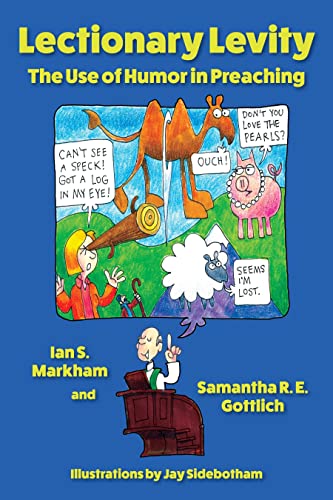
Spanning all 3 years of the lectionary cycle, this book provides a welcome tool for the renewal of preaching from the gospel readings. In a concise, uniform, and simple format, the authors provide a thematic summary of the gospel, list several possible points for preaching, and offer a humorous story for the week that illumines the deeper meaning of the biblical text. Lectionary Levity also functions as a practical manual on how to use humor in preaching and allows the reader to view the gospel in a different light so as to enliven the worship experience. A treasure trove of biblical insights, homiletical helps, and just good humor!
Die Inhaltsangabe kann sich auf eine andere Ausgabe dieses Titels beziehen.
Über die Autorinnen und Autoren
Ian S. Makham is the Dean and President of Virginia Theological Seminary and a Professor of Theology and Ethics. He is the author of numerous books, including Against Atheism and An Introduction to Ministry (co-written with Oran Warder). His awards include the Robertson Fellow; Claggett Fellow attached to Washington National Cathedral; Frank Woods Fellow at Trinity College, Melbourne; and F. D. Maurice Lectures at King’s College, London. He lives in Alexandria, Virginia.
Samantha Gottlich is a graduate of Virginia Theological Seminary and active in ordained ministry in the Episcopal Diocese of Texas. She is the coauthor of Faith Rules: An Episcopal Manual.
Jay Sidebotham serves as Director of RenewalWorks, a ministry of Forward Movement. A graduate of Union Seminary, New York, and ordained to the priesthood in 1990, he has served in parishes in New York, Washington, North Carolina, Rhode Island, and Illinois. Throughout his ministry, he has had a deep commitment to making the Bible accessible to people of all ages, and cartoons have been one of the primary ways he has accomplished that.
Auszug. © Genehmigter Nachdruck. Alle Rechte vorbehalten.
Lectionary Levity
The Use of Humor in Preaching
By Ian S. Markham, Samantha R. E. Gottlich, Jay SidebothamChurch Publishing Incorporated
Copyright © 2017 Ian S. Markham and Samantha R. E. Gottlich
All rights reserved.
ISBN: 978-0-8192-3357-8All rights reserved.
CHAPTER 1
YEAR A
First Sunday of Advent
Matthew 24:36–44
Gospel Summary
Advent is the in-between time. It falls between the two comings of Christ. The first coming of Christ was as a babe in the manger in Bethlehem. From this Christ, we learn about a God who loves us and seeks to invite us to discover the significance and challenge of being loving. In Advent, we anticipate the second coming, when God will finally act in human history to bring about a culmination of all time and usher in an age where goodness, love, and justice all coincide.
In this Gospel, we are forbidden to speculate as to the timing (interestingly, not even the Son knows — which became a major christological issue for the Church Fathers!). Much is made of the analogy with Noah: the first awareness of God's action in the world was when the flood swept away all people. And the Gospel passage culminates with the requirement that we must be "awake" — an exhortation that occurs elsewhere in this Gospel.
Possible Themes for Preaching
• The Advent sense is created by the two comings of Christ: in the first, Christ has revealed the nature of love; in the second, which we anticipate, Christ will hold us to account for our labors of love. We live in between those two times.
• There is accountability for our lives and the way in which we never know when our lives will end.
• There is an obligation to be awake and seek to work out exactly what God is doing in the world.
Humorous Story
A young man appeared before St. Peter at the pearly gates. "So have you ever done anything noteworthy, perhaps even good?" St. Peter asked.
"Well," the man replied, "once I came upon a gang of bikers who were threatening this woman. I headed straight toward the largest and most heavily tattooed biker and smacked him on the head, kicked over his bike, ripped out his nose ring, and threw it on the ground. "'Now leave that woman alone!' I yelled."
St. Peter was impressed: "Wow. When did this happen?"
"Just a couple of minutes ago."
Homiletical Connection
In the end, Jesus wants us to worry less about ourselves and more about those around us. We will be held to account for our focus and orientation. Here we have a man making the care of a woman a priority. Living life ready to do whatever it costs to help others is the point of this Gospel.
Second Sunday of Advent
Matthew 3:1–12
Gospel Summary
Matthew is very careful to ground the narrative of John the Baptist in the Old Testament. The drama that unfolds is anticipated in Scripture. Now the focus is repentance. God is going to do a dramatic work in the world: the time has come for us to prepare ourselves for that moment.
Toward the end of the narrative the focus is on the Pharisees and Sadducees. Just because Abraham is your ancestor, screams John the Baptist, you should not assume that you will not be held accountable by God Almighty for your actions and behavior. It is so tempting to make assumptions — to assume that the demands of the Gospel apply to others and not to ourselves. Those (out there) need to repent, but us (in here) are okay. Advent is an appropriate moment when those who are most religious need to hold the mirror up to ourselves and ask, "To what extent am I living as God requires?"
Possible Themes for Preaching
• Adjustment: we like to imagine that people outside the family of faith are the ones that need to repent, when really it is those inside.
• The whole drama of Advent and Christmas is anticipated in the Old Testament: it is God's plan.
• Repentance might be unfashionable, but it is important work.
Humorous Story
John sits down with his friend Fred, who he knows is a musical genius. John asks Fred about his talent. "It is true," said Fred, "I was a musical prodigy. At three, I composed an opera. At four I wrote a minuet. At five, I wrote a complete symphony — yes, with all the orchestral parts. And at five-thirty, as usual, I went down and had a cup of tea."
Homiletical Connection
Assumptions are made so easily. As Fred is musing, we are assuming that he is describing his age — starting at the age of three. Right at the end, we discover he is talking about the time of day. Right at the end, we make an adjustment from seeing the conversation in terms of years to seeing the conversation in terms of hours. Making an adjustment is a Gospel theme: we need to adjust from assuming that others need to repent to recognizing that actually we need to repent. We need to recognize that accountability for sin isn't just another person's problem, but our problem.
Third Sunday of Advent
Matthew 11:2–11
Gospel Summary
Advent anticipates both the first coming of Jesus as a baby and the second coming of Christ as history comes to culmination. Historically, whenever the Church finds the world a hard and cruel place, expectations around the second coming increase. And each time these expectations are dashed. We are still here and still waiting. So watching John the Baptist have doubts is an appropriate Advent message. Even the person who foretold that Jesus was the Messiah is having his own moment of doubt. He was expecting someone "stronger than I" (Matthew 3:11); Jesus was not always showing such strength.
It is okay to have questions about your faith; it is okay to sometimes wonder if it is true. Remember the axiom: the opposite of faith is not doubt, but certainty. Faith and questions go together. And Jesus gives the simple answer: "Look at what I am doing." Jesus is fulfilling the expectations of Scripture; Jesus is more than words, he is a person of action.
Possible Themes for Preaching
• Having questions about your faith is okay. It is not a betrayal of your faith.
• As a Church, we keep expecting the second coming. But we are still waiting. Sometimes this can be hard.
• The Old Testament is the basis of the question and the source of the answer.
Humorous Story
Q: How do you get an elephant into the refrigerator?
A: Open the door and place the elephant into the refrigerator.
Q: How do you get a giraffe into the refrigerator?
A: Open the door, take out the elephant, and then put the giraffe into the refrigerator.
Q: The King of the Jungle calls a meeting of all the animals. Every single animal turns up save for one. Which one is it?
A: Well, obviously the giraffe — it is stuck in the refrigerator.
Q: You come to a crocodile-infested river. There is no bridge nor boat and you must get across the river. How do you do it?
A: Easy; you wade across. All the crocodiles are at the meeting called by the King of the Jungle.
Homiletical Connection
These jokes are often presented like an intelligence test. Can you work out the right answer in your mind? It is important that we always feel it is okay to bring our intellect into the Church. We are allowed to ask questions; we are allowed to think; we are allowed to wonder whether it is all true.
Fourth Sunday of...
„Über diesen Titel“ kann sich auf eine andere Ausgabe dieses Titels beziehen.
Suchergebnisse für Lectionary Levity: The Use of Humor in Preaching

Beispielbild für diese ISBN
Lectionary Levity : The Use of Humor in Preaching
Verlag:
Church Publishing Incorporated, 2017
ISBN 10: 0819233579
ISBN 13: 9780819233578
Gebraucht
Softcover
Anbieter: Better World Books, Mishawaka, IN, USA
Verkäuferbewertung 5 von 5 Sternen

Zustand: Good. Sidebotham, Jay (illustrator). Pages intact with minimal writing/highlighting. The binding may be loose and creased. Dust jackets/supplements are not included. Stock photo provided. Product includes identifying sticker. Better World Books: Buy Books. Do Good. Bestandsnummer des Verkäufers 67677109-6
Gebraucht kaufen
EUR 20,53
Versand gratis
Versand innerhalb von USA
Versand innerhalb von USA
Anzahl: 1 verfügbar
Beispielbild für diese ISBN
Lectionary Levity: The Use of Humor in Preaching
Anbieter: INDOO, Avenel, NJ, USA
Verkäuferbewertung 5 von 5 Sternen
Zustand: New. Sidebotham, Jay (illustrator). Bestandsnummer des Verkäufers 9780819233578
Foto des Verkäufers
Lectionary Levity
Anbieter: Rarewaves USA, HEBRON, KY, USA
Verkäuferbewertung 5 von 5 Sternen
Paperback. Zustand: New. Sidebotham, Jay (illustrator). Spanning all 3 years of the lectionary cycle, this book provides a welcome tool for the renewal of preaching from the gospel readings. In a concise, uniform, and simple format, the authors provide a thematic summary of the gospel, list several possible points for preaching, and offer a humorous story for the week that illumines the deeper meaning of the biblical text. Lectionary Levity also functions as a practical manual on how to use humor in preaching and allows the reader to view the gospel in a different light so as to enliven the worship experience. A treasure trove of biblical insights, homiletical helps, and just good humor! Bestandsnummer des Verkäufers LU-9780819233578
Beispielbild für diese ISBN
Lectionary Levity: The Use of Humor in Preaching
Anbieter: Revaluation Books, Exeter, Vereinigtes Königreich
Verkäuferbewertung 5 von 5 Sternen
Paperback. Zustand: Brand New. Sidebotham, Jay (illustrator). 304 pages. 9.00x6.00x0.71 inches. In Stock. Bestandsnummer des Verkäufers 0819233579
Neu kaufen
EUR 58,79
EUR 11,84 Versand
Versand von Vereinigtes Königreich nach USA
Versand von Vereinigtes Königreich nach USA
Anzahl: 1 verfügbar
Foto des Verkäufers
Lectionary Levity
Anbieter: Rarewaves USA United, HEBRON, KY, USA
Verkäuferbewertung 5 von 5 Sternen
Paperback. Zustand: New. Sidebotham, Jay (illustrator). Spanning all 3 years of the lectionary cycle, this book provides a welcome tool for the renewal of preaching from the gospel readings. In a concise, uniform, and simple format, the authors provide a thematic summary of the gospel, list several possible points for preaching, and offer a humorous story for the week that illumines the deeper meaning of the biblical text. Lectionary Levity also functions as a practical manual on how to use humor in preaching and allows the reader to view the gospel in a different light so as to enliven the worship experience. A treasure trove of biblical insights, homiletical helps, and just good humor! Bestandsnummer des Verkäufers LU-9780819233578
Neu kaufen
EUR 52,81
EUR 44,64 Versand
Versand innerhalb von USA
Versand innerhalb von USA
Anzahl: 16 verfügbar