
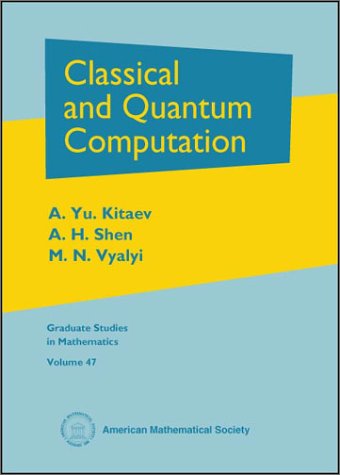
Verwandte Artikel zu Classical and Quantum Computation (Graduate Studies...
Inhaltsangabe
This book is an introduction to a new rapidly developing theory of quantum computing. It begins with the basics of classical theory of computation: Turing machines, Boolean circuits, parallel algorithms, probabilistic computation, NP-complete problems, and the idea of complexity of an algorithm. The second part of the book provides an exposition of quantum computation theory. It starts with the introduction of general quantum formalism (pure states, density matrices, and superoperators), universal gate sets and approximation theorems. Then the authors study various quantum computation algorithms: Grover's algorithm, Shor's factoring algorithm, and the Abelian hidden subgroup problem. In concluding sections, several related topics are discussed (parallel quantum computation, a quantum analog of NP-completeness, and quantum error-correcting codes).Rapid development of quantum computing started in 1994 with a stunning suggestion by Peter Shor to use quantum computation for factoring large numbers - an extremely difficult and time-consuming problem when using a conventional computer. Shor's result spawned a burst of activity in designing new algorithms and in attempting to actually build quantum computers. Currently, the progress is much more significant in the former: a sound theoretical basis of quantum computing is under development and many algorithms have been suggested.In this concise text, the authors provide solid foundations to the theory - in particular, a careful analysis of the quantum circuit model - and cover selected topics in depth. Included are a complete proof of the Solovay-Kitaev theorem with accurate algorithm complexity bounds, approximation of unitary operators by circuits of doubly logarithmic depth. Among other interesting topics are toric codes and their relation to the anyon approach to quantum computing. Prerequisites are very modest and include linear algebra, elements of group theory and probability, and the notion of a formal or an intuitive algorithm. This text is suitable for a course in quantum computation for graduate students in mathematics, physics, or computer science. More than 100 problems (most of them with complete solutions) and an appendix summarizing the necessary results are a very useful addition to the book. It is available in both hardcover and softcover editions.
Die Inhaltsangabe kann sich auf eine andere Ausgabe dieses Titels beziehen.
Suchergebnisse für Classical and Quantum Computation (Graduate Studies...

Foto des Verkäufers
Classical and Quantum Computation (Graduate Studies in Mathematics)
Verlag:
Amer Mathematical Society, 2002
ISBN 10: 0821832298
ISBN 13: 9780821832295
Gebraucht
Softcover
Anbieter: Austin Goodwill 1101, Austin, TX, USA
Verkäuferbewertung 5 von 5 Sternen

Zustand: good. Book shows general signs of use and handling. May have light wear on the cover or edges and minimal writing or highlighting. Binding remains tight, and pages are clean and readable. Bestandsnummer des Verkäufers CTXV.0821832298.G
Gebraucht kaufen
EUR 21,69
EUR 2,93 Versand
Versand innerhalb von USA
Versand innerhalb von USA
Anzahl: 1 verfügbar
Foto des Verkäufers
Classical and Quantum Computation (Graduate Studies in Mathematics)
Verlag:
Amer Mathematical Society, 2002
ISBN 10: 0821832298
ISBN 13: 9780821832295
Gebraucht
Softcover
Anbieter: Goodbooks Company, Springdale, AR, USA
Verkäuferbewertung 5 von 5 Sternen
Zustand: acceptable. This copy does have liquid damage. Bestandsnummer des Verkäufers GBV.0821832298.A
Gebraucht kaufen
EUR 20,77
EUR 4,43 Versand
Versand innerhalb von USA
Versand innerhalb von USA
Anzahl: 1 verfügbar
Beispielbild für diese ISBN
Classical and Quantum Computation
Verlag:
Amer Mathematical Society, 2002
ISBN 10: 0821832298
ISBN 13: 9780821832295
Gebraucht
Softcover
Anbieter: GreatBookPrices, Columbia, MD, USA
Verkäuferbewertung 5 von 5 Sternen
Zustand: As New. Unread book in perfect condition. Bestandsnummer des Verkäufers 2431563
Gebraucht kaufen
EUR 60,43
EUR 2,35 Versand
Versand innerhalb von USA
Versand innerhalb von USA
Anzahl: 1 verfügbar
Beispielbild für diese ISBN
Classical and Quantum Computation (Graduate Studies in Mathematics)
Anbieter: Revaluation Books, Exeter, Vereinigtes Königreich
Verkäuferbewertung 5 von 5 Sternen
Paperback. Zustand: Brand New. uk ed. edition. 272 pages. 10.25x7.25x0.50 inches. In Stock. Bestandsnummer des Verkäufers 0821832298
Neu kaufen
EUR 55,03
EUR 11,79 Versand
Versand von Vereinigtes Königreich nach USA
Versand von Vereinigtes Königreich nach USA
Anzahl: 1 verfügbar
Foto des Verkäufers
Classical and Quantum Computation
Anbieter: GreatBookPrices, Columbia, MD, USA
Verkäuferbewertung 5 von 5 Sternen
Zustand: New. Bestandsnummer des Verkäufers 2431563-n
Neu kaufen
EUR 66,41
EUR 2,35 Versand
Versand innerhalb von USA
Versand innerhalb von USA
Anzahl: 1 verfügbar
Beispielbild für diese ISBN
Classical and Quantum Computation (eng)
Anbieter: Brook Bookstore On Demand, Napoli, NA, Italien
Verkäuferbewertung 5 von 5 Sternen
Zustand: new. Bestandsnummer des Verkäufers 395dab1a4461bc7944f4f37ef9e39492
Neu kaufen
EUR 77,03
EUR 5,50 Versand
Versand von Italien nach USA
Versand von Italien nach USA
Anzahl: 5 verfügbar
Beispielbild für diese ISBN
Classical and Quantum Computation
Verlag:
American Mathematical Society, 2002
ISBN 10: 0821832298
ISBN 13: 9780821832295
Neu
Softcover
Anbieter: Kennys Bookshop and Art Galleries Ltd., Galway, GY, Irland
Verkäuferbewertung 5 von 5 Sternen
Zustand: New. 2002. Paperback. Presents an introduction to the theory of quantum computing. This book starts with the basics of classical theory of computation: Turing machines, Boolean circuits, parallel algorithms, probabilistic computation, NP-complete problems, and the idea of complexity of an algorithm. It provides an exposition of quantum computation theory. Series: Graduate Studies in Mathematics. Num Pages: 272 pages, Illustrations. BIC Classification: PBW; PHQ; UYA. Category: (P) Professional & Vocational. Dimension: 254 x 177 x 13. Weight in Grams: 478. . . . . . Bestandsnummer des Verkäufers V9780821832295
Neu kaufen
EUR 82,31
EUR 9,50 Versand
Versand von Irland nach USA
Versand von Irland nach USA
Anzahl: 1 verfügbar
Beispielbild für diese ISBN
Classical and Quantum Computation
Anbieter: PBShop.store UK, Fairford, GLOS, Vereinigtes Königreich
Verkäuferbewertung 5 von 5 Sternen
PAP. Zustand: New. New Book. Shipped from UK. Established seller since 2000. Bestandsnummer des Verkäufers FW-9780821832295
Neu kaufen
EUR 96,85
EUR 4,90 Versand
Versand von Vereinigtes Königreich nach USA
Versand von Vereinigtes Königreich nach USA
Anzahl: 5 verfügbar
Foto des Verkäufers
Classical and Quantum Computation
Verlag:
American Mathematical Society, US, 2002
ISBN 10: 0821832298
ISBN 13: 9780821832295
Neu
Paperback
Anbieter: Rarewaves.com USA, London, LONDO, Vereinigtes Königreich
Verkäuferbewertung 5 von 5 Sternen
Paperback. Zustand: New. This book is an introduction to a new rapidly developing theory of quantum computing. It begins with the basics of classical theory of computation: Turing machines, Boolean circuits, parallel algorithms, probabilistic computation, NP-complete problems, and the idea of complexity of an algorithm. The second part of the book provides an exposition of quantum computation theory. It starts with the introduction of general quantum formalism (pure states, density matrices, and superoperators), universal gate sets and approximation theorems. Then the authors study various quantum computation algorithms: Grover's algorithm, Shor's factoring algorithm, and the Abelian hidden subgroup problem. In concluding sections, several related topics are discussed (parallel quantum computation, a quantum analog of NP-completeness, and quantum error-correcting codes).Rapid development of quantum computing started in 1994 with a stunning suggestion by Peter Shor to use quantum computation for factoring large numbers - an extremely difficult and time-consuming problem when using a conventional computer. Shor's result spawned a burst of activity in designing new algorithms and in attempting to actually build quantum computers. Currently, the progress is much more significant in the former: a sound theoretical basis of quantum computing is under development and many algorithms have been suggested.In this concise text, the authors provide solid foundations to the theory - in particular, a careful analysis of the quantum circuit model - and cover selected topics in depth. Included are a complete proof of the Solovay-Kitaev theorem with accurate algorithm complexity bounds, approximation of unitary operators by circuits of doubly logarithmic depth. Among other interesting topics are toric codes and their relation to the anyon approach to quantum computing. Prerequisites are very modest and include linear algebra, elements of group theory and probability, and the notion of a formal or an intuitive algorithm. This text is suitable for a course in quantum computation for graduate students in mathematics, physics, or computer science. More than 100 problems (most of them with complete solutions) and an appendix summarizing the necessary results are a very useful addition to the book. It is available in both hardcover and softcover editions. Bestandsnummer des Verkäufers LU-9780821832295
Neu kaufen
EUR 103,25
Versand gratis
Versand von Vereinigtes Königreich nach USA
Versand von Vereinigtes Königreich nach USA
Anzahl: 3 verfügbar
Beispielbild für diese ISBN
Classical and Quantum Computation (Graduate Studies in Mathematics)
Anbieter: Revaluation Books, Exeter, Vereinigtes Königreich
Verkäuferbewertung 5 von 5 Sternen
Paperback. Zustand: Brand New. uk ed. edition. 272 pages. 10.25x7.25x0.50 inches. In Stock. Bestandsnummer des Verkäufers __0821832298
Neu kaufen
EUR 95,93
EUR 11,79 Versand
Versand von Vereinigtes Königreich nach USA
Versand von Vereinigtes Königreich nach USA
Anzahl: 3 verfügbar