
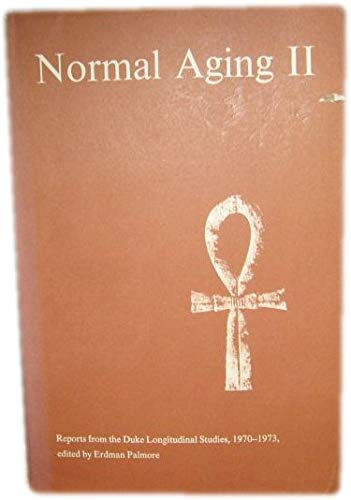
Normal Aging II: Reports from the Duke Longitudinal Studies, 1970-1973: Reports from the Duke Longitudinal Study, 1970-1973 - Hardcover
Inhaltsangabe
Since they began in 1955, the Duke Longitudinal Studies have aging have been regarded as landmark investigations, amassing invaluable data on the typical physical changes that accompany aging, typical patterns of mental health and mental illness, psychological aging, and the normal social roles, self-concepts, satisfactions, and adjustments to retirement of the aged. Comprising information on more than 750 aged and middle-aged persons, these studies have contributed enormously to our ability to distinguish normal and inevitable processes of aging from those that may accompany aging because of accident, stress, maladjustment, or disuse.
Die Inhaltsangabe kann sich auf eine andere Ausgabe dieses Titels beziehen.
Auszug. © Genehmigter Nachdruck. Alle Rechte vorbehalten.
Normal Aging II
Reports from the Duke Longitudinal Studies, 1970-1973
By Erdman PalmoreDuke University Press
Copyright © 1974 Duke University Press
All rights reserved.
ISBN: 978-0-8223-0311-4All rights reserved.
Contents
Foreword,
Contributors,
Figures,
Tables,
Chapter 1. Introduction,
Chapter 2. Physical Aging,
Chapter 3. Health Care,
Chapter 4. Mental Aging,
Chapter 5. Mental Illness,
Chapter 6. Social Roles and Self-Concepts,
Chapter 7. Leisure and Sexual Behavior,
Chapter 8. Longevity,
Chapter 9. Summary,
Appendix A. Design of the Adaptation Study,
Appendix B. Data Processing in Longitudinal Studies,
Index,
CHAPTER 1
Introduction
This volume is the sequel to Normal Aging: Reports from the Duke Longitudinal Study, 1955-1969. Its purpose is to bring together and summarize the main findings which build upon and extend those presented in the first volume. It contains all the reports from the Duke Longitudinal Studies published since 1969 as well as an almost equal number of papers presented at professional meetings or written especially for this volume. These reports present new findings on aging among the older longitudinal panel as well as the first findings on the middle-aged panel.
Both of these volumes deal with "normal aging" in two senses: healthy aging and typical aging. The aged and middle-aged persons studied were relatively healthy in that they were noninstitutionalized, ambulatory, community residents who were willing and able to come to the Duke Medical Center for one or two days of tests and examinations. Second, the more common or typical patterns and problems of aging are focused upon rather than the unusual abnormalities. This volume deals with the typical physical changes that accompany aging, typical health care patterns, typical patterns of mental aging, some common forms of mental illness among the aged, the normal social roles, self concepts, satisfactions, leisure and sexual behavior, and the overall factors related to longevity.
As pointed out in the first volume, investigations of normal aging are of crucial importance in advancing the science of gerontology and in helping aged persons develop and enjoy a richer and longer life. When we can distinguish normal and inevitable processes of aging from those which may accompany aging simply because of accident, stress, maladjustment, or disuse, we can better focus our attention and efforts on those factors which can be changed and corrected.
Both volumes also emphasize the theoretical and methodological advantages of the longitudinal and interdisciplinary methods used in these studies. Since aging is by definition a process of change over time, it would seem that the best way to study aging is longitudinally, by repeated observations over time. This is not meant to deny the value of cross-sectional studies, nor to deny the technical and methodological problems connected with longitudinal study, but it is meant to reassert the unique advantages of longitudinal studies such as the following: each panel member can be used as his own control, consistent trends can be distinguished from temporary fluctuations, errors due to retrospective distortion are minimized, early warning signs of disease or death can be studied, cohort differences can be distinguished from age changes, and the effects of one kind of change on another kind of change at a later time period can be studied.
The interdisciplinary nature of the study is useful because aging affects many interrelated types of behavior and functioning. When specialists from different disciplines work together, the mutual stimulation, correction, and combination of perspectives can result in more accurate, thorough, and comprehensive understanding of the aging process.
However, this sequel differs from the first volume in several respects. While most of the reports in the first volume were previously published elsewhere, this sequel contains fifteen original papers written especially for this volume or presented to professional meetings but not published elsewhere. Second, while the first volume was limited to reports from the first longitudinal study of aging (persons over 60 years of age), this sequel is about one-third devoted to reports from the Adaptation Study of middle-aged persons (46-70 years of age). Third, this sequel shows that the tempo of reports produced has increased, because it contains thirty-five reports produced in the past four years (about nine per year) compared to the fifty basic reports in the first volume which were produced during the preceeding fourteen years (about three and one-half per year).
The reader who is interested in detailed description and discussion of the first longitudinal study of aging is referred to chapter 1 of the first Normal Aging volume. Suffice it to say here that the first longitudinal study of aging began in 1955 with 271 persons 60-90 years of age. The subjects were not a strictly representative sample, but were selected from a pool of volunteers who lived in the community so that the overall sample reflected the age, sex, ethnic, and socioeconomic characteristics of the older population in Durham, N.C. Each panelist was brought in to the Medical Center for a two-day long series of medical, psychiatric, psychological, and social examinations. These examinations were repeated every three or four years until 1965, every two years until 1972, and since then the examinations are being repeated on an annual basis. In 1973, the eighth round of examinations on the survivors of this study was completed.
The second longitudinal study, or Adaptation Study, was begun in 1968 with 502 persons 46-70 years of age. These panelists were a random sample of the members of the local health insurance association stratified by age and sex. The sample and study was designed so that at the end of five years there would remain approximately 40 persons in each of ten five-year age-sex cohorts. This design makes possible various kinds of cross-sequential types of analyses in order to separate the effects of aging from cohort differences and from changes in the environment over time. Each subject was brought in for a one-day long series of physical, mental, and social examinations. The panelists are reexamined at two-year intervals and in 1973 the third round of examinations was completed. For more details and discussion of the adaptation study design, the reader is referred to Appendix A in this volume.
The articles which are reprinted by permission from various journals are presented with no deletions except for duplicate passages such as those that repeat the description of the panelists. Deletions of a sentence or more in these articles are indicated by ellipses, and minor changes have been made for uniformity. Since most of the reports are interdisciplinary, the placement of some reports in one chapter rather than another was somewhat arbitrary, but an attempt was made to group reports by the type of central variable under investigation. Each chapter first presents the reports from the first longitudinal study and then reports from the Adaptation Study. Brief summaries of the reports introduce the chapters, and the book closes with an overall summary of the main findings and themes. The reader may wish to start with these summaries in order to decide which reports to read in more detail.
We appreciate the cooperation of the many authors and journals or publishers for their permission to reprint their articles. Special thanks are due to Mrs....
„Über diesen Titel“ kann sich auf eine andere Ausgabe dieses Titels beziehen.
Suchergebnisse für Normal Aging II: Reports from the Duke Longitudinal...

Beispielbild für diese ISBN
Normal Aging: Reports from the Duke Longitudinal Studies, 1970-1973, Volume II
Verlag:
Duke University Press, Durham, 1974
ISBN 10: 0822303116
ISBN 13: 9780822303114
Gebraucht
Hardcover
Anbieter: PsychoBabel & Skoob Books, Didcot, Vereinigtes Königreich
Verkäuferbewertung 5 von 5 Sternen

hardcover. Zustand: Good. Zustand des Schutzumschlags: Good. Hardcover. Dust jacket is marked. Jacket spine is faded. Minor tear on front of jacket. Jacket leading corners, edges and spine ends are worn. Jacket spine foot is chipped. Hardcover spine ends and leading corners are a little bumped. A few light marks on page block. Binding is intact, contents are clean and clear. AM. Used. Bestandsnummer des Verkäufers 409983
Gebraucht kaufen
EUR 13,21
EUR 14,33 Versand
Versand von Vereinigtes Königreich nach USA
Versand von Vereinigtes Königreich nach USA
Anzahl: 1 verfügbar
Beispielbild für diese ISBN
Normal Aging II: Reports from the Duke Longitudinal Studies, 1970â"1973 (v. 2)
Verlag:
Duke University Press Books, 1974
ISBN 10: 0822303116
ISBN 13: 9780822303114
Gebraucht
Hardcover
Anbieter: Midtown Scholar Bookstore, Harrisburg, PA, USA
Verkäuferbewertung 5 von 5 Sternen
Hardcover. Zustand: Good. torn/chipped dj, some wear, still NICE - may have remainder mark or previous owner's name Standard-sized. Bestandsnummer des Verkäufers 0822303116-01
Gebraucht kaufen
EUR 26,33
EUR 5,16 Versand
Versand innerhalb von USA
Versand innerhalb von USA
Anzahl: 1 verfügbar
Beispielbild für diese ISBN
Normal Aging II: Reports from the Duke Longitudinal Studies, 1970-1973
Anbieter: THE SAINT BOOKSTORE, Southport, Vereinigtes Königreich
Verkäuferbewertung 5 von 5 Sternen
Hardback. Zustand: Good. Used copy in good condition - Usually dispatched within 3 working days. Bestandsnummer des Verkäufers D9780822303114
Gebraucht kaufen
EUR 16,18
EUR 23,78 Versand
Versand von Vereinigtes Königreich nach USA
Versand von Vereinigtes Königreich nach USA
Anzahl: 1 verfügbar
Beispielbild für diese ISBN
Normal Aging II
Verlag:
Duke University Press, Durham , NC, 1974
ISBN 10: 0822303116
ISBN 13: 9780822303114
Gebraucht
Hardcover
Erstausgabe
Anbieter: PEND BOOKS, Newton Stewart, Vereinigtes Königreich
Verkäuferbewertung 3 von 5 Sternen

Cloth. Zustand: Very Good. Zustand des Schutzumschlags: Very Good. First Edition. Sequel to the first volume. 316pp. Brown cloth with brown printed dj. Bestandsnummer des Verkäufers 31984
Gebraucht kaufen
EUR 7,09
EUR 74,53 Versand
Versand von Vereinigtes Königreich nach USA
Versand von Vereinigtes Königreich nach USA
Anzahl: 1 verfügbar
Beispielbild für diese ISBN
Normal Aging II: Reports from the Duke Longitudinal Studies, 1970-1973
Anbieter: Buchpark, Trebbin, Deutschland
Verkäuferbewertung 5 von 5 Sternen
Zustand: Gut. Zustand: Gut | Seiten: 336 | Sprache: Englisch | Produktart: Bücher | Keine Beschreibung verfügbar. Bestandsnummer des Verkäufers 25720267/203
Gebraucht kaufen
EUR 18,94
EUR 105,00 Versand
Versand von Deutschland nach USA
Versand von Deutschland nach USA
Anzahl: 1 verfügbar