
Verwandte Artikel zu What Makes Sound Patterns Expressive? The Poetic Mode...
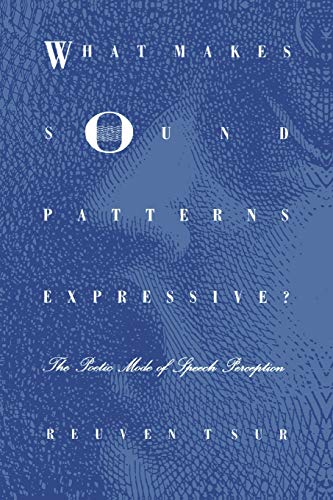
What Makes Sound Patterns Expressive? The Poetic Mode of Speech Perception (Sound and Meaning: The Roman Jakobson Linguistics and Poetics) - Softcover
Inhaltsangabe
Poets, academics, and those who simply speak a language are subject to mysterious intuitions about the perceptual qualities and emotional symbolism of the sounds of speech. Such intuitions are Reuven Tsur's point of departure in this investigation into the expressive effect of sound patterns, addressing questions of great concern for literary theorists and critics as well as for linguists and psychologists.
Research in recent decades has established two distinct types of aural perception: a nonspeech mode, in which the acoustic signals are received in the manner of musical sounds or natural noises; and a speech mode, in which acoustic signals are excluded from awareness and only an abstract phonetic category is perceived. Here, Tsur proposes a third type of speech perception, a poetic mode in which some part of the acoustic signal becomes accessible, however faintly, to consciousness.
Using Roman Jakobson's model of childhood acquisition of the phonological system, Tsur shows how the nonreferential babbling sounds made by infants form a basis for aesthetic valuation of language. He tests the intersubjective and intercultural validity of various spatial and tactile metaphors for certain sounds. Illustrating his insights with reference to particular literary texts, Tsur considers the relative merits of cognitive and psychoanalytic approaches to the emotional symbolism of speech sounds.
Die Inhaltsangabe kann sich auf eine andere Ausgabe dieses Titels beziehen.
Von der hinteren Coverseite
Poets, academics, and those who simply speak a language are subject to mysterious intuitions about the perceptual qualities and emotional symbolism of the sounds of speech. Such intuitions are Reuven Tsur's point of departure in this investigation into the expressive effect of sound patterns, addressing questions of great concern for literary theorists and critics as well as linguists and psychologists.
Auszug. © Genehmigter Nachdruck. Alle Rechte vorbehalten.
What Makes Sound Patterns Expressive?
The Poetic Mode of Speech Perception
By Reuven TsurDuke University Press
Copyright © 1992 Duke University Press
All rights reserved.
ISBN: 978-0-8223-1170-6All rights reserved.
Contents
Preface,
1 How Do Sound Patterns Know They Are Expressive? The Poetic Mode of Speech Perception,
2 On Musicality in Verse and Phonological Universals,
3 Some Spatial and Tactile Metaphors for Sounds,
4 A Reading of Rimbaud's "Voyelles",
5 Psychoanalytic or Cognitive Explanation,
References,
Index,
CHAPTER 1
How Do Sound Patterns Know They Are Expressive? The Poetic Mode of Speech Perception
Expressive Sound Patterns
Children often ask: "How does the dog know that barking dogs don't bite"? Similarly, it seems worth asking: May we attribute to dogs and sounds just any property we like, or is there something in the nature of dogs and sounds that warrants the attribution of these properties and renders their behavior consistent? Literary critics and ordinary readers usually have strong intuitions about the expressiveness of sound patterns in poetry. A vast literature exists on the subject; however, much of it is ad hoc, arbitrary, or skeptical. "It is precisely critics interested in the meaning and idea-content of poetry," says Hrushovski (1968: 410), "that feel some kind of embarrassment toward the existence of sound organization, and attempt to enlist it in the service of the total interpretation. As against this approach there are critics and theoreticians who deny all in all the very existence of specific meanings attributable to specific sounds."
In what follows I shall adopt Hrushovski's approach, according to which the various language sounds have certain general potentialities of meaningful impression (412) and can be combined with other elements so that they impress the reader as if they expressed some specific meaning (411). My claim is that these general potentialities—which I shall refer to as combinational potential—have firm, intersubjective foundations on the acoustic, phonetic, or phonological levels of the sound structure of language. More specifically, I shall rely on a simplified version of the mechanism as put forward by Liberman and his colleagues at the Haskins Laboratories, by which listeners decode the sounds and recover the phonemes.
Hrushovski claims that much of the dispute over whether sound can or cannot be expressive comes to a dead end because the issue is treated as if it were one phenomenon. "As a matter of fact, there are several kinds of relations between sound and meaning, and in each kind the problem is revealed in different forms" (412). He discusses four kinds of such relations: (a) Onomatopoeia; (b) Expressive Sounds; (c) Focusing Sound Patterns; (d) Neutral Sound Patterns. The main business of this book concerns the second of these relations, but my discussions will have some implications for the first. Hrushovski describes expressive sound pattern as follows: "A sound combination is grasped as expressive of the tone, mood or some general quality of meaning. Here, an abstraction from the sound pattern (i.e. some kind of tone or 'quality' of the sounds is parallel to an abstraction from the meaning of the words (tone, mood etc.)" (444).
Traditional poetics has important things to say about how "tone, mood etc." are abstracted from the meaning of the words. But how are they abstracted from the speech sounds? In this chapter I shall look into some possible sources of the "tone" or "quality" of the sounds and the way that tone or quality is grasped in relation to an abstraction from the meaning of the words (tone, mood, emotion, etc.). One important aspect of the issue is that sounds are what I call "double-edged"; that is, they may be expressive of vastly different, or even opposing, qualities. Thus, the sibilants /s/ and /š/ may have a hushing quality in one context and a harsh quality to varying degrees in some others. Hrushovski quotes Poe's line
And the silken, sad, uncertain rustling of each purple curtain
where the sibilants may be onomatopoetic, imitating the noises; or they may reinforce—or be expressive of—a quiet mood in Shakespeare's sonnet:
When to the sessions of sweet, silent thought
I summon up remembrance of things past,
I sigh the lack of many a thing I sought,
And with old woes new wail my dear time's waste.
My argument relies on the assumption that sounds are bundles of features on the acoustic, phonetic, and phonological levels. The various features may have different expressive potentialities. The claim I shallelaborate is that in different contexts, different potentialities of the various features of the same sounds may be realized. Thus, the sibilants /s/ and /š/ at some level of description may have features with noisy potential and others with hushing potential. In Poe's line the former is realized by the contents, in Shakespeare's quatrain the latter.
At the beginning of Fónagy's article on communication in poetry (1961), statistical methods are applied to the expressive correspondence between mood and sound quality in poetry. This work is of particular interest for at least two reasons. First, it does not investigate the relations of sounds with specific themes, but with highly generic moods: tender and aggressive. Second, it does not consider these moods in isolation, but as a pair of opposites whose mutual relations may be treated in terms of more/less rather than in absolute terms. The data Fónagy presents are illuminating and highly suggestive. In six especially tender and six especially aggressive poems by the Hungarian poet Sándor Petofi,
the majority of sounds occur with the same relative frequency in both groups. All the more striking is the fact that the frequency of certain sounds shows a significant difference in both groups. The phonemes /l/, /m/, and /n/ are definitely more frequent in tender-toned poems, whereas /k/, /t/, and /r/ predominate in those with aggressive tone. For some reason, precisely these sounds seem to be the most significantly correlated with aggression, either positively, or negatively. (195)
The phonemes /m/ and /n/ have a similar negative correlation with aggression in poems by Hugo and Verlaine; /l/ is overwhelmingly tender for Verlaine, but not for Hugo. The voiceless stops /k/ and /t/ are significantly less frequent in tender poems by Petofi, Verlaine and Hugo, and Rückert (Hungarian, French, and German poets). So, this distribution is surely not language-dependent. It would be interesting to know, to what extent if at all, "double-edgedness" is responsible for the equal distribution of other sounds in both groups of poems, owing to conflicting features' canceling out each others' influence (I shall try to answer this question later on). As for vowels, Fónagy mentions Macdermott who, through a statistical analysis of English poems, found that dark vowels are more frequent in lines referring to dark colors, mystic obscurity, or slow and heavy movement, or depicting hatred and struggle (Fónagy, 1961: 194). From this summary, one might expect to find a greater frequency of dark vowels in aggressive poems than in tender ones. Fónagy's investigation of Petofi's poetry reveals that this is indeed the case (for the other poets, he gives only the consonant distribution). Whereas dark vowels occurred in Standard Hungarian 38.88 percent of the time, in Petofi's aggressive poems it was 44.38 percent,...
„Über diesen Titel“ kann sich auf eine andere Ausgabe dieses Titels beziehen.
Suchergebnisse für What Makes Sound Patterns Expressive? The Poetic Mode...

Beispielbild für diese ISBN
What Makes Sound Patterns Expressive?: The Poetic Mode of Speech Perception
Verlag:
Duke University Press, Durham, NC, 1992
ISBN 10: 0822311704
ISBN 13: 9780822311706
Gebraucht
Trade Paperback
Anbieter: Emily's Books, Brainerd, MN, USA
Verkäuferbewertung 5 von 5 Sternen

Trade Paperback. Zustand: Very Good-. There is light soiling to the top page edges otherwise this is a clean book with light to moderate wear. Size: 8vo - over 7¾" - 9¾" tall. Bestandsnummer des Verkäufers 058987
Gebraucht kaufen
EUR 13,71
EUR 4,35 Versand
Versand innerhalb von USA
Versand innerhalb von USA
Anzahl: 1 verfügbar
Beispielbild für diese ISBN
What Makes Sound Patterns Expressive?: The Poetic Mode of Speech Perception
Verlag:
Duke University Press, Durham, NC, 1992
ISBN 10: 0822311704
ISBN 13: 9780822311706
Gebraucht
Soft cover
Anbieter: Used Esoteric Books, Fairfax, CA, USA
Verkäuferbewertung 5 von 5 Sternen
Soft cover. Zustand: Fine. Soft Cover, 174 pp. [==] Fine. Appears unread, slight edgewear, unmarked pages. Bestandsnummer des Verkäufers 7268
Gebraucht kaufen
EUR 20,81
EUR 3,51 Versand
Versand innerhalb von USA
Versand innerhalb von USA
Anzahl: 1 verfügbar
Beispielbild für diese ISBN
What Makes Sound Patterns Expressive? The Poetic Mode of Speech Perception.
Verlag:
Duke University Press, c.1992,, 1992
ISBN 10: 0822311704
ISBN 13: 9780822311706
Gebraucht
paperback,
Anbieter: Harry Alter, Sylva, NC, USA
Verkäuferbewertung 5 von 5 Sternen
paperback, Zustand: Very Good, Duke University Press, c.1992, trade paperbk.prtg., 174pp., NF $. Bestandsnummer des Verkäufers 104725
Gebraucht kaufen
EUR 22,62
EUR 3,47 Versand
Versand innerhalb von USA
Versand innerhalb von USA
Anzahl: 1 verfügbar
Foto des Verkäufers
What Makes Sound Patterns Expressive? : The Poetic Mode of Speech Perception
Anbieter: GreatBookPrices, Columbia, MD, USA
Verkäuferbewertung 5 von 5 Sternen
Zustand: As New. Unread book in perfect condition. Bestandsnummer des Verkäufers 202717
Gebraucht kaufen
EUR 30,94
EUR 2,32 Versand
Versand innerhalb von USA
Versand innerhalb von USA
Anzahl: 1 verfügbar
Beispielbild für diese ISBN
What Makes Sound Patterns Expressive?
Anbieter: PBShop.store UK, Fairford, GLOS, Vereinigtes Königreich
Verkäuferbewertung 5 von 5 Sternen
PAP. Zustand: New. New Book. Shipped from UK. Established seller since 2000. Bestandsnummer des Verkäufers FW-9780822311706
Neu kaufen
EUR 30,06
EUR 4,84 Versand
Versand von Vereinigtes Königreich nach USA
Versand von Vereinigtes Königreich nach USA
Anzahl: 1 verfügbar
Foto des Verkäufers
What Makes Sound Patterns Expressive? : The Poetic Mode of Speech Perception
Anbieter: GreatBookPrices, Columbia, MD, USA
Verkäuferbewertung 5 von 5 Sternen
Zustand: New. Bestandsnummer des Verkäufers 202717-n
Neu kaufen
EUR 32,89
EUR 2,32 Versand
Versand innerhalb von USA
Versand innerhalb von USA
Anzahl: 1 verfügbar
Beispielbild für diese ISBN
What Makes Sound Patterns Expressive?: The Poetic Mode of Speech Perception (Sound and Meaning: The Roman Jakobson Series in Linguistics and Poetics)
Anbieter: California Books, Miami, FL, USA
Verkäuferbewertung 4 von 5 Sternen

Zustand: New. Bestandsnummer des Verkäufers I-9780822311706
Neu kaufen
EUR 35,29
Versand gratis
Versand innerhalb von USA
Versand innerhalb von USA
Anzahl: Mehr als 20 verfügbar
Beispielbild für diese ISBN
What Makes Sound Patterns Expressive? The Poetic Mode of Speech Perception
Print-on-DemandAnbieter: Revaluation Books, Exeter, Vereinigtes Königreich
Verkäuferbewertung 5 von 5 Sternen
Paperback. Zustand: Brand New. 188 pages. 9.25x6.00x0.75 inches. In Stock. This item is printed on demand. Bestandsnummer des Verkäufers __0822311704
Neu kaufen
EUR 30,89
EUR 11,63 Versand
Versand von Vereinigtes Königreich nach USA
Versand von Vereinigtes Königreich nach USA
Anzahl: 1 verfügbar
Beispielbild für diese ISBN
What Makes Sound Patterns Expressive?
Anbieter: Kennys Bookshop and Art Galleries Ltd., Galway, GY, Irland
Verkäuferbewertung 5 von 5 Sternen
Zustand: New. Poets, academics, and those who simply speak a language are subject to mysterious intuitions about the perceptual qualities and emotional symbolism of the sounds of speech. This title investigates the expressive effect of sound patterns, addressing questions of concern for literary theorists and critics as well as for linguists and psychologists. Series: Sound & Meaning; the Roman Jakobson Series in Linguistics and Poetics. Num Pages: 188 pages, Illustrations. BIC Classification: CFH. Category: (P) Professional & Vocational. Dimension: 229 x 149 x 16. Weight in Grams: 284. . 1992. Paperback. . . . . Bestandsnummer des Verkäufers V9780822311706
Neu kaufen
EUR 33,64
EUR 9,50 Versand
Versand von Irland nach USA
Versand von Irland nach USA
Anzahl: 1 verfügbar
Foto des Verkäufers
What Makes Sound Patterns Expressive?
Anbieter: Rarewaves USA, HEBRON, KY, USA
Verkäuferbewertung 5 von 5 Sternen
Paperback. Zustand: New. Poets, academics, and those who simply speak a language are subject to mysterious intuitions about the perceptual qualities and emotional symbolism of the sounds of speech. Such intuitions are Reuven Tsur's point of departure in this investigation into the expressive effect of sound patterns, addressing questions of great concern for literary theorists and critics as well as for linguists and psychologists.Research in recent decades has established two distinct types of aural perception: a nonspeech mode, in which the acoustic signals are received in the manner of musical sounds or natural noises; and a speech mode, in which acoustic signals are excluded from awareness and only an abstract phonetic category is perceived. Here, Tsur proposes a third type of speech perception, a poetic mode in which some part of the acoustic signal becomes accessible, however faintly, to consciousness.Using Roman Jakobson's model of childhood acquisition of the phonological system, Tsur shows how the nonreferential babbling sounds made by infants form a basis for aesthetic valuation of language. He tests the intersubjective and intercultural validity of various spatial and tactile metaphors for certain sounds. Illustrating his insights with reference to particular literary texts, Tsur considers the relative merits of cognitive and psychoanalytic approaches to the emotional symbolism of speech sounds. Bestandsnummer des Verkäufers LU-9780822311706
Neu kaufen
EUR 43,96
Versand gratis
Versand innerhalb von USA
Versand innerhalb von USA
Anzahl: Mehr als 20 verfügbar