
Inhaltsangabe
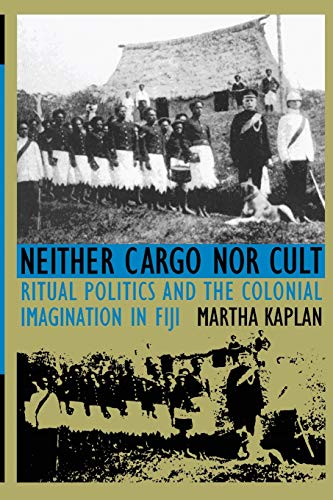
In the 1880s an oracle priest, Navosavakadua, mobilized Fijians of the hinterlands against the encroachment of both Fijian chiefs and British colonizers. British officials called the movement the Tuka cult, imagining it as a contagious superstition that had to be stopped. Navosavakadua and many of his followers, deemed "dangerous and disaffected natives," were exiled. Scholars have since made Tuka the standard example of the Pacific cargo cult, describing it as a millenarian movement in which dispossessed islanders sought Western goods by magical means. In this study of colonial and postcolonial Fiji, Martha Kaplan examines the effects of narratives made real and traces a complex history that began neither as a search for cargo, nor as a cult.
Engaging Fijian oral history and texts as well as colonial records, Kaplan resituates Tuka in the flow of indigenous Fijian history-making and rereads the archives for an ethnography of British colonizing power. Proposing neither unchanging indigenous culture nor the inevitable hegemony of colonial power, she describes the dialogic relationship between plural, contesting, and changing articulations of both Fijian and colonial culture.
A remarkable enthnographic account of power and meaning, Neither Cargo nor Cult addresses compelling questions within anthropological theory. It will attract a wide audience among those interested in colonial and postcolonial societies, ritual and religious movements, hegemony and resistance, and the Pacific Islands.
Die Inhaltsangabe kann sich auf eine andere Ausgabe dieses Titels beziehen.
Über die Autorin bzw. den Autor
Martha Kaplan is Assistant Professor of Anthropology at Vassar College.
Von der hinteren Coverseite
"An extraordinary book. Martha Kaplan's cultural analysis of Fijian politics is complex and subtle."--Henry J. Rutz, Hamilton College
Auszug. © Genehmigter Nachdruck. Alle Rechte vorbehalten.
Neither Cargo Nor Cult
Ritual Politics and the Colonial Imagination in Fiji
By Martha KaplanDuke University Press
Copyright © 1995 Duke University Press
All rights reserved.
ISBN: 978-0-8223-1593-3All rights reserved.
Contents
List of Figures,
Preface,
Acknowledgments,
1 Introduction: Culture, History, and Colonialism,
2 Embattled People of the Land: The ra Social Landscape, 1840–1875,
3 Navosavakadua as Priest of the Land,
4 Colonial Constructions of Disorder: Navosavakadua as "Dangerous and Disaffected Native",
5 Navosavakadua's Ritual Polity,
6 Routinizing Articulating Systems: Jehovah and the People of the Land, 1891–1940,
7 Narratives of Navosavakadua in the 1980s and 1990s,
8 Navosavakadua Among the Vatukaloko,
9 Conclusion: do Cults Exist? do States Exist?,
Bibliography,
CHAPTER 1
INTRODUCTION: CULTURE, HISTORY, AND COLONIALISM
Agency and Meaning in Colonial History
What shapes the lives of colonized people? Is their agency a product of indigenous cultural systematics, rejecting, encompassing, transforming external change? Or is colonial power the prevailing force in their lives; do they respond to, react to, resist incursion, in an agency already therefore shaped by colonial hegemonic structures? How are anthropologists to understand encounters, conjunctures, domination, asymmetries of power, beyond first contact moments into the complex societies of a connected colonial and postcolonial world? How, in particular, can we rethink a part of Fijian colonial history previously called a cargo cult?
In establishing our rapprochement with history, it seems to me that anthropologists have used three analytic strategies to write about agency, meaning, and colonial history. One strategy insists on the priority of cultural difference. Here the concept of culture and cultural difference, the preeminent contribution of anthropology to the social sciences, is invoked to shape accounts both of indigenous change and of indigenous apprehension of external incursion. One leading example is Marshall Sahlins's "structure and history" including his recent work on the multiple cosmologies driving the capitalist world system (1981, 1985, 1988, 1992). Another example is David Lan's (1985) account of the agency of spirit mediums in the guerilla war to liberate Zimbabwe. This approach produces narratives which insist upon local categories of meaning and local agency for an understanding of encounters with the world system or colonizing peoples.
In contrast, a second analytic strategy sees colonial power as the overwhelming tension-charged historical watershed forever changing the world of the colonized. Here colonial societies are understood to be products of the agency of external transformative dominators, and colonized people can emerge again as agents in their own right only as colonized, local, already transformed, resisters. Instances of this approach include world system scholars such as Eric Wolf (1982) who find transforming agency in capitalist penetration, and also studies which, influenced by Foucault or Gramsci, focus on discourse and particular (here colonial) systems of meaning and practice beyond the realm of political economy narrowly defined—law, literature, sexuality—that dominate and transform (see, e.g., Cohn 1987, Said 1978, Stoler 1989). For many such scholars the emphasis is on colonial constructions of others, especially those accounts which find any scholarship concerning "others" so intricately implicated in western categories or in the mechanisms of colonial domination that concepts of "culture" and "cultural difference" themselves become artifacts of colonial categorizing (Said 1978, and see, e.g., Clifford and Marcus 1986).
A third strategy finds a space in between insistence on cultural continuity and insistence on colonial transformation. As figured in Michael Taussig's (1987) recent work on terror, that space is chaotic: neither indigenous nor colonial but an "epistemic murk" in between. The epistemic murk extends from participants to chroniclers. In Taussig's view such spaces almost defy portrayal, since even counterrepresentations and counterdiscourses risk replicating colonizer's discourses; montage and incompleteness are the techniques he uses to represent the chaotics he finds.
Establishing a strategy for writing a colonial history—as an anthropologist—is not a hypothetical question here. I want to begin with four narratives out of Fiji's past and present: a colonial official's essay, a present-day Fijian's recollection of an ancestor, a brief reconstruction of what I think Navosavakadua might have intended, and a cosmological history by an Indo-Fijian visionary mystic. In their disjunctures and interrelations lie the problems I want to address.
Intersecting Narratives: Navosavakadua or the Tuka?
A Colonial Officer's Narrative of Tuka
In 1891 John Bates Thurston, British colonial governor of Fiji from 1888 to 1897, asked A. B. Joske, irrepressible memoirist and commissioner and magistrate in the hill districts and Ra province, to summarize "the movement" in an article for The Australasian, a Sydney-based newspaper. I excerpt from this article:
Superstition in Fiji
In the country round about Kauvadra, the Mount Olympus of Fiji, there seems to have been always prevalent a superstition called by the natives the "Tuka," the priests of which professed to possess an elixir of life....
The first historical knowledge of it was about 30 years ago, when, owing to the spread of Christianity, the natives of different districts became able to have freer intercourse with one another [due to the cessation of warfare]. About then Saro Saro, a high priest of the "Tuka" gave a good deal of trouble to the late King Cakobau ... [and was eventually] put to death by his tribal chief.
However, Saro Saro left a descendant, said to be his son—one Dugamoi—who, engrafting his native legends and superstitions on the Biblical narratives compounded a new Tuka.... [Dugamoi] established a great reputation among the followers of the "Tuka" as a high priest and prophet who gave him the title of "Na Vosa va Ka dua" [sic] literally, the man who speaks only once and must be obeyed. The Chief Justice of the colony ... holds this title of honor amongst Fijians.
Dugamoi first came prominently into notice about the end of the year 1877. He then made a tour through the least civilized portions of Viti Levu [the main island of the Fiji group], predicting a millennium when all who died as faithful votaries of the faith would rise again, and aided by divine powers sweep all unbelievers from the face of the earth....
The people of the eastern highlands of Fiji, partially conquered under King Cakobau's reign, closely related to those of the eastern highlands, who in 1876 had been in revolt against British authority, and who during that trying period had been with great difficulty kept steady, became very uneasy and excited, and to secure absolute peace Na Vosa va Ka dua had to be ... deported to one of the eastern islands of the group, but after a short period of detention he was allowed to return to his home.
Again he started to preach his new and improved version of the "Tuka" supplementing native legends with what he found in the Bible. These doctrines have gradually spread over the northern coasts and eastern highlands of Fiji.... In the year 1885 Na Vosa va Ka dua began to have men drilled. Although the new reign of the...
„Über diesen Titel“ kann sich auf eine andere Ausgabe dieses Titels beziehen.
Weitere beliebte Ausgaben desselben Titels

Suchergebnisse für Neither Cargo nor Cult: Ritual Politics and the Colonial...

Beispielbild für diese ISBN
Neither Cargo nor Cult: Ritual Politics and the Colonial Imagination in Fiji
Verlag:
Duke University Press Books, 1995
ISBN 10: 0822315939
ISBN 13: 9780822315933
Gebraucht
paperback
Anbieter: Book House in Dinkytown, IOBA, Minneapolis, MN, USA
Verkäuferbewertung 5 von 5 Sternen

paperback. Zustand: Good. Good paperback from a personal collection (NOT ex-library). Spine is uncreased, binding tight and sturdy. Some shelfwear. A few bouts of marginalia to about the first third of text; previous owner name to first page. Ships same or next day from Dinkytown, Minneapolis, Minnesota. Bestandsnummer des Verkäufers 324974
Gebraucht kaufen
EUR 13,58
EUR 5,71 Versand
Versand innerhalb von USA
Versand innerhalb von USA
Anzahl: 1 verfügbar
Beispielbild für diese ISBN
Neither Cargo nor Cult: Ritual Politics and the Colonial Imagination in Fiji
Verlag:
Duke University Press Books, 1995
ISBN 10: 0822315939
ISBN 13: 9780822315933
Gebraucht
Paperback
Anbieter: Midtown Scholar Bookstore, Harrisburg, PA, USA
Verkäuferbewertung 5 von 5 Sternen
Paperback. Zustand: Very Good. Very Good - Crisp, clean, unread book with some shelfwear/edgewear, may have a remainder mark - NICE PAPERBACK Standard-sized. Bestandsnummer des Verkäufers M0822315939Z2
Gebraucht kaufen
EUR 17,38
EUR 5,27 Versand
Versand innerhalb von USA
Versand innerhalb von USA
Anzahl: 1 verfügbar
Beispielbild für diese ISBN
Neither Cargo nor Cult: Ritual Politics and the Colonial Imagination in Fiji
Anbieter: Leahi Books, Olalla, WA, USA
Verkäuferbewertung 5 von 5 Sternen
Soft cover. Zustand: Fine. Neither Cargo nor Cult: Ritual Politics and the Colonial Imagination in Fiji Martha Kaplan Duke University Press 340 pp. softcover 1995 ISBN 0822315939 FINE, tight and unread, no marks, no writing no underlining, no chips no tears, only one small bump to lower corner keeps this from being rated new. Bestandsnummer des Verkäufers SOP-FIJ-K05
Gebraucht kaufen
EUR 25,35
EUR 5,27 Versand
Versand innerhalb von USA
Versand innerhalb von USA
Anzahl: 1 verfügbar
Beispielbild für diese ISBN
Neither Cargo Nor Cult : Ritual Politics and the Colonial Imagination in Fiji
Anbieter: GreatBookPrices, Columbia, MD, USA
Verkäuferbewertung 5 von 5 Sternen
Zustand: New. Bestandsnummer des Verkäufers 202570-n
Neu kaufen
EUR 33,18
EUR 2,32 Versand
Versand innerhalb von USA
Versand innerhalb von USA
Anzahl: 5 verfügbar
Foto des Verkäufers
Neither Cargo nor Cult
Anbieter: Rarewaves.com USA, London, LONDO, Vereinigtes Königreich
Verkäuferbewertung 5 von 5 Sternen
Paperback. Zustand: New. In the 1880s an oracle priest, Navosavakadua, mobilized Fijians of the hinterlands against the encroachment of both Fijian chiefs and British colonizers. British officials called the movement the Tuka cult, imagining it as a contagious superstition that had to be stopped. Navosavakadua and many of his followers, deemed "dangerous and disaffected natives," were exiled. Scholars have since made Tuka the standard example of the Pacific cargo cult, describing it as a millenarian movement in which dispossessed islanders sought Western goods by magical means. In this study of colonial and postcolonial Fiji, Martha Kaplan examines the effects of narratives made real and traces a complex history that began neither as a search for cargo, nor as a cult. Engaging Fijian oral history and texts as well as colonial records, Kaplan resituates Tuka in the flow of indigenous Fijian history-making and rereads the archives for an ethnography of British colonizing power. Proposing neither unchanging indigenous culture nor the inevitable hegemony of colonial power, she describes the dialogic relationship between plural, contesting, and changing articulations of both Fijian and colonial culture. A remarkable enthnographic account of power and meaning, Neither Cargo nor Cult addresses compelling questions within anthropological theory. It will attract a wide audience among those interested in colonial and postcolonial societies, ritual and religious movements, hegemony and resistance, and the Pacific Islands. Bestandsnummer des Verkäufers LU-9780822315933
Neu kaufen
EUR 35,58
Versand gratis
Versand von Vereinigtes Königreich nach USA
Versand von Vereinigtes Königreich nach USA
Anzahl: 3 verfügbar
Foto des Verkäufers
Neither Cargo nor Cult: Ritual Politics and the Colonial Imagination in Fiji (Paperback or Softback)
Verlag:
Duke University Press 6/15/1995, 1995
ISBN 10: 0822315939
ISBN 13: 9780822315933
Neu
Paperback or Softback
Anbieter: BargainBookStores, Grand Rapids, MI, USA
Verkäuferbewertung 5 von 5 Sternen
Paperback or Softback. Zustand: New. Neither Cargo nor Cult: Ritual Politics and the Colonial Imagination in Fiji. Book. Bestandsnummer des Verkäufers BBS-9780822315933
Beispielbild für diese ISBN
Neither Cargo nor Cult
Anbieter: PBShop.store UK, Fairford, GLOS, Vereinigtes Königreich
Verkäuferbewertung 5 von 5 Sternen
PAP. Zustand: New. New Book. Shipped from UK. Established seller since 2000. Bestandsnummer des Verkäufers FW-9780822315933
Neu kaufen
EUR 32,25
EUR 4,87 Versand
Versand von Vereinigtes Königreich nach USA
Versand von Vereinigtes Königreich nach USA
Anzahl: 5 verfügbar
Beispielbild für diese ISBN
Neither Cargo nor Cult: Ritual Politics and the Colonial Imagination in Fiji (eng)
Anbieter: Brook Bookstore On Demand, Napoli, NA, Italien
Verkäuferbewertung 5 von 5 Sternen
Zustand: new. Bestandsnummer des Verkäufers 958f6b97bd2d5781d6c98cd5a3d85aa3
Neu kaufen
EUR 32,09
EUR 5,50 Versand
Versand von Italien nach USA
Versand von Italien nach USA
Anzahl: 5 verfügbar
Beispielbild für diese ISBN
Neither Cargo nor Cult (Paperback)
Verlag:
Duke University Press, North Carolina, 1995
ISBN 10: 0822315939
ISBN 13: 9780822315933
Neu
Paperback
Anbieter: Grand Eagle Retail, Bensenville, IL, USA
Verkäuferbewertung 5 von 5 Sternen
Paperback. Zustand: new. Paperback. In the 1880s an oracle priest, Navosavakadua, mobilized Fijians of the hinterlands against the encroachment of both Fijian chiefs and British colonizers. British officials called the movement the Tuka cult, imagining it as a contagious superstition that had to be stopped. Navosavakadua and many of his followers, deemed "dangerous and disaffected natives," were exiled. Scholars have since made Tuka the standard example of the Pacific cargo cult, describing it as a millenarian movement in which dispossessed islanders sought Western goods by magical means. In this study of colonial and postcolonial Fiji, Martha Kaplan examines the effects of narratives made real and traces a complex history that began neither as a search for cargo, nor as a cult.Engaging Fijian oral history and texts as well as colonial records, Kaplan resituates Tuka in the flow of indigenous Fijian history-making and rereads the archives for an ethnography of British colonizing power. Proposing neither unchanging indigenous culture nor the inevitable hegemony of colonial power, she describes the dialogic relationship between plural, contesting, and changing articulations of both Fijian and colonial culture.A remarkable enthnographic account of power and meaning, Neither Cargo nor Cult addresses compelling questions within anthropological theory. It will attract a wide audience among those interested in colonial and postcolonial societies, ritual and religious movements, hegemony and resistance, and the Pacific Islands. "An extraordinary book. Martha Kaplan's cultural analysis of Fijian politics is complex and subtle."—Henry J. Rutz, Hamilton College Shipping may be from multiple locations in the US or from the UK, depending on stock availability. Bestandsnummer des Verkäufers 9780822315933
Foto des Verkäufers
Neither Cargo Nor Cult : Ritual Politics and the Colonial Imagination in Fiji
Anbieter: GreatBookPrices, Columbia, MD, USA
Verkäuferbewertung 5 von 5 Sternen
Zustand: As New. Unread book in perfect condition. Bestandsnummer des Verkäufers 202570
Gebraucht kaufen
EUR 38,44
EUR 2,32 Versand
Versand innerhalb von USA
Versand innerhalb von USA
Anzahl: 5 verfügbar