
Verwandte Artikel zu Mathematics, Science, and Postclassical Theory
Mathematics, Science, and Postclassical Theory - Softcover
Buch 1 von 18: Science and Cultural Theory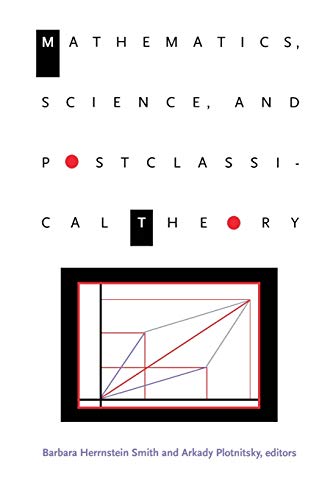
Inhaltsangabe
Mathematics, Science, and Postclassical Theory is a unique collection of essays dealing with the intersections between science and mathematics and the radical reconceptions of knowledge, language, proof, truth, and reality currently emerging from poststructuralist literary theory, constructivist history and sociology of science, and related work in contemporary philosophy. Featuring a distinguished group of international contributors, this volume engages themes and issues central to current theoretical debates in virtually all disciplines: agency, causality, determinacy, representation, and the social dynamics of knowledge.
In a substantive introductory essay, the editors explain the notion of "postclassical theory" and discuss the significance of ideas such as emergence and undecidability in current work in and on science and mathematics. Other essays include a witty examination of the relations among mathematical thinking, writing, and the technologies of virtual reality; an essay that reconstructs the conceptual practices that led to a crucial mathematical discovery-or construction-in the 19th century; a discussion of the implications of Bohr's complementarity principle for classical ideas of reality; an examination of scientific laboratories as "hybrid" communities of humans and nonhumans; an analysis of metaphors of control, purpose, and necessity in contemporary biology; an exploration of truth and lies, and the play of words and numbers in Shakespeare, Frege, Wittgenstein, and Beckett; and a final chapter on recent engagements, or nonengagements, between rationalist/realist philosophy of science and contemporary science studies.
Contributors. Malcolm Ashmore, Michel Callon, Owen Flanagan, John Law, Susan Oyama, Andrew Pickering, Arkady Plotnitsky, Brian Rotman, Barbara Herrnstein Smith, John Vignaux Smyth, E. Roy Weintraub
Die Inhaltsangabe kann sich auf eine andere Ausgabe dieses Titels beziehen.
Über die Autorin bzw. den Autor
Barbara Herrnstein Smith is Professor of Comparative Literature and English and Director of the Center for Interdisciplinary Studies in Science and Cultural Theory at Duke University. Arkady Plotnitsky is Visiting Scholar at Duke University's Center for Interdisciplinary Studies in Science and Cultural Theory.
Von der hinteren Coverseite
'Mathematics, Science, and Postclassical Theory' is a unique collection of essays dealing with the intersections between science and mathematics and the radical reconceptions of knowledge, language, proof, truth, and reality currently emerging from poststructuralist literary theory, constructive history and sociology of science, and related work in contemporary philosophy.
Auszug. © Genehmigter Nachdruck. Alle Rechte vorbehalten.
Mathematics, Science, and Postclassical Theory
By Barbara Herrnstein Smith, Arkady PlotnitskyDuke University Press
Copyright © 1997 Duke University Press
All rights reserved.
ISBN: 978-0-8223-1863-7All rights reserved.
Contents
Introduction: Networks and Symmetries, Decidable and Undecidable,
Thinking Dia-Grams: Mathematics, Writing, and Virtual Reality,
Concepts and the Mangle of Practice: Constructing Quaternions,
The Moment of Truth on Dublin Bridge: A Response to Andrew Pickering,
Explanation, Agency, and Metaphysics: A Reply to Owen Flanagan,
Agency and the Hybrid,
The Accidental Chordate: Contingency in Developmental Systems,
Complementarity, Idealization, and the Limits of Classical Conceptions of Reality,
Is "Is a Precursor of" a Transitive Relation?,
Fraud by Numbers: Quantitative Rhetoric in the Piltdown Forgery Discovery,
A Glance at SunSet: Numerical Fundaments in Frege, Wittgenstein, Shakespeare, Beckett,
Microdynamics of Incommensurability: Philosophy of Science Meets Science Studies,
Notes on Contributors,
CHAPTER 1
Thinking Dia-Grams: Mathematics, Writing, and Virtual Reality
Brian Rotman
IN the epilogue to his essay on the development of writing systems, Roy Harris declares:
It says a great deal about Western culture that the question of the origin of writing could be posed clearly for the first time only after the traditional dogmas about the relationship between speech and writing had been subjected both to the brash counterpropaganda of a McLuhan and to the inquisitorial scepticism of a Derrida. But it says even more that the question could not be posed clearly until writing itself had dwindled to microchip dimensions. Only with this ... did it become obvious that the origin of writing must be linked to the future of writing in ways which bypass speech altogether.
Harris's intent is programmatic. The passage continues with the injunction not to "re-plough McLuhan's field, or Derrida's either," but sow them, so as to produce eventually a "history of writing as writing."
Preeminent among dogmas that block such a history is alphabeticism: the insistence that we interpret all writing — understood for the moment as any systematized graphic activity that creates sites of interpretation and facilitates communication and sense making — along the lines of alphabetic writing, as if it were the inscription of prior speech ("prior" in an ontogenetic sense as well as the more immediate sense of speech first uttered and then written down and recorded). Harris's own writings in linguistics as well as Derrida's program of deconstruction, McLuhan's efforts to dramatize the cultural imprisonments of typography, and Walter Ong's long-standing theorization of the orality/ writing disjunction in relation to consciousness, among others, have all demonstrated the distorting and reductive effects of the subordination of graphics to phonetics and have made it their business to move beyond this dogma. Whether, as Harris intimates, writing will one day find a speechless characterization of itself is impossible to know, but these displacements of the alphabet's hegemony have already resulted in an open-ended and more complex articulation of the writing/speech couple, especially in relation to human consciousness, than was thinkable before the microchip.
A written symbol long recognized as operating nonalphabetically — even by those deeply and quite unconsciously committed to alphabeticism — is that of number, the familiar and simple other half, as it were, of the alphanumeric keyboard. But, despite this recognition, there has been no sustained attention to mathematical writing even remotely matching the enormous outpouring of analysis, philosophizing, and deconstructive opening up of what those in the humanities have come simply to call "texts."
Why, one might ask, should this be so? Why should the sign system long acknowledged as the paradigm of abstract rational thought and the without-which-nothing of Western technoscience have been so unexamined, let alone analyzed, theorized, or deconstructed, as a mode of writing? One answer might be a second-order or reflexive version of Harris's point about the microchip dwindling of writing, since the very emergence of the microchip is inseparable from the action and character of mathematical writing. Not only would the entire computer revolution have been impossible without mathematics as the enabling conceptual technology (the same could be said in one way or another of all technoscience), but, more crucially, the computer's mathematical lineage and intended application as a calculating/reasoning machine hinges on its autological relation to mathematical practice. Given this autology, mathematics would presumably be the last to reveal itself and declare its origins in writing. (I shall return to this later.)
A quite different and more immediate answer stems from the difficulties put in the way of any proper examination of mathematical writing by the traditional characterizations of mathematics — Platonic realism or various intuitionisms — and by the moves they have legitimated within the mathematical community. Platonism is the contemporary orthodoxy. In its standard version it holds that mathematical objects are mentally apprehensible and yet owe nothing to human culture; they exist, are real, objective, and "out there," yet are without material, empirical, embodied, or sensory dimension. Besides making an enigma out of mathematics' usefulness, this has the consequence of denying or marginalizing to the point of travesty the ways in which mathematical signs are the means by which communication, significance, and semiosis are brought about. In other words, the constitutive nature of mathematical writing is invisibilized, mathematical language in general being seen as a neutral and inert medium for describing a given prior reality — such as that of number — to which it is essentially and irremediably posterior.
With intuitionist viewpoints such as those of Brouwer and Husserl, the source of the difficulty is not understood in terms of some external metaphysical reality, but rather as the nature of our supposed internal intuition of mathematical objects. In Brouwer's case this is settled at the outset: numbers are nothing other than ideal objects formed within the inner Kantian intuition of time that is the condition for the possibility of our cognition, which leads Brouwer into the quasi-solipsistic position that mathematics is an essentially "languageless activity." With Husserl, whose account of intuition, language, and ideality is a great deal more elaborated than Brouwer's, the end result is nonetheless a complete blindness to the creative and generative role played by mathematical writing. Thus, in "The Origin of Geometry," the central puzzle on which Husserl meditates is "How does geometrical ideality ... proceed from its primary intrapersonal origin, where it is a structure within the conscious space of the first inventor's soul, to its ideal objectivity?" It must be said that Husserl doesn't, in this essay or anywhere else, settle his question. And one suspects that it is incapable of solution. Rather, it is the premise itself that has to be denied: that is, it is the coherence of the idea of primal (semiotically unmediated) intuition lodged originally in any individual consciousness that has to be rejected. On the contrary, does not all mathematical intuition — geometrical or otherwise — come into being in relation to...
„Über diesen Titel“ kann sich auf eine andere Ausgabe dieses Titels beziehen.
Suchergebnisse für Mathematics, Science, and Postclassical Theory

Foto des Verkäufers
Mathematics, Science, and Postclassical Theory (Science and Cultural Theory)
Anbieter: Zoom Books East, Glendale Heights, IL, USA
Verkäuferbewertung 5 von 5 Sternen

Zustand: very_good. Book is in very good condition and may include minimal underlining highlighting. The book can also include "From the library of" labels. May not contain miscellaneous items toys, dvds, etc. . We offer 100% money back guarantee and 24 7 customer service. Bestandsnummer des Verkäufers ZEV.0822318636.VG
Gebraucht kaufen
EUR 4,37
Versand gratis
Versand innerhalb von USA
Versand innerhalb von USA
Anzahl: 1 verfügbar
Beispielbild für diese ISBN
Mathematics, Science, and Postclassical Theory
Anbieter: ThriftBooks-Dallas, Dallas, TX, USA
Verkäuferbewertung 5 von 5 Sternen
Paperback. Zustand: Fair. No Jacket. Readable copy. Pages may have considerable notes/highlighting. ~ ThriftBooks: Read More, Spend Less. Bestandsnummer des Verkäufers G0822318636I5N00
Gebraucht kaufen
EUR 5,97
Versand gratis
Versand innerhalb von USA
Versand innerhalb von USA
Anzahl: 1 verfügbar
Beispielbild für diese ISBN
Mathematics, Science, and Postclassical Theory (Science and Cultural Theory)
Anbieter: HPB-Movies, Dallas, TX, USA
Verkäuferbewertung 5 von 5 Sternen
paperback. Zustand: Very Good. Connecting readers with great books since 1972! Used books may not include companion materials, and may have some shelf wear or limited writing. We ship orders daily and Customer Service is our top priority! Bestandsnummer des Verkäufers S_447541275
Gebraucht kaufen
EUR 6,18
EUR 3,33 Versand
Versand innerhalb von USA
Versand innerhalb von USA
Anzahl: 1 verfügbar
Beispielbild für diese ISBN
Mathematics, Science, and Postclassical Theory (Science and Cultural Theory)
Verlag:
Duke University Press Books, 1997
ISBN 10: 0822318636
ISBN 13: 9780822318637
Gebraucht
paperback
Anbieter: Books From California, Simi Valley, CA, USA
Verkäuferbewertung 4 von 5 Sternen

paperback. Zustand: Good. Bestandsnummer des Verkäufers mon0003544355
Gebraucht kaufen
EUR 13,59
EUR 4,43 Versand
Versand innerhalb von USA
Versand innerhalb von USA
Anzahl: 1 verfügbar
Foto des Verkäufers
Mathematics, Science, and Postclassical Theory
Anbieter: GreatBookPrices, Columbia, MD, USA
Verkäuferbewertung 5 von 5 Sternen
Zustand: As New. Unread book in perfect condition. Bestandsnummer des Verkäufers 202401
Gebraucht kaufen
EUR 41,72
EUR 2,35 Versand
Versand innerhalb von USA
Versand innerhalb von USA
Anzahl: Mehr als 20 verfügbar
Foto des Verkäufers
Small states in years of depression : the Oslo Alliance 1930-1940.
ISBN 10: 0822318636
ISBN 13: 9780822318637
Gebraucht
Hardcover
Anbieter: Kloof Booksellers & Scientia Verlag, Amsterdam, Niederlande
Verkäuferbewertung 4 von 5 Sternen
Zustand: very good. [translated from the Dutch by the author]. Assen : Van Gorcum , 1989. Hardcover. xi,382 pp. 24 cm. Condition : very good copy. ISBN 9780822318637. Keywords : POLITICS, Bestandsnummer des Verkäufers 93720
Gebraucht kaufen
EUR 20,95
EUR 30,00 Versand
Versand von Niederlande nach USA
Versand von Niederlande nach USA
Anzahl: 1 verfügbar
Foto des Verkäufers
Mathematics, Science, and Postclassical Theory
Anbieter: GreatBookPricesUK, Woodford Green, Vereinigtes Königreich
Verkäuferbewertung 5 von 5 Sternen
Zustand: As New. Unread book in perfect condition. Bestandsnummer des Verkäufers 202401
Gebraucht kaufen
EUR 48,64
EUR 17,65 Versand
Versand von Vereinigtes Königreich nach USA
Versand von Vereinigtes Königreich nach USA
Anzahl: Mehr als 20 verfügbar
Foto des Verkäufers
Mathematics, Science, and Postclassical Theory
Anbieter: GreatBookPricesUK, Woodford Green, Vereinigtes Königreich
Verkäuferbewertung 5 von 5 Sternen
Zustand: New. Bestandsnummer des Verkäufers 202401-n
Neu kaufen
EUR 50,40
EUR 17,65 Versand
Versand von Vereinigtes Königreich nach USA
Versand von Vereinigtes Königreich nach USA
Anzahl: Mehr als 20 verfügbar
Beispielbild für diese ISBN
Mathematics, Science, and Postclassical Theory (Science and Cultural Theory)
Anbieter: Revaluation Books, Exeter, Vereinigtes Königreich
Verkäuferbewertung 5 von 5 Sternen
Paperback. Zustand: Brand New. 288 pages. 9.25x6.50x0.75 inches. In Stock. Bestandsnummer des Verkäufers x-0822318636
Neu kaufen
EUR 54,32
EUR 14,71 Versand
Versand von Vereinigtes Königreich nach USA
Versand von Vereinigtes Königreich nach USA
Anzahl: 2 verfügbar
Foto des Verkäufers
Mathematics, Science, and Postclassical Theory
Anbieter: GreatBookPrices, Columbia, MD, USA
Verkäuferbewertung 5 von 5 Sternen
Zustand: New. Bestandsnummer des Verkäufers 202401-n
Neu kaufen
EUR 68,44
EUR 2,35 Versand
Versand innerhalb von USA
Versand innerhalb von USA
Anzahl: Mehr als 20 verfügbar