
Verwandte Artikel zu Contested Communities: Class, Gender, and Politics...
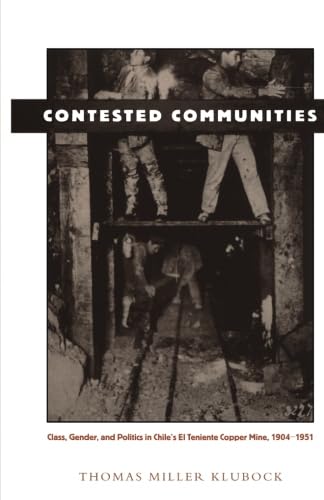
Contested Communities: Class, Gender, and Politics in Chile’s El Teniente Copper Mine, 1904-1951 (Comparative and International Working-Class History) - Softcover
Inhaltsangabe
In Contested Communities Thomas Miller Klubock analyzes the experiences of the El Teniente copper miners during the first fifty years of the twentieth century. Describing the everyday life and culture of the mining community, its impact on Chilean politics and national events, and the sense of self and identity working-class men and women developed in the foreign-owned enclave, Klubock provides important insights into the cultural and social history of Chile. Klubock shows how a militant working-class community was established through the interplay between capitalist development, state formation, and the ideologies of gender. In describing how the North American copper company attempted to reconfigure and reform the work and social-cultural lives of men and women who migrated to the mine, Klubock demonstrates how struggles between labor and capital took place on a gendered field of power and reconstituted social constructions of masculinity and femininity. As a result, Contested Communities describes more accurately than any previous study the nature of grassroots labor militancy, working-class culture, and everyday politics of gender relations during crucial years of the Chilean Popular Front in the 1930s and 1940s.
Die Inhaltsangabe kann sich auf eine andere Ausgabe dieses Titels beziehen.
Über die Autorin bzw. den Autor
Thomas Miller Klubock is Associate Professor of History, SUNY Stony Brook.
Von der hinteren Coverseite
"Revealing a defining moment of modern Chilean history, "Contested Communities" is a crucially important work. First-rate, fascinating labor history . . . remarkable for its boldness and originality."--Jeffrey L. Gould, Indiana University
Auszug. © Genehmigter Nachdruck. Alle Rechte vorbehalten.
Contested Communities
Class, Gender, and Politics in Chile's El Teniente Copper Mine, 1904-1951
By Thomas Miller KlubockDuke University Press
Copyright © 1998 Duke University Press
All rights reserved.
ISBN: 978-0-8223-2092-0All rights reserved.
Contents
Preface,
Acknowledgments,
Introduction,
Part I: Gender and the Process of Proletarianization, 1904-1938,
1 The Formation of a Modern Mining Enterprise: Capital, Labor Migration, and Early Forms of Worker Resistance,
2 Labor Strife, Social Welfare, and the Regulation of Working-Class Sexuality,
3 Community, Politics, and the Invention of a Labor Tradition,
Part II: Gender, Culture, and the Politics of Everyday Life,
4 Miners and Citizens: The State, the Popular Front, and Labor Politics,
5 Conflict and Accommodation at Work: Masculinity and the Labor Process inside the Mine,
6 "Rotos Macanudos" and Football Stars: Popular Culture, Working-Class Masculinity, and Opposition in the Mining Camps,
7 Women, Marriage, and the Organization of Sexuality,
Part III: Men and Women on Strike: The Mining Community and the Demise of Populism, 1942-1948,
8 Workers' Movements, Women's Mobilization, and Labor Politics,
9 The Radicalization of Working-Class Politics: United States Intervention, Miners' Strikes, and the Crisis of Populism,
Conclusion,
Notes,
Bibliography,
Index,
CHAPTER 1
The Formation of a Modern Mining Enterprise
Capital, Labor Migration, and Early Forms of Worker Resistance
In 1920, at the age of forty-eight, Carmen Aceituno began work in the El Teniente copper mine as a day laborer. The mining company was experiencing an explosive period of growth as a result of expanding international markets for copper and had sent agents (enganchadores) into the countryside to recruit workers with promises of high wages and pay advances. Aceituno came to the mine from the nearby agricultural town of Coinco and labored in El Teniente off and on for the next eighteen years. After working a short stint in 1920, he left El Teniente, only returning in 1923 to work for seven months. Aceituno went back to work in the mine in 1924, 1925, 1926, and 1928 for short stretches and then worked four straight years between 1934 and 1938. His work in the mine was punctuated by periodic absences and dismissals. Aceituno was fired on three occasions during his intermittent career for absenteeism, lack of productivity, and drunkenness.
Aceituno's experience of work in the mine is characteristic of El Teniente's early labor force. Most workers who migrated to the mine had participated in a transient labor force that traveled the Chilean countryside working on rural estates according to seasonal demand for labor, in the many small, labor-intensive copper mines that dotted Chile's Andean mountain range, in ports and cities, and in the nitrate mines of the northern Atacama Desert since the middle of the nineteenth century. These workers resisted pressures to settle in El Teniente and frequently abandoned their jobs in search of better opportunities elsewhere. Miners also refused to accommodate to the company's demands for work discipline. Drinking on the job, low productivity, and absenteeism posed an endemic problem for company supervisors.
The development of the El Teniente mine represented a shift in the Chilean mining industry from the small, undercapitalized, rudimentary, domestically owned mines of the nineteenth century to large, capital-intensive, vertically integrated, foreign-owned industrial enterprises employing sophisticated technology for the extraction, smelting, and processing of copper ore. By the end of the First World War, El Teniente employed over five thousand workers, and its demand for trained labor grew as it expanded production during the 1920s. The itinerant mining labor force of workers like Aceituno presented a major obstacle to the company's growth. Throughout the 1920s, the company found its efforts to increase production hampered by a population of workers that displayed little conformity to the new rhythms of work and discipline in the modern mining enterprise. These male workers were joined by an equally transient group of single women workers who migrated to the mine's camps, informal settlements on El Teniente's outskirts, and the nearby city of Rancagua in search of work as domestic servants and in petty commerce. Women participated with men in a turbulent popular culture of drinking and fluid romantic and sexual relationships that undermined the North American copper company's efforts to discipline and settle its labor force.
Constructing a Foreign Enclave: The El Teniente Mine and the Braden Copper Company
Beginning in 1873, Chile confronted a series of economic crises. The expansive growth of the previous four decades based on the export of mineral and agricultural primary commodities to world markets had begun to slow. In the mining sector, Chilean producers had exhausted the high-grade copper ore in their small, labor-intensive mines. At the same time, large bodies of copper ore were found in the United States, and by the 1880s North American mines began to supply a large portion of the world's copper, eliminating markets for Chilean exports. Whereas in 1876 Chile produced 62 percent of the total world copper supply, by 1900 its share of international copper production had dropped to 5 percent. The agricultural export economy encountered a similar decline as demand for Chilean wheat diminished as a result of the loss of markets in the United States and Australia and the limits to production on large estates. Further expansion in both the agricultural and mining sectors required reform of antiquated systems of labor relations and investment in new methods of production.
Chilean mining entrepreneurs, however, failed to develop high levels of productive capital in the mining sector or to invest in the modernization of mining and processing techniques. Nineteenth-century copper mines were small enterprises, often discovered and developed by independent prospectors who lacked capital, struggled with chronic debt, and depended on financing from merchants to run their operations and market their ore. Mine owners and producers continued, as during the colonial period, to be subordinated financially to large —and often foreign-owned— commercial houses. Chilean mine owners turned to cheap labor and subcontracting to independent miners rather than mechanization to increase production. Throughout the nineteenth century various foreign writers commented favorably on the ways in which Chilean mine owners combined colonial methods of production with cheap labor. One British writer noted, for example, that mining in Chile was a bad business that was made viable only through the use of "the least expensive labor force imaginable." Similarly, Charles Darwin wrote that "it is now well known that the Chilean method of mining is the cheapest." Most foreign critics were quick to observe that the only profitable mining business lay in financing and commerce, rather than production.
Confronted with continuing cycles of debt to commercial houses, mining producers intensified their exploitation of mine workers (peones and apires). Labor in the copper mines of the nineteenth century was harshly disciplined, intense, and brutal. Mine workers who stole rocks of ore were legally beaten by mine owners and police, mining camps were rigidly controlled by armed guards, and miners were forced to carry identification cards. Work...
„Über diesen Titel“ kann sich auf eine andere Ausgabe dieses Titels beziehen.
Suchergebnisse für Contested Communities: Class, Gender, and Politics...

Beispielbild für diese ISBN
Contested Communities: Class, Gender, and Politics in Chile's El Teniente Copper Mine, 1904-1951
Anbieter: World of Books (was SecondSale), Montgomery, IL, USA
Verkäuferbewertung 5 von 5 Sternen

Paperback. Zustand: Good. In Contested Communities Thomas Miller Klubock analyzes the experiences of the El Teniente copper miners during the first fifty years of the twentieth century. Describing the everyday life and culture of the mining community, its impact on Chilean politics and national events, and the sense of self and identity working-class men and women developed in the foreign-owned enclave, Klubock provides important insights into the cultural and social history of Chile.Klubock shows how a militant working-class community was established through the interplay between capitalist development, state formation, and the ideologies of gender. In describing how the North American copper company attempted to reconfigure and reform the work and social-cultural lives of men and women who migrated to the mine, Klubock demonstrates how struggles between labor and capital took place on a gendered field of power and reconstituted social constructions of masculinity and femininity. As a result, Contested Communities describes more accurately than any previous study the nature of grassroots labor militancy, working-class culture, and everyday politics of gender relations during crucial years of the Chilean Popular Front in the 1930s and 1940s. Bestandsnummer des Verkäufers CIN0822320924G
Gebraucht kaufen
EUR 5,51
Versand gratis
Versand innerhalb von USA
Versand innerhalb von USA
Anzahl: 1 verfügbar
Beispielbild für diese ISBN
Contested Communities: Class, Gender, and Politics in Chileâs El Teniente Copper Mine, 1904-1951 (Comparative and International Working-Class History)
Verlag:
Duke University Press (edition Illustrated), 1998
ISBN 10: 0822320924
ISBN 13: 9780822320920
Gebraucht
Paperback
Anbieter: BooksRun, Philadelphia, PA, USA
Verkäuferbewertung 5 von 5 Sternen
Paperback. Zustand: Very Good. Illustrated. It's a well-cared-for item that has seen limited use. The item may show minor signs of wear. All the text is legible, with all pages included. It may have slight markings and/or highlighting. Bestandsnummer des Verkäufers 0822320924-11-1
Gebraucht kaufen
EUR 5,93
Versand gratis
Versand innerhalb von USA
Versand innerhalb von USA
Anzahl: 1 verfügbar
Beispielbild für diese ISBN
Contested Communities : Class, Gender, and Politics in Chile's el Teniente Copper Mine, 1904-1951
Anbieter: Better World Books, Mishawaka, IN, USA
Verkäuferbewertung 5 von 5 Sternen
Zustand: Good. Pages intact with minimal writing/highlighting. The binding may be loose and creased. Dust jackets/supplements are not included. Stock photo provided. Product includes identifying sticker. Better World Books: Buy Books. Do Good. Bestandsnummer des Verkäufers 5749091-6
Gebraucht kaufen
EUR 6,36
Versand gratis
Versand innerhalb von USA
Versand innerhalb von USA
Anzahl: 2 verfügbar
Beispielbild für diese ISBN
Contested Communities : Class, Gender, and Politics in Chile's el Teniente Copper Mine, 1904-1951
Anbieter: Better World Books, Mishawaka, IN, USA
Verkäuferbewertung 5 von 5 Sternen
Zustand: Fine. Used book that is in almost brand-new condition. May contain a remainder mark. Better World Books: Buy Books. Do Good. Bestandsnummer des Verkäufers 8668536-6
Gebraucht kaufen
EUR 6,36
Versand gratis
Versand innerhalb von USA
Versand innerhalb von USA
Anzahl: 1 verfügbar
Beispielbild für diese ISBN
Contested Communities: Class, Gender, and Politics in Chile's El Teniente Copper Mine, 1904-1951 (Comparative and International Working-Class History)
Verlag:
Duke University Press Books, 1998
ISBN 10: 0822320924
ISBN 13: 9780822320920
Gebraucht
Softcover
Anbieter: Wonder Book, Frederick, MD, USA
Verkäuferbewertung 5 von 5 Sternen
Zustand: Good. Good condition. A copy that has been read but remains intact. May contain markings such as bookplates, stamps, limited notes and highlighting, or a few light stains. Bestandsnummer des Verkäufers Z14M-00238
Gebraucht kaufen
EUR 6,43
Versand gratis
Versand innerhalb von USA
Versand innerhalb von USA
Anzahl: 1 verfügbar
Beispielbild für diese ISBN
Contested Communities: Class, Gender, and Politics in Chile's El Teniente Copper Mine, 1904-1951
Anbieter: World of Books Inc, Montgomery, IL, USA
Verkäuferbewertung 4 von 5 Sternen

Paperback. Zustand: Good. In Contested Communities Thomas Miller Klubock analyzes the experiences of the El Teniente copper miners during the first fifty years of the twentieth century. Describing the everyday life and culture of the mining community, its impact on Chilean politics and national events, and the sense of self and identity working-class men and women developed in the foreign-owned enclave, Klubock provides important insights into the cultural and social history of Chile.Klubock shows how a militant working-class community was established through the interplay between capitalist development, state formation, and the ideologies of gender. In describing how the North American copper company attempted to reconfigure and reform the work and social-cultural lives of men and women who migrated to the mine, Klubock demonstrates how struggles between labor and capital took place on a gendered field of power and reconstituted social constructions of masculinity and femininity. As a result, Contested Communities describes more accurately than any previous study the nature of grassroots labor militancy, working-class culture, and everyday politics of gender relations during crucial years of the Chilean Popular Front in the 1930s and 1940s. Bestandsnummer des Verkäufers CIN0822320924G
Gebraucht kaufen
EUR 7,35
Versand gratis
Versand innerhalb von USA
Versand innerhalb von USA
Anzahl: 1 verfügbar
Beispielbild für diese ISBN
Contested Communities: Class, Gender, and Politics in Chileâs El Teniente Copper Mine, 1904-1951 (Comparative and International Working-Class History)
Verlag:
Duke University Press Books, 1998
ISBN 10: 0822320924
ISBN 13: 9780822320920
Gebraucht
Paperback
Anbieter: Midtown Scholar Bookstore, Harrisburg, PA, USA
Verkäuferbewertung 5 von 5 Sternen
Paperback. Zustand: Good. Good - Bumped and creased book with tears to the extremities, but not affecting the text block, may have remainder mark or previous owner's name - GOOD PAPERBACK Standard-sized. Bestandsnummer des Verkäufers M0822320924Z3
Gebraucht kaufen
EUR 3,54
EUR 5,36 Versand
Versand innerhalb von USA
Versand innerhalb von USA
Anzahl: 1 verfügbar
Beispielbild für diese ISBN
Contested Communities: Class, Gender, and Politics in Chileâs El Teniente Copper Mine, 1904-1951 (Comparative and International Working-Class History)
Verlag:
Duke University Press Books July 1998, 1998
ISBN 10: 0822320924
ISBN 13: 9780822320920
Gebraucht
Paper Back
Anbieter: Isle of Books, Bozeman, MT, USA
Verkäuferbewertung 4 von 5 Sternen
Paper Back. Zustand: Very Good. Bestandsnummer des Verkäufers 565132
Gebraucht kaufen
EUR 13,80
Versand gratis
Versand innerhalb von USA
Versand innerhalb von USA
Anzahl: 1 verfügbar
Beispielbild für diese ISBN
Contested Communities: Class, Gender, and Politics in Chile's El Teniente Copper Mine, 1904-1951 (Comparative and International Working-Class History)
Verlag:
Duke University Press Books, 1998
ISBN 10: 0822320924
ISBN 13: 9780822320920
Gebraucht
paperback
Anbieter: Textbooks_Source, Columbia, MO, USA
Verkäuferbewertung 5 von 5 Sternen
paperback. Zustand: Good. Illustrated. Ships in a BOX from Central Missouri! May not include working access code. Will not include dust jacket. Has used sticker(s) and some writing or highlighting. UPS shipping for most packages, (Priority Mail for AK/HI/APO/PO Boxes). Bestandsnummer des Verkäufers 000387317U
Gebraucht kaufen
EUR 12,80
EUR 3,56 Versand
Versand innerhalb von USA
Versand innerhalb von USA
Anzahl: 4 verfügbar
Beispielbild für diese ISBN
Contested Communities: Class, Gender, and Politics in Chile?s El Teniente Copper Mine, 1904-1951 (Comparative and International Working-Class History)
Verlag:
Duke University Press Books, 1998
ISBN 10: 0822320924
ISBN 13: 9780822320920
Gebraucht
Paperback
Anbieter: Book House in Dinkytown, IOBA, Minneapolis, MN, USA
Verkäuferbewertung 5 von 5 Sternen
Paperback. Zustand: Very Good. First Paperback Edition. Very good paperback copy (NOT ex-library). Spine is uncreased, binding tight and sturdy; text also very good. Shelfwear is very minor. Ships same or next business day from Dinkytown in Minneapolis, Minnesota. Bestandsnummer des Verkäufers 323433
Gebraucht kaufen
EUR 11,51
EUR 5,81 Versand
Versand innerhalb von USA
Versand innerhalb von USA
Anzahl: 1 verfügbar