
Verwandte Artikel zu Producing American Races: Henry James, William Faulkner,...
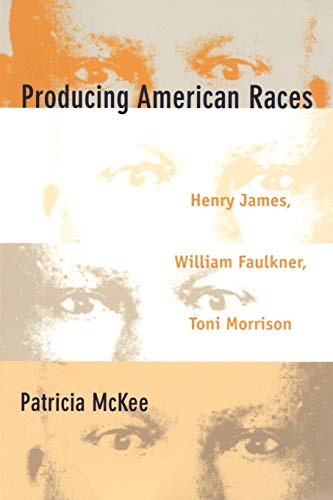
Producing American Races: Henry James, William Faulkner, Toni Morrison (New Americanists) - Softcover
Inhaltsangabe
In Producing American Races Patricia McKee examines three authors who have powerfully influenced the formation of racial identities in the United States: Henry James, William Faulkner, and Toni Morrison. Using their work to argue that race becomes visible only through image production and exchange, McKee illuminates the significance that representational practice has had in the process of racial construction. McKee provides close readings of six novels-James's The Wings of the Dove and The Golden Bowl, Faulkner's The Sound and the Fury and Light in August, and Morrison's Sula and Jazz-interspersed with excursions into Lacanian and Freudian theory, critical race theory, epistemology, and theories of visuality. In James and Faulkner, she finds, race is represented visually through media that highlight ways of seeing and being seen. Written in the early twentieth century, the novels of James and Faulkner reveal how whiteness depended on visual culture even before film and television became its predominant media. In Morrison, the culture is aural and oral-and often about the absence of the visual. Because Morrison's African American communities produce identity in nonvisual, even anti-visual terms, McKee argues, they refute not just white representations of black persons as objects but also visual orders of representation that have constructed whites as subjects and blacks as objects. With a theoretical approach that both complements and transcends current scholarship about race-and especially whiteness-Producing American Races will engage scholars in American literature, critical race theory, African American studies, and cultural studies. It will also be of value to those interested in the novel as a political and aesthetic form.
Die Inhaltsangabe kann sich auf eine andere Ausgabe dieses Titels beziehen.
Über die Autorin bzw. den Autor
Patricia McKee, Professor of English at Dartmouth College, is the author of Public and Private: Gender, Class, and the British Novel, 1764–1878 and Heroic Commitment in Richardson, Eliot, and James.
Von der hinteren Coverseite
"McKee's intellectually original approach to discussing whiteness puts her book at the cutting edge of contemporary race studies. Her use of familiar novels to talk about race, identity, and complexities of visual culture is provocatively original."--Robyn Wiegman, University of California, Irvine
Auszug. © Genehmigter Nachdruck. Alle Rechte vorbehalten.
Producing American Races
Henry James, William Faulkner, Toni Morrison
By Patricia McKeeDuke University Press
Copyright © 1999 Duke University Press
All rights reserved.
ISBN: 978-0-8223-2363-1All rights reserved.
Contents
Acknowledgments,
Introduction: Race and Media,
chapter one: Reproducing Whiteness: The Wings of the Dove,
chapter two: Collective Whiteness in The Golden Bowl,
chapter three: Self-Division as Racial Divide: The Sound and the Fury,
chapter four: Playing White Men in Light in August,
chapter five: Black Spaces in Sula,
chapter six: Off the Record: Jazz and the Production of Black Culture,
Afterword,
Notes,
Index,
CHAPTER 1
Reproducing Whiteness The Wings of the Dove
In The Wings of the Dove (1902), Milly Theale, a young, rich, white American woman visiting Europe, becomes ill and dies. This character, James says in his preface (1909) to the novel, was of a sort that had long interested him.
I had from far back mentally projected a certain sort of young American as more the "heir of all the ages" than any other young person whatever ...; so that here was a chance to confer on some such figure a supremely touching value. To be the heir of all the ages only to know yourself, as that consciousness deepened, balked of your inheritance, would be to play the part, it struck me, or at least to arrive at the type, in the light on the whole the most becoming.
The role James chooses for his "most becoming" American is one with "touching value." The pathos of the part depends on the American being both "the heir of all the ages" and "balked of your inheritance."
This particular conflation of power and powerlessness is one that I want to identify as a representation of racial whiteness. If "to be everything and nothing" characterizes whiteness, to have everything and nothing is the condition of James's heroine in The Wings of the Dove. Milly Theale learns to represent her condition, moreover, in the comprehensive yet blank terms that define European and American whiteness in the novel.
It is in an iconic register that racial identity in this novel achieves both a completeness of significance and a void of particularity. The images adopted by characters may be identified with the visualization of individual identity that Habermas suggests became a primary means of political representation in twentieth-century democracies. What Robyn Wiegman calls "the ascendancy of technological corporealities" in this century means that "iconicity instead of corporeal abstraction" functions as the medium of public relations and that "commodified identities" become "the primary signifying form of the public sphere."
Milly Theale becomes an icon in The Wings of the Dove, and she is something of a public figure. Yet even among iconic identities, as Wiegman emphasizes, racial difference has entailed distinctions between surfaces and depths of meaning.
"Blackness" in particular becomes ... not only more than skin deep, but epistemically linked to the articulation of other differences, most prominently gender. In this process, the possibilities of a kind of interior psychic complexity is overwritten by the determinations of the body's corporeal scripting, and the African (=American) is consigned to a psychological as well as a physical negativity of "being." At the same time, whiteness achieves its priority as a visible absence, signifying a dis-corporated, universal, and psychically complicated humanity.
Here Wiegman discriminates between the bodily determination of black persons, as well as, to some extent, white women, and the symbolic indeterminacy of white male identity.
James also employs an economy of race, gender, surfaces, and depths of identity to produce differences between white Europeans and white Americans. According to this economy, only white male Americans distinguish themselves in terms of psychic complexity. White Europeans remain codified, identifying themselves in exchangeable and surface terms; these characters claim their own similarity, whereas white male Americans claim individual difference. In The Wings of the Dove, characters who participate in the public sphere of upper-middle-class social life in London are marked by a blankness. European codes of whiteness bring complexity to the surface of social exchange and blank out both "interior psychic complexity" and any bodily determination of identity. Milly Theale assumes iconic identity within this social sphere, James suggests, to avoid any moral responsibility for or bodily determination of her identity.
Both Milly's psychic complexity and her body are blanked out by representations that discount any particular or determinate identity. The iconicity of whiteness in the novel, practiced primarily by female characters, depends on covering or screening identity so that neither particular material nor particular psychic qualities can be recognized as determinant. Milly's body is rendered indeterminate, as a body that may or may not be dying. Her material identity, once represented in these terms, has the effect of obscuring material determination. Milly's psyche is also obscured by representations, such as the dove, copied from a repertoire of likenesses available to multiple persons.
The American heiress in this novel thereby balks herself of her inheritance, James suggests, because she uses for herself the voided social code of Europeans. The white American male, whom James discusses in other words as well as in his preface to The Wings of the Dove, is to be identified by no void. He can be distinguished from Europeans, who cede responsibility for their identity to cultural codes, by his assumption of individual moral responsibility. His inner sense of responsibility, moreover, means that the white male American produces his meaning, whereas Europeans merely occupy established positions within their cultural codes of meaning. This distinction between productive Americans and merely reproductive Europeans becomes the most important mark of James's American whiteness.
Covers of Whiteness
The covers produced for Milly's individual identity do not hide it but reproduce it in comprehensive terms that allow for no hidden meaning. Thus the status of her body is suspended between the possibilities of life and death, which cover everything in the sense that their total opposition represents a complete range of possibilities; yet they determine nothing. Milly's inner character is similarly voided of the capacity to choose life or death when it is represented by an image of the Holy Spirit. Once Milly adopts the icon of the dove, her body as well as her character are discounted. As an iconic identity, the dove-like woman is nonparticular because many people could play the part. But the image also empties Milly of particularity because the Holy Spirit transcends both body and individual psyche. An icon of transcendence, the dove is a cover of unlimited meaning that signifies no person in particular.
Milly Theale learns to assume the power of whiteness from English characters in the novel, whose icons she reproduces. In the role of the mere "American girl," Milly is able to provide a cover for her behavior. But in this role, her behavior is completely discounted; it is produced as marginal behavior for the sake of discountability. This occurs, for example, when Milly plays the part for Kate Croy and Merton Densher after unexpectedly meeting them at the National Gallery.
Whatever the facts, their...
„Über diesen Titel“ kann sich auf eine andere Ausgabe dieses Titels beziehen.
Suchergebnisse für Producing American Races: Henry James, William Faulkner,...

Beispielbild für diese ISBN
Producing American Races: Henry James, William Faulkner, Toni Morrison (New Americanists)
Anbieter: Anybook.com, Lincoln, Vereinigtes Königreich
Verkäuferbewertung 5 von 5 Sternen

Zustand: Good. This is an ex-library book and may have the usual library/used-book markings inside.This book has soft covers. In good all round condition. Please note the Image in this listing is a stock photo and may not match the covers of the actual item,550grams, ISBN:9780822323631. Bestandsnummer des Verkäufers 3727866
Gebraucht kaufen
EUR 8,76
EUR 15,86 Versand
Versand von Vereinigtes Königreich nach USA
Versand von Vereinigtes Königreich nach USA
Anzahl: 1 verfügbar
Beispielbild für diese ISBN
Producing American Races: Henry James, William Faulkner, Toni Morrison (New Americanists)
Anbieter: Anybook.com, Lincoln, Vereinigtes Königreich
Verkäuferbewertung 5 von 5 Sternen
Zustand: Good. This is an ex-library book and may have the usual library/used-book markings inside.This book has soft covers. In good all round condition. Please note the Image in this listing is a stock photo and may not match the covers of the actual item,500grams, ISBN:9780822323631. Bestandsnummer des Verkäufers 9644675
Gebraucht kaufen
EUR 9,18
EUR 15,86 Versand
Versand von Vereinigtes Königreich nach USA
Versand von Vereinigtes Königreich nach USA
Anzahl: 1 verfügbar
Foto des Verkäufers
Producing American Races: Henry James, William Faulkner, Toni Morrison (New Americanists Ser.)
Verlag:
Duke University Press, Durham & London, 1999
ISBN 10: 082232363X
ISBN 13: 9780822323631
Gebraucht
Soft cover
Anbieter: Kenneth A. Himber, Lebanon, NJ, USA
Verkäuferbewertung 5 von 5 Sternen
Soft cover. Zustand: As New. First Softcover Edition. Softcover book is a clean tight unmarked copy. Bestandsnummer des Verkäufers 007033
Gebraucht kaufen
EUR 22,65
EUR 5,16 Versand
Versand innerhalb von USA
Versand innerhalb von USA
Anzahl: 1 verfügbar
Beispielbild für diese ISBN
Producing American Races: Henry James, William Faulkner, Toni Morrison (New Americanists)
Anbieter: Shadow Books, Norwich, Vereinigtes Königreich
Verkäuferbewertung 5 von 5 Sternen
Soft cover. Zustand: Fine. No Jacket. Bestandsnummer des Verkäufers 100753-03
Gebraucht kaufen
EUR 18,02
EUR 10,44 Versand
Versand von Vereinigtes Königreich nach USA
Versand von Vereinigtes Königreich nach USA
Anzahl: 1 verfügbar
Foto des Verkäufers
Producing American Races : Henry James, William Faulkner, Toni Morrison
Anbieter: GreatBookPrices, Columbia, MD, USA
Verkäuferbewertung 5 von 5 Sternen
Zustand: As New. Unread book in perfect condition. Bestandsnummer des Verkäufers 202127
Gebraucht kaufen
EUR 34,67
EUR 2,28 Versand
Versand innerhalb von USA
Versand innerhalb von USA
Anzahl: Mehr als 20 verfügbar
Beispielbild für diese ISBN
Producing American Races Henry James, William Faulkner, Toni Morrison
Print-on-DemandAnbieter: Revaluation Books, Exeter, Vereinigtes Königreich
Verkäuferbewertung 5 von 5 Sternen
Paperback. Zustand: Brand New. 240 pages. 9.25x6.00x0.75 inches. In Stock. This item is printed on demand. Bestandsnummer des Verkäufers __082232363X
Neu kaufen
EUR 34,93
EUR 11,66 Versand
Versand von Vereinigtes Königreich nach USA
Versand von Vereinigtes Königreich nach USA
Anzahl: 1 verfügbar
Beispielbild für diese ISBN
Producing American Races: Henry James, William Faulkner, Toni Morrison
Anbieter: Kennys Bookshop and Art Galleries Ltd., Galway, GY, Irland
Verkäuferbewertung 5 von 5 Sternen
Zustand: New. Examines three authors who have influenced the formation of racial identities in the United States: Henry James, William Faulkner, and Toni Morrison. Using their work, this title illuminates the significance that representational practice has had in the process of racial construction. Series: New Americanists. Num Pages: 256 pages. BIC Classification: 1KBB; 2AB; DSBH; DSK. Category: (P) Professional & Vocational. Dimension: 235 x 154 x 19. Weight in Grams: 408. . 1999. Paperback. . . . . Bestandsnummer des Verkäufers V9780822323631
Neu kaufen
EUR 38,36
EUR 9,50 Versand
Versand von Irland nach USA
Versand von Irland nach USA
Anzahl: 1 verfügbar
Beispielbild für diese ISBN
Producing American Races: Henry James, William Faulkner, Toni Morrison (New Americanists)
Anbieter: Ria Christie Collections, Uxbridge, Vereinigtes Königreich
Verkäuferbewertung 5 von 5 Sternen
Zustand: New. In English. Bestandsnummer des Verkäufers ria9780822323631_new
Neu kaufen
EUR 34,73
EUR 13,17 Versand
Versand von Vereinigtes Königreich nach USA
Versand von Vereinigtes Königreich nach USA
Anzahl: 1 verfügbar
Foto des Verkäufers
Producing American Races : Henry James, William Faulkner, Toni Morrison
Anbieter: GreatBookPrices, Columbia, MD, USA
Verkäuferbewertung 5 von 5 Sternen
Zustand: New. Bestandsnummer des Verkäufers 202127-n
Neu kaufen
EUR 45,63
EUR 2,28 Versand
Versand innerhalb von USA
Versand innerhalb von USA
Anzahl: Mehr als 20 verfügbar
Foto des Verkäufers
Producing American Races
Anbieter: Rarewaves USA, HEBRON, KY, USA
Verkäuferbewertung 5 von 5 Sternen
Paperback. Zustand: New. In Producing American Races Patricia McKee examines three authors who have powerfully influenced the formation of racial identities in the United States: Henry James, William Faulkner, and Toni Morrison. Using their work to argue that race becomes visible only through image production and exchange, McKee illuminates the significance that representational practice has had in the process of racial construction.McKee provides close readings of six novels-James's The Wings of the Dove and The Golden Bowl, Faulkner's The Sound and the Fury and Light in August, and Morrison's Sula and Jazz-interspersed with excursions into Lacanian and Freudian theory, critical race theory, epistemology, and theories of visuality. In James and Faulkner, she finds, race is represented visually through media that highlight ways of seeing and being seen. Written in the early twentieth century, the novels of James and Faulkner reveal how whiteness depended on visual culture even before film and television became its predominant media. In Morrison, the culture is aural and oral-and often about the absence of the visual. Because Morrison's African American communities produce identity in nonvisual, even anti-visual terms, McKee argues, they refute not just white representations of black persons as objects but also visual orders of representation that have constructed whites as subjects and blacks as objects.With a theoretical approach that both complements and transcends current scholarship about race-and especially whiteness-Producing American Races will engage scholars in American literature, critical race theory, African American studies, and cultural studies. It will also be of value to those interested in the novel as a political and aesthetic form. Bestandsnummer des Verkäufers LU-9780822323631
Neu kaufen
EUR 50,37
Versand gratis
Versand innerhalb von USA
Versand innerhalb von USA
Anzahl: Mehr als 20 verfügbar