
Verwandte Artikel zu Relative Values: Reconfiguring Kinship Studies
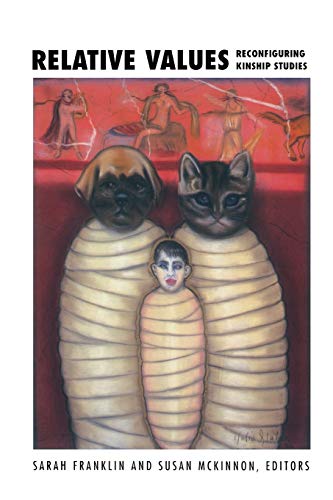
Inhaltsangabe
The essays in Relative Values draw on new work in anthropology, science studies, gender theory, critical race studies, and postmodernism to offer a radical revisioning of kinship and kinship theory. Through a combination of vivid case studies and trenchant theoretical essays, the contributors-a group of internationally recognized scholars-examine both the history of kinship theory and its future, at once raising questions that have long occupied a central place within the discipline of anthropology and moving beyond them.
Ideas about kinship are vital not only to understanding but also to forming many of the practices and innovations of contemporary society. How do the cultural logics of contemporary biopolitics, commodification, and globalization intersect with kinship practices and theories? In what ways do kinship analogies inform scientific and clinical practices; and what happens to kinship when it is created in such unfamiliar sites as biogenetic labs, new reproductive technology clinics, and the computers of artificial life scientists? How does kinship constitute-and get constituted by-the relations of power that draw lines of hierarchy and equality, exclusion and inclusion, ambivalence and violence? The contributors assess the implications for kinship of such phenomena as blood transfusions, adoption across national borders, genetic support groups, photography, and the new reproductive technologies while ranging from rural China to mid-century Africa to contemporary Norway and the United States. Addressing these and other timely issues, Relative Values injects new life into one of anthropology's most important disciplinary traditions.
Posing these and other timely questions, Relative Values injects an important interdisciplinary curiosity into one of anthropology's most important disciplinary traditions.
Contributors. Mary Bouquet, Janet Carsten, Charis Thompson Cussins, Carol Delaney, Gillian Feeley-Harnik, Sarah Franklin, Deborah Heath, Stefan Helmreich, Signe Howell, Jonathan Marks, Susan McKinnon, Michael G. Peletz, Rayna Rapp, Martine Segalen, Pauline Turner Strong, Melbourne Tapper, Karen-Sue Taussig, Kath Weston, Yunxiang Yan
Die Inhaltsangabe kann sich auf eine andere Ausgabe dieses Titels beziehen.
Über die Autorin bzw. den Autor
Sarah Franklin is Reader in Cultural Anthropology for the Department of Sociology at Lancaster University, England.
Susan McKinnon is Associate Professor of Anthropology at the University of Virginia.
Von der hinteren Coverseite
"This important collection of inter-disciplinary essays on the new kinship shows diverse ways that relative values, shifting solidarities, and partial connections of truth and affect today create the ties that bind."--Paul Rabinow, University of California, Berkeley
Auszug. © Genehmigter Nachdruck. Alle Rechte vorbehalten.
RELATIVE VALUES
Reconfiguring Kinship StudiesDuke University Press
Copyright © 2001 Duke University PressAll right reserved.
ISBN: 978-0-8223-2796-7
Contents
Illustrations........................................................................................................................................................................viiAcknowledgments......................................................................................................................................................................ixINTRODUCTION Relative Values: Reconfiguring Kinship Studies Sarah Franklin and Susan McKinnon......................................................................................11 Substantivism, Antisubstantivism, and Anti-antisubstantivism Janet Carsten........................................................................................................292 The Ethnography of Creation: Lewis Henry Morgan and the American Beaver Gillian Feeley-Harnik.....................................................................................543 Making Kinship, with an Old Reproductive Technology Mary Bouquet..................................................................................................................854 Kinship in Hypertext: Transubstantiating Fatherhood and Information Flow in Artificial Life Stefan Helmreich......................................................................1165 Kinship, Controversy, and the Sharing of Substance: The Race/Class Politics of Blood Transfusion Kath Weston......................................................................1476 Strategic Naturalizing: Kinship in an Infertility Clinic Charis Thompson...........................................................................................................1757 Self-Conscious Kinship: Some Contested Values in Norwegian Transnational Adoption Signe Howell....................................................................................2038 Practicing Kinship in Rural North China Yunxiang Yan..............................................................................................................................2249 The Shift in Kinship Studies in France: The Case of Grandparenting Martine Segalen................................................................................................24610 The Economies in Kinship and the Paternity of Culture: Origin Stories in Kinship Theory Susan McKinnon...........................................................................27711 Biologization Revisited: Kinship Theory in the Context of the New Biologies Sarah Franklin.......................................................................................30212 Blood/Kinship, Governmentality, and Cultures of Order in Colonial Africa Melbourne Tapper........................................................................................32913 "We're Going to Tell These People Who They Really Are": Science and Relatedness Jonathan Marks...................................................................................35514 Genealogical Dis-Ease: Where Hereditary Abnormality, Biomedical Explanation, and Family Responsibility Meet Rayna Rapp, Deborah Heath, and Karen-Sue Taussig.....................38415 Ambivalence in Kinship since the 1940s Michael G. Peletz.........................................................................................................................41316 Cutting the Ties That Bind: The Sacrifice of Abraham and Patriarchal Kinship Carol Delaney.......................................................................................44517 To Forget Their Tongue, Their Name, and Their Whole Relation: Captivity, Extra-Tribal Adoption, and the Indian Child Welfare Act Pauline Turner Strong...........................468Contributors.........................................................................................................................................................................495Index................................................................................................................................................................................499
Chapter One
Substantivism, Antisubstantivism, and Anti-antisubstantivismJanet Carsten
This essay explores the uses of the term substance in the anthropological literature on kinship. I begin with the varied meanings of substance in English. The very breadth of this semantic domain, I suggest, has been central to the fruitfulness of analyses of kinship that have employed the term. And this is amply attested to elsewhere in this volume, where substance is used not only to refer to blood (see Weston) and other bodily fluids but also to information (Helmreich), rivers and railways (Feeley-Harnik), and family photographs (Bouquet). But the ambiguities of substance, which seem to have gone largely unexamined in the literature, also raise problems-particularly for the analytic rigor of any comparative endeavor.
The Oxford English Dictionary (OED) lists twenty-three separate meanings for substance covering three full pages. Several of these meanings clearly overlap or are closely related to each other. Nevertheless, there are some important distinctions between substance as essential nature or essence; a separate distinct thing; that which underlies phenomena; matter or subject matter; the material of which a physical thing consists; the matter or tissue composing an animal body part or organ; any corporeal matter; a solid or real thing (as opposed to appearance or shadow); a vital part; what gives a thing its character; and the consistency of a fluid. I have selected just some of the OED's long list of meanings-those that, it seems to me, have relevance for an examination of the uses to which substance has been put in the anthropological study of kinship. The OED's list of meanings might be further reduced to four broader categories: vital part or essence; separate distinct thing; that which underlies phenomena; and corporeal matter. All of these distinct meanings have some bearing on anthropological understandings. Indeed, I maintain that the utility of substance as a term is due in large measure to the very breadth of the meanings that I have delineated.
This ambiguity emerges clearly in David Schneider's deployment of substance in American Kinship: A Cultural Account (1980). In tracing the passage of substance, from Schneider's original application of it in 1968 in the analysis of American kinship, to India, and from India to Melanesia, I attempt to highlight some of these discrepancies of meaning. It would be quite impossible to present a thorough examination of all the uses to which substance has been put. I have selected a few of the more prominent instances in order to make explicit the analytic work that is being done. It should be clear that I am more interested in what substance does than what it is. I focus on how substance has been employed in the analysis of kinship, rather than on what it means within any one particular culture. This is part of a larger project to study critically what kinship itself does for anthropologists (see Carsten 2000).
This chapter offers a critique "from within." The work that I discuss here has been highly influential and fruitful in the analysis of kinship and personhood over the past twenty years. Substance has undoubtedly been "good to think with," yet partly because of a lingering dissatisfaction with my own use of substance in the study of Malay kinship, it seemed worth exploring its ambiguities....
„Über diesen Titel“ kann sich auf eine andere Ausgabe dieses Titels beziehen.
Suchergebnisse für Relative Values: Reconfiguring Kinship Studies

Beispielbild für diese ISBN
Relative Values: Reconfiguring Kinship Studies
Anbieter: World of Books (was SecondSale), Montgomery, IL, USA
Verkäuferbewertung 5 von 5 Sternen

Zustand: Very Good. Item in very good condition! Textbooks may not include supplemental items i.e. CDs, access codes etc. Bestandsnummer des Verkäufers 00110303189
Gebraucht kaufen
EUR 5,51
Versand gratis
Versand innerhalb von USA
Versand innerhalb von USA
Anzahl: 1 verfügbar
Foto des Verkäufers
Relative Values: Reconfiguring Kinship Studies
Anbieter: The Haunted Bookshop, LLC, Iowa City, IA, USA
Verkäuferbewertung 4 von 5 Sternen

Paperback. Zustand: Good+. Clean pages except for a prior owner's name on the first (half-title) page; spine has a reading crease, but binding remains secure; soft cover has tiny surface peels at corners and mild shelfwear around bottom edges, otherwise sound. ix, 519pp. incl. index. Bestandsnummer des Verkäufers 00086219
Gebraucht kaufen
EUR 11,03
EUR 4,91 Versand
Versand innerhalb von USA
Versand innerhalb von USA
Anzahl: 1 verfügbar
Beispielbild für diese ISBN
Relative Values: Reconfiguring Kinship Studies
Anbieter: WorldofBooks, Goring-By-Sea, WS, Vereinigtes Königreich
Verkäuferbewertung 5 von 5 Sternen
Paperback. Zustand: Very Good. The book has been read, but is in excellent condition. Pages are intact and not marred by notes or highlighting. The spine remains undamaged. Bestandsnummer des Verkäufers GOR006138940
Gebraucht kaufen
EUR 20,93
EUR 6,62 Versand
Versand von Vereinigtes Königreich nach USA
Versand von Vereinigtes Königreich nach USA
Anzahl: 1 verfügbar
Beispielbild für diese ISBN
Relative Values: Reconfiguring Kinship Studies
Anbieter: N. Fagin Books, Chicago, IL, USA
Verkäuferbewertung 5 von 5 Sternen
2001. Anthropological theory. Duke University Press. Very good - fine wrappers/paperback 519p. Bestandsnummer des Verkäufers 9666
Gebraucht kaufen
EUR 22,94
EUR 5,36 Versand
Versand innerhalb von USA
Versand innerhalb von USA
Anzahl: 1 verfügbar
Beispielbild für diese ISBN
Relative Values: Reconfiguring Kinship Studies
Anbieter: Phatpocket Limited, Waltham Abbey, HERTS, Vereinigtes Königreich
Verkäuferbewertung 5 von 5 Sternen
Zustand: Good. Your purchase helps support Sri Lankan Children's Charity 'The Rainbow Centre'. Ex-library, so some stamps and wear, but in good overall condition. Our donations to The Rainbow Centre have helped provide an education and a safe haven to hundreds of children who live in appalling conditions. Bestandsnummer des Verkäufers Z1-E-030-02554
Gebraucht kaufen
EUR 19,46
EUR 12,57 Versand
Versand von Vereinigtes Königreich nach USA
Versand von Vereinigtes Königreich nach USA
Anzahl: 1 verfügbar
Beispielbild für diese ISBN
Relative Values: Reconfiguring Kinship Studies
Anbieter: Recycle Bookstore, San Jose, CA, USA
Verkäuferbewertung 4 von 5 Sternen
Paperback. Zustand: Near Fine. Duke University Press, 2001. Book has mild wear to top edges. otherwise in excellent condition, clean and sharp with tight binding, bright and unmarked pages; a very well-kept copy with fresh interiors. Bestandsnummer des Verkäufers 1045567
Gebraucht kaufen
EUR 27,54
EUR 5,13 Versand
Versand innerhalb von USA
Versand innerhalb von USA
Anzahl: 1 verfügbar
Foto des Verkäufers
Relative Values : Reconfiguring Kinship Studies
Anbieter: GreatBookPrices, Columbia, MD, USA
Verkäuferbewertung 5 von 5 Sternen
Zustand: As New. Unread book in perfect condition. Bestandsnummer des Verkäufers 201807
Gebraucht kaufen
EUR 41,95
EUR 2,36 Versand
Versand innerhalb von USA
Versand innerhalb von USA
Anzahl: Mehr als 20 verfügbar
Beispielbild für diese ISBN
Relative Values
Anbieter: PBShop.store UK, Fairford, GLOS, Vereinigtes Königreich
Verkäuferbewertung 5 von 5 Sternen
PAP. Zustand: New. New Book. Shipped from UK. Established seller since 2000. Bestandsnummer des Verkäufers FW-9780822327967
Neu kaufen
EUR 40,62
EUR 6,93 Versand
Versand von Vereinigtes Königreich nach USA
Versand von Vereinigtes Königreich nach USA
Anzahl: 15 verfügbar
Beispielbild für diese ISBN
Relative Values: Reconfiguring Kinship Studies (eng)
Anbieter: Brook Bookstore On Demand, Napoli, NA, Italien
Verkäuferbewertung 5 von 5 Sternen
Zustand: new. Bestandsnummer des Verkäufers 5719c50634d4ae3be485e6b0b49ba40b
Neu kaufen
EUR 39,93
EUR 8,00 Versand
Versand von Italien nach USA
Versand von Italien nach USA
Anzahl: Mehr als 20 verfügbar
Foto des Verkäufers
Relative Values : Reconfiguring Kinship Studies
Anbieter: GreatBookPrices, Columbia, MD, USA
Verkäuferbewertung 5 von 5 Sternen
Zustand: New. Bestandsnummer des Verkäufers 201807-n
Neu kaufen
EUR 46,57
EUR 2,36 Versand
Versand innerhalb von USA
Versand innerhalb von USA
Anzahl: Mehr als 20 verfügbar