
Verwandte Artikel zu Lines of Flight: Discursive Time and Countercultural...
Lines of Flight: Discursive Time and Countercultural Desire in the Work of Thomas Pynchon (Post-Contemporary Interventions) - Hardcover
Buch 66 von 94: Post-contemporary interventions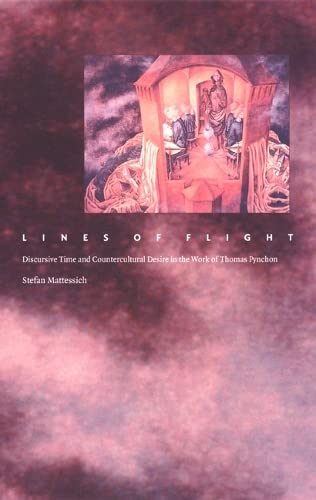
Inhaltsangabe
For Thomas Pynchon, the characteristic features of late capitalism--the rise of the military-industrial complex, consumerism, bureaucratization and specialization in the workplace, standardization at all levels of social life, and the growing influence of the mass media--all point to a transformation in the way human beings experience time and duration. Focusing on Pynchon's novels as representative artifacts of the postwar period, Stefan Mattessich analyzes this temporal transformation in relation not only to Pynchon's work but also to its literary, cultural, and theoretical contexts.
Mattessich theorizes a new kind of time--subjective displacement--dramatized in the parody, satire, and farce deployed through Pynchon's oeuvre. In particular, he is interested in showing how this sense of time relates to the counterculture of the 1960s and 1970s. Examining this movement as an instance of flight or escape and exposing the beliefs behind it, Mattessich argues that the counterculture's rejection of the dominant culture ultimately became an act of self-cancellation, a rebellion in which the counterculture found itself defined by the very order it sought to escape. He points to parallels in Pynchon's attempts to dramatize and enact a similar experience of time in the doubling-back, crisscrossing, and erasure of his writing. Mattessich lays out a theory of cultural production centered on the ethical necessity of grasping one's own susceptibility to discursive forms of determination.
Die Inhaltsangabe kann sich auf eine andere Ausgabe dieses Titels beziehen.
Über die Autorin bzw. den Autor
Stefan Mattessich is Professor of English at Santa Monica College.
Von der hinteren Coverseite
""Lines of Flight" is an impressive achievement, reminiscent of the work of Fredric Jameson in its engagement with social and political issues, its sensitivity to questions of the ideology of form, and the authority with which it parses complex problems of textuality and discourse and identifies their cultural significance. Pynchon has not had so sympathetic a reader."--Hayden White, Stanford University
Auszug. © Genehmigter Nachdruck. Alle Rechte vorbehalten.
Lines of Flight-CL
By Stefan MattessichDuke University Press
Copyright © 2002 Stefan MattessichAll right reserved.
ISBN: 9780822329794
Chapter One
IMPERIUM, MISOGYNY, AND POSTMODERN PARODY IN V.Broken lives, broken strings, Broken threads, broken springs, Broken bottles, broken heads People sleeping in broken beds. Ain't no use jivin' Ain't no use jokin' Everything is broken. -Bob Dylan
No one who reads Pynchon can deny the force and inventiveness of his prose. His prolix imagination verges on the uncanny, and his mastery of various discourses has awed all who have experienced it. But if Pynchon is an exuberant writer, he is so only by virtue of a counterforce acting on that forcefulness, interrupting its flows in particular ways-cutting into a dramatic sequence with an absurd song, modulating from a clipped comic diction and tone to epic sentences a page long, mingling tragedy with pornography, melodrama with slapstick. The diffraction of modes and genres through the disjointed narratives of Pynchon's first novel, V. (1960), reflects a highly organized, crystalline structure that is nonetheless anarchic, patterned and intricate yet loose-jointed, expansive, at the same time. A subversion of expenditure takes place within the mutations of narrative form, undermining the illusions of continuity and depth, frustrating the possibilities of coherence and closure. A peculiar emptying out of content attends this subversion in V., marking in the language a lightness and strange insubstantiality that is often difficult to gauge.
This quality in Pynchon's prose corresponds to what Baudrillard calls a logic of simulation, in which, through successive orders of abstraction, the "real" withdraws into a permanent elsewhere, and systems of meaning (signs, images, discourses) no longer bear any relation to a stable referent but instead float in the medium of their own "divine irreference," a hyperreal that "envelops the whole edifice of representation" (Simulations, 11). This breakdown of meaning is variously described by Baudrillard as a process of "satellitization" (10), as a proliferation of signs incapable of dissimulating their own hollowness, as an implosion or a "non-distinction of active and passive" opposites (58), as a neutralization or "annihilation of stakes" in the political and social spheres (60). In the postmodern world Baudrillard describes,
All events are to be read in reverse, where one perceives ... that all ... things arrive too late, with an overdue history, a lagging spiral, that they have exhausted their meaning long in advance and only survive as an artificial effervescence of signs, that all these events follow on illogically from one another, with a total equanimity toward the greatest inconsistencies ... thus the whole newsreel of the "present" gives the sinister impression of kitsch, retro and porno all at the same time. (71-72)
Although Baudrillard is here speaking about the effect of the news media on contemporary culture, it could be said that V. exemplifies this exhaustion, this artificial effervescence of signs exactly. Pynchon's novel enacts a search for meaning or substance behind the initial "V.," which stands for a whole range of possible signifiers, partial objects, fetishes, puzzles, secret codes, and for the novel itself, V. as the signifier of the desire for "real" or authentic writing. But in what critics Alec McHoul and David Wills call V.'s "eternal condemnation to the signifier" (Writing Pynchon, 168), the necessary failure of this voicing becomes an obsession of the text, and in this sense V. can be seen as a simulacrum in the particular "phase" Baudrillard singles out as modern-that is, in which "strategies of the real" or "a panic-stricken production of the real and the referential" become a predominant feature (Simulations, 13).
All of this may seem an overly elaborate introduction to a discussion of parody and the parodic in Pynchon's first novel, but it is necessary to broach the issue of how to read, or how to hear, that peculiar displaced tonality so original to it. Parody. Para-ode. Beside, beyond, or past another text; an echoing, and also a damping out of sound, an effect of distance, an entropic repetition, a doubling that in its attenuation becomes increasingly aware of an emptiness it cannot revoke, a speech that reveals in its midst a growing silence. It is here that the uncanny character of Pynchon's prose finds its dramatic voice, but not before transgressing as many rules of dramatic order and serious discourse as it can. Whether in the more obvious scandal of transposing the rituals of psychoanalysis into Eigenvalue's psychodontia, or in the brutal rape and suicide of an African slave described from the perspective of her Afrikaner assailant in the context of a two-month-long "Siege Party" limned with an almost comic-book flatness, a determined antiseriousness prevails in the novel at almost every level and becomes its point. The question of how to take seriously a nonserious discourse has implications for postmodernism in general. The usual criticisms leveled at its practitioners-that they reduce historical phenomena to language games, that they leave no way of talking about value, truth, or morality, that they collude in the "annihilation of stakes" Baudrillard describes-have their source, I believe, in a cultural confusion over how to read a particular kind of parodic refusal to mean within norms of cultural intelligibility. There is no common syntax capable of teaching how to read with a full awareness of the essentially generic nature of norms, and "parody" in its more contemporary form forces this issue directly. Pynchon's V., as an early example of this contemporary form, encapsulates these problems, and it is with this in mind that I would like to proceed with a discussion of tone and voice in the novel.
The historical is one register at which reference and the real are thematized in V. It is across history, and in particular a history of European imperialism in the early twentieth century, that Stencil "hunts" the elusive figure of the woman V. The mystery of her identity and historical function is incarnated in a series of scenarios that provide the novel with one of its two central narrative axes. These scenarios are fictional or "Stencilized" elaborations of historical fields only partially recovered in the form of evidence or fact. The only thread tying them together is the recurrence in Stencil's "archive" of the initial, which may or may not be a particular woman, or a woman at all. As a "remarkably scattered concept" (389), one of whose attributes is "disguise" (388), V.'s very indeterminacy is an invitation. "She" draws into being Stencil's successive impersonations of historical characters and re-creations of historical scenes. "She" compels, by being absent, his imaginative distortions of the past and underwrites a strategy of "soul-transvestism," the effect of which is to fracture the narrative into subchapters, and the narrative voice into a host of different identifications.
Stencil thus becomes for Pynchon a means of calling into question the nature of historical objectivity. This problematic, taken up again in Fausto Maijstral's confessions near the end of the novel (included as a sort of chronicle of events at Malta during World War II, in which V. figures), injects an ambiguity into the process of constituting a past, collective or individual, an ambiguity that is figured as expressly "feminine." "Memory," says Fausto, "is a...
„Über diesen Titel“ kann sich auf eine andere Ausgabe dieses Titels beziehen.