
Inhaltsangabe
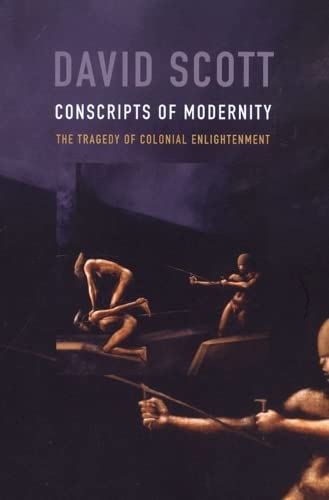
At this stalled and disillusioned juncture in postcolonial history—when many anticolonial utopias have withered into a morass of exhaustion, corruption, and authoritarianism—David Scott argues the need to reconceptualize the past in order to reimagine a more usable future. He describes how, prior to independence, anticolonialists narrated the transition from colonialism to postcolonialism as romance—as a story of overcoming and vindication, of salvation and redemption. Scott contends that postcolonial scholarship assumes the same trajectory, and that this imposes conceptual limitations. He suggests that tragedy may be a more useful narrative frame than romance. In tragedy, the future does not appear as an uninterrupted movement forward, but instead as a slow and sometimes reversible series of ups and downs.
Scott explores the political and epistemological implications of how the past is conceived in relation to the present and future through a reconsideration of C. L. R. James’s masterpiece of anticolonial history, The Black Jacobins, first published in 1938. In that book, James told the story of Toussaint L’Ouverture and the making of the Haitian Revolution as one of romantic vindication. In the second edition, published in the United States in 1963, James inserted new material suggesting that that story might usefully be told as tragedy. Scott uses James’s recasting of The Black Jacobins to compare the relative yields of romance and tragedy. In an epilogue, he juxtaposes James’s thinking about tragedy, history, and revolution with Hannah Arendt’s in On Revolution. He contrasts their uses of tragedy as a means of situating the past in relation to the present in order to derive a politics for a possible future.
Die Inhaltsangabe kann sich auf eine andere Ausgabe dieses Titels beziehen.
Über die Autorin bzw. den Autor
David Scott is Professor of Anthropology at Columbia University. He is the author of Refashioning Futures: Criticism after Postcoloniality and Formations of Ritual: Colonial and Anthropological Discourses on the Sinhala Yaktovil. He is editor of the journal Small Axe.
Von der hinteren Coverseite
""Conscripts of Modernity" is a highly original and lucidly argued text, a major advance in David Scott's effort to elaborate a new form of postcolonial criticism in the wake of the collapse of the emancipatory hopes embodied in the anticolonialist moment. Scott's position will be found controversial by some. But it will not and cannot be ignored."--Stuart Hall, Emeritus Professor of Sociology, The Open University
Auszug. © Genehmigter Nachdruck. Alle Rechte vorbehalten.
Conscripts of Modernity
The Tragedy of Colonial EnlightenmentBy David ScottDuke University Press
Copyright © 2005 David ScottAll right reserved.
ISBN: 9780822334330
Chapter One
Futures Past
Tranquillity to-day is either innate (the philistine) or to be acquired only by a deliberate doping of the personality. It was in the stillness of a seaside suburb that could be heard most clearly and insistently the booming of Franco's heavy artillery, the rattle of Stalin's firing squads and the fierce shrill turmoil of the revolutionary movement striving for clarity and influence. Such is our age and this book is of it, with something of the fever and the fret. Nor does the writer regret it. The book is the history of a revolution and written under different circumstances it would have been a different but not necessarily a better book.
I
These, of course, are the memorable closing sentences of the preface to the first edition of C. L. R. James's incomparable work of anticolonial revolutionary history, The Black Jacobins, published in 1938. They are unforgettable sentences. But they are unforgettable not only because of the indignation that edges them, or the defiance that surrounds them, or the resolve that breathes through them. They are unforgettable also because they so vividly, so palpably, so proximately, and so self-consciously locate James at the dramatic scene of his history-writing. They situate James in a singular way in relation to the historical experience that makes up his living present and the aspirations that animate his utopian hopes for a possible alternative future. The creative and intellectual labor of political-historical reconstruction that constitutes The Black Jacobins-and constitutes it as the kind of narrative that it is-is inseparable from those unfolding dramas he evokes and inscribes into the unnatural stillness of his seaside tableau.
Notice the implicit reference in the quoted passage to Wordsworth's famous description of the ideal conditions of poetic creation in his preface to the Lyrical Ballads. And notice too the allusion to the aesthetic intensity of Keats's weary melancholy in "Ode to a Nightingale." As we know especially from his later autobiographical sketches, the English Romantics and the idea of "poetry as criticism of life" constituted a significant part of James's intellectual self-fashioning in the 1920s in Trinidad. Revolutionary that he had become by the time he wrote The Black Jacobins in London in the 1930s, however, it is understandable that he should have been impatient with the desire of the English Romantics to withdraw into an artificial tranquility, to "fade" and "dissolve" into that seductive silence far away from the cacophony of social and political upheaval that surrounded them in the late eighteenth and early nineteenth centuries. Like him, after all, Wordsworth and Coleridge and Keats and Shelley (to name only some of the Romantic poets whose trace one finds in The Black Jacobins) lived and wrote in a time of revolution and reaction. At the same time, however, and in a way so characteristic of James's poetics, the passage is not without a finely tuned ambiguity of literary-critical affiliation and commitment. For in establishing the militantly disenchanted tone and literary-historical register of his own revolutionary discontent, James is also drawing deeply here on the moral sensibilities, aesthetic ideas, and subversive energies of these very Romantics themselves, on their ideal of redemptive heroism as much as their republican and antislavery politics. Most important of all though, the passage shows us James drawing on the Romantics' (almost defining) preoccupation with the peculiar mimetic powers of the imagination, its expansive capacity to transcend time and distance and to open itself to a selfless and sympathetic connection with the suffering and struggles of others. This relation between imaginative identification and historical reconstruction is at the heart of the literary-political genius of The Black Jacobins.
THE HISTORICAL SIGNIFIERS James references in the closing sentences of his preface are vividly iconic. The Spanish Civil War had opened on July 17, 1936, with the generals' coup against the newly elected Popular Front government, the Second Spanish Republic, and, with the help of Mussolini's Italy and Hitler's Germany, would eventually (in March 1939) see the Nationalists under Francisco Franco come to power. For a whole generation born around the early years of the twentieth century, the Republican War (as it is sometimes called) was an arousing and emblematic war, gathering and compressing in the ferocity of the three-year conflict all the ideological confrontations that were beginning to define-and disfigure-the twentieth century: the confrontation between Left and Right, capitalism and communism, fascism and democracy, tradition and progress. Many volunteers risked their lives for Spanish Republicans, and some, like the critic Christopher Caudwell, were killed in battle. As George Orwell (one of the volunteers to fight and return) was to show in his firsthand account, Homage to Catalonia, and in the several reviews he wrote during 1937 and 1938, the war simultaneously exposed the political and diplomatic bankruptcy of the liberal democratic West and its Non-Intervention Agreement (sponsored by Britain and France), and the kinds of duplicity, treachery, and murder in which the Communist International (even as it organized and helped to sustain the International Brigades) stood ready and willing to engage to stamp out what was left of the revolution. It was James's war too, if at a somewhat greater distance than for Orwell. In 1937 he wrote a short, insurgent preface to Mary Low's and Juan Brea's Red Spanish Notebook in which the revolutionary heroism of the Trotskyist POUM (Unified Marxist Workers' Party) is praised. "They will conquer," James wrote with lyrical determination. "They must. If not to-day then to-morrow, by whatever tortuous and broken roads, despite the stumblings and the falls." It was, if nothing else, more programmatic (and less self-serving) than W. H. Auden's memorable "yes, I am Spain." Reflecting back on this historical moment, Eric Hobsbawm, whose orthodox (communist) political sympathies were never James's (nor, of course, Orwell's), is perhaps nevertheless seeing from a generational perspective roughly shared by his elder when he writes: "What Spain meant to liberals and those on the Left who lived through the 1930s, is now difficult to remember, though for many of us the survivors, now all past the Biblical life-span, it remains the only political cause which, even in retrospect, appears as pure and compelling as it did in 1936."
Not so the legacy of the Russian Revolution of October 1917. Here the ambiguities came early, and remained. The rise of Stalin's dictatorship over the Communist Party of the Soviet Union after Lenin's death in January 1924, his gradual ascendancy over the Communist International, and his declaration of the policy of "Socialism in One Country" represented for many who identified themselves with the emancipatory ideals of Marxism the beginning of the end of the hope in Russia of providing leadership for the anticipated worldwide revolution. Stalin moved rapidly to diminish the space of dissent, moving first against his principal rival, Trotsky, and the so-called Left Opposition. They were effectively defeated between 1927 and 1928, when Trotsky was, in succession,...
„Über diesen Titel“ kann sich auf eine andere Ausgabe dieses Titels beziehen.
Weitere beliebte Ausgaben desselben Titels

Suchergebnisse für Conscripts of Modernity: The Tragedy of Colonial Enlightenme...

Beispielbild für diese ISBN
Conscripts of Modernity: The Tragedy of Colonial Enlightenment
Verlag:
Duke University Press Books, 2004
ISBN 10: 082233433X
ISBN 13: 9780822334330
Gebraucht
Hardcover
Anbieter: Midtown Scholar Bookstore, Harrisburg, PA, USA
Verkäuferbewertung 5 von 5 Sternen

Hardcover. Zustand: Good. Good - Bumped and creased book with tears to the extremities, but not affecting the text block, may have remainder mark or previous owner's name - GOOD Standard-sized. Bestandsnummer des Verkäufers M082233433XZ3
Gebraucht kaufen
EUR 70,77
EUR 5,21 Versand
Versand innerhalb von USA
Versand innerhalb von USA
Anzahl: 5 verfügbar
Beispielbild für diese ISBN
Conscripts of Modernity: The Tragedy of Colonial Enlightenment
Anbieter: THE SAINT BOOKSTORE, Southport, Vereinigtes Königreich
Verkäuferbewertung 5 von 5 Sternen
Hardback. Zustand: Good. Used copy in good condition - Usually dispatched within 3 working days. Bestandsnummer des Verkäufers D9780822334330
Gebraucht kaufen
EUR 86,51
EUR 23,77 Versand
Versand von Vereinigtes Königreich nach USA
Versand von Vereinigtes Königreich nach USA
Anzahl: 1 verfügbar
Beispielbild für diese ISBN
Conscripts of Modernity
Anbieter: PBShop.store UK, Fairford, GLOS, Vereinigtes Königreich
Verkäuferbewertung 4 von 5 Sternen

HRD. Zustand: New. New Book. Shipped from UK. Established seller since 2000. Bestandsnummer des Verkäufers FW-9780822334330
Neu kaufen
EUR 106,83
EUR 5,75 Versand
Versand von Vereinigtes Königreich nach USA
Versand von Vereinigtes Königreich nach USA
Anzahl: 1 verfügbar
Foto des Verkäufers
Conscripts of Modernity : The Tragedy of Colonial Enlightenment
Anbieter: GreatBookPrices, Columbia, MD, USA
Verkäuferbewertung 5 von 5 Sternen
Zustand: New. Bestandsnummer des Verkäufers 2561029-n
Neu kaufen
EUR 113,84
EUR 2,29 Versand
Versand innerhalb von USA
Versand innerhalb von USA
Anzahl: 1 verfügbar
Foto des Verkäufers
Conscripts of Modernity : The Tragedy of Colonial Enlightenment
Anbieter: GreatBookPrices, Columbia, MD, USA
Verkäuferbewertung 5 von 5 Sternen
Zustand: As New. Unread book in perfect condition. Bestandsnummer des Verkäufers 2561029
Gebraucht kaufen
EUR 115,22
EUR 2,29 Versand
Versand innerhalb von USA
Versand innerhalb von USA
Anzahl: 1 verfügbar
Foto des Verkäufers
Conscripts of Modernity : The Tragedy of Colonial Enlightenment
Anbieter: GreatBookPricesUK, Woodford Green, Vereinigtes Königreich
Verkäuferbewertung 5 von 5 Sternen
Zustand: New. Bestandsnummer des Verkäufers 2561029-n
Neu kaufen
EUR 101,77
EUR 17,19 Versand
Versand von Vereinigtes Königreich nach USA
Versand von Vereinigtes Königreich nach USA
Anzahl: 1 verfügbar
Beispielbild für diese ISBN
Conscripts of Modernity: The Tragedy of Colonial Enlightenment
Anbieter: THE SAINT BOOKSTORE, Southport, Vereinigtes Königreich
Verkäuferbewertung 5 von 5 Sternen
Hardback. Zustand: New. New copy - Usually dispatched within 4 working days. Bestandsnummer des Verkäufers B9780822334330
Neu kaufen
EUR 101,78
EUR 18,37 Versand
Versand von Vereinigtes Königreich nach USA
Versand von Vereinigtes Königreich nach USA
Anzahl: 1 verfügbar
Beispielbild für diese ISBN
Conscripts of Modernity The Tragedy of Colonial Enlightenment
Anbieter: Revaluation Books, Exeter, Vereinigtes Königreich
Verkäuferbewertung 5 von 5 Sternen
Hardcover. Zustand: Brand New. new title edition. 296 pages. 9.00x6.00x1.00 inches. In Stock. Bestandsnummer des Verkäufers __082233433X
Neu kaufen
EUR 113,80
EUR 14,33 Versand
Versand von Vereinigtes Königreich nach USA
Versand von Vereinigtes Königreich nach USA
Anzahl: 1 verfügbar
Beispielbild für diese ISBN
Conscripts Of Modernity
Anbieter: Kennys Bookshop and Art Galleries Ltd., Galway, GY, Irland
Verkäuferbewertung 5 von 5 Sternen
Zustand: New. 2004. Hardcover. . . . . . Bestandsnummer des Verkäufers V9780822334330
Neu kaufen
EUR 122,28
EUR 10,50 Versand
Versand von Irland nach USA
Versand von Irland nach USA
Anzahl: 1 verfügbar
Foto des Verkäufers
Conscripts of Modernity : The Tragedy of Colonial Enlightenment
Anbieter: GreatBookPricesUK, Woodford Green, Vereinigtes Königreich
Verkäuferbewertung 5 von 5 Sternen
Zustand: As New. Unread book in perfect condition. Bestandsnummer des Verkäufers 2561029
Gebraucht kaufen
EUR 116,97
EUR 17,19 Versand
Versand von Vereinigtes Königreich nach USA
Versand von Vereinigtes Königreich nach USA
Anzahl: 1 verfügbar