
Verwandte Artikel zu Bodies in Contact: Rethinking Colonial Encounters in...
Inhaltsangabe
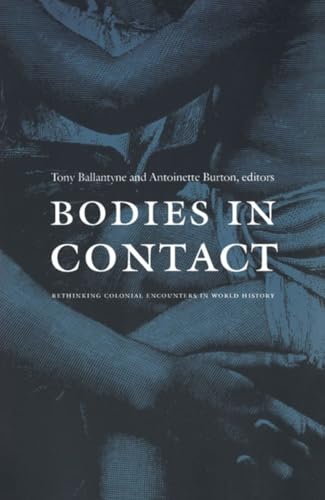
From portrayals of African women's bodies in early modern European travel accounts to the relation between celibacy and Indian nationalism to the fate of the Korean "comfort women" forced into prostitution by the occupying Japanese army during the Second World War, the essays collected in Bodies in Contact demonstrate how a focus on the body as a site of cultural encounter provides essential insights into world history. Together these essays reveal the "body as contact zone" as a powerful analytic rubric for interpreting the mechanisms and legacies of colonialism and illuminating how attention to gender alters understandings of world history. Rather than privileging the operations of the Foreign Office or gentlemanly capitalists, these historical studies render the home, the street, the school, the club, and the marketplace visible as sites of imperial ideologies.
Bodies in Contact brings together important scholarship on colonial gender studies gathered from journals around the world. Breaking with approaches to world history as the history of "the West and the rest," the contributors offer a panoramic perspective. They examine aspects of imperial regimes including the Ottoman, Mughal, Soviet, British, Han, and Spanish, over a span of six hundred years--from the fifteenth century through the mid-twentieth. Discussing subjects as diverse as slavery and travel, ecclesiastical colonialism and military occupation, marriage and property, nationalism and football, immigration and temperance, Bodies in Contact puts women, gender, and sexuality at the center of the "master narratives" of imperialism and world history.
Contributors. Joseph S. Alter, Tony Ballantyne, Antoinette Burton, Elisa Camiscioli, Mary Ann Fay, Carter Vaughn Findley, Heidi Gengenbach, Shoshana Keller, Hyun Sook Kim, Mire Koikari, Siobhan Lambert-Hurley, Melani McAlister, Patrick McDevitt, Jennifer L. Morgan, Lucy Eldersveld Murphy, Rosalind O'Hanlon, Rebecca Overmyer-Velázquez, Fiona Paisley, Adele Perry, Sean Quinlan, Mrinalini Sinha, Emma Jinhua Teng, Julia C. Wells
Die Inhaltsangabe kann sich auf eine andere Ausgabe dieses Titels beziehen.
Über die Autorin bzw. den Autor
Tony Ballantyne is Senior Lecturer in History at the University of Otago in New Zealand. He is the author of Orientalism and Race: Aryanism in the British Empire and the editor of Science, Empire, and the European Exploration of the Pacific.
Antoinette Burton is Catherine C. and Bruce A. Bastian Professor of Global and Transnational Studies, Department of History, University of Illinois. She is the author of Dwelling in the Archive: Women Writing House, Home, and History in Late Colonial India and At the Heart of the Empire: Indians and the Colonial Encounter in Late-Victorian Britain. She is the editor of After the Imperial Turn: Thinking with and through the Nation (also published by Duke University Press) and a coeditor of The Journal of Women's History.
Von der hinteren Coverseite
""Bodies in Contact" is an excellent work, full of lively essays based on an engaging variety of historical perspectives. Instructors in world history rightly complain that there is little available to students that covers gender. This volume helps fill that gap with articles on important issues in the history of contact and empire."--Bonnie G. Smith, author of "The Gender of History: Men, Women, and Historical Practice "
Auszug. © Genehmigter Nachdruck. Alle Rechte vorbehalten.
Bodies in Contact
Rethinking Colonial Encounters in World HistoryDUKE UNIVERSITY PRESS
Copyright © 2005 DUKE UNIVERSITY PRESSAll right reserved.
ISBN: 978-0-8223-3467-5
Contents
Acknowledgments..............................................................................................................................xiTONY BALLANTYNE AND ANTOINETTE BURTON | Introduction: Bodies, Empires, and World Histories...................................................1ROSALIND O'HANLON | Masculinity and the Bangash Nawabs of Farrukhabad........................................................................19EMMA JINHUA TENG | An Island of Women: Gender in Qing Travel Writing about Taiwan............................................................38JENNIFER L. MORGAN | Male Travelers, Female Bodies, and the Gendering of Racial Ideology, 1500-1700..........................................54REBECCA OVERMYER-VELZQUEZ | Christian Morality in New Spain: The Nahua Woman in the Franciscan Imaginary....................................67JULIA C. WELLS | Eva's Men: Gender and Power at the Cape of Good Hope........................................................................84SEAN QUINLAN | Colonial Bodies, Hygiene, and Abolitionist Politics in Eighteenth-Century France..............................................106MARY ANN FAY | Women, Property, and Power in Eighteenth-Century Cairo........................................................................125ADELE PERRY | Reproducing Colonialism in British Columbia, 1849-1871.........................................................................143LUCY ELDERSVELD MURPHY | Native American and Mtis Women as "Public Mothers" in the Nineteenth-Century Midwest...............................164MRINALINI SINHA | Britishness, Clubbability, and the Colonial Public Sphere..................................................................183PATRICK F. McDEVITT | Muscular Catholicism: Nationalism, Masculinity, and Gaelic Team Sports, 1884-1916......................................201ELISA CAMISCIOLI | Reproducing the "French Race": Immigration and Pronatalism in Early-Twentieth-Century France..............................219FIONA PAISLEY | Race Hysteria, Darwin 1938...................................................................................................234HEIDI GENGENBACH | Tattooed Secrets: Women's History in Magude District, Southern Mozambique.................................................253CARTER VAUGHN FINDLEY | An Ottoman Occidentalist in Europe: Ahmed Midhat Meets Madame Gnar, 1889............................................277SIOBHAN LAMBERT HURLEY | Out of India: The Journeys of the Begam of Bhopal, 1901-1930........................................................293JOSEPH S. ALTER | Celibacy, Sexuality, and Nationalism in North India........................................................................310SHOSHANA KELLER | Women's Liberation and Islam in Soviet Uzbekistan, 1926-1941...............................................................321MIRE KOIKARI | Gender, Power, and U.S. Imperialism: The Occupation of Japan, 1945-1952.......................................................342HYUN SOOK KIM | History and Memory: The "Comfort Women" Controversy..........................................................................363MELANI McALISTER | "One Black Allah": The Middle East in the Cultural Politics of African American Liberation, 1955-1970.....................383TONY BALLANTYNE AND ANTOINETTE BURTON | Postscript: Bodies, Genders, Empires: Reimagining World Histories....................................405Contributors.................................................................................................................................425Index........................................................................................................................................431
Chapter One
Rosalind O'HanlonMasculinity and the Bangash Nawabs of Farrukhabad
Understandings of gender were as fundamental to the culture of early modern Islamic empires as they were to the maritime empires constructed by European powers. Mughal authority in India rested on the creation of alliances with rival warrior kingdoms, and codes of masculine sociability were prominent in courtly culture. During the eighteenth century, these imperial traditions were increasingly challenged by a range of insurgent groups (Sikhs, Marathas, and Pathans) that fostered distinctive military traditions and visions of manhood. Through its examination of the Pathan soldier and courtier Muhammad Khan Bangash's manipulation of these competing codes of masculinity, this essay underscores that the performance of gender identities was a crucial cross-cultural means of establishing hierarchies and affirming common identities within the cosmopolitan world of Mughal imperial politics.
This paper focuses on rulership, warfare, and masculinity in eighteenth-century north India, and for three reasons. First, it is very difficult to specify how the coming of colonial society changed gender roles and identities without knowing very much about the eighteenth century, although this has not deterred many historians from trying. Second, and following on from this, one of the wider questions for any historian of gender in South Asia arises out of suggestions by Ashis Nandy and others that precolonial Indian societies worked with rather fluid and permeable gender identities, in which ideas about bisexuality and androgyny featured strongly and in which "softer" forms of creativity and intuition were not strongly identified with femininity, nor values of violence and power with masculinity. It was on these malleable and multiplex identities, Nandy argues, that Victorian colonial culture imposed its much more rigid and dichotomous ideologies of gender, setting masculine against and above feminine and establishing a homology between political and sexual dominance that juxtaposed the manliness, rationality, courage, and control of British rulers-essentially British middle-class sexual stereotypes-against degenerated, effete, and superstitious colonial subjects. In this way, Nandy argues, the rather small sectors of Indian society in which the martial values of the Kshatriya order predominated came during the colonial period to threaten and partially to displace those more fluid and diffuse identities of Indian tradition. This reconstitution of Indian gender values and identities under colonialism is an important one, and a starting point for me is the late precolonial period.
Third, the recent work of Mrinalini Sinha on "colonial masculinity" in late-nineteenth-century Bengal has raised some extremely important questions about the significance of masculine identities as a cross-cultural means of establishing hierarchies and affirming common identities. Sinha examines the ideological constructs of the "manly Englishman" and "effeminate Bengali" in a range of different political contexts. She shows how colonial rulers and Indian elites alike employed them in complex ideological maneuvers, sometimes to institute a hierarchy, sometimes to suggest commonalities. This is a very interesting approach, in that it extends into the field of masculine identities questions about the links between gender, race, and imperialism which are already the subject of intense scrutiny and debate from the perspective of women's histories. These latter have illustrated how colonial officials, missionaries, Indian reformers, and nationalists came to agree that the domains of women and family, "custom" and community lay properly outside the normal...
„Über diesen Titel“ kann sich auf eine andere Ausgabe dieses Titels beziehen.
Suchergebnisse für Bodies in Contact: Rethinking Colonial Encounters in...

Beispielbild für diese ISBN
Bodies in Contact : Rethinking Colonial Encounters in World History
Anbieter: Better World Books: West, Reno, NV, USA
Verkäuferbewertung 5 von 5 Sternen

Zustand: Very Good. Pages intact with possible writing/highlighting. Binding strong with minor wear. Dust jackets/supplements may not be included. Stock photo provided. Product includes identifying sticker. Better World Books: Buy Books. Do Good. Bestandsnummer des Verkäufers 12961871-6
Gebraucht kaufen
EUR 7,64
Versand gratis
Versand innerhalb von USA
Versand innerhalb von USA
Anzahl: 1 verfügbar
Beispielbild für diese ISBN
Bodies in Contact : Rethinking Colonial Encounters in World History
Anbieter: Better World Books, Mishawaka, IN, USA
Verkäuferbewertung 5 von 5 Sternen
Zustand: Good. Former library copy. Pages intact with minimal writing/highlighting. The binding may be loose and creased. Dust jackets/supplements are not included. Includes library markings. Stock photo provided. Product includes identifying sticker. Better World Books: Buy Books. Do Good. Bestandsnummer des Verkäufers 5375407-6
Gebraucht kaufen
EUR 7,64
Versand gratis
Versand innerhalb von USA
Versand innerhalb von USA
Anzahl: 1 verfügbar
Beispielbild für diese ISBN
Bodies in Contact : Rethinking Colonial Encounters in World History
Anbieter: Better World Books, Mishawaka, IN, USA
Verkäuferbewertung 5 von 5 Sternen
Zustand: Good. Pages intact with minimal writing/highlighting. The binding may be loose and creased. Dust jackets/supplements are not included. Stock photo provided. Product includes identifying sticker. Better World Books: Buy Books. Do Good. Bestandsnummer des Verkäufers 14072135-75
Gebraucht kaufen
EUR 7,64
Versand gratis
Versand innerhalb von USA
Versand innerhalb von USA
Anzahl: 1 verfügbar
Beispielbild für diese ISBN
Bodies in Contact: Rethinking Colonial Encounters in World History
Anbieter: NW Book Rescue, Hubbard, OR, USA
Verkäuferbewertung 2 von 5 Sternen

paperback. Zustand: Fair. Acceptable copy. May have minimal notes, ex libris stickers, or some wear. Guranteed to be readable, decent copy. Bestandsnummer des Verkäufers SGSO-09-15-2022-0407-2.1M-G0438
Gebraucht kaufen
EUR 7,64
Versand gratis
Versand innerhalb von USA
Versand innerhalb von USA
Anzahl: 1 verfügbar
Beispielbild für diese ISBN
Bodies in Contact: Rethinking Colonial Encounters in World History
Anbieter: ThriftBooks-Atlanta, AUSTELL, GA, USA
Verkäuferbewertung 5 von 5 Sternen
Paperback. Zustand: Good. No Jacket. Pages can have notes/highlighting. Spine may show signs of wear. ~ ThriftBooks: Read More, Spend Less. Bestandsnummer des Verkäufers G0822334674I3N00
Gebraucht kaufen
EUR 9,67
Versand gratis
Versand innerhalb von USA
Versand innerhalb von USA
Anzahl: 1 verfügbar
Beispielbild für diese ISBN
Bodies in Contact: Rethinking Colonial Encounters in World History
Verlag:
Duke University Press Books, 2005
ISBN 10: 0822334674
ISBN 13: 9780822334675
Gebraucht
Paperback
Anbieter: Books From California, Simi Valley, CA, USA
Verkäuferbewertung 4 von 5 Sternen

Paperback. Zustand: Good. Bestandsnummer des Verkäufers mon0004206610
Gebraucht kaufen
EUR 7,14
EUR 4,44 Versand
Versand innerhalb von USA
Versand innerhalb von USA
Anzahl: 1 verfügbar
Beispielbild für diese ISBN
Bodies in Contact: Rethinking Colonial Encounters in World History
Verlag:
Duke University Press Books, 2005
ISBN 10: 0822334674
ISBN 13: 9780822334675
Gebraucht
paperback
Anbieter: Midtown Scholar Bookstore, Harrisburg, PA, USA
Verkäuferbewertung 5 von 5 Sternen
paperback. Zustand: Acceptable. Acceptable, Reading copy only, with writing/markings, bumps/creasing, and heavy wear. Standard-sized. Bestandsnummer des Verkäufers mon0000346101
Gebraucht kaufen
EUR 8,25
EUR 5,34 Versand
Versand innerhalb von USA
Versand innerhalb von USA
Anzahl: 1 verfügbar
Beispielbild für diese ISBN
Bodies In Contact: Rethinking Colonial Encounters In World History
Verlag:
Durham, North Carolina, U.S.A.: Duke Univ Pr, 2005
ISBN 10: 0822334674
ISBN 13: 9780822334675
Gebraucht
Soft cover
Anbieter: TotalitarianMedia, Los Angeles, CA, USA
Verkäuferbewertung 4 von 5 Sternen
Soft cover. Zustand: Fine. No Jacket. Bodies in Contact: Rethinking Colonial Encounters in World History (ISBN: 9780822334675) Tony Ballantyne; Antoinette Burton (eds.), Duke University Press, 2005, 445p, trade pb, covers lightly bumped/scuffed, CLEAN text, solid binding, nice copy---10.00. Bestandsnummer des Verkäufers ABE-4212009663
Gebraucht kaufen
EUR 9,16
EUR 5,34 Versand
Versand innerhalb von USA
Versand innerhalb von USA
Anzahl: 1 verfügbar
Beispielbild für diese ISBN
Bodies in Contact: Rethinking Colonial Encounters in World History
Verlag:
Duke University Press Books, 2005
ISBN 10: 0822334674
ISBN 13: 9780822334675
Gebraucht
Paperback
Anbieter: Sequitur Books, Boonsboro, MD, USA
Verkäuferbewertung 5 von 5 Sternen
Paperback. Zustand: As New. [Interesting provenance: From the private library of renowned historian, Philip D. Morgan.] Softcover. Good binding and cover. Light edge wear. Contemporary signature of Morgan on front end page, else unmarked. From the professional library of Dr. Philip D. Morgan, a professor of History at Johns Hopkins University. Morgan specializes in the African-American experience, the history of slavery, the early Caribbean, and the study of the early Atlantic world. Morgan is the author of more than 14 books on Colonial America and African American history. He has won both the Bancroft Prize and the Frederick Douglass Prize for his book Slave Counterpoint: Black Culture in the Eighteenth-Century Chesapeake and Lowcountry (1998). Bestandsnummer des Verkäufers 2504240002
Gebraucht kaufen
EUR 10,95
EUR 5,31 Versand
Versand innerhalb von USA
Versand innerhalb von USA
Anzahl: 1 verfügbar
Foto des Verkäufers
Bodies in Contact: Rethinking Colonial Encounters in World History
Anbieter: Cycle Books LA, South el monte, CA, USA
Verkäuferbewertung 5 von 5 Sternen
Zustand: new. Bestandsnummer des Verkäufers AMTV.0822334674.N
Neu kaufen
EUR 16,14
EUR 2,66 Versand
Versand innerhalb von USA
Versand innerhalb von USA
Anzahl: 1 verfügbar