
Verwandte Artikel zu Trading Roles: Gender, Ethnicity, and the Urban Economy...
Trading Roles: Gender, Ethnicity, and the Urban Economy in Colonial Potosí (Latin America Otherwise) - Softcover
Buch 34 von 58: Latin America Otherwise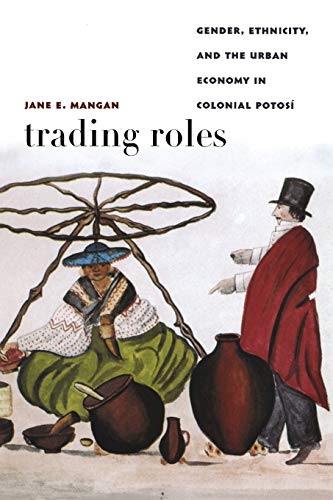
Inhaltsangabe
Located in the heart of the Andes, Potosí was arguably the most important urban center in the Western Hemisphere during the colonial era. It was internationally famous for its abundant silver mines and regionally infamous for its labor draft. Set in this context of opulence and oppression associated with the silver trade, Trading Roles emphasizes daily life in the city's streets, markets, and taverns. As Jane E. Mangan shows, food and drink transactions emerged as the most common site of interaction for Potosinos of different ethnic and class backgrounds. Within two decades of Potosí's founding in the 1540s, the majority of the city's inhabitants no longer produced food or alcohol for themselves; they purchased these items. Mangan presents a vibrant social history of colonial Potosí through an investigation of everyday commerce during the city's economic heyday, between the discovery of silver in 1545 and the waning of production in the late seventeenth century.
Drawing on wills and dowries, judicial cases, town council records, and royal decrees, Mangan brings alive the bustle of trade in Potosí. She examines quotidian economic transactions in light of social custom, ethnicity, and gender, illuminating negotiations over vendor locations, kinship ties that sustained urban trade through the course of silver booms and busts, and credit practices that developed to mitigate the pressures of the market economy. Mangan argues that trade exchanges functioned as sites to negotiate identities within this colonial multiethnic society. Throughout the study, she demonstrates how women and indigenous peoples played essential roles in Potosí's economy through the commercial transactions she describes so vividly.
Die Inhaltsangabe kann sich auf eine andere Ausgabe dieses Titels beziehen.
Über die Autorin bzw. den Autor
Jane E. Mangan is Assistant Professor of History at Davidson College in Davidson, North Carolina. She is the editor of Natural and Moral History of the Indies, by José de Acosta (also published by Duke University Press).
Von der hinteren Coverseite
""Trading Roles" is an unusually lively, detailed account of 'the underdogs' of a colonial Spanish American city. It draws attention not only to relatively invisible historical actors but to the rich texture of the deals and socially patterned expectations that brought them together."--Kathryn Burns, author of "Colonial Habits: Convents and the Spiritual Economy of Cuzco, Peru"
Auszug. © Genehmigter Nachdruck. Alle Rechte vorbehalten.
TRADING ROLES
Gender, Ethnicity, and the Urban Economy in Colonial Potos By JANE E. MANGANDUKE UNIVERSITY PRESS
Copyright © 2005 Duke University PressAll right reserved.
ISBN: 978-0-8223-3470-5
Contents
About the Series.............................................................................................viiAcknowledgments..............................................................................................xiIntroduction.................................................................................................11 "The Largest Population and the Most Commerce": The Genesis of Potos's Urban Economy.....................212 Making Room to Sell: Location, Regulation, and the Properties of Urban Trade..............................483 Light on the Chicha, Heavy on the Bread: The Colonial Market for Brewing and Baking.......................764 The World of Credit in the City of Silver.................................................................1065 Enterprising Women: Female Traders in the Urban Economy...................................................1346 Vale un Potos? The Urban Marketplace in the Face of Decline, 1650-1700..................................161Conclusions..................................................................................................178Appendix.....................................................................................................191Notes........................................................................................................197Glossary.....................................................................................................251Bibliography.................................................................................................255Index........................................................................................................267
Chapter One
"THE LARGEST POPULATION AND THE MOST COMMERCE"The Genesis of Potos's Urban Economy
Potos was discovered by two native Andeans transporting food from Cochabamba to the mines of Porco, or so claimed one early seventeenth-century source. These men, guayradores who smelted silver, traveled a route that took them past the foot of the Cerro Rico. At precisely this point in the journey one of their freight llamas strayed from the rest. The man known as Guallpa chased the llama up the slopes of the Cerro only to stumble onto a huge outcropping of silver. He discretely replaced the llama's load of food with silver and rejoined his companion. For several months Guallpa returned to the Cerro, took the ore, and refined it for himself. His fellow guayradores in Porco became suspicious because, suddenly, he was eating and dressing better than they were. Where, they asked, do you find such rich ore?
Accounts of discovery have a way of blending events and myths. This tale contradicts others in the precise details, but it reveals the dominant themes of Potos's dynamic sixteenth-century history. Silver and sustenance were the twin engines of Potos's economy from its 1545 founding; native laborers were its fuel. Thus it is supremely fitting that this recounting of Potos's discovery has at its core two native Andeans transporting commercial goods from the breadbasket region of Cochabamba to silver mines at Porco (see map 1). Other hints of Potos's sixteenth-century history also emerge here. These men were experts in the art of refining silver. And, with a bit of skill and calculation, Guallpa obtained higher profits than other native Andeans.
But the silver riches bred discontent. Guallpa revealed his secret to a friend, and the two argued over how long they could disguise the source of their material comforts. In the words of El Inca Garcilaso de la Vega, since "its wealth was so great that they could not or would not conceal it from their masters, they then revealed it." The masters, encomenderos named Villaroel and Quixada, traveled to the site with fellow Spaniards. Then, having confirmed the existence of silver, they undertook the legal acts necessary to found the asiento de minas on 16 April 1545. In the end, the tale of discovery plays out ominously for native Andeans, as the economic advantage passes to Spanish masters.
The period between Guallpa's discovery and the late sixteenth-century Spanish domination of silver refining is the subject of this opening chapter. Two major themes emerge in this development of the urban economy. First, the history of the initial decades stands out because the city's mines and markets offered opportunities for both Indians and Spaniards to earn profits. Thus, in Potos's incipient urban economy one can read complex tales of benefit for a small sector of the indigenous population, which would become increasingly differentiated. Second, these economic developments reveal a history of both men's and women's activities in the urban economy. The urban economy complements our understanding of male mine laborers by adding a view of women's activity to the evolution of the city.
The silver refining expertise of yanaconas like Guallpa gave them a clear economic advantage in the first decades after Potos's founding. Indigenous elites, known as kurakas, and later indigenous labor draft leaders (capitanes de mita) had opportunities to provision Potos's growing market and to profit from such exchanges. At the same time indigenous women emerged as critical leaders in urban trade. While monetary gain is clearly a motive, many of these individuals also enacted economic strategies for the benefit and with the assistance of their ayllus, the basic kin unit in the Andes which comprised numerous household groupings related through endogamous lineage. The nature of Potos's economy changed between 1545 and 1600. Barter and supply based on Andean modes of production characterized it in the first decades, but by the 1570s and that decade's Toledan reforms, cash-based exchanges and supply influenced by Spanish economic regulations were increasingly common. During the late sixteenth century, after Toledo's tenure, the population shifted to include more Spaniards, and even Spanish women, who would compete with native Andeans for mining, refining, and trade profits. By this point only certain elements within the indigenous population had the ability to benefit from Potos's economy. This interval of Potos's history provides clues to the economic and social negotiations, as well as the trade and personal relationships, that contributed to the growth of its unique urban economy.
BEFORE 1545
Do not take the silver from this mountain. It is for other masters. -Arzns de Orsa y Vela, Historia de la Villa Imperial de Potos
None of the many tellings of Potos's discovery mention preconquest mining at Potos, and most ignore possible Inca or local knowledge of the silver located there. The closest settlement to Potos was Cantumarca, a native community located almost two miles to the west of the Cerro Rico. This village revealed no evidence of having carried out preconquest mining at Potos. Yet it is difficult to conclude that native Andeans had no knowledge of the silver at Potos, since Inca laborers worked the silver mines at Porco, some twenty-two miles to the southwest. Both mountains of silver sat at the very extremes of Collasuyu, the southeastern quadrant of Tawantinsuyu, as the Incas called their empire. This land was home to ancient Aymara kingdoms invaded by Inca expansionists during the fifteenth-century reigns of Tupac...
„Über diesen Titel“ kann sich auf eine andere Ausgabe dieses Titels beziehen.
Suchergebnisse für Trading Roles: Gender, Ethnicity, and the Urban Economy...

Beispielbild für diese ISBN
Trading Roles: Gender, Ethnicity, and the Urban Economy in Colonial Potos? (Latin America Otherwise)
Anbieter: World of Books (was SecondSale), Montgomery, IL, USA
Verkäuferbewertung 5 von 5 Sternen

Zustand: Very Good. Item in very good condition! Textbooks may not include supplemental items i.e. CDs, access codes etc. Bestandsnummer des Verkäufers 00110188947
Gebraucht kaufen
EUR 3,99
Versand gratis
Versand innerhalb von USA
Versand innerhalb von USA
Anzahl: 1 verfügbar
Beispielbild für diese ISBN
Trading Roles: Gender, Ethnicity, and the Urban Economy in Colonial Potos? (Latin America Otherwise)
Anbieter: World of Books (was SecondSale), Montgomery, IL, USA
Verkäuferbewertung 5 von 5 Sternen
Zustand: Good. Item in good condition. Textbooks may not include supplemental items i.e. CDs, access codes etc. Bestandsnummer des Verkäufers 00106471852
Gebraucht kaufen
EUR 3,99
Versand gratis
Versand innerhalb von USA
Versand innerhalb von USA
Anzahl: 2 verfügbar
Beispielbild für diese ISBN
Trading Roles
Anbieter: World of Books Inc, Montgomery, IL, USA
Verkäuferbewertung 4 von 5 Sternen

Paperback. Zustand: Very Good. A social history of trade in a colonial city in Peru, arguing that markets, stores, and taverns were important sites of cultural creation and showing how the gender and ethnic identities of participants affected how they adapted to the market economy. Bestandsnummer des Verkäufers CIN0822334704VG
Gebraucht kaufen
EUR 5,79
Versand gratis
Versand innerhalb von USA
Versand innerhalb von USA
Anzahl: 1 verfügbar
Beispielbild für diese ISBN
Trading Roles: Gender, Ethnicity, and the Urban Economy in Colonial PotosÃ
Anbieter: ThriftBooks-Dallas, Dallas, TX, USA
Verkäuferbewertung 5 von 5 Sternen
Paperback. Zustand: Good. No Jacket. Pages can have notes/highlighting. Spine may show signs of wear. ~ ThriftBooks: Read More, Spend Less. Bestandsnummer des Verkäufers G0822334704I3N00
Gebraucht kaufen
EUR 5,96
Versand gratis
Versand innerhalb von USA
Versand innerhalb von USA
Anzahl: 1 verfügbar
Beispielbild für diese ISBN
Trading Roles: Gender, Ethnicity, and the Urban Economy in Colonial PotosÃ
Anbieter: ThriftBooks-Atlanta, AUSTELL, GA, USA
Verkäuferbewertung 5 von 5 Sternen
Paperback. Zustand: Good. No Jacket. Pages can have notes/highlighting. Spine may show signs of wear. ~ ThriftBooks: Read More, Spend Less. Bestandsnummer des Verkäufers G0822334704I3N00
Gebraucht kaufen
EUR 5,96
Versand gratis
Versand innerhalb von USA
Versand innerhalb von USA
Anzahl: 1 verfügbar
Beispielbild für diese ISBN
Trading Roles: Gender, Ethnicity, and the Urban Economy in Colonial PotosÃ
Anbieter: ThriftBooks-Atlanta, AUSTELL, GA, USA
Verkäuferbewertung 5 von 5 Sternen
Paperback. Zustand: Very Good. No Jacket. May have limited writing in cover pages. Pages are unmarked. ~ ThriftBooks: Read More, Spend Less. Bestandsnummer des Verkäufers G0822334704I4N00
Gebraucht kaufen
EUR 5,96
Versand gratis
Versand innerhalb von USA
Versand innerhalb von USA
Anzahl: 1 verfügbar
Beispielbild für diese ISBN
Trading Roles: Gender, Ethnicity, and the Urban Economy in Colonial Potosà (Latin America Otherwise)
Verlag:
Duke University Press Books, 2005
ISBN 10: 0822334704
ISBN 13: 9780822334705
Gebraucht
Paperback
Anbieter: Midtown Scholar Bookstore, Harrisburg, PA, USA
Verkäuferbewertung 5 von 5 Sternen
Paperback. Zustand: Acceptable. Acceptable - This is a significantly damaged book. It should be considered a reading copy only. Please order this book only if you are interested in the content and not the condition. May be ex-library. Standard-sized. Bestandsnummer des Verkäufers M0822334704Z4
Gebraucht kaufen
EUR 2,38
EUR 5,24 Versand
Versand innerhalb von USA
Versand innerhalb von USA
Anzahl: 1 verfügbar
Beispielbild für diese ISBN
Trading Roles: Gender, Ethnicity, and the Urban Economy in Colonial Potosà (Latin America Otherwise)
Verlag:
Duke University Press (edition Illustrated), 2005
ISBN 10: 0822334704
ISBN 13: 9780822334705
Gebraucht
Paperback
Anbieter: BooksRun, Philadelphia, PA, USA
Verkäuferbewertung 5 von 5 Sternen
Paperback. Zustand: Very Good. Illustrated. It's a well-cared-for item that has seen limited use. The item may show minor signs of wear. All the text is legible, with all pages included. It may have slight markings and/or highlighting. Bestandsnummer des Verkäufers 0822334704-11-1
Gebraucht kaufen
EUR 8,14
Versand gratis
Versand innerhalb von USA
Versand innerhalb von USA
Anzahl: 1 verfügbar
Beispielbild für diese ISBN
Trading Roles: Gender, Ethnicity, and the Urban Economy in Colonial Potosà (Latin America Otherwise)
Verlag:
Duke University Press (edition Illustrated), 2005
ISBN 10: 0822334704
ISBN 13: 9780822334705
Gebraucht
Paperback
Anbieter: BooksRun, Philadelphia, PA, USA
Verkäuferbewertung 5 von 5 Sternen
Paperback. Zustand: Very Good. Illustrated. It's a well-cared-for item that has seen limited use. The item may show minor signs of wear. All the text is legible, with all pages included. It may have slight markings and/or highlighting. Bestandsnummer des Verkäufers 0822334704-11-18
Gebraucht kaufen
EUR 8,14
Versand gratis
Versand innerhalb von USA
Versand innerhalb von USA
Anzahl: 1 verfügbar
Beispielbild für diese ISBN
Trading Roles: Gender, Ethnicity, and the Urban Economy in Colonial Potosí
Verlag:
Duke University Press, 2005
ISBN 10: 0822334704
ISBN 13: 9780822334705
Gebraucht
Trade Paperback
Erstausgabe
Anbieter: Inga's Original Choices, Piggott, AR, USA
Verkäuferbewertung 5 von 5 Sternen
Trade Paperback. Zustand: Near Fine. First Edition. A stock image [photo] is an accurate representation of the listed book's cover design . Covers clean, colors bright, minor edge wear. Pages [ including index nd various indices] clean, mostly unmarked [a few pages with minor marks and corner bends], binding tight and square; very faint moisture mark at title page. One of the Latin America Otherwise series. All books are in my smoke free & climate controlled shop and will have qualities and/or flaws described. Domestic & international shipping includes tracking information. Size: 8vo - over 7¾" - 9¾" tall. Bestandsnummer des Verkäufers 011494
Gebraucht kaufen
EUR 6,07
EUR 5,24 Versand
Versand innerhalb von USA
Versand innerhalb von USA
Anzahl: 1 verfügbar