
Verwandte Artikel zu Materiality (Politics, History, and Culture)
Materiality (Politics, History, and Culture) - Softcover
Buch 8 von 36: Politics, History, and Culture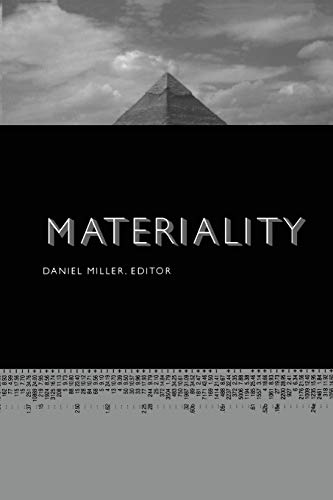
Inhaltsangabe
Throughout history and across social and cultural contexts, most systems of belief-whether religious or secular-have ascribed wisdom to those who see reality as that which transcends the merely material. Yet, as the studies collected here show, the immaterial is not easily separated from the material. Humans are defined, to an extraordinary degree, by their expressions of immaterial ideals through material forms. The essays in Materiality explore varied manifestations of materiality from ancient times to the present. In assessing the fundamental role of materiality in shaping humanity, they signal the need to decenter the social within social anthropology in order to make room for the material. Considering topics as diverse as theology, technology, finance, and art, the contributors-most of whom are anthropologists-examine the many different ways in which materiality has been understood and the consequences of these differences. Their case studies show that the latest forms of financial trading instruments can be compared with the oldest ideals of ancient Egypt, that the promise of software can be compared with an age-old desire for an unmediated relationship to divinity. Whether focusing on the theology of Islamic banking, Australian Aboriginal art, derivatives trading in Japan, or textiles that respond directly to their environment, each essay adds depth and nuance to the project that Materiality advances: a profound acknowledgment and rethinking of one of the basic properties of being human. Contributors. Matthew Engelke, Webb Keane, Susanne Küchler, Bill Maurer, Lynn Meskell, Daniel Miller, Hirokazu Miyazaki, Fred Myers, Christopher Pinney, Michael Rowlands, Nigel Thrift
Die Inhaltsangabe kann sich auf eine andere Ausgabe dieses Titels beziehen.
Über die Autorin bzw. den Autor
Daniel Miller is Professor of Anthropology at University College London. He is the author of many books, including The Sari (with Mukulika Banerjee); Capitalism: An Ethnographic Approach; A Theory of Shopping; and The Internet: An Ethnographic Approach (with Don Slater). He is the editor, most recently, of Home Possessions: Material Culture behind Closed Doors and Car Cultures.
Von der hinteren Coverseite
"This is first-class scholarship: lively, consequential, engaging, informed, and lucid. Daniel Miller and his colleagues explore--with imagination, ethnographic insight, and remarkable clarity--a range of related issues central to current debates within and beyond cultural anthropology."--Donald Brenneis, University of California, Santa Cruz
Auszug. © Genehmigter Nachdruck. Alle Rechte vorbehalten.
MATERIALITY
DUKE UNIVERSITY PRESS
Copyright © 2005 DUKE UNIVERSITY PRESSAll right reserved.
ISBN: 978-0-8223-3542-9
Contents
DANIEL MILLER Materiality: An Introduction...........................................................................1LYNN MESKELL Objects in the Mirror Appear Closer Than They Are.......................................................51MICHAEL ROWLANDS A Materialist Approach to Materiality...............................................................72FRED MYERS Some Properties of Art and Culture: Ontologies of the Image and Economies of Exchange.....................88MATTHEW ENGELKE Sticky Subjects and Sticky Objects: The Substance of African Christian Healing.......................118BILL MAURER Does Money Matter? Abstraction and Substitution in Alternative Financial Forms...........................140HIROKAZU MIYAZAKI The Materiality of Finance Theory..................................................................165WEBB KEANE Signs Are Not the Garb of Meaning: On the Social Analysis of Material Things..............................182SUSANNE KCHLER Materiality and Cognition: The Changing Face of Things...............................................206NIGEL THRIFT Beyond Mediation: Three New Material Registers and Their Consequences...................................231CHRISTOPHER PINNEY Things Happen: Or, From Which Moment Does That Object Come?.......................................256Contributors..........................................................................................................273Index.................................................................................................................277
Chapter One
DANIEL MILLERMateriality: An Introduction
There is an underlying principle to be found in most of the religions that dominate recorded history. Wisdom has been accredited to those who claim that materiality represents the merely apparent, behind which lies that which is real. Perhaps the most systematic development of this belief arose over two millennia within South Asia. For religions such as Buddhism and Hinduism, theology has been centered upon the critique of materiality. At its simplest Hinduism, for example, rests upon the concept of maya, which proclaims the illusory nature of the material world. The aim of life is to transcend the apparently obvious: the stone we stub our toe against, or the body as the core of our sensuous existence. Truth comes from our apprehension that this is mere illusion. Nevertheless, paradoxically, material culture has been of considerable consequence as the means of expressing this conviction. The merely vestigial forms at the center of a temple may be contrasted with the massive gates at the periphery. The faded pastels of an elderly woman are in stark contrast with the bright and sensual colors of the bride precisely in order to express in material form the goal of transcending our attachment to material life.
But the history of South Asia is not just the history of its religions. There is a parallel history, which tells of the endless struggle of cosmology with practice. This is the history of accumulation, taxation, wars and looting, empire and excess. It culminates in the integration of this region within a global political economy in which politics is increasingly subservient to an economics whose premise with respect to materiality could hardly be more different. In economic thought the accumulation of material commodities is itself the source of our extended capacity as humanity. Poverty is defined as the critical limit to our ability to realize ourselves as persons, consequent upon a lack of commodities. The focus upon materiality, though here in the form of accumulation, is therefore just as strong in economics as it is in Hinduism. For a discipline, such as anthropology, that is concerned with what it is to be human, we need to therefore start our discussion of this issue with an acknowledgment that the definition of humanity has often become almost synonymous with the position taken on the question of materiality. Furthermore, this has been a highly normative quest, closely linked to the question of what morality is, in the society or period in question.
Even within the most secular and self-consciously modern systems of belief the issue of materiality remains foundational to most people's stance to the world. The first major secular theory of humanity that seemed capable of dominating the world, Marxism, rested upon a philosophy of praxis, whose foundation also lies in its stance to materiality. Humanity is viewed as the product of its capacity to transform the material world in production, in the mirror of which we create ourselves. Capitalism is condemned above all for interrupting this virtuous cycle by which we create the objects that in turn create our understanding of who we can be. Instead commodities are fetishized and come to oppress those who made them. Contemporary critiques, such as Naomi Klein's (2001) No Logo, whether expressed as environmentalism or anti-globalism, may be cruder in their philosophical underpinnings, but seem to be just as focused upon the issue of materiality-for instance a loss of humanity in the face of commodities and brands-as is the neoclassical economics they confront. The centrality of materiality to the way we understand ourselves may equally well emerge from topics as diverse as love or science and associated beliefs such as the epistemology of positivism.
This constant return to the same issue demonstrates why we need to engage with the issue of materiality as far more than a mere footnote or esoteric extra to the study of anthropology. The stance to materiality also remains the driving force behind humanity's attempts to transform the world in order to make it accord with beliefs as to how the world should be. Hinduism and economics are not just beliefs about the world, but vast institutional forces that try to ensure that people live according to their tenets through priesthoods or through structural adjustment programs. In this respect capitalism and religion are equal and analogous. Chapters in this volume will attest to this foundational relationship between the stance toward materiality and the stance toward humanity through case studies ranging from ancient to contemporary practices and based around topics as diverse as theology, technology, finance, politics, and art.
This introduction will begin with two attempts to theorize materiality: the first, a vulgar theory of mere things as artifacts; the second, a theory that claims to entirely transcend the dualism of subjects and objects. It will then engage with theories associated with Bruno Latour and Alfred Gell that seek to follow a similar path, but with a greater emphasis upon the nature of agency. This is followed by a consideration of materiality and power, including claims to transcend materiality, and a consideration of the relativity of materiality where some things and some people are seen as more material than others, leading finally to an exploration of the plurality of forms of materiality. In turn, three case studies of finance and religion are used to explore the plurality of immateriality and the relationship between materiality and immateriality.
Throughout these discussions two issues emerge which are then considered in their own right. The first is the tendency to reduce all such concerns with materiality through a reification of ourselves, defined variously as the subject, as social relations or as society. In opposition to this social anthropology several chapters critique...
„Über diesen Titel“ kann sich auf eine andere Ausgabe dieses Titels beziehen.
Suchergebnisse für Materiality (Politics, History, and Culture)

Beispielbild für diese ISBN
Materiality
Anbieter: World of Books (was SecondSale), Montgomery, IL, USA
Verkäuferbewertung 5 von 5 Sternen

Paperback. Zustand: Good. A collection of essays rethinking the current uses of material culture study in anthropology, including engagements with art, science, and technology. Bestandsnummer des Verkäufers 00104654291
Gebraucht kaufen
EUR 7,34
Versand gratis
Versand innerhalb von USA
Versand innerhalb von USA
Anzahl: 1 verfügbar
Beispielbild für diese ISBN
Materiality
Anbieter: Better World Books, Mishawaka, IN, USA
Verkäuferbewertung 5 von 5 Sternen
Zustand: Good. Pages intact with minimal writing/highlighting. The binding may be loose and creased. Dust jackets/supplements are not included. Stock photo provided. Product includes identifying sticker. Better World Books: Buy Books. Do Good. Bestandsnummer des Verkäufers 1009891-6
Gebraucht kaufen
EUR 7,38
Versand gratis
Versand innerhalb von USA
Versand innerhalb von USA
Anzahl: 2 verfügbar
Beispielbild für diese ISBN
Materiality
Anbieter: Better World Books, Mishawaka, IN, USA
Verkäuferbewertung 5 von 5 Sternen
Zustand: Very Good. Former library copy. Pages intact with possible writing/highlighting. Binding strong with minor wear. Dust jackets/supplements may not be included. Includes library markings. Stock photo provided. Product includes identifying sticker. Better World Books: Buy Books. Do Good. Bestandsnummer des Verkäufers GRP62673556
Gebraucht kaufen
EUR 7,38
Versand gratis
Versand innerhalb von USA
Versand innerhalb von USA
Anzahl: 1 verfügbar
Beispielbild für diese ISBN
Materiality (Politics, History, and Culture)
Verlag:
Duke University Press Books, 2005
ISBN 10: 0822335425
ISBN 13: 9780822335429
Gebraucht
paperback
Anbieter: HPB-Red, Dallas, TX, USA
Verkäuferbewertung 5 von 5 Sternen
paperback. Zustand: Good. Connecting readers with great books since 1972! Used textbooks may not include companion materials such as access codes, etc. May have some wear or writing/highlighting. We ship orders daily and Customer Service is our top priority! Bestandsnummer des Verkäufers S_444663492
Gebraucht kaufen
EUR 4,60
EUR 3,35 Versand
Versand innerhalb von USA
Versand innerhalb von USA
Anzahl: 1 verfügbar
Beispielbild für diese ISBN
Materiality
Anbieter: ThriftBooks-Dallas, Dallas, TX, USA
Verkäuferbewertung 5 von 5 Sternen
Paperback. Zustand: Good. No Jacket. Pages can have notes/highlighting. Spine may show signs of wear. ~ ThriftBooks: Read More, Spend Less. Bestandsnummer des Verkäufers G0822335425I3N00
Gebraucht kaufen
EUR 8,17
Versand gratis
Versand innerhalb von USA
Versand innerhalb von USA
Anzahl: 1 verfügbar
Beispielbild für diese ISBN
Materiality
Anbieter: World of Books Inc, Montgomery, IL, USA
Verkäuferbewertung 4 von 5 Sternen

Paperback. Zustand: Good. A collection of essays rethinking the current uses of material culture study in anthropology, including engagements with art, science, and technology. Bestandsnummer des Verkäufers CIN0822335425G
Gebraucht kaufen
EUR 9,18
Versand gratis
Versand innerhalb von USA
Versand innerhalb von USA
Anzahl: 1 verfügbar
Foto des Verkäufers
Materiality (Politics, History, and Culture)
Anbieter: WeBuyBooks, Rossendale, LANCS, Vereinigtes Königreich
Verkäuferbewertung 5 von 5 Sternen
paperback. Zustand: Very Good. Most items will be dispatched the same or the next working day. A copy that has been read, but is in excellent condition. Pages are intact and not marred by notes or highlighting. The spine remains undamaged. Bestandsnummer des Verkäufers rev4811064515
Gebraucht kaufen
EUR 12,97
EUR 7,48 Versand
Versand von Vereinigtes Königreich nach USA
Versand von Vereinigtes Königreich nach USA
Anzahl: 1 verfügbar
Beispielbild für diese ISBN
Materiality (Politics, History, and Culture)
Anbieter: Bird Creek Books, Hillsdale, MI, USA
Verkäuferbewertung 5 von 5 Sternen
Soft cover. Zustand: Very Good. Very good condition, only one marking on first page, clean otherwise. Some minor wear on binding edge from shelf wear. Bestandsnummer des Verkäufers ABE-1759781073531
Gebraucht kaufen
EUR 18,38
EUR 4,66 Versand
Versand innerhalb von USA
Versand innerhalb von USA
Anzahl: 1 verfügbar
Foto des Verkäufers
Materiality
Anbieter: Hamelyn, Madrid, M, Spanien
Verkäuferbewertung 5 von 5 Sternen
Zustand: Good. : Materiality explora las diversas manifestaciones de la materialidad desde la antigüedad hasta el presente. Los ensayos reunidos aquí muestran que lo inmaterial no se separa fácilmente de lo material. Los humanos se definen, en un grado extraordinario, por sus expresiones de ideales inmateriales a través de formas materiales. Los estudios de caso muestran que las últimas formas de instrumentos de comercio financiero se pueden comparar con los ideales más antiguos del antiguo Egipto, que la promesa del software se puede comparar con un deseo ancestral de una relación no mediada con la divinidad. EAN: 9780822335429 Tipo: Libros Categoría: Otros Título: Materiality Autor: Daniel Miller Editorial: Duke University Press Idioma: en Páginas: 294 Formato: tapa blanda. Bestandsnummer des Verkäufers Happ-2025-12-02-381759c6
Gebraucht kaufen
EUR 15,93
EUR 11,99 Versand
Versand von Spanien nach USA
Versand von Spanien nach USA
Anzahl: 1 verfügbar
Beispielbild für diese ISBN
Materiality
Verlag:
Duke University Press, United States, 2005
ISBN 10: 0822335425
ISBN 13: 9780822335429
Gebraucht
Paperback
Anbieter: Clarendon Books P.B.F.A., Leicester, Vereinigtes Königreich
Verkäuferbewertung 5 von 5 Sternen
Paperback. Zustand: Good. Card covers in tidy condition, a little rubbed at the edges, a couple of creased page corners Size: 8vo - over 7¾" - 9¾" tall. Bestandsnummer des Verkäufers 080531
Gebraucht kaufen
EUR 12,11
EUR 22,39 Versand
Versand von Vereinigtes Königreich nach USA
Versand von Vereinigtes Königreich nach USA
Anzahl: 1 verfügbar