
Verwandte Artikel zu Unruly Immigrants: Rights, Activism, and Transnational...
Unruly Immigrants: Rights, Activism, and Transnational South Asian Politics in the United States - Softcover
Inhaltsangabe
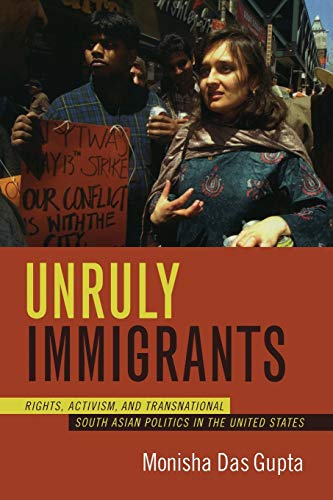
In Unruly Immigrants, Monisha Das Gupta explores the innovative strategies that South Asian feminist, queer, and labor organizations in the United States have developed to assert claims to rights for immigrants without the privileges or security of citizenship. Since the 1980s many South Asian immigrants have found the India-centered "model minority" politics of previous generations inadequate to the task of redressing problems such as violence against women, homophobia, racism, and poverty. Thus they have devised new models of immigrant advocacy, seeking rights that are mobile rather than rooted in national membership, and advancing their claims as migrants rather than as citizens-to-be. Creating social justice organizations, they have inventively constructed a transnational complex of rights by drawing on local, national, and international laws to seek entitlements for their constituencies. Das Gupta offers an ethnography of seven South Asian organizations in the northeastern United States, looking at their development and politics as well as the conflicts that have emerged within the groups over questions of sexual, class, and political identities. She examines the ways that women's organizations have defined and responded to questions of domestic violence as they relate to women's immigration status; she describes the construction of a transnational South Asian queer identity and culture by people often marginalized by both mainstream South Asian and queer communities in the United States; and she draws attention to the efforts of labor groups who have sought economic justice for taxi drivers and domestic workers by confronting local policies that exploit cheap immigrant labor. Responding to the shortcomings of the state, their communities, and the larger social movements of which they are a part, these groups challenge the assumption that citizenship is the necessary basis of rights claims.
Die Inhaltsangabe kann sich auf eine andere Ausgabe dieses Titels beziehen.
Über die Autorin bzw. den Autor
Monisha Das Gupta is Assistant Professor of Ethnic Studies and Women's Studies at the University of Hawai'i.
Von der hinteren Coverseite
""Unruly Immigrants" is a brilliantly written study of feminist, queer, and labor activism among post-1965 South Asian immigrants in the United States. These transnational activists confront issues of rights, citizenship, and identity to mount challenges both within and outside their communities against the monolithic positioning of South Asians as 'model minorities.' This book is a path-breaking contribution to South Asian diaspora studies."--Linda Carty, Africana Studies, Syracuse University
Auszug. © Genehmigter Nachdruck. Alle Rechte vorbehalten.
Unruly Immigrants
Rights, Activism, and Transnational South Asian Politics in the United StatesBy MONISHA DAS GUPTADuke University Press
Copyright © 2006 Duke University PressAll right reserved.
ISBN: 978-0-8223-3898-7
Contents
Acknowledgments..................................................................1INTRODUCTION: Encounters.........................................................27CHAPTER 1: Terms of Belonging....................................................56CHAPTER 2: Contests over Culture.................................................82CHAPTER 3: Law and Oppression....................................................109CHAPTER 4: "Owning Our Lives": Women's Organizations.............................159CHAPTER 5: Subverting Seductions: Queer Organizations............................208CHAPTER 6: "Know Your Place in History": Labor Organizations.....................255Conclusion.......................................................................261Notes............................................................................275Works Cited......................................................................299
Chapter One
Terms of Belonging
In October 1994 at Boston's Northeastern University a group of South Asian students organized a forum titled "Shades of Brown." An organization to which I belonged, South Asian Women for Action (SAWA), had been invited to the forum, and I volunteered to attend along with another SAWA member. We arrived at the event expecting to discuss our gendered experiences of the value placed on skin color by our families and communities. As feminists, we were eager to hear from other South Asian women, especially those who, like my SAWA friend, had grown up in the United States.
To our surprise, the forum generated a heated debate about the image in the United States of South Asians as model minorities-that is, people of color who had been portrayed as being successful in the United States because of their cultural values and their determination to work hard. The image seemed to appeal to many participants, most of whom were from the area's elite universities. Most followed in the footsteps of their professional parents, preparing for careers in medicine, law, or the sciences. These students saw a number of merits in being stereotyped "positively." Wasn't it better to be a model minority than a demonized one? One student confessed that she liked being complimented on her long dark hair and burnished skin. Emboldened, another participant explained that the model minority image could and did inspire South Asian youths to be better than their white peers. The image provided him with an incentive to preserve South Asian values, which he felt fueled the group's success in the United States.
A few of us in the room strenuously disagreed. Buying into the model minority image, we argued, erased those South Asian immigrant experiences that deviate from this myth of success. A Northeastern University student pointed out that some South Asian students on that very campus were the children of motel owners. For them, the model minority image had been elusive. My friend and I, as community representatives, talked about how the image pitted South Asians against African Americans and Latina/os, thereby impairing our chances to build alliances with them when doing progressive issue based work.
At one point, a dark-skinned Harvard medical student burst out: "I'd rather be a model minority than have a white woman passing me clutch her purse." For a minute, we all sat there speechless. Pulsing in the room was his desire to deracinate himself; to distance himself from a loaded history of racialized, sexualized, and gendered constructions of criminality; to somehow escape the treatment meted out routinely to young black men and sometimes to inner-city South Asian youth-as SAWA members knew from their brothers' brushes with the criminal justice system. My friend and I glanced at each other across the room. We had to intervene. But confronting South Asian racism toward other minority groups, couched in such pleas as this young man's, was not easy. The conversation petered out. Walking out into the dusk on Huntington Avenue, I wondered how we South Asians had come to be wedged between blacks and whites. And what enabled some of us in that room to resist the model minority image and others to hide behind it?
At this time as part of my research I was looking at a 1976 testimony to the U.S. Congress by a representative of the Association of Indians in America (AIA) who requested the addition of a separate category in the census for immigrants of Indian ancestry. The document struck me as extraordinary in that it represented these immigrants' ungainly wrestling with U.S. racial categories. As such, it disturbed me greatly; in those pages I heard the echoes of the Harvard student's simultaneous awareness of and retreat from race. In my role as an activist in the 1990s in the process of reconceptualizing my identity as a woman of color and collectively framing anti-racist South Asian politics, I wanted to connect the two moments to understand the processes that racialized South Asians. Thus began an excavation. I pored over government documents -congressional hearings, censuses, interagency and Civil Rights Commission reports, notices in the Federal Register, and circulars from the Office of Management and Budget. I tracked down the AIA testifier, Manoranjan Dutta, and conducted multiple phone interviews with him to grasp the urgencies that informed the AIA's framing of race and rights.
Between 1975 and 1979 the AIA, committed to fostering habits of good citizenship among newly arrived immigrants, mobilized certain sections to confront race- and nationality-based discrimination in their new home. Many immigrants were both puzzled and outraged at their first encounter with discrimination. In India, they had been the beneficiaries of full citizenship on account of their class, caste, and, in some cases, male privilege. Their unequal treatment in the United States, they felt, relegated them to second-class citizenship. For them, full citizenship meant equality in the political sphere and in the realm of rights. Their treatment in their new homeland as abstract liberal citizens would mean that particularities of race, color, gender, and national origin could not interfere with their enjoyment of rights. Consequently, the immigrants embarked on a campaign to demand protection against their mistreatment.
Safeguards against the forms of discrimination they faced were ensured by the civil rights legislation of the 1960s, the implementation of which explicitly tied group rights to racial categorization. On finding out that U.S. residents from the "Indian subcontinent" had been classified as white in the 1970 census, some immigrants campaigned to see themselves as a separate group in the 1980 census and thus officially be recognized as a minority. At no time before the 1970 census were immigrants of Indian descent in the United States categorized as white.
The AIA-driven redesignation of these immigrants as nonwhites in the 1980 census has been mischaracterized as a moment when they were converted into "instant ethnics" who gained access to minority rights (Espiritu 1992, 126); or as a case of mistaken identity (Fisher 1980, 129); or as an example of the political expediency of this new group, which quickly learned to manipulate group rights (Helweg and Helweg 1990, 155). In this chapter, I offer a rereading of the legal-bureaucratic...
„Über diesen Titel“ kann sich auf eine andere Ausgabe dieses Titels beziehen.
Suchergebnisse für Unruly Immigrants: Rights, Activism, and Transnational...

Foto des Verkäufers
Unruly Immigrants: Rights, Activism, and Transnational South Asian Politics in the United States
Anbieter: Zoom Books East, Glendale Heights, IL, USA
Verkäuferbewertung 5 von 5 Sternen

Zustand: very_good. Book is in very good condition and may include minimal underlining highlighting. The book can also include "From the library of" labels. May not contain miscellaneous items toys, dvds, etc. . We offer 100% money back guarantee and 24 7 customer service. Bestandsnummer des Verkäufers ZEV.082233898X.VG
Gebraucht kaufen
EUR 3,96
Versand gratis
Versand innerhalb von USA
Versand innerhalb von USA
Anzahl: 1 verfügbar
Foto des Verkäufers
Unruly Immigrants: Rights, Activism, and Transnational South Asian Politics in the United States
Anbieter: Greenworld Books, Arlington, TX, USA
Verkäuferbewertung 5 von 5 Sternen
Zustand: good. Fast Free Shipping â" Good condition. It may show normal signs of use, such as light writing, highlighting, or library markings, but all pages are intact and the book is fully readable. A solid, complete copy that's ready to enjoy. Bestandsnummer des Verkäufers GWV.082233898X.G
Gebraucht kaufen
EUR 4,58
Versand gratis
Versand innerhalb von USA
Versand innerhalb von USA
Anzahl: 1 verfügbar
Beispielbild für diese ISBN
Unruly Immigrants: Rights, Activism, and Transnational South Asian Politics in the United States
Anbieter: More Than Words, Waltham, MA, USA
Verkäuferbewertung 5 von 5 Sternen
Zustand: Good. A sound copy with only light wear. Overall a solid copy at a great price! Bestandsnummer des Verkäufers BOS-W-12h-01449
Gebraucht kaufen
EUR 1,13
EUR 3,47 Versand
Versand innerhalb von USA
Versand innerhalb von USA
Anzahl: 1 verfügbar
Beispielbild für diese ISBN
Unruly Immigrants: Rights, Activism, and Transnational South Asian Politics in the United States
Verlag:
Duke University Press Books, 2006
ISBN 10: 082233898X
ISBN 13: 9780822338987
Gebraucht
Softcover
Anbieter: World of Books (was SecondSale), Montgomery, IL, USA
Verkäuferbewertung 5 von 5 Sternen
Zustand: Good. Item in good condition. Textbooks may not include supplemental items i.e. CDs, access codes etc. Bestandsnummer des Verkäufers 00105935037
Gebraucht kaufen
EUR 5,37
Versand gratis
Versand innerhalb von USA
Versand innerhalb von USA
Anzahl: 1 verfügbar
Beispielbild für diese ISBN
Unruly Immigrants: Rights, Activism, and Transnational South Asian Politics in the United States
Anbieter: ThriftBooks-Atlanta, AUSTELL, GA, USA
Verkäuferbewertung 5 von 5 Sternen
Paperback. Zustand: Very Good. No Jacket. May have limited writing in cover pages. Pages are unmarked. ~ ThriftBooks: Read More, Spend Less. Bestandsnummer des Verkäufers G082233898XI4N00
Gebraucht kaufen
EUR 5,90
Versand gratis
Versand innerhalb von USA
Versand innerhalb von USA
Anzahl: 1 verfügbar
Beispielbild für diese ISBN
Unruly Immigrants: Rights, Activism, and Transnational South Asian Politics in the United States
Anbieter: ThriftBooks-Dallas, Dallas, TX, USA
Verkäuferbewertung 5 von 5 Sternen
Paperback. Zustand: Very Good. No Jacket. May have limited writing in cover pages. Pages are unmarked. ~ ThriftBooks: Read More, Spend Less. Bestandsnummer des Verkäufers G082233898XI4N00
Gebraucht kaufen
EUR 5,90
Versand gratis
Versand innerhalb von USA
Versand innerhalb von USA
Anzahl: 1 verfügbar
Beispielbild für diese ISBN
Unruly Immigrants: Rights, Activism, and Transnational South Asian Politics in the United States
Anbieter: ThriftBooks-Atlanta, AUSTELL, GA, USA
Verkäuferbewertung 5 von 5 Sternen
Paperback. Zustand: Good. No Jacket. Pages can have notes/highlighting. Spine may show signs of wear. ~ ThriftBooks: Read More, Spend Less. Bestandsnummer des Verkäufers G082233898XI3N00
Gebraucht kaufen
EUR 5,90
Versand gratis
Versand innerhalb von USA
Versand innerhalb von USA
Anzahl: 1 verfügbar
Beispielbild für diese ISBN
Unruly Immigrants: Rights, Activism, and Transnational South Asian Politics in the United States
Verlag:
Duke University Press Books, 2006
ISBN 10: 082233898X
ISBN 13: 9780822338987
Gebraucht
Softcover
Anbieter: Wonder Book, Frederick, MD, USA
Verkäuferbewertung 5 von 5 Sternen
Zustand: Very Good. Very Good condition. A copy that may have a few cosmetic defects. May also contain light spine creasing or a few markings such as an owner's name, short gifter's inscription or light stamp. Bestandsnummer des Verkäufers J11F-01658
Gebraucht kaufen
EUR 6,27
Versand gratis
Versand innerhalb von USA
Versand innerhalb von USA
Anzahl: 1 verfügbar
Beispielbild für diese ISBN
Unruly Immigrants : Rights, Activism, and Transnational South Asian Politics in the United States
Anbieter: Better World Books, Mishawaka, IN, USA
Verkäuferbewertung 5 von 5 Sternen
Zustand: Good. Pages intact with minimal writing/highlighting. The binding may be loose and creased. Dust jackets/supplements are not included. Stock photo provided. Product includes identifying sticker. Better World Books: Buy Books. Do Good. Bestandsnummer des Verkäufers 4133179-6
Gebraucht kaufen
EUR 6,58
Versand gratis
Versand innerhalb von USA
Versand innerhalb von USA
Anzahl: 1 verfügbar
Beispielbild für diese ISBN
Unruly Immigrants : Rights, Activism, and Transnational South Asian Politics in the United States
Anbieter: Better World Books, Mishawaka, IN, USA
Verkäuferbewertung 5 von 5 Sternen
Zustand: Very Good. Former library copy. Pages intact with possible writing/highlighting. Binding strong with minor wear. Dust jackets/supplements may not be included. Includes library markings. Stock photo provided. Product includes identifying sticker. Better World Books: Buy Books. Do Good. Bestandsnummer des Verkäufers 10857706-20
Gebraucht kaufen
EUR 6,58
Versand gratis
Versand innerhalb von USA
Versand innerhalb von USA
Anzahl: 1 verfügbar