
Verwandte Artikel zu Under Cover of Science: American Legal-Economic Theory...
Inhaltsangabe
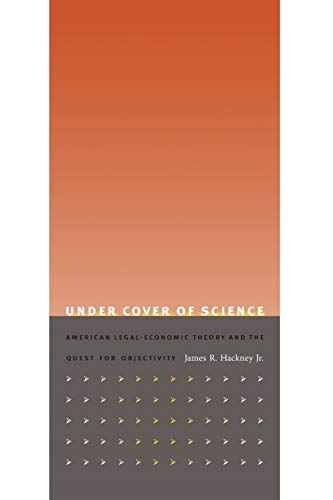
For more than two decades, the law and economics movement has been one of the most influential and controversial schools of thought in American jurisprudence. In this authoritative intellectual history, James R. Hackney Jr. situates the modern law and economics movement within the trajectory of American jurisprudence from the early days of the Republic to the present. Hackney is particularly interested in the claims of objectivity or empiricism asserted by proponents of law and economics. He argues that the incorporation of economic analysis into legal decision making is not an inherently objective enterprise. Rather, law and economics often cloaks ideological determinations--particularly regarding the distribution of wealth--under the cover of science.
Hackney demonstrates how legal-economic thought has been affected by the prevailing philosophical ideas about objectivity, which have in turn evolved in response to groundbreaking scientific discoveries. Thus Hackney's narrative is a history not only of law and economics but also of select strands of philosophy and science. He traces forward from the seventeenth-century the interaction of legal thinking and economic analysis with ideas about the attainability of certitude. The principal legal-economic theories Hackney examines are those that emerged from classical legal thought, legal realism, law and neoclassical economics, and critical legal studies. He links these theories respectively to formalism, pragmatism, the analytic turn, and neopragmatism/postmodernism, and he explains how each of these schools of philosophical thought was influenced by specific scientific discoveries: Newtonian physics, Darwin's theory of evolution, Einstein's theories of relativity, and quantum mechanics. Under Cover of Science challenges claims that the contemporary law and economics movement is an objective endeavor by historicizing ideas about certitude and empiricism and their relation to legal-economic thought.
Die Inhaltsangabe kann sich auf eine andere Ausgabe dieses Titels beziehen.
Über die Autorin bzw. den Autor
James R. Hackney Jr. is Professor of Law and Associate Dean for Academic Affairs at Northeastern University School of Law.
Von der hinteren Coverseite
""Under Cover of Science" is a sweeping intellectual history that relates the development of law and economics to science and its claims to objectivity. James R. Hackney Jr. ranges from Newton to Darwin to Einstein, and from classical economics to institutional economics to neoclassical economics. I cannot think of another book that so extensively explores the history of the interrelations of law and economics."--Stephen M. Feldman, author of "American Legal Thought from Premodernism to Postmodernism: An Intellectual Voyage"
Auszug. © Genehmigter Nachdruck. Alle Rechte vorbehalten.
UNDER COVER OF SCIENCE
AMERICAN LEGAL-ECONOMIC THEORY AND THE QUEST FOR OBJECTIVITYBy James R. Hackney Jr.Duke University Press
Copyright © 2006 Duke University PressAll right reserved.
ISBN: 978-0-8223-3998-4
Contents
Acknowledgments.............................................................................................ixPROLOGUE The Structure of American Legal-Economic Theory...................................................xiiiONE Modern Science, Classical Thought, and the Birth of American Legal-Economic Theory.....................1TWO The Pragmatic Reconstruction of American Legal-Economic Theory.........................................39THREE Neoclassicism and the Reprise of Formalism...........................................................81FOUR The Dissolution of American Legal-Economic Theory.....................................................121EPILOGUE Gazing into the Future and Our Postmodern Times...................................................157Notes.......................................................................................................175Index.......................................................................................................227
Chapter One
MODERN SCIENCE, CLASSICAL THOUGHT, AND THE BIRTH OF AMERICAN LEGAL-ECONOMIC THEORY
* Modernity is a complex concept. Stephen Toulmin has characterized it as having two distinct branches-literary and scientific. Initially sixteenth-century Renaissance literature, and its humanistic impulses, significantly shaped modernity. While literary musing strongly influenced modern intellectual thought in the West, our principal focus will be on the scientific contributions to modernity. In America, the prototypical modern state, the scientific ethos dominated legal discourse until recently. Classical legal theory highlights the point. Classical legal theory derives from classical thought (or the classical era)-seventeenth-century through early-nineteenth-century ideas concerning science, philosophy, economics, and law.
Scientific modernism, or modern science, originates in the seventeenth century. Francis Bacon and Ren Descartes epitomize philosophical speculation on scientific method. They both promoted modern science as a powerful, all-encompassing worldview standing against religious zealotry, relativism (skepticism), and other perceived societal ills. Indeed, their influence on the modern mind can scarcely be underestimated. While they both held distinct views regarding scientific method, it is useful, before turning to their specific philosophical visions, to explore their similarities. It is only then that Sir Isaac Newton's grand contribution can be understood as reflecting Baconian and Cartesian ideas. Newtonian physics established science as the preeminent intellectual field and the discipline for all other fields to mimic, including law.
A summary of the cultural and historical background to the seventeenth century is necessary to fully appreciate the tectonic shift represented by the rise of science. In the seventeenth century Europe was embroiled in political, cultural, and intellectual crises. The Thirty Years' War (1618-48) had brought to a head festering religious crises, which were manifested in the Reformation and led to brutal combat. Without the Roman Catholic Church as a touchstone for social cohesion (instead it was being invoked as a call to arms), there was cultural crisis. Catholic partisans, Erasmus of Rotterdam most prominently, set the intellectual foundation for the counter-Reformation, arguing that Protestant theology fell short because there was no way to mediate varying conceptions of religious truth. Individual interpretation necessarily led to religious nihilism. This religious skepticism was infectious.
Philosophical skepticism reflected the general cultural crisis. Skepticism is widely recognized as setting in relief modern thought. If we mark the seventeenth century as modernity's starting point, the succeeding four centuries may be looked upon as an extended effort to respond to the skeptical impulse. To understand its import as the departure point for modernity, we first must sketch out the contours of skepticism.
Sixteenth-century scholars were deeply interested in antiquity and Greek skepticism, particularly the writings of Sextus Empiricus. Empiricus and the later skeptics argued that human limitations with regard to knowledge acquisition through the senses made it impossible to divine universal truths. In attacking the quest for certainty, skeptics leveled an extensive critique against Aristotelian science. (Post Reformation, Aristotelian philosophy was also suspect because it had been adopted as Roman Catholicism's unofficial philosophy.) This critique extended the skeptical crisis to science-the very heart of the western intellectual tradition.
Michel de Montaigne, the most influential sixteenth-century skeptic, was deeply influenced by Sextus Empiricus's writings. He took particular aim at claims to scientific certainty in his essay "Apology of Raymond Sebond." In stressing that sense-knowledge was uncertain, Montaigne struck at the burgeoning scientific revolution's core. His critique took on specific significance in a climate where Aristotelian science had been roundly criticized. Montaigne exemplified the sixteenth-century skeptical crisis, setting the stage for efforts to resurrect the quest for certainty and for modernity. Make no mistake-the stakes are high. Are we to accept the notion that claims to knowledge are tentative or will we assume the stance that we can conquer all doubt? It is the latter path that marks the initial trajectory of modernity, including American legal-economic theory.
The path was laid out by two towering seventeenth-century figures in western intellectual history, Francis Bacon and Ren Descartes. They both begin by granting skeptics their initial suspicion that the senses are not infallible. However, they arrived, through different paths, at the conclusion that scientific certainty is indeed obtainable. The different styles make up the two dominant scientific conceptions in western thought: rationalism (represented by Descartes) and empiricism (represented by Bacon). Varying terminology may be used to express their ideas. For example, deductivism or reductionism will be used as a proxy for rationalism, and inductivism or experimentalism for empiricism. The central point is that two distinct scientific strands were developed to counter skepticism. Of course, this is a gross generalization that will be given a more nuanced treatment as we progress. Indeed, Descartes and Bacon each had room in his scientific method for tools championed by the other. However, there is a distinct emphasis in both Descartes's and Bacon's philosophies of science. More important than differences in their individual methods, both Descartes and Bacon took it as their grand quest to rescue western civilization from skepticism. In its place, they installed science as the antidote to cultural crisis.
Descartes is, to say the least, an enigmatic figure in western intellectual history. While he is best known for his metaphysical stance, as articulated in his Meditations, it is arguable that his deepest influence lay in his views on scientific method. Meditations is based on a fictional character's intellectual musings or meditations over six days (there is one meditation for each day). Descartes's metaphysics, constructed through the meditations, were to...
„Über diesen Titel“ kann sich auf eine andere Ausgabe dieses Titels beziehen.
Weitere beliebte Ausgaben desselben Titels

Suchergebnisse für Under Cover of Science: American Legal-Economic Theory...

Beispielbild für diese ISBN
Under Cover of Science: American Legal-Economic Theory and the Quest for Objectivity
Verlag:
Duke University Press Books, 2007
ISBN 10: 0822339986
ISBN 13: 9780822339984
Gebraucht
paperback
Anbieter: HPB-Red, Dallas, TX, USA
Verkäuferbewertung 5 von 5 Sternen

paperback. Zustand: Very Good. Connecting readers with great books since 1972! Used textbooks may not include companion materials such as access codes, etc. May have some wear or limited writing/highlighting. We ship orders daily and Customer Service is our top priority! Bestandsnummer des Verkäufers S_444663465
Gebraucht kaufen
EUR 2,67
EUR 3,24 Versand
Versand innerhalb von USA
Versand innerhalb von USA
Anzahl: 1 verfügbar
Beispielbild für diese ISBN
Under Cover of Science: American Legal-Economic Theory and the Quest for Objectivity
Verlag:
Duke University Press Books, 2007
ISBN 10: 0822339986
ISBN 13: 9780822339984
Gebraucht
Softcover
Anbieter: St Vincent de Paul of Lane County, Eugene, OR, USA
Verkäuferbewertung 5 von 5 Sternen
Zustand: Very Good. paperback A well-cared-for item that has seen limited use but remains in better than average cosmetic condition. The item is complete, and without major damage. It may have limited signs of use. Packed with care, shipped promptly. Bestandsnummer des Verkäufers S-04-4200
Gebraucht kaufen
EUR 3,56
EUR 3,45 Versand
Versand innerhalb von USA
Versand innerhalb von USA
Anzahl: 1 verfügbar
Beispielbild für diese ISBN
Under Cover of Science: American Legal-Economic Theory and the Quest for Objectivity
Verlag:
Duke University Press Books, 2007
ISBN 10: 0822339986
ISBN 13: 9780822339984
Gebraucht
Paperback
Anbieter: Midtown Scholar Bookstore, Harrisburg, PA, USA
Verkäuferbewertung 5 von 5 Sternen
Paperback. Zustand: Very Good. Very Good - Crisp, clean, unread book with some shelfwear/edgewear, may have a remainder mark - NICE PAPERBACK Standard-sized. Bestandsnummer des Verkäufers M0822339986Z2
Gebraucht kaufen
EUR 2,34
EUR 5,19 Versand
Versand innerhalb von USA
Versand innerhalb von USA
Anzahl: 1 verfügbar
Beispielbild für diese ISBN
Under Cover of Science: American Legal-Economic Theory and the Quest for Objectivity
Verlag:
Duke University Press Books, 2007
ISBN 10: 0822339986
ISBN 13: 9780822339984
Gebraucht
Paperback
Anbieter: Midtown Scholar Bookstore, Harrisburg, PA, USA
Verkäuferbewertung 5 von 5 Sternen
Paperback. Zustand: Good. Good - Bumped and creased book with tears to the extremities, but not affecting the text block, may have remainder mark or previous owner's name - GOOD PAPERBACK Standard-sized. Bestandsnummer des Verkäufers M0822339986Z3
Gebraucht kaufen
EUR 2,36
EUR 5,19 Versand
Versand innerhalb von USA
Versand innerhalb von USA
Anzahl: 14 verfügbar
Beispielbild für diese ISBN
Under Cover of Science : American Legal-Economic Theory and the Quest for Objectivity
Anbieter: Better World Books, Mishawaka, IN, USA
Verkäuferbewertung 5 von 5 Sternen
Zustand: Fine. Used book that is in almost brand-new condition. May contain a remainder mark. Better World Books: Buy Books. Do Good. Bestandsnummer des Verkäufers 58045977-6
Gebraucht kaufen
EUR 9,16
Versand gratis
Versand innerhalb von USA
Versand innerhalb von USA
Anzahl: 1 verfügbar
Foto des Verkäufers
Under Cover of Science : American Legal-Economic Theory and the Quest for Objectivity
Anbieter: GreatBookPrices, Columbia, MD, USA
Verkäuferbewertung 5 von 5 Sternen
Zustand: As New. Unread book in perfect condition. Bestandsnummer des Verkäufers 5056508
Gebraucht kaufen
EUR 34,56
EUR 2,28 Versand
Versand innerhalb von USA
Versand innerhalb von USA
Anzahl: Mehr als 20 verfügbar
Beispielbild für diese ISBN
Under Cover of Science - American Legal-Economic Theory and the Quest for Objectivity
Anbieter: PBShop.store UK, Fairford, GLOS, Vereinigtes Königreich
Verkäuferbewertung 5 von 5 Sternen
PAP. Zustand: New. New Book. Shipped from UK. Established seller since 2000. Bestandsnummer des Verkäufers FW-9780822339984
Neu kaufen
EUR 35,38
EUR 4,85 Versand
Versand von Vereinigtes Königreich nach USA
Versand von Vereinigtes Königreich nach USA
Anzahl: 1 verfügbar
Foto des Verkäufers
Under Cover of Science : American Legal-Economic Theory and the Quest for Objectivity
Anbieter: GreatBookPrices, Columbia, MD, USA
Verkäuferbewertung 5 von 5 Sternen
Zustand: New. Bestandsnummer des Verkäufers 5056508-n
Neu kaufen
EUR 39,02
EUR 2,28 Versand
Versand innerhalb von USA
Versand innerhalb von USA
Anzahl: Mehr als 20 verfügbar
Beispielbild für diese ISBN
Under Cover of Science American LegalEconomic Theory and the Quest for Objectivity
Print-on-DemandAnbieter: Revaluation Books, Exeter, Vereinigtes Königreich
Verkäuferbewertung 5 von 5 Sternen
Paperback. Zustand: Brand New. new title edition. 264 pages. 8.75x5.75x0.75 inches. In Stock. This item is printed on demand. Bestandsnummer des Verkäufers __0822339986
Neu kaufen
EUR 34,91
EUR 11,65 Versand
Versand von Vereinigtes Königreich nach USA
Versand von Vereinigtes Königreich nach USA
Anzahl: 1 verfügbar
Beispielbild für diese ISBN
Under Cover of Science: American Legal-Economic Theory and the Quest for Objectivity
Anbieter: Kennys Bookshop and Art Galleries Ltd., Galway, GY, Irland
Verkäuferbewertung 5 von 5 Sternen
Zustand: New. A critique of the Law & Economics movement, this book draws connections between conceptions of science and efforts at legitimating American legal theory as an objective enterprise. Num Pages: 264 pages. BIC Classification: 1KBB; KCA; LAB; PDA. Category: (P) Professional & Vocational. Dimension: 155 x 228 x 17. Weight in Grams: 368. . 2007. Paperback. . . . . Bestandsnummer des Verkäufers V9780822339984
Neu kaufen
EUR 38,42
EUR 9,50 Versand
Versand von Irland nach USA
Versand von Irland nach USA
Anzahl: 1 verfügbar