
Verwandte Artikel zu Next of Kin: The Family in Chicano/a Cultural Politics...
Next of Kin: The Family in Chicano/a Cultural Politics (Latin America Otherwise) - Softcover
Buch 47 von 58: Latin America Otherwise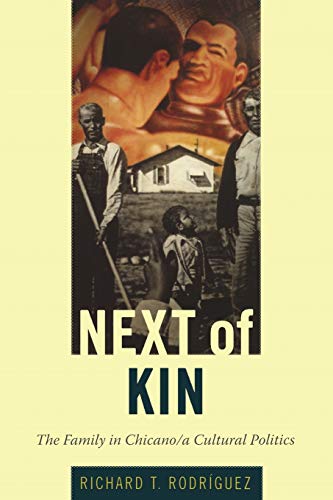
Inhaltsangabe
As both an idea and an institution, the family has been at the heart of Chicano/a cultural politics since the Mexican American civil rights movement emerged in the late 1960s. In Next of Kin, Richard T. Rodríguez explores the competing notions of la familia found in movement-inspired literature, film, video, music, painting, and other forms of cultural expression created by Chicano men. Drawing on cultural studies and feminist and queer theory, he examines representations of the family that reflect and support a patriarchal, heteronormative nationalism as well as those that reconfigure kinship to encompass alternative forms of belonging.
Describing how la familia came to be adopted as an organizing strategy for communitarian politics, Rodríguez looks at foundational texts including Rodolfo Gonzales's well-known poem "I Am Joaquín," the Chicano Liberation Youth Conference's manifesto El Plan Espiritual de Aztlán, and José Armas's La Familia de La Raza. Rodríguez analyzes representations of the family in the films I Am Joaquín, Yo Soy Chicano, and Chicana; the Los Angeles public affairs television series ¡Ahora!; the experimental videos of the artist-activist Harry Gamboa Jr.; and the work of hip-hop artists such as Kid Frost and Chicano Brotherhood. He reflects on homophobia in Chicano nationalist thought, and examines how Chicano gay men have responded to it in works including Al Lujan's video S&M in the Hood, the paintings of Eugene Rodríguez, and a poem by the late activist Rodrigo Reyes. Next of Kin is both a wide-ranging assessment of la familia's symbolic power and a hopeful call for a more inclusive cultural politics.
Die Inhaltsangabe kann sich auf eine andere Ausgabe dieses Titels beziehen.
Über die Autorin bzw. den Autor
Richard T. Rodríguez is Associate Professor of English and Latina/Latino Studies at the University of Illinois, Urbana-Champaign.
Von der hinteren Coverseite
"A gorgeous tapestry of cultural forms and interpretive brilliance, "Next of Kin" reopens the debate over our conflicted understandings of "la familia" in light of the challenges produced by feminism and queer studies. A must read for all those interested in Chicana and Chicano politics, fiction, film, photography, performance, and painting. Richard T. Rodriguez has given us a map with which to negotiate the twenty-first century uses of the family."--George Mariscal, author of "Brown-Eyed Children of the Sun: Lessons from the Chicano Movement, 1965-1975"
Auszug. © Genehmigter Nachdruck. Alle Rechte vorbehalten.
Next of Kin
The Family in Chicano/a Cultural PoliticsBy Richard T. RodrguezDUKE UNIVERSITY PRESS
Copyright © 2009 Duke University PressAll right reserved.
ISBN: 978-0-8223-4543-5
Contents
ABOUT THE SERIES........................................ixACKNOWLEDGMENTS.........................................1INTRODUCTION Staking Family Claims.....................19Reappraising the Archive................................55Shooting the Patriarch..................................95The Verse of the Godfather..............................135Carnal Knowledge........................................167AFTERWORD Making Queer Familia.........................177NOTES...................................................211BIBLIOGRAPHY............................................235DISCOGRAPHY.............................................237FILMOGRAPHY.............................................239
Chapter One
Reappraising the Archive
It is impossible to understand the Chicano without understanding the importance of the family.
* * * Jos Armas, "Chicano Writing: The New Mexico Narrative" (1986) The vision of la familia continues to be a form of discourse that provides Mexican Americans with identity, support, and comfort in an often hostile environment.
* * * Margarita Gangotena, "The Rhetoric of La Familia among Mexican Americans" (1994) We must move beyond a celebration of la familia to address questions of power and patriarchy.
* * * Vicki L. Ruz, From Out of the Shadows: Mexican Women in Twentieth-Century America (1998)
This chapter undertakes three main tasks. First, it makes a critical inventory of an archive containing manifestos, essays, poems, and artistic images from the late 1960s to the early 1990s that invoke a genealogy of la familia in Chicano/a cultural politics. Second, it unravels and rereads the complex discourses that posit family as an exemplary symbolic figure that must ultimately match silhouettes with a politically charged community and extended kinship network identified as la raza. Finally, it seeks to understand patriarchy as a system dependent upon paternal governance and heterosexual presumption in relation to Chicano/a community formations as reflected in cultural productions embracing the "militant ethos" known as Chicanismo (I. Garca 1997). The upshot is to illustrate how critical discourse on gender and sexuality allows us to critique the ways that Chicano/a cultural nationalism and notions of la familia continue to be codified by dominant articulations of masculinity.
Considering how la familia is never defined in neutral terms, the protean complexities derived from its wide-ranging communitarian import demand the attention of those with vested interest in Chicano/a cultural politics. Indeed, to reanimate la familia in the name of egalitarianism requires an unpacking of its conventional signification. In this chapter I will illustrate the ways in which la familia, as an organizing principle and symbol for cultural empowerment stemming from movement contexts, often rested upon a heteropatriarchal order. Yet because the contexts that give rise to la familia are nothing less than a series of sociohistorical starts and detours, exposing its emergence within a more complex genealogical narrative allows for comprehension of how resistance within contributes to its reconfigured political import in light of feminist and queer critique.
SIFTING THROUGH THE ARCHIVE
Begin with the now-classic manifesto El Plan Espiritual de Aztln, known by many as "The Chicano Movement Manifesto" (Pesquera and Segura 1993, 98). El Plan was the seminal stratagem for empowerment drawn up at the historic Chicano Youth Liberation Conference of 1969 in Denver, Colorado whose authors included activist Rodolfo "Corky" Gonzales, poet Alurista, and historian and poet Juan Gmez-Quiones. El Plan's rallying cry for political deliverance is crystallized in a four-point plan. The first point, or "Punto Primero," is an urgent call for nationalism, "the common denominator that all members of La Raza can agree upon" (Chicano Liberation Youth Conference 1972, 405). "Punto Segundo" is comprised of seven "Organizational Goals." Goal number six insists that:
Cultural values of our people strengthen our identity and the moral backbone of the movement. Our culture unites and educates the family of La Raza towards liberation with one heart and one mind. We must insure [sic] that our writers, poets, musicians, and artists produce literature and art that is appealing to our people and relates to our revolutionary culture. Our cultural values of life, family, and home will serve as a powerful weapon to defeat the gringo dollar value system and encourage the process of love and brotherhood. (405)
Furthermore, goal number seven builds upon number six's call for family as community, which would entail a call for a family politics within the realm of social movement:
Political liberation can only come through an independent action on our part, since the two party system is the same animal with two heads that feeds from the same trough. Where we are a majority we will control; where we are a minority we will represent a pressure group. Nationally, we will represent one party, La Familia de La Raza. (405)
It comes as no surprise that Chicano movement struggles should wish to enlist the family as a point of departure and return. After all, the rampant despair of disenfranchised Chicano/a communities was the motivating force behind the movements of the 1960s and 1970s. On the one hand, the families from which many Chicano student activists emerged were of poor or working-class backgrounds, a fact that jump-started in many an activist the sense of struggle. On the other hand, as Ignacio M. Garca (1989, 12) explains, young Chicano activists "believed that their own parents and grandparents had been passive and accommodating to discrimination and exploitation." In this view, these activists must render their given families apathetic to in turn recast biological kin as a social collective that took to heart their self-awareness as a political constituency. Within other contexts, one's commitment to the biological family demanded extension into the public sphere to orchestrate kinship networks with one's community in the name of carnalismo (brotherhood). In either case la familia necessarily became a constellation of forces inspiring those battles waged for political and economic justice in the name of la raza.
While the Chicano movement cannot be classified as a monolithic entity, requiring instead comprehension as a social force emerging from distinct regions and multiple social justice trajectories, the deployment of the family principle nonetheless figured prominently in various organizational practices and discursive strategies put forth by movement leaders. For example, Reies Lpez Tijerina, one of the movement's earliest leaders chiefly known for mobilizing the movement to restore land grants to pre-Anglo settlement owners, maintains that the family is the fundamental source of nourishment as well as protection from the external damage of the dominant culture. For Tijerina:
The heart of human dignity is the family. The family is the source of values, virtues, and the love that nurtures harmony and fraternity. Our mothers are the first teachers and then, the nation. Our...
„Über diesen Titel“ kann sich auf eine andere Ausgabe dieses Titels beziehen.
Suchergebnisse für Next of Kin: The Family in Chicano/a Cultural Politics...

Beispielbild für diese ISBN
Next of Kin: The Family in Chicano/a Cultural Politics
Verlag:
Duke University Press Books, 2009
ISBN 10: 0822345439
ISBN 13: 9780822345435
Gebraucht
paperback
Anbieter: Open Books, Chicago, IL, USA
Verkäuferbewertung 5 von 5 Sternen

paperback. Zustand: Good. Pen underlining throughout. Open Books is a nonprofit social venture that provides literacy experiences for thousands of readers each year through inspiring programs and creative capitalization of books. Bestandsnummer des Verkäufers mon0000786158
Gebraucht kaufen
EUR 5,39
EUR 3,48 Versand
Versand innerhalb von USA
Versand innerhalb von USA
Anzahl: 1 verfügbar
Beispielbild für diese ISBN
Next of Kin: The Family in Chicano/a Cultural Politics
Verlag:
Duke University Press Books, 2009
ISBN 10: 0822345439
ISBN 13: 9780822345435
Gebraucht
Paperback
Anbieter: HPB Inc., Dallas, TX, USA
Verkäuferbewertung 5 von 5 Sternen
Paperback. Zustand: Very Good. Connecting readers with great books since 1972! Used books may not include companion materials, and may have some shelf wear or limited writing. We ship orders daily and Customer Service is our top priority! Bestandsnummer des Verkäufers S_441278629
Gebraucht kaufen
EUR 6,05
EUR 3,27 Versand
Versand innerhalb von USA
Versand innerhalb von USA
Anzahl: 1 verfügbar
Beispielbild für diese ISBN
Next of Kin: The Family in Chicano/a Cultural Politics
Anbieter: Phatpocket Limited, Waltham Abbey, HERTS, Vereinigtes Königreich
Verkäuferbewertung 5 von 5 Sternen
Zustand: Acceptable. Used - Acceptable. Your purchase helps support Sri Lankan Children's Charity 'The Rainbow Centre'. Ex-library with wear and barcode page may have been removed. Our donations to The Rainbow Centre have helped provide an education and a safe haven to hundreds of children who live in appalling conditions. Bestandsnummer des Verkäufers Z1-R-039-02229
Gebraucht kaufen
EUR 20,02
EUR 12,41 Versand
Versand von Vereinigtes Königreich nach USA
Versand von Vereinigtes Königreich nach USA
Anzahl: 1 verfügbar
Foto des Verkäufers
Next of Kin : The Family in Chicano/A Cultural Politics
Anbieter: GreatBookPrices, Columbia, MD, USA
Verkäuferbewertung 5 von 5 Sternen
Zustand: As New. Unread book in perfect condition. Bestandsnummer des Verkäufers 6365884
Gebraucht kaufen
EUR 35,49
EUR 2,30 Versand
Versand innerhalb von USA
Versand innerhalb von USA
Anzahl: Mehr als 20 verfügbar
Foto des Verkäufers
Next of Kin : The Family in Chicano/A Cultural Politics
Anbieter: GreatBookPrices, Columbia, MD, USA
Verkäuferbewertung 5 von 5 Sternen
Zustand: New. Bestandsnummer des Verkäufers 6365884-n
Neu kaufen
EUR 36,00
EUR 2,30 Versand
Versand innerhalb von USA
Versand innerhalb von USA
Anzahl: Mehr als 20 verfügbar
Beispielbild für diese ISBN
Next of Kin: The Family in Chicano/a Cultural Politics
Anbieter: Your Online Bookstore, Houston, TX, USA
Verkäuferbewertung 5 von 5 Sternen
paperback. Zustand: New. Bestandsnummer des Verkäufers 0822345439-11-37191036
Foto des Verkäufers
Next of Kin: The Family in Chicano/a Cultural Politics (Paperback or Softback)
Verlag:
Duke University Press 8/1/2009, 2009
ISBN 10: 0822345439
ISBN 13: 9780822345435
Neu
Paperback or Softback
Anbieter: BargainBookStores, Grand Rapids, MI, USA
Verkäuferbewertung 5 von 5 Sternen
Paperback or Softback. Zustand: New. Next of Kin: The Family in Chicano/a Cultural Politics. Book. Bestandsnummer des Verkäufers BBS-9780822345435
Beispielbild für diese ISBN
Next of Kin
Anbieter: PBShop.store UK, Fairford, GLOS, Vereinigtes Königreich
Verkäuferbewertung 5 von 5 Sternen
PAP. Zustand: New. New Book. Shipped from UK. Established seller since 2000. Bestandsnummer des Verkäufers FW-9780822345435
Neu kaufen
EUR 35,37
EUR 4,85 Versand
Versand von Vereinigtes Königreich nach USA
Versand von Vereinigtes Königreich nach USA
Anzahl: 1 verfügbar
Beispielbild für diese ISBN
Next of Kin The Family in Chicano/a Cultural Politics
Print-on-DemandAnbieter: Revaluation Books, Exeter, Vereinigtes Königreich
Verkäuferbewertung 5 von 5 Sternen
Paperback. Zustand: Brand New. 400 pages. 9.29x6.30x0.67 inches. In Stock. This item is printed on demand. Bestandsnummer des Verkäufers __0822345439
Neu kaufen
EUR 34,94
EUR 11,66 Versand
Versand von Vereinigtes Königreich nach USA
Versand von Vereinigtes Königreich nach USA
Anzahl: 1 verfügbar
Beispielbild für diese ISBN
Next of Kin: The Family in Chicano/a Cultural Politics
Anbieter: Ria Christie Collections, Uxbridge, Vereinigtes Königreich
Verkäuferbewertung 5 von 5 Sternen
Zustand: New. In English. Bestandsnummer des Verkäufers ria9780822345435_new
Neu kaufen
EUR 34,74
EUR 13,17 Versand
Versand von Vereinigtes Königreich nach USA
Versand von Vereinigtes Königreich nach USA
Anzahl: 1 verfügbar