
Verwandte Artikel zu On Being Included: Racism and Diversity in Institutional...
Inhaltsangabe
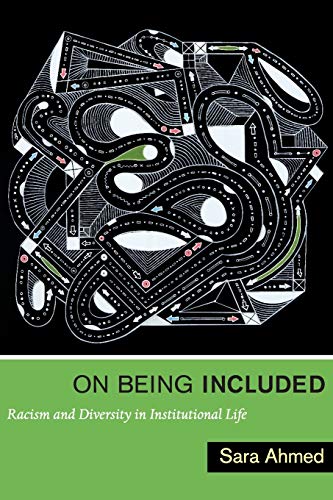
What does diversity do? What are we doing when we use the language of diversity? Sara Ahmed offers an account of the diversity world based on interviews with diversity practitioners in higher education, as well as her own experience of doing diversity work. Diversity is an ordinary, even unremarkable, feature of institutional life. Yet diversity practitioners often experience institutions as resistant to their work, as captured through their use of the metaphor of the "brick wall." On Being Included offers an explanation of this apparent paradox. It explores the gap between symbolic commitments to diversity and the experience of those who embody diversity. Commitments to diversity are understood as "non-performatives" that do not bring about what they name. The book provides an account of institutional whiteness and shows how racism can be obscured by the institutionalization of diversity. Diversity is used as evidence that institutions do not have a problem with racism. On Being Included offers a critique of what happens when diversity is offered as a solution. It also shows how diversity workers generate knowledge of institutions in attempting to transform them.
Die Inhaltsangabe kann sich auf eine andere Ausgabe dieses Titels beziehen.
Über die Autorin bzw. den Autor
Sara Ahmed is Professor of Race and Cultural Studies at Goldsmiths College, University of London. Her books include The Cultural Politics of Emotion; Strange Encounters: Embodied Others in Post-Coloniality; and Differences that Matter: Feminist Theory and Postmodernism.
Auszug. © Genehmigter Nachdruck. Alle Rechte vorbehalten.
On Being Included
Racism and Diversity in Institutional LifeBy Sara AhmedDuke University Press
Copyright © 2012 Duke University PressAll right reserved.
ISBN: 978-0-8223-5236-5
Contents
ACKNOWLEDGMENTS............................................ixINTRODUCTION On Arrival....................................11 Institutional Life.......................................192 The Language of Diversity................................513 Equality and Performance Culture.........................834 Commitment as a Non-performative.........................1135 Speaking about Racism....................................141CONCLUSION A Phenomenological Practice.....................173NOTES......................................................191REFERENCES.................................................221INDEX......................................................235
Chapter One
Institutional Life
What is an institution? I want to start my reflections on racism and diversity within institutional life by asking what it means to think about institutions as such. We need to ask how it is that institutions become an object of diversity and antiracist practice in the sense that recognizing the institutional nature of diversity and racism becomes a goal for practitioners. Diversity work is typically described as institutional work. Why this is the case might seem obvious. The obvious is that which tends to be unthought and thus needs to be thought. We can repeat the question by giving it more force: what counts as an institution? Why do institutions count?
These questions are foundational to the social sciences. Emile Durkheim's definition of sociology is "the science of institutions, of their genesis and functioning" ([1901] 1982: 45). If the institution can be understood as the object of the social sciences, then the institution might be how the social derives its status as science. Durkheim's description was derived from Marcel Mauss and Paul Fauconnet's 1901 contribution on sociology to La Grand Encyclopédie (see M. Gane 2005: xii). The history of sociology is indeed a history of institutional thought.
Durkheim's innovative sociological method suggested that social facts can be approached as things. Arguably, treating institutions as an object of sociological inquiry, as social facts, can risk stabilizing institutions as things. We might stabilize institutions by assuming they refer to what is already stabilized. Within the humanities, the turn to thinking on the question of institutions has been predicated on a critique of sociological models. Samuel Weber's Institutions and Interpretation (2001), for example, cites with approval the work of René Lourau, who suggests that the sociological theories of institutions tend to assume their stability. Institutions, Lourau suggests, have been:
increasingly used to designate what I and others before me have called the instituted (l'institué), the established order, the already existing norms, the state of fact thereby being confounded with the state of right (l'état de droit). By contrast, the instituting aspect (I'instituant) ... has been increasingly obscured. The political implication of the sociological theories appears clearly here. By emptying the concept of institution of one of its primordial components (that of instituting, in the sense of founding, creating, breaking with an old order and creating a new one), sociology has finally come to identify the institution with the status quo. (Weber 2001: xv)
This reading of sociological work on institutions could be described as presuming the stability of its object (can all "sociological theories" of institutions be reduced to this identification?). Across a range of social science disciplines, including economics and political science as well as sociology, we have witnessed the emergence of "the new institutionalism," concerned precisely with how we can understand institutions as processes or even as effects of processes. Indeed, Victor Nee argues that the new institutionalism "seeks to explain institutions rather than simply assume their existence" (1998: 1). To explain institutions is to give an account of how they emerge or take form. Such explanations require a "thick" form of description, as I suggested in the introduction, a way of describing not simply the activities that take place within institutions (which would allow the institution into the frame of analysis only as a container, as what contains what is described, rather than being part of a description) but how those activities shape the sense of an institution or even institutional sense. The organizational studies scholars James G. March and Johan P. Olsen suggest that a thick approach to institutions would consider "routines, procedures, conventions, roles, strategies, organizational forms, and technologies" (1989: 22). The new institutionalism aims to think through how institutions become instituted over time (to "flesh out" this how): in other words, to think how institutions acquire the regularity and stability that allows them to be recognizable as institutions in the first place. Institutions can be thought of as verbs as well as nouns: to put the "doing" back into the institution is to attend to how institutional realities become given, without assuming what is given by this given.
The new institutionalism allows us to consider the work of creating institutions as part of institutional work. Although this chapter does not engage with the "new institutionalism" literatures in a general sense, I consider how phenomenology can offer a resource for thinking about institutionality. My arguments thus connect with some of the sociological literature on institutions insofar as the new institutionalism in sociology has been influenced by phenomenology. Phenomenology allows us to theorize how a reality is given by becoming background, as that which is taken for granted. Indeed, I argue that a phenomenological approach is well suited to the study of institutions because of the emphasis on how something becomes given by not being the object of perception. Edmund Husserl (often described as the founder of phenomenology) considers "the world from the natural standpoint" as a world that is spread around, or just around, where objects are "more or less familiar, agreeing with what is actually perceived without themselves being perceived" ([1913] 1969: 100). To be in this world is to be involved with things in such a way that they recede from consciousness. When things become institutional, they recede. To institutionalize x is for x to become routine or ordinary such that x becomes part of the background for those who are part of an institution.
In his later work, Husserl ([1936/54] 1970) came to denote the "world of the natural attitude" as "the life-world," the world that is given to our immediate experience, a general background or horizon, which is also a world shared with others. To share a world might be to share the points of recession. If the tendency when we are involved in the world is to look over what is around us, then the task of the phenomenologist is to attend to what is looked over, to allow what is "overed" to surface. In this chapter, I hope to offer this kind of attention. My primary aim is to offer an ethnographic approach to institutional life that works with the detail of how that life is described by diversity practitioners. Diversity work could be described as...
„Über diesen Titel“ kann sich auf eine andere Ausgabe dieses Titels beziehen.
Suchergebnisse für On Being Included: Racism and Diversity in Institutional...

Foto des Verkäufers
On Being Included: Racism and Diversity in Institutional Life
Anbieter: Dream Books Co., Denver, CO, USA
Verkäuferbewertung 5 von 5 Sternen

Zustand: acceptable. This copy has clearly been enjoyedâ"expect noticeable shelf wear and some minor creases to the cover. Binding is strong, and all pages are legible. May contain previous library markings or stamps. Bestandsnummer des Verkäufers DBV.0822352362.A
Gebraucht kaufen
EUR 4,56
Versand gratis
Versand innerhalb von USA
Versand innerhalb von USA
Anzahl: 2 verfügbar
Beispielbild für diese ISBN
On Being Included Racism and D
Verlag:
Duke University Press Books, 2012
ISBN 10: 0822352362
ISBN 13: 9780822352365
Gebraucht
Softcover
Anbieter: World of Books (was SecondSale), Montgomery, IL, USA
Verkäuferbewertung 5 von 5 Sternen
Zustand: Good. Item in good condition. Textbooks may not include supplemental items i.e. CDs, access codes etc. Bestandsnummer des Verkäufers 00105750826
Gebraucht kaufen
EUR 4,56
Versand gratis
Versand innerhalb von USA
Versand innerhalb von USA
Anzahl: 3 verfügbar
Foto des Verkäufers
On Being Included: Racism and Diversity in Institutional Life
Anbieter: Bay State Book Company, North Smithfield, RI, USA
Verkäuferbewertung 5 von 5 Sternen
Zustand: acceptable. The book is complete and readable, with all pages and cover intact. Dust jacket, shrink wrap, or boxed set case may be missing. Pages may have light notes, highlighting, or minor water exposure, but nothing that affects readability. May be an ex-library copy and could include library markings or stickers. Bestandsnummer des Verkäufers BSM.1BVU5
Gebraucht kaufen
EUR 4,99
Versand gratis
Versand innerhalb von USA
Versand innerhalb von USA
Anzahl: 1 verfügbar
Beispielbild für diese ISBN
On Being Included: Racism and Diversity in Institutional Life
Anbieter: World of Books Inc, Montgomery, IL, USA
Verkäuferbewertung 2 von 5 Sternen

Paperback. Zustand: Good. Argues that a commitment to diversity is frequently substituted for a commitment to actual change. This title traces the work that diversity does, examining how the term is used and the way it serves to make questions about racism seem impertinent. Bestandsnummer des Verkäufers CIN0822352362G
Gebraucht kaufen
EUR 6,34
Versand gratis
Versand innerhalb von USA
Versand innerhalb von USA
Anzahl: 3 verfügbar
Beispielbild für diese ISBN
On Being Included: Racism and Diversity in Institutional Life
Verlag:
Duke University Press Books, 2012
ISBN 10: 0822352362
ISBN 13: 9780822352365
Gebraucht
Paperback
Anbieter: HPB-Red, Dallas, TX, USA
Verkäuferbewertung 5 von 5 Sternen
Paperback. Zustand: Acceptable. Connecting readers with great books since 1972. Used textbooks may not include companion materials such as access codes, etc. May have condition issues including wear and notes/highlighting. We ship orders daily and Customer Service is our top priority! Bestandsnummer des Verkäufers S_423125156
Gebraucht kaufen
EUR 4,44
EUR 3,23 Versand
Versand innerhalb von USA
Versand innerhalb von USA
Anzahl: 1 verfügbar
Beispielbild für diese ISBN
On Being Included: Racism and Diversity in Institutional Life
Verlag:
Duke University Press Books, 2012
ISBN 10: 0822352362
ISBN 13: 9780822352365
Gebraucht
Paperback
Anbieter: HPB Inc., Dallas, TX, USA
Verkäuferbewertung 5 von 5 Sternen
Paperback. Zustand: Very Good. Connecting readers with great books since 1972! Used books may not include companion materials, and may have some shelf wear or limited writing. We ship orders daily and Customer Service is our top priority! Bestandsnummer des Verkäufers S_470772517
Gebraucht kaufen
EUR 5,78
EUR 3,23 Versand
Versand innerhalb von USA
Versand innerhalb von USA
Anzahl: 1 verfügbar
Beispielbild für diese ISBN
On Being Included: Racism and Diversity in Institutional Life
Anbieter: St Vincent de Paul of Lane County, Eugene, OR, USA
Verkäuferbewertung 5 von 5 Sternen
Zustand: Very Good. Paperback 100% of proceeds go to charity! May have signs of use, wear and minor cosmetic defects. Bestandsnummer des Verkäufers O-01-4231
Gebraucht kaufen
EUR 6,63
EUR 3,44 Versand
Versand innerhalb von USA
Versand innerhalb von USA
Anzahl: 1 verfügbar
Beispielbild für diese ISBN
On Being Included: Racism and Diversity in Institutional Life
Verlag:
Duke University Press Books, 2012
ISBN 10: 0822352362
ISBN 13: 9780822352365
Gebraucht
Paperback
Anbieter: HPB-Ruby, Dallas, TX, USA
Verkäuferbewertung 5 von 5 Sternen
Paperback. Zustand: Very Good. Connecting readers with great books since 1972! Used books may not include companion materials, and may have some shelf wear or limited writing. We ship orders daily and Customer Service is our top priority! Bestandsnummer des Verkäufers S_473717357
Gebraucht kaufen
EUR 7,49
EUR 3,23 Versand
Versand innerhalb von USA
Versand innerhalb von USA
Anzahl: 1 verfügbar
Beispielbild für diese ISBN
On Being Included: Racism and Diversity in Institutional Life
Verlag:
Duke University Press Books, 2012
ISBN 10: 0822352362
ISBN 13: 9780822352365
Gebraucht
Paperback
Anbieter: HPB-Red, Dallas, TX, USA
Verkäuferbewertung 5 von 5 Sternen
Paperback. Zustand: Very Good. Connecting readers with great books since 1972! Used textbooks may not include companion materials such as access codes, etc. May have some wear or limited writing/highlighting. We ship orders daily and Customer Service is our top priority! Bestandsnummer des Verkäufers S_476721059
Gebraucht kaufen
EUR 11,54
EUR 3,23 Versand
Versand innerhalb von USA
Versand innerhalb von USA
Anzahl: 1 verfügbar
Beispielbild für diese ISBN
On Being Included: Racism and Diversity in Institutional Life
Verlag:
Duke University Press, 2012
ISBN 10: 0822352362
ISBN 13: 9780822352365
Gebraucht
Trade Paperback
Anbieter: Arches Bookhouse, Portland, OR, USA
Verkäuferbewertung 5 von 5 Sternen
Trade Paperback. Zustand: GOOD. 243pp. Pen markings to a few early pages. Sound and clean otherwise. Bestandsnummer des Verkäufers 506560
Gebraucht kaufen
EUR 9,77
EUR 6,03 Versand
Versand innerhalb von USA
Versand innerhalb von USA
Anzahl: 1 verfügbar