
Verwandte Artikel zu The Paraguay Reader: History, Culture, Politics (Latin...
The Paraguay Reader: History, Culture, Politics (Latin America Readers) - Softcover
Buch 6 von 18: The Latin America Readers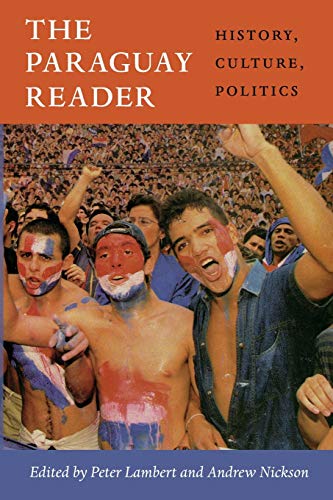
Inhaltsangabe
Hemmed in by the vast, arid Chaco to the west and, for most of its history, impenetrable jungles to the east, Paraguay has been defined largely by its isolation. Partly as a result, there has been a dearth of serious scholarship or journalism about the country. Going a long way toward redressing this lack of information and analysis, The Paraguay Reader is a lively compilation of testimonies, journalism, scholarship, political tracts, literature, and illustrations, including maps, photographs, paintings, drawings, and advertisements. Taken together, the anthology's many selections convey the country's extraordinarily rich history and cultural heritage, as well as the realities of its struggles against underdevelopment, foreign intervention, poverty, inequality, and authoritarianism.
Most of the Reader is arranged chronologically. Weighted toward the twentieth century and early twenty-first, it nevertheless gives due attention to major events in Paraguay's history, such as the Triple Alliance War (1864-70) and the Chaco War (1932-35). The Reader's final section, focused on national identity and culture, addresses matters including ethnicity, language, and gender. Most of the selections are by Paraguayans, and many of the pieces appear in English for the first time. Helpful introductions by the editors precede each of the book's sections and all of the selected texts.
Die Inhaltsangabe kann sich auf eine andere Ausgabe dieses Titels beziehen.
Über die Autorin bzw. den Autor
Peter Lambert is a Senior Lecturer in Spanish and Latin American Studies in the Department of Politics, Languages and International Studies at the University of Bath. He is a coeditor of Latin American Foreign Policies: Between Ideology and Pragmatism and Political Violence and the Construction of National Identity in Latin America.
Andrew Nickson is the Honorary Reader in Public Management and Latin American Studies at the University of Birmingham. He is the author of Local Government in Latin America and the Historical Dictionary of Paraguay. Lambert and Nickson are the editors of Transition to Democracy in Paraguay.
Auszug. © Genehmigter Nachdruck. Alle Rechte vorbehalten.
THE PARAGUAY READER
HISTORY, CULTURE, POLITICSDUKE UNIVERSITY PRESS
Copyright © 2013 Duke University PressAll right reserved.
ISBN: 978-0-8223-5268-6
Contents
List of Illustrations....................................................ixAcknowledgments..........................................................xiIntroduction.............................................................1I The Birth of Paraguay.................................................11II The Nationalist Experiment...........................................53III A Slow Recovery.....................................................129IV From the Chaco War to the Civil War..................................193V Dictatorship and Resistance...........................................235VI A Transition in Search of Democracy..................................321VII What Does It Mean to Be Paraguayan?.................................383Epilogue: The Impeachment of President Fernando Lugo.....................451Suggestions for Further Reading..........................................457Acknowledgment of Copyright and Sources..................................463Index....................................................................471
Chapter One
The Birth of Paraguay
The first conquistadores to enter what is now Paraguay came in search of gold: Aleixo García traveled overland from the Atlantic coast of Brazil in 1524 en route to upper Peru in present-day Bolivia and, in 1528, Sebastian Cabot sailed up the River Paraguay as far as present-day Paraguay. False accounts of the mineral wealth of Paraguay arose because some local caciques possessed gold, which came from their intermittent trade with the Incas beyond the Chaco. The first expedition up the River Paraguay to establish settlements in Paraguay was consequently motivated by the mistaken belief that Paraguay was the famed El Dorado. On August 15, 1537, Asunción was founded by Juan de Salazar y Espinoza, and in 1541, when their initial settlement at Buenos Aires was abandoned in the face of attacks from hostile Pampa Indians, the Spaniards sought refuge in Asunción.
For the next fifty years the town became the headquarters of the Spanish conquest of the southern half of South America, as well as a strategic outpost for repelling Portuguese expansion westward by bandeirantes (marauding gangs in search of slaves) from Brazil. As the starting-off point for expeditions to create eight new settlements, Asunción became known as the madre de ciudades (mother of cities). When in 1549, the fruitless Chaco expedition of Domingo Martínez de Irala returned to Asunción with the news that upper Peru had been conquered from the Pacific, it became clear that Asunción would not be the gateway to the silver mines of Potosí or El Dorado. In 1617 a royal decree separated Buenos Aires from the province of Paraguay, after which Asunción declined in importance as the colonial administration was transferred to Buenos Aires. With no gold or silver mines to attract further immigration from Spain, and with no outlet to the sea, Paraguay became an economic backwater and remained isolated and weakly integrated into the world economy throughout the rest of the colonial period.
Henceforth, the indigenous peoples of Paraguay soon became the primary resource to be exploited by the relatively few conquistadores who remained in the province, especially after 1615, when growing attacks by bandeirantes forced the colonial authorities to divert human resources to the military defense of the province. From 1600 Indians were principally used for the production of yerba mate (Paraguayan tea), which soon became the major export throughout the colonial period. To this end, two radically different means of institutionalizing control over the indigenous peoples were employed, which ultimately came into conflict: that of the encomienda system of tribute in the form of forced labor, and that practiced by the Jesuit missions. The introduction of the encomienda system led to a radical change in the relationship between the Spanish and the indigenous people, as alliance and friendship were replaced by exploitation. The pacto de sangre that produced the predominantly mestizo population, which resulted from miscegenation between the Spanish and indigenous peoples, was achieved through rancheadas, the violent abduction of Indian women whom the conquistadores used as concubines, keeping as many as fifty each. There were eighteen major rebellions in opposition to the rancheadas and the encomienda, from the uprising of Jueves Santo in 1539 to the repression at Arecayá in 1660, generally led by spiritual leaders called the Ñande Ru, who sought a return to the precolonial integrity of Guaraní culture that had been shattered by the conquest.
In the early seventeenth century, foreign Jesuits began to evangelize the Guaranís of eastern Paraguay, many of whom had fled from the area around Asunción after the Spanish conquest. They established autocratic but self-sufficient economic units in thirty fortified settlements, called reducciones, which reached a population of over 200,000. Political tensions arose between the encomenderos (rural landowners) and the Jesuits over the appropriation of Guaraní labor for the production of yerba mate. This tension erupted in armed conflict in 1649–50 during the governorship of Bernardo de Cárdenas and more seriously, in the Comuneros rebellion (1721–35) led by the mestizo elite against what they saw as Spanish support for the privileges of the Jesuits. Although the leaders of the rebellion were executed, their objectives were eventually achieved in 1767, when the Jesuits were expelled from Paraguay and the rest of Latin America.
The seventeenth century was a period of territorial retrenchment and demographic stagnation for the province of Paraguay, and there was virtually no further European immigration during the century. Constant attacks by Chaco Indians and bandeirantes gradually whittled down the effective size of the colony, which by 1676, had been reduced to the area of the present-day metropolitan area of Asunción and the largely self-contained Jesuit missions in the southeast of the province.
The eighteenth century was a period of gradual territorial and demographic growth, assisted by the process of mestizaje (miscegenation) and the extinguishing of the encomienda system. With the introduction of cattle ranching, forestry and tobacco, the period also saw the gradual diversification of the provincial economy away from extreme dependence on yerba mate, and the beginnings of economic growth. In 1776, nominal control over Paraguay passed from Lima to the newly created Viceroyalty of the River Plate. The Bourbon Reforms introduced by King Carlos III had a significant impact on Paraguay, relaxing trade restrictions, and integrating Paraguay more closely into the regional economy of the River Plate. Foreign trade rose rapidly as commercial traffic on the River Paraguay increased substantially. This acceleration of economic activity encouraged the immigration of foreign merchants from the 1780s, who soon challenged the political and social hegemony of the traditional encomendero elite and gained a foothold in the Cabildo (municipal council) de Asunción, thereby contributing to the growing independence movement. After three centuries of external control and geographical isolation, a strong basis for a nationalist sentiment had been created in Paraguay, as the...
„Über diesen Titel“ kann sich auf eine andere Ausgabe dieses Titels beziehen.
Suchergebnisse für The Paraguay Reader: History, Culture, Politics (Latin...

Beispielbild für diese ISBN
The Paraguay Reader : History, Culture, Politics
Anbieter: Better World Books, Mishawaka, IN, USA
Verkäuferbewertung 5 von 5 Sternen

Zustand: Good. Former library copy. Pages intact with minimal writing/highlighting. The binding may be loose and creased. Dust jackets/supplements are not included. Includes library markings. Stock photo provided. Product includes identifying sticker. Better World Books: Buy Books. Do Good. Bestandsnummer des Verkäufers 41222800-6
Gebraucht kaufen
EUR 17,74
Versand gratis
Versand innerhalb von USA
Versand innerhalb von USA
Anzahl: 1 verfügbar
Beispielbild für diese ISBN
The Paraguay Reader: History, Culture, Politics (The Latin America Readers)
Anbieter: Lakeside Books, Benton Harbor, MI, USA
Verkäuferbewertung 5 von 5 Sternen
Zustand: New. Brand New! Not Overstocks or Low Quality Book Club Editions! Direct From the Publisher! We're not a giant, faceless warehouse organization! We're a small town bookstore that loves books and loves it's customers! Buy from Lakeside Books! Bestandsnummer des Verkäufers OTF-S-9780822352686
Neu kaufen
EUR 19,34
EUR 3,56 Versand
Versand innerhalb von USA
Versand innerhalb von USA
Anzahl: Mehr als 20 verfügbar
Foto des Verkäufers
Paraguay Reader : History, Culture, Politics
Anbieter: GreatBookPrices, Columbia, MD, USA
Verkäuferbewertung 5 von 5 Sternen
Zustand: New. Bestandsnummer des Verkäufers 19035571-n
Neu kaufen
EUR 20,57
EUR 2,35 Versand
Versand innerhalb von USA
Versand innerhalb von USA
Anzahl: 4 verfügbar
Beispielbild für diese ISBN
The Paraguay Reader : History, Culture, Politics
Anbieter: Better World Books Ltd, Dunfermline, Vereinigtes Königreich
Verkäuferbewertung 5 von 5 Sternen
Zustand: Very Good. Former library copy. Pages intact with possible writing/highlighting. Binding strong with minor wear. Dust jackets/supplements may not be included. Includes library markings. Stock photo provided. Product includes identifying sticker. Better World Books: Buy Books. Do Good. Bestandsnummer des Verkäufers 7942953-6
Gebraucht kaufen
EUR 17,73
EUR 5,97 Versand
Versand von Vereinigtes Königreich nach USA
Versand von Vereinigtes Königreich nach USA
Anzahl: 1 verfügbar
Foto des Verkäufers
The Paraguay Reader: History, Culture, Politics (Paperback or Softback)
Verlag:
Duke University Press 12/31/2012, 2012
ISBN 10: 0822352680
ISBN 13: 9780822352686
Neu
Paperback or Softback
Anbieter: BargainBookStores, Grand Rapids, MI, USA
Verkäuferbewertung 5 von 5 Sternen
Paperback or Softback. Zustand: New. The Paraguay Reader: History, Culture, Politics. Book. Bestandsnummer des Verkäufers BBS-9780822352686
Foto des Verkäufers
The Paraguay Reader
Anbieter: Rarewaves USA, HEBRON, KY, USA
Verkäuferbewertung 5 von 5 Sternen
Paperback. Zustand: New. Hemmed in by the vast, arid Chaco to the west and, for most of its history, impenetrable jungles to the east, Paraguay has been defined largely by its isolation. Partly as a result, there has been a dearth of serious scholarship or journalism about the country. Going a long way toward redressing this lack of information and analysis, The Paraguay Reader is a lively compilation of testimonies, journalism, scholarship, political tracts, literature, and illustrations, including maps, photographs, paintings, drawings, and advertisements. Taken together, the anthology's many selections convey the country's extraordinarily rich history and cultural heritage, as well as the realities of its struggles against underdevelopment, foreign intervention, poverty, inequality, and authoritarianism. Most of the Reader is arranged chronologically. Weighted toward the twentieth century and early twenty-first, it nevertheless gives due attention to major events in Paraguay's history, such as the Triple Alliance War (1864-70) and the Chaco War (1932-35). The Reader's final section, focused on national identity and culture, addresses matters including ethnicity, language, and gender. Most of the selections are by Paraguayans, and many of the pieces appear in English for the first time. Helpful introductions by the editors precede each of the book's sections and all of the selected texts. Bestandsnummer des Verkäufers LU-9780822352686
Neu kaufen
EUR 27,51
Versand gratis
Versand innerhalb von USA
Versand innerhalb von USA
Anzahl: Mehr als 20 verfügbar
Beispielbild für diese ISBN
The Paraguay Reader: History, Culture, Politics
Verlag:
Duke Univ Pr, Durham, NC, 2013
ISBN 10: 0822352680
ISBN 13: 9780822352686
Gebraucht
Paperback
Anbieter: M & M Books, ATHENS, GA, USA
Verkäuferbewertung 3 von 5 Sternen

Paperback. Zustand: As New. No Jacket. 2013 Edition. clean text and cover; tight binding. Bestandsnummer des Verkäufers 134114
Gebraucht kaufen
EUR 22,03
EUR 6,02 Versand
Versand innerhalb von USA
Versand innerhalb von USA
Anzahl: 1 verfügbar
Foto des Verkäufers
Paraguay Reader : History, Culture, Politics
Anbieter: GreatBookPrices, Columbia, MD, USA
Verkäuferbewertung 5 von 5 Sternen
Zustand: As New. Unread book in perfect condition. Bestandsnummer des Verkäufers 19035571
Gebraucht kaufen
EUR 25,79
EUR 2,35 Versand
Versand innerhalb von USA
Versand innerhalb von USA
Anzahl: 4 verfügbar
Beispielbild für diese ISBN
The Paraguay Reader: History, Culture, Politics (The Latin America Readers)
Anbieter: California Books, Miami, FL, USA
Verkäuferbewertung 5 von 5 Sternen
Zustand: New. Bestandsnummer des Verkäufers I-9780822352686
Neu kaufen
EUR 26,62
EUR 2,67 Versand
Versand innerhalb von USA
Versand innerhalb von USA
Anzahl: Mehr als 20 verfügbar
Beispielbild für diese ISBN
The Paraguay Reader: History, Culture, Politics (The Latin America Readers)
Verlag:
Duke University Press Books, 2012
ISBN 10: 0822352680
ISBN 13: 9780822352686
Gebraucht
Paperback
Anbieter: Pomfret Street Books, Carlisle, PA, USA
Verkäuferbewertung 5 von 5 Sternen
Paperback. Zustand: Near Fine. Binding Tight Pages Clean Light Edge Wear. Book. Bestandsnummer des Verkäufers 134280
Gebraucht kaufen
EUR 27,54
EUR 4,46 Versand
Versand innerhalb von USA
Versand innerhalb von USA
Anzahl: 1 verfügbar