
Verwandte Artikel zu The Politics of Possibility: Risk and Security Beyond...
Inhaltsangabe
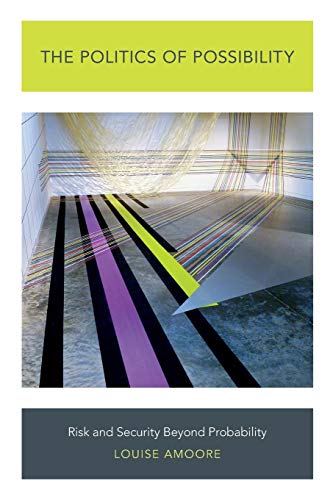
Since September 11, 2001, the imagination of "low probability, high consequence" events has become a distinctive feature of contemporary politics. Uncertain futures-devastation by terrorist attack, cyber crime, flood, financial market collapse-must be discerned and responded to as possibilities, however improbable they may be. In The Politics of Possibility, Louise Amoore examines this development, tracing its genealogy through the diverse worlds of risk management consulting, computer science, commercial logistics, and data visualization. She focuses on the increasingly symbiotic relationship between commercial opportunities and state security threats, a relation that turns the trusted, iris-scanned traveler into "a person of national security interest," and the designer of risk algorithms for casino and insurance fraud into a homeland security resource. Juxtaposing new readings of Agamben, Foucault, Derrida, Massumi, and Connolly with interpretations of post-9/11 novels and artworks, Amoore analyzes the "politics of possibility" and its far-reaching implications for society, associative life, and political accountability.
Die Inhaltsangabe kann sich auf eine andere Ausgabe dieses Titels beziehen.
Über die Autorin bzw. den Autor
Louise Amoore is Professor of Political Geography at Durham University in Durham, England. She is the author of Globalization Contested: An International Political Economy of Work, editor of The Global Resistance Reader, and a coeditor of Risk and the War on Terror.
Auszug. © Genehmigter Nachdruck. Alle Rechte vorbehalten.
THE POLITICS OF POSSIBILITY
Risk and Security Beyond Probability
By LOUISE AMOOREDuke University Press
Copyright © 2013 Duke University Press
All rights reserved.
ISBN: 978-0-8223-5560-1All rights reserved.
Contents
| Acknowledgements........................................................... | ix |
| INTRODUCTION. On the Politics of Possibility............................... | 1 |
| Part I. TECHNIQUES......................................................... | |
| 1 ON AUTHORITY. Probabilities for a World of Possibility................... | 29 |
| 2 ON RISK. Securing Uncertain Futures...................................... | 55 |
| Part II. SPACES............................................................ | |
| 3 ON THE LINE. Life Signatures and the Writing of the Border............... | 79 |
| 4 ON LOCATION. Reconciling Security and Mobility........................... | 105 |
| Part III. EFFECTS.......................................................... | |
| 5 ON AESTHETICS. Security's Objects and the Form of Data................... | 129 |
| 6 ON A POTENTIAL POLITICS. Toward an Ethics of the Unanticipated........... | 155 |
| Notes...................................................................... | 177 |
| Bibliography............................................................... | 203 |
| Index...................................................................... | 217 |
CHAPTER 1
ON AUTHORITY
Probabilities for a World of Possibility
Weather energy goes round in circles, runs down corridors, cascades down stairways.It diffuses, regathers, reforms, diffuses again. It moves in jets and trickles, isdivided by layers thick and thin. It's always moving through one system to another,taking different shapes over time. That's why there'll always be the unexpected.The number will not help you solve that problem directly. But if you want helpwith your war ... the extent of the unexpectedness can be modified, increasingthe probability of prediction. Don't think of the date for your invasion, or you willmake a prison for yourself. Think of your data instead. How does it fit into thesurrounding context? —Giles Foden, Turbulence, 190
In 1944 in a remote Scottish village, Henry Meadows, a young mathematicianworking for the UK's Meteorological Office, seeks the secret Rymannumber that will make possible the crucial five-day advance forecastingof the weather for the D-Day landings. In Giles Foden's novel Turbulence,a depiction of the relationships between prediction, probability, weather,and war, the strategic decision on the date of invasion is but the visiblesurface of a series of frenetic backroom calculations and disputes betweenforecasters. As Foden's protagonist Meadows complains, acknowledgingsomething of the performative force of his forecasts, "it was as if we werenow expected not just to predict the weather but make it, in order that thevast ensemble of men and machines could at last be unleashed upon theenemy." His mentor, and the author of the much sought after equation,Wallace Ryman has warned him not to focus on the analogue reading ofpatterns of past weather events, or the "prison" that is the date of the invasionitself, but to observe the differential layers of the weather system, toallow for movement, circulation, and the unexpected. Yet Meadows's colleaguesare uneasy at what they see as the inferential "approximation" beinginvited into their statistical calculations of future weather. "The Americans'analogue models," objects his superior, "use historical data statistically toextrapolate how current weather will develop." "With the greatest respectto our allies," replies Meadows, "I don't think that is what Ryman was talkingabout. He would say you could have hundreds of years of data and stillget it wrong. You might pick up some quasi-periodic phenomena but thesingularities could be completely against the grain." Statistical extrapolationfrom a series of past weather events, Foden's character tells us, couldin itself represent a danger to sovereign judgment, missing, as it might, thesingularities against the grain, the outliers that elude the series.
In Foden's novel the authorization of a sovereign decision—on the basisof which the lives of two and a half million men, and perhaps a war, couldbe secured or lost—is displayed in its vivid complexity. Behind the visibledecision to authorize the invasion are multiple layers of numbers, calculations,science, laws, disputes, errors, guesswork, gut-feelings, and instincts.The dispersal of authority into this complex network, we might say withIan Hacking, is one specific means by which the sovereign is lent objectivityvia number. In the sovereign decisions on the exception, it is preciselythe declaration of emergency and special measures that clears space forthe dispersal of decision into multiple authorities, plural enumerations. IfWilliam Connolly's sense of an exception as the that which decides, the that"comprised of a plurality of forces," is to be brought into conversation withthe rich histories of science and statistics of Hacking or Lorraine Daston,then what is needed is an analysis of how authorizations multiply underthe positional sovereignty of the state. How, in short, do multiple layers ofnumber and calculation authorize, and become authorized by, the sovereigndecision on exception?
In this chapter I focus on specific instances of the designation of exceptionaltimes, the institution of necessary measures, and the authorizationof particular forms of number. As in Foden's world of forecasting to "modifythe extent of the unexpected," I am interested in how specific forms ofprobability have been contested or adopted as credible for use in apparentlyobjective sovereign decisions. On the one hand, the "approximate"speculative knowledge of commerce and economy—otherwise thought tobe a poor basis for a security judgment—appears to be invited into governmenttechniques during times of war. On the other, it is precisely by meansof sovereign enrollment in the strategies of war that economic knowledgesof circulation and laissez-faire are afforded the kind of credibility otherwisereserved for science, medicine, and law. The question of whetherRyman's number could be credibly deployed in a sovereign decision is aquestion of the allowable extent of the incorporation of possible elementswithin probabilistic statistical models. Forecasting the weather five daysin advance in the 1940s, and even today, demands more than statisticalextrapolation—there are gaps, and these gaps are filled with computermodels, subjective probabilities, equations, disagreement, intuition, andexpectation. Likewise, the absence of long-term historical "threat" data onevents such as terrorism has encouraged more speculative and imaginativeforms of calculation. Where data on past events are incomplete or absent,probabilistic knowledge is loosened to incorporate assumptions about thatwhich is merely possible. I illustrate my point in this chapter with referenceto two such instances when forms of probability and statistical knowledgewere enrolled within the complex of sovereignty: the accounting practicesplaced at the service of the state in the governing of population in WorldWar II, and the computer science and consulting practices enlisted withinthe so-called war on...
„Über diesen Titel“ kann sich auf eine andere Ausgabe dieses Titels beziehen.
Suchergebnisse für The Politics of Possibility: Risk and Security Beyond...

Beispielbild für diese ISBN
The Politics of Possibility: Risk and Security Beyond Probability
Anbieter: ThriftBooks-Atlanta, AUSTELL, GA, USA
Verkäuferbewertung 5 von 5 Sternen

Paperback. Zustand: Good. No Jacket. Pages can have notes/highlighting. Spine may show signs of wear. ~ ThriftBooks: Read More, Spend Less. Bestandsnummer des Verkäufers G0822355604I3N00
Gebraucht kaufen
EUR 18,33
Versand gratis
Versand innerhalb von USA
Versand innerhalb von USA
Anzahl: 1 verfügbar
Beispielbild für diese ISBN
The Politics of Possibility : Risk and Security Beyond Probability
Anbieter: Better World Books: West, Reno, NV, USA
Verkäuferbewertung 5 von 5 Sternen
Zustand: Good. Former library copy. Pages intact with minimal writing/highlighting. The binding may be loose and creased. Dust jackets/supplements are not included. Includes library markings. Stock photo provided. Product includes identifying sticker. Better World Books: Buy Books. Do Good. Bestandsnummer des Verkäufers 45133346-75
Gebraucht kaufen
EUR 18,42
Versand gratis
Versand innerhalb von USA
Versand innerhalb von USA
Anzahl: 1 verfügbar
Beispielbild für diese ISBN
Politics of Possibility: Risk and Security Beyond Probability
Verlag:
Duke University Press November 2013, 2013
ISBN 10: 0822355604
ISBN 13: 9780822355601
Gebraucht
Paper Back
Anbieter: Eagle Eye Books, Decatur, GA, USA
Verkäuferbewertung 4 von 5 Sternen

Paper Back. Zustand: Used. Bestandsnummer des Verkäufers 914999
Gebraucht kaufen
EUR 16,51
EUR 3,56 Versand
Versand innerhalb von USA
Versand innerhalb von USA
Anzahl: 1 verfügbar
Beispielbild für diese ISBN
The Politics of Possibility: Risk and Security Beyond Probability
Anbieter: WorldofBooks, Goring-By-Sea, WS, Vereinigtes Königreich
Verkäuferbewertung 5 von 5 Sternen
Paperback. Zustand: Very Good. The book has been read, but is in excellent condition. Pages are intact and not marred by notes or highlighting. The spine remains undamaged. Bestandsnummer des Verkäufers GOR007665780
Gebraucht kaufen
EUR 26,16
EUR 6,71 Versand
Versand von Vereinigtes Königreich nach USA
Versand von Vereinigtes Königreich nach USA
Anzahl: 1 verfügbar
Beispielbild für diese ISBN
The Politics of Possibility: Risk and Security Beyond Probability
Anbieter: WorldofBooks, Goring-By-Sea, WS, Vereinigtes Königreich
Verkäuferbewertung 5 von 5 Sternen
Paperback. Zustand: Fine. Bestandsnummer des Verkäufers GOR015068056
Gebraucht kaufen
EUR 26,16
EUR 6,71 Versand
Versand von Vereinigtes Königreich nach USA
Versand von Vereinigtes Königreich nach USA
Anzahl: 1 verfügbar
Foto des Verkäufers
Politics of Possibility : Risk and Security Beyond Probability
Anbieter: GreatBookPrices, Columbia, MD, USA
Verkäuferbewertung 5 von 5 Sternen
Zustand: New. Bestandsnummer des Verkäufers 20011042-n
Neu kaufen
EUR 34,12
EUR 2,35 Versand
Versand innerhalb von USA
Versand innerhalb von USA
Anzahl: Mehr als 20 verfügbar
Foto des Verkäufers
The Politics of Possibility: Risk and Security Beyond Probability (Paperback or Softback)
Verlag:
Duke University Press 11/13/2013, 2013
ISBN 10: 0822355604
ISBN 13: 9780822355601
Neu
Paperback or Softback
Anbieter: BargainBookStores, Grand Rapids, MI, USA
Verkäuferbewertung 5 von 5 Sternen
Paperback or Softback. Zustand: New. The Politics of Possibility: Risk and Security Beyond Probability. Book. Bestandsnummer des Verkäufers BBS-9780822355601
Foto des Verkäufers
Politics of Possibility : Risk and Security Beyond Probability
Anbieter: GreatBookPrices, Columbia, MD, USA
Verkäuferbewertung 5 von 5 Sternen
Zustand: As New. Unread book in perfect condition. Bestandsnummer des Verkäufers 20011042
Gebraucht kaufen
EUR 37,34
EUR 2,35 Versand
Versand innerhalb von USA
Versand innerhalb von USA
Anzahl: Mehr als 20 verfügbar
Beispielbild für diese ISBN
The Politics of Possibility: Risk and Security Beyond Probability
Anbieter: California Books, Miami, FL, USA
Verkäuferbewertung 5 von 5 Sternen
Zustand: New. Bestandsnummer des Verkäufers I-9780822355601
Neu kaufen
EUR 37,63
EUR 2,67 Versand
Versand innerhalb von USA
Versand innerhalb von USA
Anzahl: Mehr als 20 verfügbar
Foto des Verkäufers
The Politics of Possibility
Anbieter: Rarewaves.com USA, London, LONDO, Vereinigtes Königreich
Verkäuferbewertung 5 von 5 Sternen
Paperback. Zustand: New. Since September 11, 2001, the imagination of "low probability, high consequence" events has become a distinctive feature of contemporary politics. Uncertain futures-devastation by terrorist attack, cyber crime, flood, financial market collapse-must be discerned and responded to as possibilities, however improbable they may be. In The Politics of Possibility, Louise Amoore examines this development, tracing its genealogy through the diverse worlds of risk management consulting, computer science, commercial logistics, and data visualization. She focuses on the increasingly symbiotic relationship between commercial opportunities and state security threats, a relation that turns the trusted, iris-scanned traveler into "a person of national security interest," and the designer of risk algorithms for casino and insurance fraud into a homeland security resource. Juxtaposing new readings of Agamben, Foucault, Derrida, Massumi, and Connolly with interpretations of post-9/11 novels and artworks, Amoore analyzes the "politics of possibility" and its far-reaching implications for society, associative life, and political accountability. Bestandsnummer des Verkäufers LU-9780822355601
Neu kaufen
EUR 45,89
Versand gratis
Versand von Vereinigtes Königreich nach USA
Versand von Vereinigtes Königreich nach USA
Anzahl: Mehr als 20 verfügbar