
Verwandte Artikel zu Tango Lessons: Movement, Sound, Image, and Text in...
Inhaltsangabe
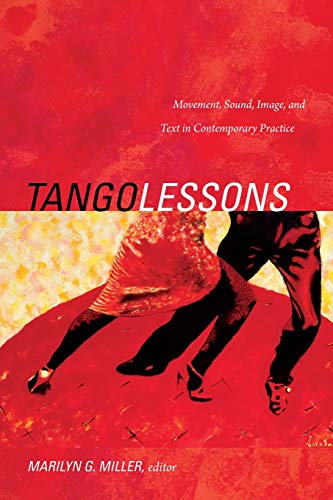
From its earliest manifestations on the street corners of nineteenth-century Buenos Aires to its ascendancy as a global cultural form, tango has continually exceeded the confines of the dance floor or the music hall. In Tango Lessons, scholars from Latin America and the United States explore tango's enduring vitality. The interdisciplinary group of contributors-including specialists in dance, music, anthropology, linguistics, literature, film, and fine art-take up a broad range of topics. Among these are the productive tensions between tradition and experimentation in tango nuevo, representations of tango in film and contemporary art, and the role of tango in the imagination of Jorge Luis Borges. Taken together, the essays show that tango provides a kaleidoscopic perspective on Argentina's social, cultural, and intellectual history from the late nineteenth to the early twenty-first centuries.
Contributors. Esteban Buch, Oscar Conde, Antonio Gómez, Morgan James Luker, Carolyn Merritt, Marilyn G. Miller, Fernando Rosenberg, Alejandro SustiDie Inhaltsangabe kann sich auf eine andere Ausgabe dieses Titels beziehen.
Über die Autorin bzw. den Autor
Marilyn G. Miller is Associate Professor of Spanish and Portuguese at Tulane University. She is the author of Rise and Fall of the Cosmic Race: The Cult of Mestizaje in Latin America.
Auszug. © Genehmigter Nachdruck. Alle Rechte vorbehalten.
TANGO LESSONS
MOVEMENT, SOUND, IMAGE, AND TEXT IN CONTEMPORARY PRACTICE
By MARILYN G. MILLERDuke University Press
Copyright © 2014 Duke University Press
All rights reserved.
ISBN: 978-0-8223-5566-3All rights reserved.
Contents
Acknowledgments, ix,
INTRODUCTION • MARILYN G. MILLER, 1,
CHAPTER ONE • OSCAR CONDE Lunfardo in Tango: A Way of Speaking That Defines a Way of Being, 33,
CHAPTER TWO • ALEJANDRO SUSTI Borges, Tango, and Milonga, 60,
CHAPTER THREE • MARILYN G. MILLER Picturing Tango, 82,
CHAPTER FOUR • ANTONIO GÓMEZ Tango, Politics, and the Musical of Exile, 118,
CHAPTER FIVE • FERNANDO ROSENBERG The Return of the Tango in Documentary Film, 140,
CHAPTER SIX • CAROLYN MERRITT "Manejame como un auto": Drive Me Like a Car, or What's So New about Tango Nuevo?, 164,
CHAPTER SEVEN • MORGAN JAMES LUKER Contemporary Tango and the Cultural Politics of Música Popular, 198,
CHAPTER EIGHT • ESTEBAN BUCH Gotan Project's Tango Project, 220,
Glossary, 243,
Works Cited, 247,
Contributors and Translators, 267,
Index, 269,
CHAPTER 1
Lunfardo in Tango A Way of Speaking That Defines a Way of Being
OSCAR CONDE
Translated by Kurt Hofer
Tango has demonstrated a singular originality and vitality during its many decades of existence. It presents us with a wide range of perspectives in both its musical and choreographic aspects, and we should not fail to take into account its very rich history as a poetics and a literary history as well. Even before the emergence of that period of tango history known as tango canción, initiated in 1917 with the appearance of "Mi noche triste" (Gobello, Letras de tango, 24), tango lyrics had already begun to make use of lunfardo, the distinct vocabulary of the popular classes of the Río de la Plata region, to achieve an enhanced level of expressivity. Thanks to the particularly strong bond between lunfardo and tango lyrics, especially in the 1920s and 1930s, the popularity of the form increased, and tango music and dance were ultimately complemented by a new element: poetry. This was by no means the only use of lunfardo in a literary context: it has also been used in comic sketches, in the grotesque and other forms of popular theater, in costumbrista journalism that focused on local and regional customs, in comic strips, in rock lyrics, and even in the works of some of Argentina's most canonical authors, such as Leopoldo Marechal, Ernesto Sábato, Julio Cortázar, and Manuel Puig. Nonetheless, the connection between tango and lunfardo remains readily apparent today due to the role of the former in disseminating the latter, the latter being initially circumscribed to the lower classes.
The aim of this chapter is first to show how lunfardo has occupied a privileged space in tango, even if a few of its principal lyricists (such as Homero Manzi and Alfredo Le Pera) made infrequent use of its unique vocabulary in their compositions. I then take up the relationship of tango and lunfardo, a relationship that we could credit, without risk of overstatement, with the continuing presence of tango language in the everyday experience of people living in the Río de la Plata region.
Tango is in all of its aspects a product of hybridization, constituted through a diverse constellation of musical, instrumental, and choreographic syncretisms throughout its long history. The resulting phenomenon has proved appealing over a long period to a variety of academics in fields such as anthropology, sociology, philosophy, psychology, and linguistics. Even if such a model results in the oversimplification of certain elements of this history, it is only through the adoption of an integrationist approach to tango that any of the aforementioned fields do not become the single axis of our analysis but rather are reconfigured with the aim of providing a broad, multidimensional vision of the form. Tango is without doubt a product of complexity. A series of distinct elements, all of them necessary to the process, had to come together and work in conjunction with one another to enable its emergence and development as a cultural matrix. It is for this very reason not only appropriate but also advisable that we study tango as a phenomenon of transcultural symbiosis.
While the preservation and study of tango strengthens the regeneration of the dance's singularities and constitutes a kind of return to origins and to questions of regional identity in Argentina and Uruguay, tango has at the same time become part of an indubitably transnational culture in which it has been identified as unique within "planetary folklore" (an expression coined by Morin). This status is evident in its extensive popularization in academies and dance halls throughout Europe and the Americas as well as in movies, plays, and other diverse contexts and venues.
In its early stages, however, tango was rarely seen for what it truly was: a genuine creation of the popular classes, a product of hybridization and of the waves of immigrants who arrived in the port of Buenos Aires between the end of the nineteenth and the beginning of the twentieth centuries. Contrary to what has been said time and time again, tango was not solely the creation of a marginalized segment of the population. Its history is a singular parable that stretches from the inner reaches of the lower classes to academic studies and intellectual circles, from humble cafés and popular dances of the masses to the opulent halls of the Teatro Colón, Buenos Aires's renowned opera house. Once the dance had been legitimated abroad in Paris in 1913, the Argentine upper classes adopted tango both as music and choreography, but as Eduardo Romano has pointed out, "they never swallowed the vulgarity and crassness of its lyrics" (Romano 126; nunca deglutieron el vulgarismo y la cursilería de sus letras). Nonetheless, tango lyrics in the Río de la Plata region have accompanied the common man or woman for many decades: they have provided comfort in the face of disgrace, company in moments of solitude, and an opportunity to ponder the caprices of one's destiny. No one can doubt that a corpus numbering more than thirty thousand tango lyrics provides a series of images that together constitute an extensive history of sentiment—and of private life in general—of Buenos Aires and other Argentine and Uruguayan cities during most of the twentieth century.
If anything defines the tango as a genre, both with respect to its musical roots and in terms of its poetic origins, it is hybridity. In the first case, as is now common knowledge, the earliest forms of tango developed from the confluence of various black rhythms: the habanera, the Andalusian tango, and the milonga. Blas Matamoro summarized the contribution of each of these genres in the following way: "Just as the habanera was lyrical and candombe danceable, we can say that the milonga was a lyrical genre that became a dance by incorporating some of the elements of the candombe's choreography overlaid onto the rhythmic scheme of the habanera. This formula attempts to resolve the question of defining the tango porteño [identified with the port cities of Buenos Aires and Montevideo], starting with its necessarily hybrid character" (Matamoro, "Orígenes musicales" 89). So it was in the territory of dance that tango came into its own. The discursive construction of the identity of inhabitants of the...
„Über diesen Titel“ kann sich auf eine andere Ausgabe dieses Titels beziehen.
Suchergebnisse für Tango Lessons: Movement, Sound, Image, and Text in...

Beispielbild für diese ISBN
Tango Lessons: Movement, Sound, Image, and Text in Contemporary Practice
Anbieter: Midtown Scholar Bookstore, Harrisburg, PA, USA
Verkäuferbewertung 5 von 5 Sternen

paperback. Zustand: Very Good. Very Good paperback with light shelfwear - NICE! Standard-sized. Bestandsnummer des Verkäufers mon0000343737
Gebraucht kaufen
EUR 6,48
EUR 5,36 Versand
Versand innerhalb von USA
Versand innerhalb von USA
Anzahl: 1 verfügbar
Beispielbild für diese ISBN
Tango Lessons: Movement, Sound, Image, and Text in Contemporary Practice
Anbieter: World of Books (was SecondSale), Montgomery, IL, USA
Verkäuferbewertung 5 von 5 Sternen
Paperback. Zustand: Very Good. Tango Lessons is an interdisciplinary collection of essays examining the many varied perspectives that tango provides on Argentina's social, cultural, and intellectual history from the late nineteenth century to the early twenty-first. Bestandsnummer des Verkäufers 00097857354
Gebraucht kaufen
EUR 11,99
Versand gratis
Versand innerhalb von USA
Versand innerhalb von USA
Anzahl: 1 verfügbar
Beispielbild für diese ISBN
Tango Lessons: Movement, Sound, Image, and Text in Contemporary Practice
Anbieter: World of Books (was SecondSale), Montgomery, IL, USA
Verkäuferbewertung 5 von 5 Sternen
Paperback. Zustand: Good. Tango Lessons is an interdisciplinary collection of essays examining the many varied perspectives that tango provides on Argentina's social, cultural, and intellectual history from the late nineteenth century to the early twenty-first. Bestandsnummer des Verkäufers 00092774381
Gebraucht kaufen
EUR 11,99
Versand gratis
Versand innerhalb von USA
Versand innerhalb von USA
Anzahl: 1 verfügbar
Beispielbild für diese ISBN
Tango Lessons Movement, Sound, Image, and Text in Contemporary Practice
Anbieter: Powell's Bookstores Chicago, ABAA, Chicago, IL, USA
Verkäuferbewertung 5 von 5 Sternen
Paperback. Zustand: New. New copy. Bestandsnummer des Verkäufers 2045951
Beispielbild für diese ISBN
Tango Lessons : Movement, Sound, Image, and Text in Contemporary Practice
Anbieter: Better World Books, Mishawaka, IN, USA
Verkäuferbewertung 5 von 5 Sternen
Zustand: Very Good. Pages intact with possible writing/highlighting. Binding strong with minor wear. Dust jackets/supplements may not be included. Stock photo provided. Product includes identifying sticker. Better World Books: Buy Books. Do Good. Bestandsnummer des Verkäufers 40087471-6
Gebraucht kaufen
EUR 12,82
Versand gratis
Versand innerhalb von USA
Versand innerhalb von USA
Anzahl: 3 verfügbar
Beispielbild für diese ISBN
Tango Lessons: Movement, Sound, Image, and Text in Contemporary Practice
Anbieter: World of Books Inc, Montgomery, IL, USA
Verkäuferbewertung 4 von 5 Sternen

Paperback. Zustand: Good. Tango Lessons is an interdisciplinary collection of essays examining the many varied perspectives that tango provides on Argentina's social, cultural, and intellectual history from the late nineteenth century to the early twenty-first. Bestandsnummer des Verkäufers CIN0822355663G
Gebraucht kaufen
EUR 13,83
Versand gratis
Versand innerhalb von USA
Versand innerhalb von USA
Anzahl: 1 verfügbar
Beispielbild für diese ISBN
Tango Lessons: Movement, Sound, Image, and Text in Contemporary Practice
Anbieter: World of Books Inc, Montgomery, IL, USA
Verkäuferbewertung 4 von 5 Sternen
Paperback. Zustand: Very Good. Tango Lessons is an interdisciplinary collection of essays examining the many varied perspectives that tango provides on Argentina's social, cultural, and intellectual history from the late nineteenth century to the early twenty-first. Bestandsnummer des Verkäufers CIN0822355663VG
Gebraucht kaufen
EUR 13,83
Versand gratis
Versand innerhalb von USA
Versand innerhalb von USA
Anzahl: 1 verfügbar
Foto des Verkäufers
Tango Lessons : Movement, Sound, Image, and Text in Contemporary Practice
Anbieter: GreatBookPrices, Columbia, MD, USA
Verkäuferbewertung 5 von 5 Sternen
Zustand: New. Bestandsnummer des Verkäufers 20011043-n
Neu kaufen
EUR 27,49
EUR 2,36 Versand
Versand innerhalb von USA
Versand innerhalb von USA
Anzahl: 2 verfügbar
Foto des Verkäufers
Tango Lessons
Anbieter: Rarewaves.com USA, London, LONDO, Vereinigtes Königreich
Verkäuferbewertung 5 von 5 Sternen
Paperback. Zustand: New. From its earliest manifestations on the street corners of nineteenth-century Buenos Aires to its ascendancy as a global cultural form, tango has continually exceeded the confines of the dance floor or the music hall. In Tango Lessons, scholars from Latin America and the United States explore tango's enduring vitality. The interdisciplinary group of contributors-including specialists in dance, music, anthropology, linguistics, literature, film, and fine art-take up a broad range of topics. Among these are the productive tensions between tradition and experimentation in tango nuevo, representations of tango in film and contemporary art, and the role of tango in the imagination of Jorge Luis Borges. Taken together, the essays show that tango provides a kaleidoscopic perspective on Argentina's social, cultural, and intellectual history from the late nineteenth to the early twenty-first centuries.Contributors. Esteban Buch, Oscar Conde, Antonio GÓmez, Morgan James Luker, Carolyn Merritt, Marilyn G. Miller, Fernando Rosenberg, Alejandro Susti. Bestandsnummer des Verkäufers LU-9780822355663
Neu kaufen
EUR 29,93
Versand gratis
Versand von Vereinigtes Königreich nach USA
Versand von Vereinigtes Königreich nach USA
Anzahl: 1 verfügbar
Foto des Verkäufers
Tango Lessons : Movement, Sound, Image, and Text in Contemporary Practice
Anbieter: GreatBookPrices, Columbia, MD, USA
Verkäuferbewertung 5 von 5 Sternen
Zustand: As New. Unread book in perfect condition. Bestandsnummer des Verkäufers 20011043
Gebraucht kaufen
EUR 27,68
EUR 2,36 Versand
Versand innerhalb von USA
Versand innerhalb von USA
Anzahl: 2 verfügbar