
Verwandte Artikel zu Messy Eating: Conversations on Animals as Food
Inhaltsangabe
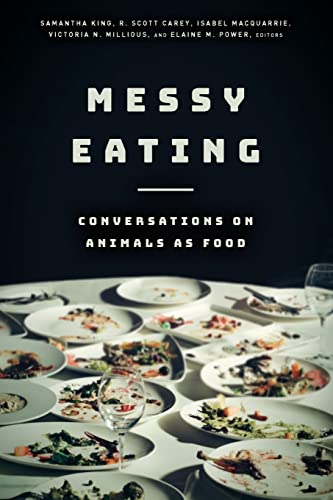
Literature on the ethics and politics of food and that on human-animal relationships have infrequently converged. Representing an initial step toward bridging this divide, Messy Eating features interviews with thirteen prominent and emerging scholars about the connections between their academic work and their approach to consuming animals as food. The collection explores how authors working across a range of perspectives-postcolonial, Indigenous, black, queer, trans, feminist, disability, poststructuralist, posthumanist, and multispecies-weave their theoretical and political orientations with daily, intimate, and visceral practices of food consumption, preparation, and ingestion.
Each chapter introduces a scholar for whom the tangled, contradictory character of human-animal relations raises difficult questions about what they eat. Representing a departure from canonical animal rights literature, most authors featured in the collection do not make their food politics or identities explicit in their published work. While some interviewees practice vegetarianism or veganism, and almost all decry the role of industrialized animal agriculture in the environmental crisis, the contributors tend to reject a priori ethical codes and politics grounded in purity, surety, or simplicity. Remarkably free of proscriptions, but attentive to the Eurocentric tendencies of posthumanist animal studies, Messy Eating reveals how dietary habits are unpredictable and dynamic, shaped but not determined by life histories, educational trajectories, disciplinary homes, activist experiences, and intimate relationships.
These accessible and engaging conversations offer rare and often surprising insights into pressing social issues through a focus on the mundane-and messy- interactions that constitute the professional, the political, and the personal.
Contributors: Neel Ahuja, Billy-Ray Belcourt, Matthew Calarco, Lauren Corman, Naisargi Dave, Maneesha Deckha, María Elena García, Sharon Holland, Kelly Struthers Montford, H. Peter Steeves, Kim TallBear, Sunaura Taylor, Harlan Weaver, Kari Weil, Cary Wolfe
Die Inhaltsangabe kann sich auf eine andere Ausgabe dieses Titels beziehen.
Über die Autorin bzw. den Autor
Samantha King (Edited By)
Samantha King is Professor of Gender Studies, Cultural Studies, and Kinesiology and Health Studies at Queen’s University. She is the author of Pink Ribbons, Inc.: Breast Cancer and the Politics of Philanthropy.
R. Scott Carey (Edited By)
R. Scott Carey is a grant writer with a PhD in Kinesiology and Health Studies from Queen’s University.
Isabel Macquarrie (Edited By)
Isabel MacQuarrie is a Juris Doctor candidate at Harvard Law School with an MA in sociology from Queen’s University.
Victoria Niva Millious (Edited By)
Victoria N. Millious is a PhD candidate in the School of Kinesiology and Health Studies, Queen’s University.
Elaine M. Power (Edited By)
Elaine M. Power is Associate Professor in the School of Kinesiology and Health Studies at Queen’s University.
Auszug. © Genehmigter Nachdruck. Alle Rechte vorbehalten.
Messy Eating
Conversations on Animals as Food
By Samantha King, R. Scott Carey, Isabel Macquarrie, Victoria N. Millious, Elaine M. PowerFordham University Press
Copyright © 2019 Fordham University Press
All rights reserved.
ISBN: 978-0-8232-8365-1All rights reserved.
Contents
Introduction SAMANTHA KING, R. SCOTT CAREY, ISABEL MACQUARRIE, VICTORIA N. MILLIOUS, AND ELAINE M. POWER, 1,
1. Turning Toward and Away CARY WOLFE, 000,
2. Subjectivities and Intersections LAUREN CORMAN, 000,
3. Being in Relation KIM TALLBEAR, 000,
4. The Tyranny of Consistency NAISARGI DAVE, 000,
5. Justice and Nonviolence MANEESHA DECKHA, 000,
6. Doing What You Can KARI WEIL, 000,
7. Waking Up H. PETER STEEVES, 000,
8. Entangled MARÍA ELENA GARCÍA, 000,
9. Disability and Interdependence SUNAURA TAYLOR, 000,
10. Asking Hard Questions NEEL AHUJA, 000,
11. Interspecies Intersectionalities HARLAN WEAVER, 000,
12. Living Philosophically MATTHEW CALARCO, 000,
13. Taking Things Back, Piece by Piece SHARON HOLLAND, 000,
Coda: Toward an Analytic of Agricultural Power KELLY STRUTHERS MONTFORD, 000,
Coda: Thinking Paradoxically BILLY-RAY BELCOURT, 000,
Acknowledgments, 000,
Recommended Reading, 000,
List of Contributors, 000,
Index, 000,
CHAPTER 1
Turning Toward and Away Cary Wolfe
Cultural critic and theorist Cary Wolfe began thinking about human–animal relationships as a student when he encountered animal rights activists on his college campus. This experience resulted in an intense sense of "not being able to turn away," and Wolfe became a vegetarian and devoted activist in his own right. During the same period, he began developing the nonhuman problematic as an object of legitimate scholarly inquiry. On the subject of eating, Wolfe observes that food is a multidimensional and complex problem, shares how his vegetarianism ruined one Thanksgiving dinner, and notes that people have "different kinds of investments" in food. We interviewed Wolfe by Skype on July 14, 2016.
SCOTT CAREY: Could you tell us a bit about yourself? This could include when and where you were born and raised; your formative cultural, intellectual, and political experiences; how you became an academic, whatever you'd like to share.
CARY WOLFE: Well, that's actually three questions! If I forget any of them, just remind me. I was born in South Carolina and lived there until I was about four or five years old, when I moved to North Carolina.
That's really where I grew up; it's where I went to high school and did my university work. Even though I was quite prepared to leave and kind of wanted to go somewhere else, I got this great scholarship to go to the University of North Carolina at Chapel Hill. So I went to college and did my master's degree in Chapel Hill, and then, again, I was looking all over the country for the right PhD program. I had to decide whether I was going to do a PhD or an MFA, because I was both a poet and a scholar and was trying to figure out which one to pursue. I decided to do a PhD, so I was prepared to go anywhere else, again. But just at that moment Duke University experienced a kind of renaissance in the English Department and the Program in Literature; they hired all these fantastic people almost overnight. And I was living ten miles away, and Duke and UNC students could study back and forth with no extra tuition at both universities. So I ended up staying there again and doing my PhD at Duke, which was a fantastic experience.
But let me back up a second. My parents met as high school English teachers in an urban environment outside of Charlotte, North Carolina, in the 1960s. So I grew up in that sort of household — where there was a lot of literature, a lot of '60s culture. Not really of the hippie variety, but more of the informal, liberal '60s environment, even in the South at that time. Then my dad eventually became an academic. He first worked for the North Carolina Department of Public Instruction, where he was the head of their English and Foreign Languages division. He got a PhD, strangely enough, at Duke and went on to be an academic in English education at Old Dominion University in Virginia, specializing in the relationship between writing and learning, especially for kids from kindergarten through twelfth grade. So I grew up in an academic household; I was always around literature, poetry, and music, and art to a lesser extent. To jump back to my experience in school, my graduate school training was really a combination of Marxism and pragmatism. I did a lot of work with Fredric Jameson, Frank Lentricchia, Barbara Herrnstein Smith, Franco Moretti, Terry Eagleton, and a long list of other great people.
But one day when I was in graduate school, I was walking through the Pit, one of the central areas of the UNC campus, and I stopped by the student animal rights group table. And they had all these pamphlets and things displayed, including some material about biomedical research that was taking place on, I believe it was, primates, on the UNC campus. I just idly stopped by and started looking at these materials and I remember saying to the people at the table — who later became very good friends of mine — "You guys have got to be kidding. You're making this stuff up, right?" And they said, "No, it's going on in that building right there." And I was in disbelief. I realized much later, especially with my own work with students, that I had been completely in the dark about this entire infrastructure of exploitation and violence toward animals, and it never occurred to me it that it existed, really. I wouldn't call it a "conversion" experience necessarily, but it was definitely an intense ethical sense of not being able to turn away from what I had learned.
So I got really involved in the animal rights movement. And in that part of North Carolina, the so-called Research Triangle, there are a bunch of colleges and universities, including Duke, UNC, and NC State, so there's a high concentration of PhDs — in fact the highest concentration of PhDs per capita in the United States. So there was a very strong state animal rights group, and that was the core of it. I became very involved in this group called the North Carolina Network for Animals; I was in the newspaper and on television and at protests. I was a hardcore activist for a number of years.
But the interesting thing is that while that was going on, I realized more and more that my academic training in Marxism and pragmatism really didn't have much to say about the plight of nonhuman life. That eventually became a very productive divergence; it's what led me to help invent, over many years, what would later be called animal studies, or human–animal studies. Because at that time there was no freestanding theoretical vocabulary that was taken seriously with regard to nonhuman life. In the academy, if you were talking about animals it was taken for granted that you were talking about some sort of symbol or metaphor for a human problematic. In many cases this was in the form of the grotesque, or monstrosity — like Dracula, that type of stuff. But it wasn't a freestanding theoretical problematic in the way that feminism clearly was, or that queer theory became. It took a number of years to build that vocabulary and, in a kind of "Trojan horse" way, bring it into the ivory tower. Fast-forward twenty-five years and it's a different world. People in all different kinds of disciplines take...
„Über diesen Titel“ kann sich auf eine andere Ausgabe dieses Titels beziehen.
Weitere beliebte Ausgaben desselben Titels

Suchergebnisse für Messy Eating: Conversations on Animals as Food

Beispielbild für diese ISBN
Messy Eating: Conversations on Animals as Food
Verlag:
Fordham University Press, 2019
ISBN 10: 0823283658
ISBN 13: 9780823283651
Gebraucht
Paperback
Anbieter: ThriftBooks-Dallas, Dallas, TX, USA
Verkäuferbewertung 5 von 5 Sternen

Paperback. Zustand: As New. No Jacket. Pages are clean and are not marred by notes or folds of any kind. ~ ThriftBooks: Read More, Spend Less. Bestandsnummer des Verkäufers G0823283658I2N00
Gebraucht kaufen
EUR 22,23
Versand gratis
Versand innerhalb von USA
Versand innerhalb von USA
Anzahl: 1 verfügbar
Beispielbild für diese ISBN
Messy Eating: Conversations on Animals as Food
Anbieter: Russell Books, Victoria, BC, Kanada
Verkäuferbewertung 5 von 5 Sternen
Paperback. Zustand: Good. Bestandsnummer des Verkäufers FORT845464
Gebraucht kaufen
EUR 8,92
EUR 17,33 Versand
Versand von Kanada nach USA
Versand von Kanada nach USA
Anzahl: 1 verfügbar
Beispielbild für diese ISBN
Messy Eating: Conversations on Animals as Food
Anbieter: thebookforest.com, San Rafael, CA, USA
Verkäuferbewertung 4 von 5 Sternen

Zustand: New. Bestandsnummer des Verkäufers BAY20-00246
Neu kaufen
EUR 25,65
EUR 4,33 Versand
Versand innerhalb von USA
Versand innerhalb von USA
Anzahl: 1 verfügbar
Beispielbild für diese ISBN
Messy Eating
Anbieter: PBShop.store UK, Fairford, GLOS, Vereinigtes Königreich
Verkäuferbewertung 5 von 5 Sternen
PAP. Zustand: New. New Book. Shipped from UK. Established seller since 2000. Bestandsnummer des Verkäufers FW-9780823283651
Neu kaufen
EUR 30,29
EUR 4,86 Versand
Versand von Vereinigtes Königreich nach USA
Versand von Vereinigtes Königreich nach USA
Anzahl: 15 verfügbar
Beispielbild für diese ISBN
Messy Eating: Conversations on Animals as Food
Verlag:
Fordham University Press, 2019
ISBN 10: 0823283658
ISBN 13: 9780823283651
Gebraucht
Softcover
Erstausgabe
Anbieter: BMV Bloor, Toronto, ON, Kanada
Verkäuferbewertung 5 von 5 Sternen
Zustand: Like New. Paperback, like new. Stated first edition. Pages clean, no notes or highlights. Very minimal shelf wear. Used - Like New. Bestandsnummer des Verkäufers 49- a - 00008
Gebraucht kaufen
EUR 26,79
EUR 8,66 Versand
Versand von Kanada nach USA
Versand von Kanada nach USA
Anzahl: 1 verfügbar
Beispielbild für diese ISBN
Messy Eating - Conversations on Animals As Food (eng)
Anbieter: Brook Bookstore On Demand, Napoli, NA, Italien
Verkäuferbewertung 5 von 5 Sternen
Zustand: new. Bestandsnummer des Verkäufers 8215b71179764c8ae9de48af8e4c8f1a
Neu kaufen
EUR 35,37
EUR 5,50 Versand
Versand von Italien nach USA
Versand von Italien nach USA
Anzahl: Mehr als 20 verfügbar
Foto des Verkäufers
Messy Eating
Anbieter: Rarewaves USA, OSWEGO, IL, USA
Verkäuferbewertung 5 von 5 Sternen
Paperback. Zustand: New. Literature on the ethics and politics of food and that on human-animal relationships have infrequently converged. Representing an initial step toward bridging this divide, Messy Eating features interviews with thirteen prominent and emerging scholars about the connections between their academic work and their approach to consuming animals as food. The collection explores how authors working across a range of perspectives-postcolonial, Indigenous, black, queer, trans, feminist, disability, poststructuralist, posthumanist, and multispecies-weave their theoretical and political orientations with daily, intimate, and visceral practices of food consumption, preparation, and ingestion. Each chapter introduces a scholar for whom the tangled, contradictory character of human-animal relations raises difficult questions about what they eat. Representing a departure from canonical animal rights literature, most authors featured in the collection do not make their food politics or identities explicit in their published work. While some interviewees practice vegetarianism or veganism, and almost all decry the role of industrialized animal agriculture in the environmental crisis, the contributors tend to reject a priori ethical codes and politics grounded in purity, surety, or simplicity. Remarkably free of proscriptions, but attentive to the Eurocentric tendencies of posthumanist animal studies, Messy Eating reveals how dietary habits are unpredictable and dynamic, shaped but not determined by life histories, educational trajectories, disciplinary homes, activist experiences, and intimate relationships. These accessible and engaging conversations offer rare and often surprising insights into pressing social issues through a focus on the mundane-and messy- interactions that constitute the professional, the political, and the personal. Contributors: Neel Ahuja, Billy-Ray Belcourt, Matthew Calarco, Lauren Corman, Naisargi Dave, Maneesha Deckha, María Elena García, Sharon Holland, Kelly Struthers Montford, H. Peter Steeves, Kim TallBear, Sunaura Taylor, Harlan Weaver, Kari Weil, Cary Wolfe. Bestandsnummer des Verkäufers LU-9780823283651
Neu kaufen
EUR 42,66
Versand gratis
Versand innerhalb von USA
Versand innerhalb von USA
Anzahl: Mehr als 20 verfügbar
Beispielbild für diese ISBN
Messy Eating: Conversations on Animals as Food
Anbieter: Kennys Bookshop and Art Galleries Ltd., Galway, GY, Irland
Verkäuferbewertung 5 von 5 Sternen
Zustand: New. 2019. Paperback. . . . . . Bestandsnummer des Verkäufers V9780823283651
Neu kaufen
EUR 36,02
EUR 9,50 Versand
Versand von Irland nach USA
Versand von Irland nach USA
Anzahl: Mehr als 20 verfügbar
Beispielbild für diese ISBN
Messy Eating Conversations on Animals as Food
Anbieter: Revaluation Books, Exeter, Vereinigtes Königreich
Verkäuferbewertung 5 von 5 Sternen
Paperback. Zustand: Brand New. 268 pages. 9.00x6.00x0.75 inches. In Stock. Bestandsnummer des Verkäufers __0823283658
Neu kaufen
EUR 35,01
EUR 11,69 Versand
Versand von Vereinigtes Königreich nach USA
Versand von Vereinigtes Königreich nach USA
Anzahl: 2 verfügbar
Beispielbild für diese ISBN
Messy Eating: Conversations on Animals as Food
Anbieter: Majestic Books, Hounslow, Vereinigtes Königreich
Verkäuferbewertung 4 von 5 Sternen
Zustand: New. Bestandsnummer des Verkäufers 390099058
Neu kaufen
EUR 39,68
EUR 7,60 Versand
Versand von Vereinigtes Königreich nach USA
Versand von Vereinigtes Königreich nach USA
Anzahl: 3 verfügbar