
Verwandte Artikel zu Remembering the Kanji: A Systematic Guide to Reading...
Remembering the Kanji: A Systematic Guide to Reading Japanese Characters: A Systematic Guide to Reading the Japanese Characters - Softcover
Buch 2 von 3: Remembering the Kanji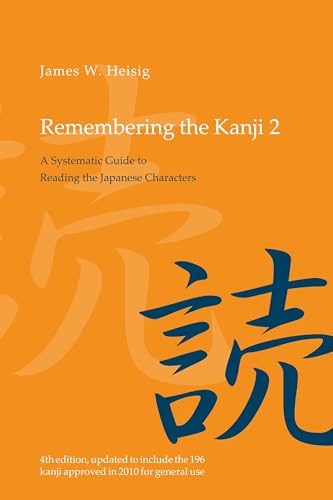
Inhaltsangabe
Following the first volume of Remembering the Kanji, the present work provides students with helpful tools for learning the pronunciation of the kanji. Behind the notorious inconsistencies in the way the Japanese language has come to pronounce the characters it received from China lie several coherent patterns. Identifying these patterns and arranging them in logical order can reduce dramatically the amount of time spent in the brute memorization of sounds unrelated to written forms.
Many of the “primitive elements,” or building blocks, used in the drawing of the characters also serve to indicate the “Chinese reading” that particular kanji use, chiefly in compound terms. By learning one of the kanji that uses such a “signal primitive,” one can learn the entire group at the same time. In this way, Remembering the Kanji 2 lays out the varieties of phonetic pattern and offers helpful hints for learning readings, that might otherwise appear completely random, in an efficient and rational way. Individual frames cross-reference the kanji to alternate readings and to the frame in volume 1 in which the meaning and writing of the kanji was first introduced.
A parallel system of pronouncing the kanji, their “Japanese readings,” uses native Japanese words assigned to particular Chinese characters. Although these are more easily learned because of the association of the meaning to a single word, the author creates a kind of phonetic alphabet of single syllable words, each connected to a simple Japanese word, and shows how they can be combined to help memorize particularly troublesome vocabulary.
The 4th edition has been updated to include the 196 new kanji approved by the government in 2010 as “general-use” kanji.
Die Inhaltsangabe kann sich auf eine andere Ausgabe dieses Titels beziehen.
Über die Autorin bzw. den Autor
James W. Heisig is a permanent research fellow at the Nanzan Institute for Religion and Culture in Nagoya, Japan.
„Über diesen Titel“ kann sich auf eine andere Ausgabe dieses Titels beziehen.
Suchergebnisse für Remembering the Kanji: A Systematic Guide to Reading...

Foto des Verkäufers
Remembering the Kanji 2: A Systematic Guide to Reading Japanese Characters
Verlag:
University of Hawaii Press, 2012
ISBN 10: 0824836693
ISBN 13: 9780824836696
Gebraucht
Softcover
Anbieter: Books for Life, LAUREL, MD, USA
Verkäuferbewertung 5 von 5 Sternen

Zustand: very_good. Book is in very good condition. Clean with little to no signs of wear or markings highlights. Bestandsnummer des Verkäufers LFM.9KD2
Gebraucht kaufen
EUR 15,52
Versand gratis
Versand innerhalb von USA
Versand innerhalb von USA
Anzahl: 1 verfügbar
Beispielbild für diese ISBN
Remembering the Kanji 2: A Systematic Guide to Reading Japanese Characters
Verlag:
University of Hawaii Press, 2012
ISBN 10: 0824836693
ISBN 13: 9780824836696
Gebraucht
Paperback
Anbieter: HPB-Red, Dallas, TX, USA
Verkäuferbewertung 5 von 5 Sternen
Paperback. Zustand: Good. Connecting readers with great books since 1972! Used textbooks may not include companion materials such as access codes, etc. May have some wear or writing/highlighting. We ship orders daily and Customer Service is our top priority! Bestandsnummer des Verkäufers S_474142390
Gebraucht kaufen
EUR 13,06
EUR 3,31 Versand
Versand innerhalb von USA
Versand innerhalb von USA
Anzahl: 1 verfügbar
Beispielbild für diese ISBN
Remembering the Kanji 2: A Systematic Guide to Reading Japanese Characters
Verlag:
University of Hawaii Press, 2012
ISBN 10: 0824836693
ISBN 13: 9780824836696
Gebraucht
paperback
Anbieter: Bookmans, Tucson, AZ, USA
Verkäuferbewertung 5 von 5 Sternen
paperback. Zustand: Good. / Satisfaction 100% guaranteed. Bestandsnummer des Verkäufers mon0002764795
Gebraucht kaufen
EUR 13,05
EUR 3,52 Versand
Versand innerhalb von USA
Versand innerhalb von USA
Anzahl: 1 verfügbar
Foto des Verkäufers
Remembering the Kanji 2: A Systematic Guide to Reading Japanese Characters
Verlag:
University of Hawaii Press, 2012
ISBN 10: 0824836693
ISBN 13: 9780824836696
Gebraucht
Softcover
Anbieter: Big River Books, Powder Springs, GA, USA
Verkäuferbewertung 5 von 5 Sternen
Zustand: good. This book is in good condition. The cover has minor creases or bends. The binding is tight and pages are intact. Some pages may have writing or highlighting. Bestandsnummer des Verkäufers BRV.0824836693.G
Gebraucht kaufen
EUR 16,69
EUR 3,52 Versand
Versand innerhalb von USA
Versand innerhalb von USA
Anzahl: 1 verfügbar
Beispielbild für diese ISBN
Remembering the Kanji 2: A Systematic Guide to Reading Japanese Characters
Verlag:
University of Hawaii Press, 2012
ISBN 10: 0824836693
ISBN 13: 9780824836696
Gebraucht
paperback
Anbieter: Sunshine State Books, Lithia, FL, USA
Verkäuferbewertung 4 von 5 Sternen

paperback. Zustand: As New. 4th Updated. Paperback--no flaws. Bestandsnummer des Verkäufers TA260312058O4
Gebraucht kaufen
EUR 20,89
EUR 5,80 Versand
Versand innerhalb von USA
Versand innerhalb von USA
Anzahl: 1 verfügbar
Beispielbild für diese ISBN
Remembering the Kanji 2: A Systematic Guide to Reading the Japanese Characters
Verlag:
University of Hawaii Press 2012-08-15, 2012
ISBN 10: 0824836693
ISBN 13: 9780824836696
Neu
Paperback
Anbieter: Chiron Media, Wallingford, Vereinigtes Königreich
Verkäuferbewertung 5 von 5 Sternen
Paperback. Zustand: New. Brand new book, sourced directly from publisher. Dispatch time is 24-48 hours from our warehouse. Book will be sent in robust, secure packaging to ensure it reaches you securely. Bestandsnummer des Verkäufers 6666-GRD-9780824836696
Neu kaufen
EUR 26,34
EUR 7,57 Versand
Versand von Vereinigtes Königreich nach USA
Versand von Vereinigtes Königreich nach USA
Anzahl: 1 verfügbar
Beispielbild für diese ISBN
Remembering the Kanji 2
Anbieter: PBShop.store UK, Fairford, GLOS, Vereinigtes Königreich
Verkäuferbewertung 5 von 5 Sternen
PAP. Zustand: New. New Book. Shipped from UK. Established seller since 2000. Bestandsnummer des Verkäufers GB-9780824836696
Neu kaufen
EUR 28,27
EUR 5,86 Versand
Versand von Vereinigtes Königreich nach USA
Versand von Vereinigtes Königreich nach USA
Anzahl: 1 verfügbar
Beispielbild für diese ISBN
Remembering the Kanji 2: A Systematic Guide to Reading Japanese Characters
Anbieter: California Books, Miami, FL, USA
Verkäuferbewertung 5 von 5 Sternen
Zustand: New. Bestandsnummer des Verkäufers I-9780824836696
Beispielbild für diese ISBN
Remembering the Kanji: A Systematic Guide to Reading Japanese Characters: Vol 2
Anbieter: Revaluation Books, Exeter, Vereinigtes Königreich
Verkäuferbewertung 5 von 5 Sternen
Paperback. Zustand: Brand New. 4th blg edition. 405 pages. 8.75x6.00x0.75 inches. In Stock. Bestandsnummer des Verkäufers __0824836693
Neu kaufen
EUR 28,83
EUR 14,58 Versand
Versand von Vereinigtes Königreich nach USA
Versand von Vereinigtes Königreich nach USA
Anzahl: 2 verfügbar
Beispielbild für diese ISBN
Remembering the Kanji 2 (Paperback)
Verlag:
University of Hawai'i Press, Honolulu, HI, 2012
ISBN 10: 0824836693
ISBN 13: 9780824836696
Neu
Paperback
Anbieter: Grand Eagle Retail, Bensenville, IL, USA
Verkäuferbewertung 5 von 5 Sternen
Paperback. Zustand: new. Paperback. Following the first volume of Remembering the Kanji, the present work provides students with helpful tools for learning the pronunciation of the kanji. Behind the notorious inconsistencies in the way the Japanese language has come to pronounce the characters it received from China lie several coherent patterns. Identifying these patterns and arranging them in logical order can reduce dramatically the amount of time spent in the brute memorization of sounds unrelated to written forms.Many of the primitive elements, or building blocks, used in the drawing of the characters also serve to indicate the Chinese reading that particular kanji use, chiefly in compound terms. By learning one of the kanji that uses such a signal primitive, one can learn the entire group at the same time. In this way, Remembering the Kanji 2 lays out the varieties of phonetic pattern and offers helpful hints for learning readings, that might otherwise appear completely random, in an efficient and rational way. Individual frames cross-reference the kanji to alternate readings and to the frame in volume 1 in which the meaning and writing of the kanji was first introduced.A parallel system of pronouncing the kanji, their Japanese readings, uses native Japanese words assigned to particular Chinese characters. Although these are more easily learned because of the association of the meaning to a single word, the author creates a kind of phonetic alphabet of single syllable words, each connected to a simple Japanese word, and shows how they can be combined to help memorize particularly troublesome vocabulary.The 4th edition has been updated to include the 196 new kanji approved by the government in 2010 as general-use kanji. Following the first volume of Remembering the Kanji, this provides students with helpful tools for learning the pronunciation of the kanji. Remembering the Kanji 2 lays out the varieties of phonetic pattern and offers helpful hints for learning readings, that might otherwise appear completely random, in an efficient and rational way. Shipping may be from multiple locations in the US or from the UK, depending on stock availability. Bestandsnummer des Verkäufers 9780824836696