
Verwandte Artikel zu Open to Disruption: Time and Craft in the Practice...
Inhaltsangabe
At a time when an emphasis on productivity in higher education threatens to undermine well-crafted research, these highly reflexive essays capture the sometimes profound intellectual effects that may accompany disrupted scholarship. They reveal that over long periods of time relationships with people studied invariably change, sometimes in dramatic ways. They illustrate how world events such as 9/11 and economic cycles impact individual biographies.
Some researchers describe how disruptions prompted them to expand the boundaries of their discipline and invent concepts that could more accurately describe phenomena that previously had no name and no scholarly history. Sometimes scholars themselves caused the disruption as they circled back to work they had considered "done" and allowed the possibility of rethinking earlier findings.
Die Inhaltsangabe kann sich auf eine andere Ausgabe dieses Titels beziehen.
Über die Autorin bzw. den Autor
Anita Ilta Garey is Associate Professor of Human Development and Family Studies and of Sociology at the University of Connecticut. Her book Weaving Work and Motherhood received the William J. Goode Award from the Family Section of the American Sociology Association. She has co-edited three other books, including (with Margaret K. Nelson) Who's Watching?: Daily Practices of Surveillance among Contemporary Families, also from Vanderbilt University Press.
Margaret K. Nelson is A. Barton Hepburn Professor in the Department of Sociology and Anthropology at Middlebury College. She is the author and editor of several books including, most recently, Parenting Out of Control: Anxious Parents in Uncertain Times.
Rosanna Hertz is the Classes of 1919-1950 Reunion Professor of Sociology and Women's and Gender Studies at Wellesley College. Her latest book is Single by Chance, Mothers by Choice: How Women Are Choosing Parenthood without Marriage and Creating the New American Family. With Barry Glassner, she co-edited Our Studies, Ourselves: Sociologists' Lives and Work.
Aus dem Klappentext
The backstage stories of the surprises, personal and professional, that disrupt research but often enrich it
Auszug. © Genehmigter Nachdruck. Alle Rechte vorbehalten.
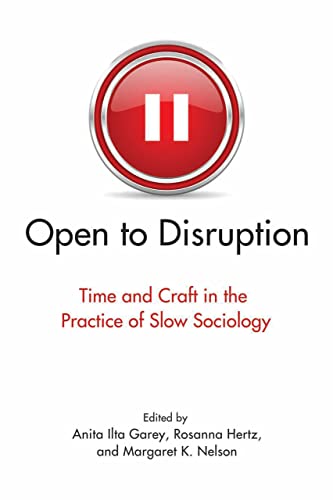
Open to Disruption
Time and Craft in the Practice of Slow Sociology
By Anita Ilta Garey, Rosanna Hertz, Margaret K. NelsonVanderbilt University Press
Copyright © 2014 Vanderbilt University Press
All rights reserved.
ISBN: 978-0-8265-1984-9All rights reserved.
Contents
Introduction: On Being Open to Disruption Margaret K. Nelson and Rosanna Hertz, 1,
Part I: Changing Subjects, Changing Relationships, Changing Worlds,
1. From a Study to a Journey: Holding an Ethnographic Gaze on Urban Poverty for Two Decades Timothy Black, 23,
2. Conflicted Selves: Trust and Betrayal in Studying the Hare Krishna E. Burke Rochford Jr., 45,
3. Returns Joanna Dreby, 63,
4. Studying My Hometown Albert Hunter, 85,
5. Breaching Boundaries and Dowsing for Stories on the Great Plains Karen V. Hansen, 100,
Part II: Changing Methods, Changing Frameworks,
6. Disrupting Scholarship Susan E. Bell, 119,
7. A Sociology of Inclusion and Exclusion through the Lens of the Maid's Daughter Mary Romero, 141,
8. Getting to the Dark Side of the Moon: Researching the Lives of Women in Cartography Will C. van den Hoonaard, 152,
9. Getting It Right Pamela Stone, 161,
10. "Breakfast at Elmo's": Adolescent Boys and Disruptive Politics in the Kinscripts Narrative Linda M. Burton and Carol B. Stack, 174,
Part III: Reflections on Disruptions: Time and Craft,
11. History on a Slow Track Emily K. Abel, 197,
12. A Serendipitous Lesson: Or, How What We Do Shapes What We Know Margaret K. Nelson, 205,
13. Paying Forward and Paying Back Rosanna Hertz, 224,
14. Rethinking Families: A Slow Journey Naomi Gerstel, 241,
15. Time to Find Words Marjorie L. DeVault, 255,
16. The Days Are Long, but the Years Fly By: Reflections on the Challenges of Doing Qualitative Research Annette Lareau, 266,
Contributors, 279,
CHAPTER 1
From a Study to a Journey
Holding an Ethnographic Gaze on Urban Poverty for Two Decades
Timothy Black
In 1990, when my research began in Springfield, Massachusetts, I had no reason to expect that twenty-four years later I would still be recording fieldnotes and tracking the lives of the boys I met then—in particular, three Puerto Rican brothers: Julio, Fausto, and Sammy, one year apart in age. The trajectories of their lives extended my work into different social spaces (schools, streets, job training, workplaces, courtrooms, prisons, drug treatment facilities, and churches) and across a range of social contacts (family members, friends, neighbors, girlfriends, street associates, teachers, counselors, attorneys, and some city leaders). These spaces and faces transformed a study into a journey.
Much of what I have learned is due to the breadth of my study—time situates analysis. First, it allows for new directions to emerge in the course of the research. Emergent themes and the flexibility of field research are commonly valued qualities of ethnographic research, but when practiced over a lengthy period of time, multiple themes emerge that can provide fresh insights and broader analytical connections, and push beyond balkanized divisions within the discipline. Second, thick sociological description is written from within and through webs of relationships. When thick description is sustained over a long period of time, the positioning within relationships changes, the duality of researcher-respondent is transmuted, and knowledge claims become relationally, or interpersonally, grounded. Third, long-term ethnography helps us document the intersections of macrosociological, institutional, and individual dynamics, illustrating the interconnections between social and individual changes, which are rarely apparent immediately but take shape over longer periods of time.
Pivotal Moments
Ethnographic study is shaped by relationships in the field, inspired and uninspired observation and documentation, imaginative sociological construction, and serendipity. It becomes a journey, however, through a series of pivotal moments over long periods of time. Urban ethnographies typically focus on place—a social space in which external forces shape local conditions, while internal cultural strategies and routines negotiate these forces. Across time, these ethnographic studies see a community in motion, shaped for instance by housing and educational initiatives, economic and employment trends, policing tactics, and health strategies, and lived through the hierarchies of race, ethnicity, social class, gender, and/ or sexuality. Time in the field allows for emergent directions of study that can augment our understandings of place and its related complexities, but longer time in the field provides the opportunity to move our gaze beyond the confines of place, as relationships take us beyond a singular social space and require that we make sense of the intersections between these varying social spaces.
Pivotal moments are junctures in the course of research that lead to new directions of inquiry. I distinguish these junctures from what we may refer to as emergent themes. Emergent themes suggest a bounded study in which the unexpected occurs and theses are modified, or else an unstructured study in which our observations and predispositions "find" a topic or issue to study. Pivotal moments convey movement, or eruptions, that foster new directions of inquiry, new social spaces to comprehend, and definitive departures from the familiar. There have been many pivotal moments in the course of my journey—too many to document here—but I will describe a few to illustrate.
My study began in a high school where I developed relationships with a few boys who were considered likely to drop out of school. I documented their school and job experiences, their family and neighborhood dynamics, their relationships with institutional authorities, and their social networks, which became the basis of my doctoral dissertation. Shortly after I defended my dissertation, Fausto, the middle Rivera brother, went on a ten-week robbing spree that ended in a failed bank heist. Little did I know at the time that his incarceration would become the first pivotal moment in a twenty-four-year research journey.
I began making visits regularly to the prisons where Fausto was incarcerated, as my research remained in motion. These Sunday trips to the prisons were all-day affairs. I picked up Fausto's older brother, Julio, early in the morning, drove to the eastern part of Massachusetts, and spent long days in waiting rooms and visiting areas before returning to Springfield. During this time, my relationship with Julio developed. Julio was a high school graduate who had lost his job in 1993. Unable to find another one, he turned to Jorge, a childhood friend and a drug dealer, to fill the gap. In 1996, Julio introduced me to Jorge and other men who hung out regularly at "the block," an open-air, Puerto Rican enclave in Springfield, where mostly men gathered each evening to socialize. The block was also a staging ground for the night's drug dealing activities that Jorge organized. I spent two years, from 1996–1998, learning from men on the block.
I had continued to track Fausto's prison experiences during the seven years he was incarcerated. This was not only a period of prison expansion, largely attributable to the War on Drugs, but also an era of getting tough on prisoners. William Weld, the governor of Massachusetts from 1991 to 1997, was a leading public figure in the movement to punish criminals...
„Über diesen Titel“ kann sich auf eine andere Ausgabe dieses Titels beziehen.
Suchergebnisse für Open to Disruption: Time and Craft in the Practice...

Beispielbild für diese ISBN
Open to Disruption
Print-on-DemandAnbieter: PBShop.store UK, Fairford, GLOS, Vereinigtes Königreich
Verkäuferbewertung 5 von 5 Sternen

HRD. Zustand: New. New Book. Delivered from our UK warehouse in 4 to 14 business days. THIS BOOK IS PRINTED ON DEMAND. Established seller since 2000. Bestandsnummer des Verkäufers IG-9780826519849
Neu kaufen
EUR 117,29
EUR 4,84 Versand
Versand von Vereinigtes Königreich nach USA
Versand von Vereinigtes Königreich nach USA
Anzahl: 15 verfügbar
Foto des Verkäufers
Open to Disruption : Time and Craft in the Practice of Slow Sociology
Verlag:
Vanderbilt University Press, 2014
ISBN 10: 0826519849
ISBN 13: 9780826519849
Gebraucht
Hardcover
Anbieter: GreatBookPrices, Columbia, MD, USA
Verkäuferbewertung 5 von 5 Sternen
Zustand: As New. Unread book in perfect condition. Bestandsnummer des Verkäufers 20904766
Gebraucht kaufen
EUR 121,77
EUR 2,30 Versand
Versand innerhalb von USA
Versand innerhalb von USA
Anzahl: Mehr als 20 verfügbar
Foto des Verkäufers
Open to Disruption : Time and Craft in the Practice of Slow Sociology
Anbieter: GreatBookPrices, Columbia, MD, USA
Verkäuferbewertung 5 von 5 Sternen
Zustand: New. Bestandsnummer des Verkäufers 20904766-n
Neu kaufen
EUR 124,50
EUR 2,30 Versand
Versand innerhalb von USA
Versand innerhalb von USA
Anzahl: Mehr als 20 verfügbar
Beispielbild für diese ISBN
Open to Disruption: Time and Craft in the Practice of Slow Sociology
Anbieter: Ria Christie Collections, Uxbridge, Vereinigtes Königreich
Verkäuferbewertung 5 von 5 Sternen
Zustand: New. In English. Bestandsnummer des Verkäufers ria9780826519849_new
Neu kaufen
EUR 116,15
EUR 13,14 Versand
Versand von Vereinigtes Königreich nach USA
Versand von Vereinigtes Königreich nach USA
Anzahl: Mehr als 20 verfügbar
Beispielbild für diese ISBN
Open to Disruption : Time and Craft in the Practice of Slow Sociology
Anbieter: GreatBookPricesUK, Woodford Green, Vereinigtes Königreich
Verkäuferbewertung 5 von 5 Sternen
Zustand: New. Bestandsnummer des Verkäufers 20904766-n
Neu kaufen
EUR 116,14
EUR 17,46 Versand
Versand von Vereinigtes Königreich nach USA
Versand von Vereinigtes Königreich nach USA
Anzahl: Mehr als 20 verfügbar
Foto des Verkäufers
Open to Disruption : Time and Craft in the Practice of Slow Sociology
Verlag:
Vanderbilt University Press, 2014
ISBN 10: 0826519849
ISBN 13: 9780826519849
Gebraucht
Hardcover
Anbieter: GreatBookPricesUK, Woodford Green, Vereinigtes Königreich
Verkäuferbewertung 5 von 5 Sternen
Zustand: As New. Unread book in perfect condition. Bestandsnummer des Verkäufers 20904766
Gebraucht kaufen
EUR 127,44
EUR 17,46 Versand
Versand von Vereinigtes Königreich nach USA
Versand von Vereinigtes Königreich nach USA
Anzahl: Mehr als 20 verfügbar
Beispielbild für diese ISBN
Open to Disruption: Time and Craft in the Practice of Slow Sociology
Print-on-DemandAnbieter: THE SAINT BOOKSTORE, Southport, Vereinigtes Königreich
Verkäuferbewertung 5 von 5 Sternen
Hardback. Zustand: New. This item is printed on demand. New copy - Usually dispatched within 5-9 working days. Bestandsnummer des Verkäufers C9780826519849
Neu kaufen
EUR 137,86
EUR 19,47 Versand
Versand von Vereinigtes Königreich nach USA
Versand von Vereinigtes Königreich nach USA
Anzahl: Mehr als 20 verfügbar
Foto des Verkäufers
OPEN TO DISRUPTION
Anbieter: moluna, Greven, Deutschland
Verkäuferbewertung 5 von 5 Sternen
Zustand: New. At a time when an emphasis on productivity in higher education threatens to undermine well-crafted research, these highly reflexive essays capture the sometimes profound intellectual effects that may accompany disrupted scholarship. They reveal that over lo. Bestandsnummer des Verkäufers 595083231
Neu kaufen
EUR 117,26
EUR 48,99 Versand
Versand von Deutschland nach USA
Versand von Deutschland nach USA
Anzahl: Mehr als 20 verfügbar
Foto des Verkäufers
Open to Disruption
Anbieter: AHA-BUCH GmbH, Einbeck, Deutschland
Verkäuferbewertung 5 von 5 Sternen
Buch. Zustand: Neu. Neuware - At a time when an emphasis on productivity in higher education threatens to undermine well-crafted research, these highly reflexive essays capture the sometimes profound intellectual effects that may accompany disrupted scholarship. They reveal that over long periods of time relationships with people studied invariably change, sometimes in dramatic ways. Bestandsnummer des Verkäufers 9780826519849
Neu kaufen
EUR 224,04
EUR 30,50 Versand
Versand von Deutschland nach USA
Versand von Deutschland nach USA
Anzahl: 2 verfügbar