
Verwandte Artikel zu Original Sin: A Biblical Theology of the Hebrew Bible:...
Original Sin: A Biblical Theology of the Hebrew Bible: Illuminating the Riddle (New Studies in Biblical Theology, Band 5) - Softcover
Buch 4 von 67: New Studies in Biblical Theology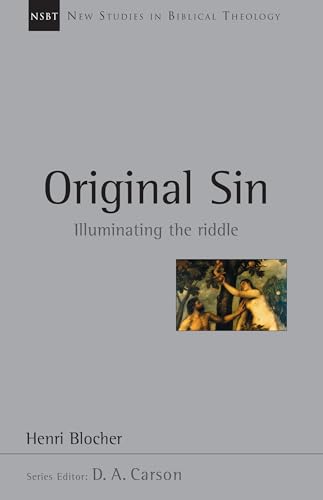
Inhaltsangabe
We live in a world shot through with evil. The twentieth century has witnessed suffering and human cruelty on a scale never before imagined. Yet, paradoxically, in recent years the doctrine of original sin has suffered neglect and ridicule. In this philosophically sophisticated treatment of the biblical evidence for original sin, Henri Blocher offers a robust response. Interacting with the best theological thinking on the subject, this New Studies in Biblical Theology volume shows that while the nature of original sin is a mystery—even a riddle—only belief in it makes sense of evil and wrongdoing. After a general survey of the biblical evidence, Blocher moves on to discuss the two key texts. First, he considers the relation of the Eden story of Genesis 2 and 3 to modern scientific, literary and theological thinking. Then, he offers a new and groundbreaking interpretation of Romans 5, where Paul discusses Christ and Adam. From this exegetical foundation, he goes on to show how the doctrine of original sin makes sense of the paradoxes of human existence. In the final chapter, he discusses the intellectual difficulties that some feel remain with the doctrine itself. Addressing key issues in biblical theology, the works comprising New Studies in Biblical Theology are creative attempts to help Christians better understand their Bibles. The NSBT series is edited by D. A. Carson, aiming to simultaneously instruct and to edify, to interact with current scholarship and to point the way ahead
Die Inhaltsangabe kann sich auf eine andere Ausgabe dieses Titels beziehen.
Über die Autorin bzw. den Autor
In October 2003, Henri Blocher was appointed to the Guenther H. Knoedler Chair of Theology at Wheaton College in Wheaton, Illinois. Since 1965 he has served as professor of systematic theology at the Faculté Libre de Théologie Evangélique in Vaux-sur-Seine near Paris, France. A leading evangelical theologian and statesman, Blocher was a member of the Lausanne Committee on World Evangelization (1975-1980), served the World Evangelical Fellowship/Alliance in a number of capacities, and taught in schools in Europe, Australia, Africa, Canada and the US. He is currently president of the Fellowship of European Evangelical Theologians. Blocher studied at a number of institutions including the Sorbonne, London Bible College, Gordon Divinity School, and Faculté Libre de Théologie Protestant of Paris. He has written six books, four of which have appeared in English, and several dozen articles. His English publications include Original Sin: Illuminating the Riddle, Evil and the Cross: Christian Thought and the Problem of Evil and In the Beginning: The Opening chapters of Genesis.
Auszug. © Genehmigter Nachdruck. Alle Rechte vorbehalten.
Original Sin
Illuminating the RiddleBy Henri BlocherIVP Academic
Copyright © 1997 Henri BlocherAll right reserved.
ISBN: 9780830826056
Chapter One
Original sin as taught in
Holy Scripture
`Nothing is so easy to denounce, nothing is so difficult tounderstand.' So wrote Augustine on original sin.
To him the doctrine was a battlefield. The controversy hascontinued unabated through the centuries. The leaders of theReformation, with the exception of Ulrich Zwingli, renewed theemphasis on the Augustinian view. It was included in the mainconfessions of faith in the Reformation churches, such as theForty-two Articles framed by Archbishop Cranmer for theChurch of England in 1553. The arguments have not subsided;Protestant liberals carry on the various attacks against thedoctrine of original sin which the Socinians and some Anabaptistshad launched in the sixteenth century. The perpetualconflict probably witnesses both to the difficulty of thearguments and to the stakes involved.
A new stage was reached (and new heights in subtlety andsophistication) in the first half of the twentieth century with thepowerful neo-orthodox reinterpretation of the doctrine. In thewake of Kierkegaard's elusive The Concept of Anxiety (1844), KarlBarth, Emil Brunner and Reinhold Niebuhr ? who praisedKierkegaard's analysis as `the profoundest in Christian thought'(Niebuhr 1941:182 n. 2) ? again preached original sin, but notwithout making far-reaching changes in their understanding of it.
Among evangelical theologians, John Murray's series of short,sharp articles, published under the title The Imputation of Adam'sSin (1959) and G. C. Berkouwer's Sin (first Dutch edition1959-60) illustrate two contrasting kinds of original thinking withinorthodox bounds: the former with rigour and careful argument;the latter with well-informed sensitivity and openness to theconcerns of contemporary theology ? but still confessing, in asofter, more sympathetically nuanced tone, the main tenets ofReformed tradition. Both contributions still deserve our fullconsideration.
Has controversy cooled since then? After years of comparativeneglect, at least in Protestant circles, there are signs that interestin the doctrine may be awakening. Feminist process theologianMarjorie Hewitt Suchocki has set out a vigorous reply toNiebuhr on original sin (Suchocki 1994). The AmericanLutheran professor Ted Peters does theology in a lively,thought-provoking way, raising deep questions on the subject oforiginal sin (Peters 1994). Professor David L. Smith in Canada(though an heir to the US Southern Baptist tradition) hasproduced a most user-friendly presentation (Smith 1994), whichfollows in the train of Bernard Ramm's moderate synthesis ofevangelical substance and modern ideas a decade earlier(Ramm 1985) ? the first token, maybe, of attention being paidto the old doctrine again. The contributions of these competentscholars are not great in number; they are, rather, wide-ranging,and semi-popular in style. They leave enough room, therefore,for a more concentrated study, one which may also take morenotice of the work of Roman Catholic theologians fromcontinental Europe.
There is no urgent need to rehearse the history of thedoctrine. It has been covered in a number of monographs, andNorman P. William?s classic (1927), though sorely lacking insympathy for Augustine, offers sufficient resources. My aim, asmy sub-title suggests, will rather be to illuminate the riddle.Original sin is a riddle, certainly, and I dare hope that this bookwill cast some light upon it (audentes fortuna juvat!); even moreimportantly, however, the human phenomenon is a riddle, and Itrust that the doctrine of original sin will illuminate thatphenomenon.
This book will be an exercise in dogmatics, not apologetics-- in this, I agree with Kierkegaard, who insisted that original sincomes under the jurisdiction of dogmatics (1980: sub-titles 9, 23and passim). `There may be some incidental apologetic benefits,but the central question will be: what are we to believe, in theobedience of faith? Since the first concern of evangelicaldogmatics, in grateful obedience to its `external principle ofknowledge', is agreement with Scripture, I shall enquire first(chapter 1) about the general support which may be found inthe whole Bible for the church dogma, that is, the `Augustinian'doctrine, of original sin. I shall be wary of the enticements ofthose who follow Karl Barth's lead and draw their theology ofsin from Christ and the cross directly. Though apparently most`Christian', this procedure conceals a subtle snare: the selectionand abstraction of the relevant elements of Christology, acomplex field of study, is bound to be arbitrary. If one startswith the cross, the character of Christ's work as a remedy for sin,as redemption, is obscured; simply to read the meaning oforiginal sin off the Christ-event is to act as if we were masters ofrevelation. Far from it! We are mere disciples, and cannot affordnot to start with the teaching of God. Sound theological methodrequires that we listen to Scripture as a whole, according to theanalogy of faith, and only then perceive how precisely thedoctrine is proclaimed and, so to speak, reinforced in the Christ-event.
The path to be travelled by this volume is fairly easy to markout. Once the biblical survey is completed, we shall turn to the`origin' passage, Genesis 3, asking whether we should read it ashistory or as myth, saga or symbol (chapter 2). Then the otherscripture upon which the doctrine of original sin was founded,Romans 5, will engage our scrutiny (chapter 3); against all theodds, will a new proposal break through the deadlock ofinterpretations ancient and modern? In the next chapter (4),we shall observe how the doctrine of `original sin' unveilshuman experience, unlocks the enigmas of life and sets them inproper perspective. Finally, we shall confront the core difficultyof Augustine's construction: the hereditary transmission of whatis a most personal exercise of freedom, namely, sin.
First, though, we need some idea of just what it is we aretalking about. Calvin's definition offers as good a starting-pointas any. Original sin, he writes in the Institutes, is that `hereditarydepravity and corruption of our nature, diffused into all parts ofthe soul, which first makes us liable to God's wrath, then alsobrings forth in us those works which Scripture calls "works ofthe flesh" (Gal. 5:19)' (II.i.8). By way of developing andcommenting on that definition, we may note the following fourpoints. First, original sin is universal sinfulness, consisting ofattitudes, orientations, propensities and tendencies which arecontrary to God's law, incompatible with his holiness, and foundin all people, in all areas of their lives. Secondly, it belongs to thenature of human beings (it is also called peccatum naturale),`nature' being that stable complex of characteristics typical ofthe class of creatures known as `human', and present from birth(natura comes from nasci, `to be born'). Thirdly, since itbelongs to our nature, it is inherited; hence its usual name in German,Erbsünde, literally `hereditary sin'. Fourthly, it stems fromAdam, whose disobedience gave original sin a historical beginning, sothat the present sinfulness of all can be traced back through...
„Über diesen Titel“ kann sich auf eine andere Ausgabe dieses Titels beziehen.
Suchergebnisse für Original Sin: A Biblical Theology of the Hebrew Bible:...

Beispielbild für diese ISBN
Original Sin: Illuminating the Riddle (New Studies in Biblical Theology, Volume 5)
Anbieter: HPB-Red, Dallas, TX, USA
Verkäuferbewertung 5 von 5 Sternen

paperback. Zustand: Good. Connecting readers with great books since 1972! Used textbooks may not include companion materials such as access codes, etc. May have some wear or writing/highlighting. We ship orders daily and Customer Service is our top priority! Bestandsnummer des Verkäufers S_468222217
Gebraucht kaufen
EUR 4,59
EUR 3,34 Versand
Versand innerhalb von USA
Versand innerhalb von USA
Anzahl: 1 verfügbar
Foto des Verkäufers
Original Sin: Illuminating the Riddle (Volume 5) (New Studies in Biblical Theology)
Anbieter: clickgoodwillbooks, Indianapolis, IN, USA
Verkäuferbewertung 4 von 5 Sternen

Zustand: acceptable. Used - Acceptable: All pages and the cover are intact, but shrink wrap, dust covers, or boxed set case may be missing. Pages may include limited notes, highlighting, or minor water damage but the text is readable. Item may be missing bundled media. Bestandsnummer des Verkäufers CSIV.083082605X.A
Gebraucht kaufen
EUR 4,57
EUR 3,56 Versand
Versand innerhalb von USA
Versand innerhalb von USA
Anzahl: 1 verfügbar
Beispielbild für diese ISBN
Original Sin: Illuminating the Riddle (Volume 5) (New Studies in Biblical Theology)
Anbieter: Marlton Books, Bridgeton, NJ, USA
Verkäuferbewertung 5 von 5 Sternen
Zustand: Good. Has some wear and creases. Has a remainder mark. paperback Used - Good 2000. Bestandsnummer des Verkäufers AB-024773
Gebraucht kaufen
EUR 6,42
EUR 2,67 Versand
Versand innerhalb von USA
Versand innerhalb von USA
Anzahl: 2 verfügbar
Beispielbild für diese ISBN
Original Sin: Illuminating the Riddle (New Studies in Biblical Theology, Volume 5)
Anbieter: HPB-Diamond, Dallas, TX, USA
Verkäuferbewertung 5 von 5 Sternen
Paperback. Zustand: Very Good. Connecting readers with great books since 1972! Used books may not include companion materials, and may have some shelf wear or limited writing. We ship orders daily and Customer Service is our top priority! Bestandsnummer des Verkäufers S_480918594
Gebraucht kaufen
EUR 7,45
EUR 3,34 Versand
Versand innerhalb von USA
Versand innerhalb von USA
Anzahl: 1 verfügbar
Beispielbild für diese ISBN
Original Sin: Illuminating the Riddle (Volume 5) (New Studies in Biblical Theology)
Anbieter: Books From California, Simi Valley, CA, USA
Verkäuferbewertung 4 von 5 Sternen
paperback. Zustand: Very Good. Bestandsnummer des Verkäufers mon0004130658
Gebraucht kaufen
EUR 7,93
EUR 4,45 Versand
Versand innerhalb von USA
Versand innerhalb von USA
Anzahl: 2 verfügbar
Beispielbild für diese ISBN
Original Sin: Illuminating the Riddle (Volume 5) (New Studies in Biblical Theology)
Anbieter: Books From California, Simi Valley, CA, USA
Verkäuferbewertung 4 von 5 Sternen
paperback. Zustand: Good. Book is slightly bowing/bending. In otherwise great condition with minimal/no other wear, crisp & clean interiors showing unmarked text, and firm binding of the text block. A good reading copy! Bestandsnummer des Verkäufers mon0004128060
Gebraucht kaufen
EUR 7,93
EUR 4,45 Versand
Versand innerhalb von USA
Versand innerhalb von USA
Anzahl: 1 verfügbar
Beispielbild für diese ISBN
Original Sin. Illuminating the Riddle [New Studies in Biblical Theology 5]
Anbieter: Windows Booksellers, Eugene, OR, USA
Verkäuferbewertung 5 von 5 Sternen
Paperback. Very good. Previous owner's stamp and label to ffep. 158 pp. Bestandsnummer des Verkäufers 734561
Gebraucht kaufen
EUR 9,18
EUR 6,69 Versand
Versand innerhalb von USA
Versand innerhalb von USA
Anzahl: 1 verfügbar
Beispielbild für diese ISBN
Original Sin. Illuminating the Riddle [New Studies in Biblical Theology 5]
Anbieter: Windows Booksellers, Eugene, OR, USA
Verkäuferbewertung 5 von 5 Sternen
Paperback. Previous owner's name penned on half title page. Heavy pencil underlining. Otherwise VG 158 pp. Bestandsnummer des Verkäufers 745866
Gebraucht kaufen
EUR 10,10
EUR 6,69 Versand
Versand innerhalb von USA
Versand innerhalb von USA
Anzahl: 1 verfügbar
Beispielbild für diese ISBN
Original Sin: Illuminating the Riddle (Volume 5) (New Studies in Biblical Theology)
Anbieter: Pennywisestore, Pound, WI, USA
Verkäuferbewertung 3 von 5 Sternen

Zustand: New. Bestandsnummer des Verkäufers E3-QNGY-QVL9
Neu kaufen
EUR 13,76
EUR 6,13 Versand
Versand innerhalb von USA
Versand innerhalb von USA
Anzahl: 2 verfügbar
Foto des Verkäufers
Original Sin : Illuminating the Riddle
Anbieter: GreatBookPrices, Columbia, MD, USA
Verkäuferbewertung 5 von 5 Sternen
Zustand: New. Bestandsnummer des Verkäufers 1718277-n
Neu kaufen
EUR 17,65
EUR 2,35 Versand
Versand innerhalb von USA
Versand innerhalb von USA
Anzahl: Mehr als 20 verfügbar