
Verwandte Artikel zu Processmind: A User's Guide to Connecting with...
Inhaltsangabe
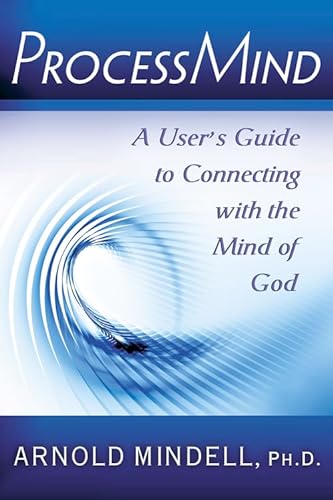
Einstein said, "I want to know the mind of God, the rest are details." This book is therapist Arnold Mindell's response. By processmind he means an earth-based experience of the universal state of consciousness that, he argues, pervades all reality. It is perhaps our most basic, least known, and greatest power, combining the nonlocality of modern physics with altered states of consciousness found in peak experiences. What makes this book unique is that it offers some experience of this mind-state to the reader. Mindell does so by connecting cosmic patterns seen in physics with experiences occurring in psychology and world spiritual traditions. He draws together ideas about Aboriginal totem spirits, quantum entanglement, and nonlocality to describe the "structure of God experiences." Enhancing his clear presentation are around 80 illustrations and 30 experiential exercises based on tested approaches that actualize our deepest, unitive consciousness. Through rational thinking and earth-based, inner experience, the reader can sense how the processmind's self-organizing intelligence helps with dreams, body symptoms, relationships, and large-group conflict issues. Altogether, the book is a kind of user's guide to tapping into an immense power that can benefit our own individual life and, ultimately, the world.
Die Inhaltsangabe kann sich auf eine andere Ausgabe dieses Titels beziehen.
Über die Autorin bzw. den Autor
Arny Mindell developed process work or what is called today, "process oriented psychology" (p.o.p.), in the mid 1970's. Beginning with Taoism, physics and Jungian psychology, by the 1990?s, he expanded process work to include quantum theory and a deeper form of democracy that applied to all states of consciousness for individuals and groups. Arny's recent research and practice has lead to "process-oriented Ecology" integrating large group conflict work with environmental issues. Together with his wife, Amy, and their many colleagues in Portland and around the world, Mindell was the co-founder of the original school of process oriented psychology in Zurich, Switzerland in the early 1980's. Today, the Mindells consult and work as facilitators on community and conflict problems for groups, cities and governments worldwide. They teach process work, give personal therapy and classes in their home city of Portland, Oregon and work in many places around the world. Mindell's books include Dreambody, The Shaman's Body, Sitting in the Fire, and Quantum Mind.
Auszug. © Genehmigter Nachdruck. Alle Rechte vorbehalten.
ProcessMind
A User's Guide to Connecting with the Mind of God
By ARNOLD MINDELLTheosophical Publishing House
Copyright © 2010 Arnold Mindell
All rights reserved.
ISBN: 978-0-8356-0886-2All rights reserved.
Contents
List of Illustrations,
Acknowledgments,
Introduction,
Part One. The Processmind in Your Personal Life,
1. Processmind as a Force Field in Everyday Life and Near Death,
2. Fields, Lightning, and Enlightenment,
3. Zen Metaskills,
4. The Power of Your Presence,
5. Your Processmind, the Tao, and Baby Talk,
Part Two. The ProcessMind in Symptoms, Relationships, and the World,
6. How Your Signature Field Masters Problems,
7. The Ground of Being and Satori in Relationships,
8. Teamwork, or Why the Enemy Is Needed,
9. World War, Death, and World Tasks,
10. The City's Processmind: New Orleans,
11. The World in Your Body and Your Body in the World,
Part Three. The ProcessMind in Science and religion,
12. Science, Religion, and God Experience,
13. Your (Earth-Based) Ethics,
14. Mysticism and Unified Fields,
Part Four. Nonlocality and the Entanglement Dance,
15. Entanglement in Religion, Physics, and Psychology,
16. Entanglement as a softskill in Relationships,
17. The World as a Co-creative Organization,
Conclusion: Ubuntu, the World's Future,
Appendix A: Quantum Mind Update,
Appendix B: Processmind Collage Pages,
Notes,
Glossary,
Bibliography,
Illustration Credits,
CHAPTER 1
Processmind as a Force Field in Everyday Life and Near Death
Just about everyone wonders now and then if there is some kind of intelligence organizing the apparently random and creative events in personal life and the universe. Are those events haphazard ... or is some kind of "mind" at work in the background? How might our awareness of such events influence them?
In my practice, I have often wondered about the mysterious power that seems to appear throughout life, especially in moments of crisis and near death. What is this power that not only produces the most amazing and helpful experiences but is also behind our ongoing difficulties and conflicts, our environmental problems ... and our ability to make peaceful changes? Science and spiritual traditions both contribute answers. Yet in the twenty-first century, we are far from a consensus about what or who we are, and what, if anything, arranges or "co-creates" our fate.
Modern leading scientists such as Albert Einstein as well as ancient world spiritual traditions have believed there is an intelligent cosmic force behind it all. Yet Einstein doubted that science had found it. In a 1926 letter to his colleague Max Born, he made a remark now well-known among theoretical physicists: "Quantum mechanics is certainly imposing. But an inner voice tells me it is not yet the real thing. The theory says a lot, but does not really bring us any closer to the secret of the Old One."
Today, about a century after the discoveries of quantum theory and relativity, cosmologists are still wondering about "the secret of the Old One." Stephen Hawking and Paul Davies refer to the intelligent force Einstein sought as the "mind of God." Some theoretical physicists hope to find this "mind" in unified field theories or related concepts. C. G. Jung, Roberto Assagioli, and other depth psychologists speak of a "collective unconscious," the "transpersonal Self," or some type of transcendent or "unitive" consciousness. Quoting sixteenth-century alchemists, Jung and his friend Wolfgang Pauli, a Nobel prize-winning quantum physicist, speculated about unified psychophysical region of experience—the "Unus Mundus." Religions have always spoken of the design, powers, and wisdom of the universe in terms of a Self, a God, or gods.
I call Einstein's "Old One" the processmind. By processmind I mean an organizing factor—perhaps the organizing factor—that operates both in our personal lives and in the universe. Studying and experiencing this processmind will connect the now separate disciplines of psychology, sociology, physics, and mysticism and provide new useful ways to relate to one another and the environment. The processmind is both inside of you and, at the same time, apparently connected to everything you notice. I will show that your processmind is in your brain yet is also "nonlocal," allowing you to be in several places at the same time.
When I first began writing, I was afraid that this nonlocal nature of the processmind, foreshadowed in quantum physics, might sound too strange. But then I realized that at least some people sense nonlocality every morning in those hypnagogic states just between sleeping and waking. In this "half sleep—half awake" state a kind of dreamlike intelligence frequently gives us "nonlocal" information about people and things in distant places. A physicist might call this experience the psychological counterpart of "quantum entanglement" (which I explain in a later chapter). Today I realize that the processmind is not just a specific altered state of consciousness; it defines the lifestyle and political view we need to resolve the deepest outer as well as inner conflicts.
In any case, the processmind can be experienced as a kind of force field. It is an active, intelligent "space" between the observer and observed. It is both you and me and the "us" we share. It is connected to the facts of everyday reality but also independent of them. After much exploring, both in myself and in people near death, I think it likely that the processmind has qualities that extend beyond our present concepts of life and death.
Quantum Mind and Processmind
The concept of the processmind expands upon all my earlier work, especially the book Quantum Mind, which I wrote about ten years ago. The quantum mind is that aspect of our psychology that corresponds to basic aspects of quantum physics. The quantum aspect of our awareness notices the tiniest, easily overlooked "nano" tendencies and self-reflects upon these subliminal experiences. However, the quantum mind is not just a supersensitive self-reflecting awareness; it also is a kind of "pilot wave" or guiding pattern. In Quantum Mind, I suggested that the math (Schrödinger's wave equation) and rules of quantum physics mirror our ability to self-reflect and to create everyday reality. Physicists speak of the wave function "collapsing" to create reality. I speak about how our self-reflection uses and then marginalizes, rather than "collapses," our dreaming nature. For example, after reflecting on a dream, you might think, "Ah ha! Now I will do this or that"; then you put the dreamworld aside temporarily while you take action in order to create a new reality.
Besides the ability we share with other parts of our universe to sense possibilities, self-reflect, and move from dreaming to everyday reality, we may have the ability to be in two places or two states at the same time, just as quantum physics suggests that material particles can behave. For example, in a dream you may be at once dead and alive—even though upon awakening, you come out of this unitive experience and soon begin reflecting, identifying with one or another of the dream images. Thus, we can characterize our quantum nature as nonlocal or "bilocal" as well as highly sensitive and self-reflective.
The processmind expands upon these characteristics of the quantum mind by adding one more crucial quality: Our deepest self, our...
„Über diesen Titel“ kann sich auf eine andere Ausgabe dieses Titels beziehen.
Suchergebnisse für Processmind: A User's Guide to Connecting with...

Beispielbild für diese ISBN
Processmind: A User's Guide to Connecting with the Mind of God
Anbieter: World of Books (was SecondSale), Montgomery, IL, USA
Verkäuferbewertung 5 von 5 Sternen

Paperback. Zustand: Good. Einstein said, I want to know the mind of God, the rest are details. This book is therapist Arnold Mindell's response. By processmind he means an earth-based experience of the universal state of consciousness that, he argues, pervades all reality. It is perhaps our most basic, least known, and greatest power, combining the nonlocality of modern physics with altered states of consciousness found in peak experiences. What makes this book unique is that it offers some experience of this mind-state to the reader. Mindell does so by connecting cosmic patterns seen in physics with experiences occurring in psychology and world spiritual traditions. He draws together ideas about Aboriginal totem spirits, quantum entanglement, and nonlocality to describe the structure of God experiences. Enhancing his clear presentation are around 80 illustrations and 30 experiential exercises based on tested approaches that actualize our deepest, unitive consciousness. Through rational thinking and earth-based, inner experience, the reader can sense how the processmind's self-organizing intelligence helps with dreams, body symptoms, relationships, and large-group conflict issues. Altogether, the book is a kind of user's guide to tapping into an immense power that can benefit our own individual life and, ultimately, the world. Bestandsnummer des Verkäufers 00105163255
Gebraucht kaufen
EUR 3,89
Versand gratis
Versand innerhalb von USA
Versand innerhalb von USA
Anzahl: 1 verfügbar
Foto des Verkäufers
ProcessMind: A User's Guide to Connecting with the Mind of God
Anbieter: 3Brothers Bookstore, Egg harbor township, NJ, USA
Verkäuferbewertung 5 von 5 Sternen
Zustand: very_good. Cover may have light wear, pages in very good condition and binding is sturdy; may have other light shelf wear or creases. May have notes or highlighting. Bestandsnummer des Verkäufers EVV.0835608867.VG
Gebraucht kaufen
EUR 3,90
Versand gratis
Versand innerhalb von USA
Versand innerhalb von USA
Anzahl: 1 verfügbar
Beispielbild für diese ISBN
ProcessMind: A User's Guide to Connecting with the Mind of God
Verlag:
Quest Books (edition Illustrated), 2010
ISBN 10: 0835608867
ISBN 13: 9780835608862
Gebraucht
Paperback
Anbieter: BooksRun, Philadelphia, PA, USA
Verkäuferbewertung 5 von 5 Sternen
Paperback. Zustand: Very Good. Illustrated. It's a well-cared-for item that has seen limited use. The item may show minor signs of wear. All the text is legible, with all pages included. It may have slight markings and/or highlighting. Bestandsnummer des Verkäufers 0835608867-11-1
Gebraucht kaufen
EUR 5,13
Versand gratis
Versand innerhalb von USA
Versand innerhalb von USA
Anzahl: 1 verfügbar
Beispielbild für diese ISBN
Processmind: A User's Guide to Connecting with the Mind of God
Anbieter: World of Books Inc, Montgomery, IL, USA
Verkäuferbewertung 4 von 5 Sternen

Paperback. Zustand: Good. Einstein said, I want to know the mind of God, the rest are details. This book is therapist Arnold Mindell's response. By processmind he means an earth-based experience of the universal state of consciousness that, he argues, pervades all reality. It is perhaps our most basic, least known, and greatest power, combining the nonlocality of modern physics with altered states of consciousness found in peak experiences. What makes this book unique is that it offers some experience of this mind-state to the reader. Mindell does so by connecting cosmic patterns seen in physics with experiences occurring in psychology and world spiritual traditions. He draws together ideas about Aboriginal totem spirits, quantum entanglement, and nonlocality to describe the structure of God experiences. Enhancing his clear presentation are around 80 illustrations and 30 experiential exercises based on tested approaches that actualize our deepest, unitive consciousness. Through rational thinking and earth-based, inner experience, the reader can sense how the processmind's self-organizing intelligence helps with dreams, body symptoms, relationships, and large-group conflict issues. Altogether, the book is a kind of user's guide to tapping into an immense power that can benefit our own individual life and, ultimately, the world. Bestandsnummer des Verkäufers CIN0835608867G
Gebraucht kaufen
EUR 5,73
Versand gratis
Versand innerhalb von USA
Versand innerhalb von USA
Anzahl: 1 verfügbar
Beispielbild für diese ISBN
ProcessMind: A User's Guide to Connecting with the Mind of God
Anbieter: HPB-Ruby, Dallas, TX, USA
Verkäuferbewertung 5 von 5 Sternen
Paperback. Zustand: Very Good. Connecting readers with great books since 1972! Used books may not include companion materials, and may have some shelf wear or limited writing. We ship orders daily and Customer Service is our top priority! Bestandsnummer des Verkäufers S_486646099
Gebraucht kaufen
EUR 2,75
EUR 3,33 Versand
Versand innerhalb von USA
Versand innerhalb von USA
Anzahl: 1 verfügbar
Beispielbild für diese ISBN
Processmind: A User's Guide to Connecting with the Mind of God
Anbieter: ThriftBooks-Atlanta, AUSTELL, GA, USA
Verkäuferbewertung 5 von 5 Sternen
Paperback. Zustand: Good. No Jacket. Pages can have notes/highlighting. Spine may show signs of wear. ~ ThriftBooks: Read More, Spend Less. Bestandsnummer des Verkäufers G0835608867I3N00
Gebraucht kaufen
EUR 6,92
Versand gratis
Versand innerhalb von USA
Versand innerhalb von USA
Anzahl: 1 verfügbar
Beispielbild für diese ISBN
Processmind: A User's Guide to Connecting with the Mind of God
Anbieter: ThriftBooks-Dallas, Dallas, TX, USA
Verkäuferbewertung 5 von 5 Sternen
Paperback. Zustand: Fair. No Jacket. Former library book; Readable copy. Pages may have considerable notes/highlighting. ~ ThriftBooks: Read More, Spend Less. Bestandsnummer des Verkäufers G0835608867I5N10
Gebraucht kaufen
EUR 6,92
Versand gratis
Versand innerhalb von USA
Versand innerhalb von USA
Anzahl: 1 verfügbar
Beispielbild für diese ISBN
Processmind: A User's Guide to Connecting with the Mind of God
Anbieter: ThriftBooks-Dallas, Dallas, TX, USA
Verkäuferbewertung 5 von 5 Sternen
Paperback. Zustand: Good. No Jacket. Pages can have notes/highlighting. Spine may show signs of wear. ~ ThriftBooks: Read More, Spend Less. Bestandsnummer des Verkäufers G0835608867I3N00
Gebraucht kaufen
EUR 6,92
Versand gratis
Versand innerhalb von USA
Versand innerhalb von USA
Anzahl: 1 verfügbar
Foto des Verkäufers
ProcessMind: A User's Guide to Connecting with the Mind of God
Anbieter: Goodwill Books, Hillsboro, OR, USA
Verkäuferbewertung 5 von 5 Sternen
Zustand: good. Signs of wear and consistent use. Bestandsnummer des Verkäufers 3IIT5G004KEY_ns
Gebraucht kaufen
EUR 3,38
EUR 3,55 Versand
Versand innerhalb von USA
Versand innerhalb von USA
Anzahl: 1 verfügbar
Foto des Verkäufers
ProcessMind: A User's Guide to Connecting with the Mind of God
Anbieter: Goodwill of Greater Milwaukee and Chicago, Racine, WI, USA
Verkäuferbewertung 5 von 5 Sternen
Zustand: good. Book is considered to be in good or better condition. The actual cover image may not match the stock photo. Hard cover books may show signs of wear on the spine, cover or dust jacket. Paperback book may show signs of wear on spine or cover as well as having a slight bend, curve or creasing to it. Book should have minimal to no writing inside and no highlighting. Pages should be free of tears or creasing. Stickers should not be present on cover or elsewhere, and any CD or DVD expected with the book is included. Book is not a former library copy. Bestandsnummer des Verkäufers SEWV.0835608867.G
Gebraucht kaufen
EUR 5,46
EUR 2,67 Versand
Versand innerhalb von USA
Versand innerhalb von USA
Anzahl: 1 verfügbar