
Verwandte Artikel zu Electron Paramagnetic Resonance: Volume 20 (Specialist...
Inhaltsangabe
Reflecting the growing volume of published work in this field, researchers will find this book an invaluable source of information on current methods and applications. As EPR continues to find new applications in virtually all areas of modern science, including physics, chemistry, biology and materials science, this series caters not only for experts in the field, but also those wishing to gain a general overview of EPR applications in a given area.
Die Inhaltsangabe kann sich auf eine andere Ausgabe dieses Titels beziehen.
Von der hinteren Coverseite
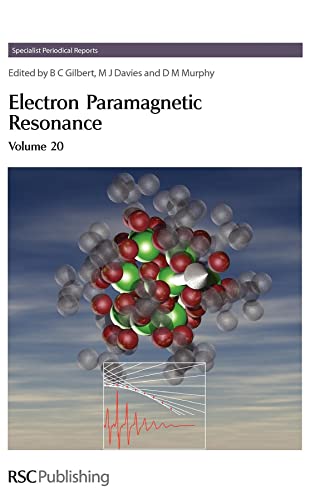
Electron Paramagnetic Resonance (EPR) highlights major developments in this area, with results being set into the context of earlier work and presented as a set of critical yet coherent overviews. The topics covered describe contrasting types of application, ranging from biological areas such as EPR studies of free-radical reactions in biology and medically-related systems, to experimental developments and applications involving EPR imaging, the use of very high fields, and time-resolved methods. Critical and up-to-the-minute reviews of advances involving the design of spin-traps, advances in spin-labelling, paramagnetic centres on solid surfaces, exchange-coupled oligomers, metalloproteins and radicals in flavoenzymes are also included. As EPR continues to find new applications in virtually all areas of modern science, including physics, chemistry, biology and materials science, this series caters not only for experts in the field, but also those wishing to gain a general overview of EPR applications in a given area.
Auszug. © Genehmigter Nachdruck. Alle Rechte vorbehalten.
Electron Paramagnetic Resonance Volume 20
By B C Gilbert, M J Davies, D M MurphyThe Royal Society of Chemistry
Copyright © 2007 The Royal Society of Chemistry
All rights reserved.
ISBN: 978-0-85404-325-5All rights reserved.
Contents
ESR Imaging Beyond Phantoms: Application to Polymer Degradation Shulamith Schlick and Mikhail V. Motyakin, 1,
Advances in Spin Trapping J.-L. Clément and P. Tordo, 29,
Site-Directed Spin-Labelling (SDSL) Applications in Biological Systems Jimmy B. Feix and Candice S. Klug, 50,
Quantum Chemical Approaches to Spin-Hamiltonian Parameters Frank Neese, 73,
Getting an Inside View of Nanomaterials with Spin Labels and Spin Probes Victor Chechik and Agneta Caragheorgheopo, 96,
EPR, ENDOR and EPR Imaging of Defects in Diamond M.E. Newton, 131,
EPR of Exchange Coupled Oligomers David Collison and Eric J.L. McInnes, 157,
Biological Free Radicals and Biomedical Applications of EPR Spectroscopy Simon K. Jackson, John T. Hancock and Philip E. James, 192,
Progress in High-Field EPR of Inorganic Materials Peter C. Riedi, 245,
CHAPTER 1
ESR Imaging Beyond Phantoms: Application to Polymer Degradation
BY SHULAMITH SCHLICK AND MIKHAIL V. MOTYAKIN
1 Introduction and Motivation
1.1 Polymer Degradation. – Polymers undergo degradation when exposed to heat, mechanical stress, and ionizing or UV irradiation in the presence of oxygen, due to the formation of reactive intermediates such as free radicals R· and ROO·, and hydroperoxides ROOH. Exposure to environmental factors leads to profound changes in polymer properties, on both molecular and macroscopic levels. The chemical structure is modified due, for example, to chain scission and cross-linking, resulting in changes of the elastic properties and of the degree of crystallinity. The chemistry of degradation is complicated because even small amounts of chromophores, free radicals, and metallic residues from polymerization reactions can introduce additional reaction pathways that usually enhance the rate of degradation. Polymer degradation is equivalent to corrosion in metals, a fundamental problem with important practical ramifications.
Electron spin resonance (ESR) methods have been used extensively for detecting and identifying the radicals formed, clarifying the degradation mechanism, and simulating the variation of the ESR spectra with temperature. Simulations of ESR line shapes for specific models of dynamics have been developed for the study of oxidative degradation of polymers due to ionizing radiation. Irradiation in vacuo has enabled the study of the type and mobility of alkyl radicals R· derived from the polymer. These studies were initially performed on polytetrafluoroethylene (Teflon) and other perfluorinated polymers, because perfluoroalkyl radicals can be stabilized even at ambient temperature; in these polymers mid-chain and end-chain alkyl radicals have been detected. Admission of oxygen led to the formation of the corresponding peroxy radicals, ROO·. The motional mechanism of the peroxy radicals was deduced by simulation of the temperature dependence of the spectra; in this way a correlation between dynamics and reactivity has been established. This approach has also been extended to protiated polymers, for instance polyethylene and polypropylene.
Direct ESR and spin-trapping experiments have identified oxygen radicals as well as membrane-derived fragments in Nafion, a perfluorinated ionomer used as a proton exchange membrane (PEM) in fuel cells, exposed to oxygen radicals produced in the Fenton reaction or by UV irradiation of hydrogen peroxide. Identification of the radicals was possible by variation of sample preparation methods, temperature used for spectra acquisition, and annealing conditions.
1.2 Polymer Stabilization by Hindered Amines. – Recent research efforts on the effects of radiation and thermal treatment on polymeric materials have two main goals: understanding the degradation mechanism and predicting polymer lifetimes, and development of protective additives. Hindered amine stabilizers (HAS) rank among the most important recent developments for stabilization of polymeric materials. Nitroxides and amino ethers are major products of reactions involving HAS. The HAS-derived nitroxides (HAS-NO) are thermally stable, but can scavenge free radicals to yield diamagnetic species; the amino ethers can regenerate the original nitroxide, thus resulting in an efficient protective effect. Some of these events are shown in Figure 1, where >NH denotes the amine, >NO· the nitroxide, and R· ROO· and ROOH the reactive intermediates derived from polymer chains exposed to oxygen and irradiation or heat. The intermediate radical N-peroxy radical >NOO· has been detected by ESR. The most stable is >NO·. Though stable, however, HAS-NO can react with alkyl radicals derived from polymeric precursors, and stabilize the polymer. In spite of numerous studies, important information on the degradation steps and kinetics is still incomplete or missing altogether.
1.3 Motivation for ESRI Studies of Polymer Degradation. – The concept of diffusion-limited oxidation (DLO) has greatly contributed to the understanding of the mechanism for polymer degradation: if oxygen diffusion is slow compared to the rate of degradation, as in accelerated degradation in the laboratory, only thin surface layers in contact with air are degraded, while the sample interior is little, if at all, affected; this is the DLO regime.
The presence of oxygen is crucial for oxidative degradation of polymers. In the diffusion limited oxidation regime, the distribution of oxygen in the polymer can be described by equation (1),
[MATHEMATICAL EXPRESSION NOT REPRODUCIBLE IN ASCII] (1)
where the first term on the right describes the rate of oxygen diffusion, and D is the oxygen diffusion coefficient; the second term describes the rate of oxygen consumption due to degradation, assuming a first order reaction, and k is the rate constant for oxygen consumption. For steady state conditions, the rate of oxygen consumption is equal to the oxygen supply by diffusion:
[MATHEMATICAL EXPRESSION NOT REPRODUCIBLE IN ASCII] (2)
For the boundary conditions [O2] = [O2] at x = 0 and [partial derivative][O2]/[partial derivative]x = 0 at x = 1, the solution of equation (2) is (l is half sample thickness):
[MATHEMATICAL EXPRESSION NOT REPRODUCIBLE IN ASCII] (3)
Assuming that all oxygen in the polymer reacts and the oxygen-containing products are not lost by diffusion, equation (3) describes the distribution of oxygen-containing products such as hydroxyl, carbonyl, and nitroxide. For large values of x equation (3) can be approximated as
C/C0 = exp [-(k/D)1/2 x] (4)
where C0 and C are the concentrations of oxidation products on the surface and at depth x, respectively.
The parameter a = (D/k)1/2, known in the literature as the degradation depth, shows the depth where most (90%) of oxygen-containing products are located. The degradation profile for two values of a, and a sample depth of 4 mm are shown in Figure 2. For a degradation depth comparable with the sample depth, a = 3.4 mm, the degradation profile is essentially homogeneous; this is the case of low k, low oxygen consumption, and low degradation rates. For a degradation depth smaller than the sample depth, a = 0.4 mm in Figure 2, the profile is...
„Über diesen Titel“ kann sich auf eine andere Ausgabe dieses Titels beziehen.
Suchergebnisse für Electron Paramagnetic Resonance: Volume 20 (Specialist...

Beispielbild für diese ISBN
Electron Paramagnetic Resonance
Anbieter: PBShop.store UK, Fairford, GLOS, Vereinigtes Königreich
Verkäuferbewertung 5 von 5 Sternen

HRD. Zustand: New. New Book. Shipped from UK. Established seller since 2000. Bestandsnummer des Verkäufers CX-9780854043255
Neu kaufen
EUR 391,83
EUR 5,86 Versand
Versand von Vereinigtes Königreich nach USA
Versand von Vereinigtes Königreich nach USA
Anzahl: 15 verfügbar
Foto des Verkäufers
Electron Paramagnetic Resonance
Anbieter: GreatBookPrices, Columbia, MD, USA
Verkäuferbewertung 5 von 5 Sternen
Zustand: New. Bestandsnummer des Verkäufers 18489819-n
Neu kaufen
EUR 407,26
EUR 2,28 Versand
Versand innerhalb von USA
Versand innerhalb von USA
Anzahl: Mehr als 20 verfügbar
Beispielbild für diese ISBN
Electron Paramagnetic Resonance
Anbieter: PBShop.store US, Wood Dale, IL, USA
Verkäuferbewertung 5 von 5 Sternen
HRD. Zustand: New. New Book. Shipped from UK. Established seller since 2000. Bestandsnummer des Verkäufers CX-9780854043255
Neu kaufen
EUR 425,42
Versand gratis
Versand innerhalb von USA
Versand innerhalb von USA
Anzahl: 15 verfügbar
Foto des Verkäufers
Electron Paramagnetic Resonance
Verlag:
Royal Society of Chemistry, 2006
ISBN 10: 085404325X
ISBN 13: 9780854043255
Gebraucht
Hardcover
Anbieter: GreatBookPrices, Columbia, MD, USA
Verkäuferbewertung 5 von 5 Sternen
Zustand: As New. Unread book in perfect condition. Bestandsnummer des Verkäufers 18489819
Gebraucht kaufen
EUR 445,50
EUR 2,28 Versand
Versand innerhalb von USA
Versand innerhalb von USA
Anzahl: Mehr als 20 verfügbar
Beispielbild für diese ISBN
Electron Paramagnetic Resonance: Volume 20 (Specialist Periodical Reports - Electron Paramagnetic Resonance, Volume 20)
Anbieter: Ria Christie Collections, Uxbridge, Vereinigtes Königreich
Verkäuferbewertung 5 von 5 Sternen
Zustand: New. In. Bestandsnummer des Verkäufers ria9780854043255_new
Neu kaufen
EUR 436,45
EUR 13,98 Versand
Versand von Vereinigtes Königreich nach USA
Versand von Vereinigtes Königreich nach USA
Anzahl: Mehr als 20 verfügbar
Beispielbild für diese ISBN
Electron Paramagnetic Resonance
Anbieter: GreatBookPricesUK, Woodford Green, Vereinigtes Königreich
Verkäuferbewertung 5 von 5 Sternen
Zustand: New. Bestandsnummer des Verkäufers 18489819-n
Neu kaufen
EUR 436,44
EUR 17,51 Versand
Versand von Vereinigtes Königreich nach USA
Versand von Vereinigtes Königreich nach USA
Anzahl: Mehr als 20 verfügbar
Foto des Verkäufers
Electron Paramagnetic Resonance
Verlag:
Royal Society of Chemistry, GB, 2006
ISBN 10: 085404325X
ISBN 13: 9780854043255
Neu
Hardcover
Anbieter: Rarewaves USA, OSWEGO, IL, USA
Verkäuferbewertung 5 von 5 Sternen
Hardback. Zustand: New. Specialist Periodical Reports provide systematic and critical review coverage in major areas of chemical research. Compiled by teams of leading authorities in the relevant subject, the series creates a unique service for the active research chemist with regular critical in-depth accounts of progress in particular areas of chemistry. Subject coverage of all volumes is very similar and publication is on an annual or biennial basis. As EPR continues to find new applications in virtually all areas of modern science, including physics, chemistry, biology and materials science, this series caters not only for experts in the field, but also those wishing to gain a general overview of EPR applications in a given area. Bestandsnummer des Verkäufers LU-9780854043255
Neu kaufen
EUR 454,09
Versand gratis
Versand innerhalb von USA
Versand innerhalb von USA
Anzahl: Mehr als 20 verfügbar
Foto des Verkäufers
Electron Paramagnetic Resonance
Anbieter: moluna, Greven, Deutschland
Verkäuferbewertung 5 von 5 Sternen
Gebunden. Zustand: New. Reflecting the growing volume of published work in this field, researchers will find this book an invaluable source of information on current methods and applications.InhaltsverzeichnisChapter 1: ESR Imaging Beyond Phantoms: Applicat. Bestandsnummer des Verkäufers 595098089
Neu kaufen
EUR 441,52
EUR 48,99 Versand
Versand von Deutschland nach USA
Versand von Deutschland nach USA
Anzahl: Mehr als 20 verfügbar
Foto des Verkäufers
Electron Paramagnetic Resonance
Verlag:
Royal Society of Chemistry, GB, 2006
ISBN 10: 085404325X
ISBN 13: 9780854043255
Neu
Hardcover
Anbieter: Rarewaves USA United, OSWEGO, IL, USA
Verkäuferbewertung 5 von 5 Sternen
Hardback. Zustand: New. Specialist Periodical Reports provide systematic and critical review coverage in major areas of chemical research. Compiled by teams of leading authorities in the relevant subject, the series creates a unique service for the active research chemist with regular critical in-depth accounts of progress in particular areas of chemistry. Subject coverage of all volumes is very similar and publication is on an annual or biennial basis. As EPR continues to find new applications in virtually all areas of modern science, including physics, chemistry, biology and materials science, this series caters not only for experts in the field, but also those wishing to gain a general overview of EPR applications in a given area. Bestandsnummer des Verkäufers LU-9780854043255
Neu kaufen
EUR 460,08
EUR 43,25 Versand
Versand innerhalb von USA
Versand innerhalb von USA
Anzahl: Mehr als 20 verfügbar
Foto des Verkäufers
Electron Paramagnetic Resonance
Verlag:
Royal Society of Chemistry, 2006
ISBN 10: 085404325X
ISBN 13: 9780854043255
Gebraucht
Hardcover
Anbieter: GreatBookPricesUK, Woodford Green, Vereinigtes Königreich
Verkäuferbewertung 5 von 5 Sternen
Zustand: As New. Unread book in perfect condition. Bestandsnummer des Verkäufers 18489819
Gebraucht kaufen
EUR 570,99
EUR 17,51 Versand
Versand von Vereinigtes Königreich nach USA
Versand von Vereinigtes Königreich nach USA
Anzahl: Mehr als 20 verfügbar