
Verwandte Artikel zu Statistical Analysis Methods For Chemists: A Software-based...
Inhaltsangabe
Many forms of chemical experimentation generate data needing analysis and interpretation in respect of the goals of the experiment and also the chemical factors which may influence the outcome. Statistical data analysis techniques provide the tools which enable a chemist to assess the information obtained from experiments. Statistical Analysis Methods for Chemists: A Software-based Approach aims to give a broad introduction to practical data analysis, and provides comprehensive coverage of basic statistical principles and reasoning. With practical examples, and integration of software output as the basis of data analysis, this useful book gives unique coverage of the statistical skills and techniques required in modern chemical experimentation. It will prove invaluable to students and researchers alike. Software update information is available from W Gardiner at w.gardiner@gcal.ac.uk or fax +44 (0)141 331 3608. Please accompany requests for information with details of the software version to be used.
Die Inhaltsangabe kann sich auf eine andere Ausgabe dieses Titels beziehen.
Auszug. © Genehmigter Nachdruck. Alle Rechte vorbehalten.
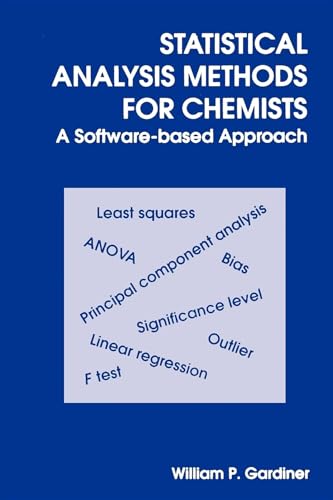
Statistical Analysis Methods for Chemists
A Software-based Approach
By William P. GardinerThe Royal Society of Chemistry
Copyright © 1997 The Royal Society of Chemistry
All rights reserved.
ISBN: 978-0-85404-549-5All rights reserved.
Contents
Glossary, xiv,
Chapter 1 Introduction,
Chapter 2 Simple Chemical Experiments: Parametric Inferential Data Analysis,
Chapter 3 One Factor Experimental Designs for Chemical Experimentation,
Chapter 4 Factorial Experimental Designs for Chemical Experimentation,
Chapter 5 Regression Modelling in the Chemical Sciences,
Chapter 6 Non-parametric Inferential Data Analysis,
Chapter 7 Two-level Factorial Designs in Chemical Experimentation,
Chapter 8 Multivariate Analysis Methods in Chemistry,
Appendix A: Statistical Tables, 329,
Appendix B: Tables of Large Data Sets, 344,
Answers to Exercises, 352,
Subject Index, 362,
CHAPTER 1
Introduction
1 INTRODUCTION
Most analytical experiments produce measurement data which require to be presented, analysed, and interpreted in respect of the chemical phenomena being studied. For such data and related analysis to have validity, methods which can produce the interpretational information sought need to be utilised. Statistics provides such methods through the rich diversity of presentational and interpretational procedures available to aid scientists in their data collection and analysis so that information within the data can be turned into useful and meaningful scientific knowledge.
Pioneering work on statistical concepts and principles began in the eighteenth century through Bayes, Bernoulli, Gauss, and Laplace. Individuals such as Francis Galton, Karl Pearson, Ronald Fisher, Egon Pearson, and Jerzy Neyman continued the development in the first half of the twentieth century. Development of many fundamental exploratory and inferential data analysis techniques stemmed from real biological problems such as Darwin's theory of evolution, Mendel's theory of genetic inheritance, and Fisher's work on agricultural experiments. In such problems, understanding and quantification of the biological effects of intra- and inter-species variation was vital to interpretation of the findings of the research. Statistical techniques are still developing mostly in relation to practical needs with the likes of artificial neural networks (ANN), fuzzy methods, and structure-activity relationships (SAR) finding favour in the chemical sciences.
Statistics can be applied within a wide range of disciplines to aid data collection and interpretation. Two quotations neatly summarise the role statistics can play as an integral part of chemical experimentation, in particular:
'The science of Statistics may be defined as the study of chance variations, and statistical methods are applicable whenever such variations affect the phenomena being studied. 'Statistics is a science concerned with the collection, classification, and interpretation of quantitative data, and with the application of probability theory to the analysis and estimation of population parameters.
Both quotations highlight that statistics is a scientifically-based tool appropriate to all aspects of experimentation from planning through to data analysis to help understand the data and to provide interpretations relevant to experimental objectives. Since all chemical measurements are subject to inherent variation, statistical methods provide a beneficial tool for explaining the features within the data accounting for such inherent variation. Knowledge of statistical principles and methods (strengths as well as weaknesses) should therefore be part of the skills of any scientist concerned with collecting and interpreting data and should also be an integral part of design planning. Statistics should not be considered as an afterthought only to be brought into play after data are collected, the 'square peg into round hole' syndrome, which is how the application of statistical methods is often viewed within the scientific community.
Applied chemical experimentation generally falls into one of three categories: monitoring, optimisation, and modelling. Monitoring is primarily Concerned with process checking such as monitoring pollution levels, investigating how data are structured, quality assurance of analytical laboratories, and quality control of experimental material such as house reference materials (HRMs) and certified reference materials (CRMs). Optimisation, often through exploratory or investigative studies, comes into play when wishing to optimise a chemical process which may influenced by a number of inter-related factors. Instances where such experimentation may occur include optimisation of analytical procedures, optimisation of a new chemical process, and assessment of how different chemical factors cause changes to a chemical outcome. Often, this type of experimentation is based on the classical one-factor-at-a-time (OFAT) approach which is inefficient and provides only partial outcome information. Through simple and logical modification of the OFAT structure to ensure that all possible factor combinations are tested, the experiment can be made more efficient and provide more relevant information on factor effects, such as factor interaction. Modelling, on the other hand, attempts to build a model of the chemical process under investigation for predictive purposes. It is often also based on the results obtained from an optimisation experiment where the importance of factors has been assessed and the most important factors retained for the purpose of model building.
I will consider all of these forms of applied chemical experimentation in relation to illustrating how statistical methods can be used to provide understanding and interpretations of collected data in relation to the experimental objectives. Chapter 2 provides an introduction to exploratory data analysis (plots and summaries) and inferential data analysis (hypothesis testing and estimation) for one- and two-sample experimentation. Chapters 3 and 4 extend this introduction into more formal design structures for one-, two-, and three-factor experimentation with Chapter 4 concentrating on factorial designs, the easily implemented alternative to the classical OFAT approach. An introduction to modelling is provided in Chapter 5 through regression methods for the fitting of relationships (linear, multiple) to chemical data. Analytical applications of these techniques in the form of calibration and comparison of two linear equations will also be discussed. Chapter 6 introduces non-parametric methods as alternatives to the previously discussed parametric procedures. Experimental methods pertaining to optimisation are further developed in Chapter 7 through two-level factorial designs for multi-factor experimentation. The final chapter, Chapter 8, introduces multivariate methods appropriate to the handling of multi-response data sets. Many of the techniques and principles that will be explored are often discussed under the heading of Chemometrics, the name given to the cross-disciplinary approach of using mathematical and statistical methods to help extract relevant information from chemical data.
The increased power and availability of computers and software has enabled statistical methods to become more readily available for the treatment of chemical data. On this basis, all analysis concepts will be geared to using software (Excel and Minitab) to provide the data presentation on which analysis can be based. The mathematical...
„Über diesen Titel“ kann sich auf eine andere Ausgabe dieses Titels beziehen.
Suchergebnisse für Statistical Analysis Methods For Chemists: A Software-based...

Beispielbild für diese ISBN
Statistical Analysis Methods for Chemists: A Software Based Approach
Verlag:
Royal Society of Chemistry, 1997
ISBN 10: 085404549X
ISBN 13: 9780854045495
Gebraucht
Paperback
Anbieter: WorldofBooks, Goring-By-Sea, WS, Vereinigtes Königreich
Verkäuferbewertung 5 von 5 Sternen

Paperback. Zustand: Very Good. The book has been read, but is in excellent condition. Pages are intact and not marred by notes or highlighting. The spine remains undamaged. Bestandsnummer des Verkäufers GOR005543231
Gebraucht kaufen
EUR 15,71
EUR 6,64 Versand
Versand von Vereinigtes Königreich nach USA
Versand von Vereinigtes Königreich nach USA
Anzahl: 2 verfügbar
Beispielbild für diese ISBN
Statistical Analysis Methods for Chemists : A Software Based Approach
Verlag:
Royal Society of Chemistry, The, 1997
ISBN 10: 085404549X
ISBN 13: 9780854045495
Gebraucht
Softcover
Anbieter: Better World Books Ltd, Dunfermline, Vereinigtes Königreich
Verkäuferbewertung 5 von 5 Sternen
Zustand: Very Good. Former library copy. Pages intact with possible writing/highlighting. Binding strong with minor wear. Dust jackets/supplements may not be included. Includes library markings. Stock photo provided. Product includes identifying sticker. Better World Books: Buy Books. Do Good. Bestandsnummer des Verkäufers 9021252-6
Gebraucht kaufen
EUR 19,47
EUR 5,93 Versand
Versand von Vereinigtes Königreich nach USA
Versand von Vereinigtes Königreich nach USA
Anzahl: 2 verfügbar
Beispielbild für diese ISBN
Statistical Analysis Methods
Verlag:
Royal Society of Chemistry, 1997
ISBN 10: 085404549X
ISBN 13: 9780854045495
Gebraucht
Softcover
Anbieter: Phatpocket Limited, Waltham Abbey, HERTS, Vereinigtes Königreich
Verkäuferbewertung 5 von 5 Sternen
Zustand: Good. Your purchase helps support Sri Lankan Children's Charity 'The Rainbow Centre'. Ex-library, so some stamps and wear, but in good overall condition. Our donations to The Rainbow Centre have helped provide an education and a safe haven to hundreds of children who live in appalling conditions. Bestandsnummer des Verkäufers Z1-V-014-02021
Gebraucht kaufen
EUR 15,99
EUR 12,62 Versand
Versand von Vereinigtes Königreich nach USA
Versand von Vereinigtes Königreich nach USA
Anzahl: 2 verfügbar
Beispielbild für diese ISBN
Statistical Analysis Methods For Chemists : A Software-based Approach
Anbieter: GreatBookPrices, Columbia, MD, USA
Verkäuferbewertung 5 von 5 Sternen
Zustand: New. Bestandsnummer des Verkäufers 768263-n
Neu kaufen
EUR 35,45
EUR 2,35 Versand
Versand innerhalb von USA
Versand innerhalb von USA
Anzahl: Mehr als 20 verfügbar
Foto des Verkäufers
Statistical Analysis Methods for Chemists: A Software Based Approach (Paperback or Softback)
Verlag:
Royal Society of Chemistry 9/12/1997, 1997
ISBN 10: 085404549X
ISBN 13: 9780854045495
Neu
Paperback or Softback
Anbieter: BargainBookStores, Grand Rapids, MI, USA
Verkäuferbewertung 5 von 5 Sternen
Paperback or Softback. Zustand: New. Statistical Analysis Methods for Chemists: A Software Based Approach. Book. Bestandsnummer des Verkäufers BBS-9780854045495
Beispielbild für diese ISBN
Statistical Analysis Methods for Chemists
Anbieter: PBShop.store US, Wood Dale, IL, USA
Verkäuferbewertung 5 von 5 Sternen
PAP. Zustand: New. New Book. Shipped from UK. Established seller since 2000. Bestandsnummer des Verkäufers CX-9780854045495
Foto des Verkäufers
Statistical Analysis Methods For Chemists : A Software-based Approach
Verlag:
Royal Society of Chemistry, 1997
ISBN 10: 085404549X
ISBN 13: 9780854045495
Gebraucht
Softcover
Anbieter: GreatBookPrices, Columbia, MD, USA
Verkäuferbewertung 5 von 5 Sternen
Zustand: As New. Unread book in perfect condition. Bestandsnummer des Verkäufers 768263
Gebraucht kaufen
EUR 37,95
EUR 2,35 Versand
Versand innerhalb von USA
Versand innerhalb von USA
Anzahl: Mehr als 20 verfügbar
Beispielbild für diese ISBN
Statistical Analysis Methods for Chemists
Anbieter: PBShop.store UK, Fairford, GLOS, Vereinigtes Königreich
Verkäuferbewertung 5 von 5 Sternen
PAP. Zustand: New. New Book. Shipped from UK. Established seller since 2000. Bestandsnummer des Verkäufers CX-9780854045495
Neu kaufen
EUR 36,66
EUR 5,95 Versand
Versand von Vereinigtes Königreich nach USA
Versand von Vereinigtes Königreich nach USA
Anzahl: 15 verfügbar
Beispielbild für diese ISBN
Statistical Analysis Methods for Chemists : A Software Based Approach
Print-on-DemandAnbieter: Chiron Media, Wallingford, Vereinigtes Königreich
Verkäuferbewertung 5 von 5 Sternen
PF. Zustand: New. This item is printed on demand. Brand new book, sourced directly from publisher. Dispatch time is 6-7 days from our warehouse. Book will be sent in robust, secure packaging to ensure it reaches you securely. Bestandsnummer des Verkäufers 6666-IUK-9780854045495
Neu kaufen
EUR 36,79
EUR 7,70 Versand
Versand von Vereinigtes Königreich nach USA
Versand von Vereinigtes Königreich nach USA
Anzahl: 20 verfügbar
Beispielbild für diese ISBN
Statistical Analysis Methods For Chemists : A Software-based Approach
Anbieter: GreatBookPricesUK, Woodford Green, Vereinigtes Königreich
Verkäuferbewertung 5 von 5 Sternen
Zustand: New. Bestandsnummer des Verkäufers 768263-n
Neu kaufen
EUR 39,83
EUR 17,79 Versand
Versand von Vereinigtes Königreich nach USA
Versand von Vereinigtes Königreich nach USA
Anzahl: Mehr als 20 verfügbar